Connect with us

NewsBeat

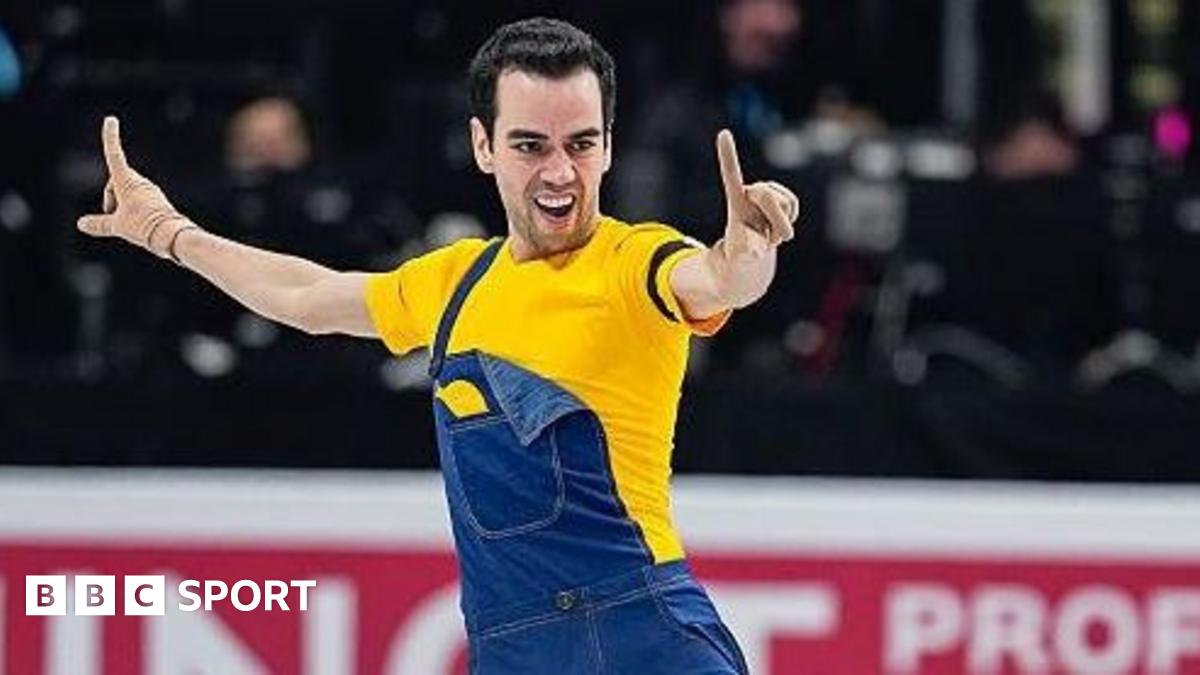
2026 Winter Olympics: Figure skater Sabate hopeful over Minions music dispute

Published

on

Tomas-Llorenc Guarino Sabate

“Huge thank you to everyone who reposted, shared and supported,” Sabate said.

“Because of you, Universal Studios reconsidered and officially granted the rights for this one special occasion.

“There are still a couple of things to be tied up with the other two music of the program, but we are so close to accomplishing it! And it’s all thanks to you.

“I’m so happy to see that the Minions hitting Olympic ice is becoming real again!”

Advertisement

The routine in Sabate’s short program – the first of two routines in singles figure skating – has proved a hit in competitions, including in Sheffield at this year’s European Figure Skating Championships, where he finished 18th but became a fan favourite.

Sabate, a six-time Spanish champion set to make his Olympic debut in Milan, said he followed all required procedures and submitted the music through the International Skating Union’s (ISU) ClicknClear system in August.

If he is unable to perform to the Minions mix, he may use music by the Bee Gees for his short program, as this was the routine he performed to in 2024-25.

The men’s event starts in Milan on Tuesday.

Advertisement

“As soon as we have more details on this specific case, we will share them as appropriate,” read an ISU statement.

“Copyright clearances can represent a challenge for all artistic sports.”

Source link

Advertisement
Continue Reading
Click to comment

Leave a Reply

Your email address will not be published. Required fields are marked *

NewsBeat

Four things we learned making The Purpose Pioneers podcast

Published

on

Four things we learned making The Purpose Pioneers podcast

From a chance encounter that is shifting the momentum of a life, to incremental progress that enables us to ‘eat the elephant’, the things we learned from our guests on our new podcast

It’s the holy grail of a fulfilled life. Whether younger or older, retired, parenting or working, it’s that thing that gets us up in the morning, inspires us to burn the midnight oil and keeps motivation high when the going gets tough: a sense of purpose. We admire elderly folk who stay active in society and motivated in daily tasks. We look on enviably at those who lead organisations with unerring passion and drive, seemingly undeterred by obstacles. And we’re impressed by youth who put their ideals into action.

So, what’s the formula?

Advertisement

As host of Positive News’ new podcast, The Purpose Pioneers, I’ve discovered that there isn’t really one – but that’s part of the beauty of the journey. Discovering one’s purpose and putting it into practice is a deeply personal and nuanced endeavour. While one person may have a light-bulb moment that sparks a mid-career pivot, others describe a collection of experiences that led to a change.

Solutions every Saturday
Uplift your inbox with our weekly newsletter. Positive News editors select the week’s top stories of progress, bringing you the essential briefing about what’s going right.
Sign up

Here are four things we learned about purpose from guests on The Purpose Pioneers.

1. A chance encounter can shift a life

Steve Micklewright is the CEO of rewilding charity Trees for Life and was featured on episode 3 of the podcast. During our conversation, he recounted an experience that would stay with him the rest of his life.

Advertisement

“We were hiking in the Dolomites, in Italy,” he says, “a beautiful, wonderful landscape. We were heading up towards the top of the treeline, and about a hundred metres up, something that I thought was a German Shepherd dog walked out in front of us. It looked at me and I looked at it, and then I thought: ‘oh my god, that’s a wolf’.”

Micklewright explains that encountering the wild animal, which appeared unphazed by his presence, crystallised for him what would later become central to his life’s work: that humans and wild animals can peacefully coexist. After that experience he went on to lead Trees for Life, an organisation that works tirelessly to restore nature and wildlife in the Caledonian pine forests of the Scottish Highlands. Taking the helm there was a turning point for Micklewright, who had previously worked for Birdlife Malta in a politically sensitive role. “What we do at Trees for Life is wholly positive,” he said on the podcast.

Steve Micklewright, CEO of rewilding charity Trees for Life. Image: Alex Baxter

Advertisement

2. Small steps are more realistic than big leaps

For some, like episode 1 guest Stephanie Wheen, focusing on small steps over a long period of time has been a key part of her journey. She is the founder and CEO of charity Gympanzees, which creates inclusive spaces for children with physical and intellectual disabilities to exercise and play. “It’s like that saying, ‘how do you eat an elephant’,” she says, when asked about what advice she might offer to others who are trying to move their goals forward. 

It’s taken “nine years of blood, sweat and tears” to get to where they are today, Wheen says. For a lot of that time, progress has felt incremental, but her perseverance has paid off: the organisation will open a state-of-the-art facility for disabled children outside of Bristol later this year.

Advertisement

Stephanie Wheen, founder and CEO of charity Gympanzees, which creates inclusive spaces for children with physical and intellectual disabilities to exercise and play

3. Experiences collected over decades could lead to change

For episode 4 guest Mark Clayton finding his purpose as the CEO of ethical bank Triodos, happened more as a slow wave. He made his start as a trainee at HSBC, and over time, rose to senior positions. He would end up spending nearly 24 years there before it became clear to him that he needed a change of direction. 

Clayton emphasises that he worked with some wonderfully dedicated people at HSBC, but that overall, there were aspects of the banking industry that were fundamentally not operating in the best interests of people. “Regulators introduced rules called ‘treating customers fairly’,” he recounts. “You sit and think, surely that shouldn’t have to be regulated for.” It was experiences like these that, over years, led to feelings of unease – and precipitated action. 

Advertisement

In February 2020, Clayton left HSBC for Unity Trust Bank, and then joined Triodos UK in January 2024. The ethical bank finances only organisations that deliver social, environmental and cultural benefits, and does not fund harmful industries such as fossil fuels. 

“I felt like I’d come home,” says Clayton.

4. Applying the scientific method might help

Episode 2 guest, Keith Bradbury, isn’t afraid to dig deep. After working in the fintech industry for nearly a decade, he knew he wanted to break out on his own. Teaming up with friend and colleague Pierce Glennie, who was also keen to test the entrepreneurial waters, the duo could have put their backgrounds to work and started a hedge fund, or something similar, says Bradbury. But that wasn’t interesting to them. “Making money wasn’t the priority,” he says.

Instead, they co-founded Ember, the UK’s first inter-city electric coach company, which currently runs services in Scotland. As an analytical thinker and someone who enjoys the process of unpicking the layers of a problem, Bradbury approaches the running of the business almost scientifically. He believes that any organisation can achieve greatness by focusing on individual aspects of their operation and improving them. Lots of small improvements, put together, create a broader solution that is “10 times, 100 times better,” he says. 

“I have this deep faith in putting together the different building blocks…of going beyond incremental change and reaching a solution that is just far, far better,” he says. “It’s almost like a paradigm shift actually, in whatever problem that you’re trying to solve.”

Main image: Keith Bradbury by Chris Watt Photography

Advertisement

Be part of the solution

At Positive News, we’re not chasing clicks or profits for media moguls – we’re here to serve you and have a positive social impact. We can’t do this unless enough people like you choose to support our journalism.

Give once from just £1, or join 1,800+ others who contribute an average of £3 or more per month. Together, we can build a healthier form of media – one that focuses on solutions, progress and possibilities, and empowers people to create positive change.

Support Positive News

Advertisement

Source link

Continue Reading

NewsBeat

Former pub left to decay is an ‘eyesore’ and ‘complete mess’, say locals

Published

on

Cambridgeshire Live

The former pub closed in 2014 and has been left derelict since

Residents say a former pub has been left to decay, leaving it as a “complete eyesore” in the area. The former Golden Lion Pub in Church Street, Stanground, was popular with locals due to its large bar, pool table, and separate lounge.

Advertisement

The pub closed in 2014 and since, it has been left abandoned and derelict. People in Stanground are concerned over the state it has been left in, with some branding it as an “eyesore” in the Peterborough suburb.

Mark Courten said the building is a “complete mess”. He added: “It’s near one of the main entrances into Stanground and all you can see is this mess. It’s been like this for many years and it needs sorting. God knows what it’s like inside!”

A woman, who wished to remain anonymous, also said the site is “very messy”. She said: “It’s a complete eyesore. It’s a shame it has been left this way.

Advertisement

“Whenever you drive or walk past it, it’s just not nice to look at. I wish something could be done about it, cause it just gets worse every time you go past it.”

Helen Fox used to work at the Golden Lion and said it was a “great place to drink”. She added: “It’s such a shame how it’s been left for so long.”

Some people, such as Allan Burns, believe the site could be put to better use. He said: “It seems to be a waste to not use the space. Parking is an issue, but I don’t see how it could be turned into parking spaces. It should be another business as they seem to have a positive impact most of the time and there are quite a few businesses there already.”

Last year, plans were submitted to Peterborough City Council to demolish the pub, due to its “poor condition” and remove it from the “street scene in a prominent location”. The council refused these plans on the grounds it would interrupt the area, as well as diminish the character of the area.

Advertisement

Despite refusal for demolition, the council confirmed that planning permission is in place to convert the site into a shop. A council spokesperson said: “There is an existing planning permission in place to convert and extend it to form a shop.

“The deadline for implementation is February 2027, so for that permission to remain in place, developers must have started that development by then.”

The owner of the building has been approached for further comment.

Source link

Advertisement
Continue Reading

NewsBeat

Zack Polanski Calls Labour To Apologise For Fake Tactical Voting Company

Published

on

Zack Polanski Calls Labour To Apologise For Fake Tactical Voting Company

Zack Polanski has demanded Labour deputy leader Lucy Powell apologise for a by-election campaign leaflet featuring a fake tactical voting company.

The offending literature was sent to voters in Gorton and Denton on the eve of a crunch poll in the Labour-held seat.

It says: “The Tactical Choice says Vote Labour. Based on a new prediction made in the last 24 hours we are recommending voting Labour.”

However, no organisation called “Tactical Choice” actually exists.

Advertisement

Three real tactical voting organisations have already recommended voters back the Greens to stop Reform winning.

The leaflet says it is promoted on behalf of Labour candidate Angeliki Stogia.

Labour is locked in a three-way battle with the Green Party and Reform UK in the seat.

Bookies make the Greens odds-on favourites, followed by Reform and then Labour, for whom Andrew Gwynne won the seat at the 2024 general election with a majority of nearly 13,500.

Advertisement

In a letter to Powell on Wednesday night, Polanski accused Labour of “lying to voters”.

He said: “Did you approve this? Do you feel the Labour Party in government should be held to different standards in terms of honesty to the British public?”

Polanski added: “Lying to the voters, as you have been caught doing, raises the real prospect that Reform will be the beneficiaries, something you have said that you don’t want.

“As this is such an important issue, for the sake of your own reputation, I would strongly urge you to apologise to the voters of Denton and Gorton before the polls open in the morning.”

Advertisement

HuffPost UK has approached Labour for comment.

Meanwhile, Keir Starmer said the choice for voters in the by-election was “unity or division”.

He said: “Driving down the cost of living with Labour or driving a wedge between communities under Reform. Moving forwards together, or opening up anger and division that holds our country back.

“Reform’s Matthew Goodwin thinks people who aren’t white can’t be English and wants women who choose not to have children to pay more tax. Vote Labour in Gorton and Denton today to send him and his toxic politics packing.”

Advertisement

Reform UK leader Nigel Farage said: “Our message on election day is clear.

“The prime minister is panicking and knows he has broken his promises to the British people. Vote Reform to ditch Starmer.”

Source link

Advertisement
Continue Reading

NewsBeat

Switzerland bar fire victims to receive one-off payment | World News

Published

on

Most of those who died were teenagers, and many were foreigners. Pic: Reuters

Switzerland said it would make a one-off payment of 50,000 Swiss francs (£47,755) to severely injured survivors and bereaved families of the New Year bar fire in Crans-Montana.

The blaze killed 41 people and injured 115 more, according to Swiss authorities.

The fire appeared to have been started by the use of sparkling candles that ignited foam soundproofing on the bar’s basement ceiling, witnesses and prosecutors said.


Bells ring out across Switzerland for fire victims

Advertisement

Most of those who died were teenagers, and many were foreigners, including several from France and Italy.

The so-called solidarity contribution aims to provide swift financial support to victims and serve as a gesture of compassion, Switzerland’s governing Federal Council said.

In principle, the payment should apply to each individual who lost their life, as well as every person who was taken to hospital, the Federal Council said in a statement.


Swiss bar not inspected for five years

Advertisement

“The Federal Council shares with the victims and their families the desire for truth and justice,” Swiss President Guy Parmelin said at a news conference.

“We too want to know what happened, why, and how it could have been prevented.”

Read more from Sky News:
Trump’s plan for Iran isn’t working – he has three options
Meet the Ukrainian who swapped Wall Street for the frontline

The Federal Council said it will also convene a roundtable to help victims, insurers and authorities reach out-of-court settlements, potentially avoiding lengthy legal battles.

Advertisement

It aims to contribute up to 20m francs to such settlements.

Advertisement

Memorial held for victims of bar fire

The Federal Council said it hoped parliament would swiftly expedite the legislation it had drafted to help victims.

The government also aims to set aside 8.5 million francs to help affected cantons cover the huge costs.

Advertisement

The government said it had taken the steps following Federal Office of Justice analysis that found gaps in existing support systems, which are mostly designed for individual cases and struggle with large-scale disasters.

Source link

Advertisement
Continue Reading

NewsBeat

‘Dead bodies left by roadside’ in Blossom Street, York

Published

on

'Dead bodies left by roadside' in Blossom Street, York

THE history of a key city centre street is being highlighted in York.

Clements Hall Local History Group has been finding out more about the history of Blossom Street for its latest book – and want York Press readers to share their memories.

Blossom Street has been the entrance to York for most of our monarchs (including Elizabeth II and Charles III).

But in 1541 Henry VIII took umbrage and decided not to enter York through Micklegate Bar, lavishly decorated by the city for his visit. Offended by the behaviour of his nephew, James V, King of Scotland following the Pilgrimage of Grace, he came through Walmgate Bar instead.

Advertisement

Princess Victoria, later Queen, came to York in 1835, staying with the Archbishop at his Palace, for four days. Each day they came into the city along Blossom Street via Micklegate Bar, as did Edward VII and Queen Alexandra in 1900, for the Royal Agricultural Show.

Blossom St in 1971 members of the Household Cavalry rehearse in Blossom Street for the visit of the Queen to York for the 1900th birthday celebrations. Photo – YEP

During the English Civil War, Blossom Street and the Bar were protected by the ‘Great Sconce’. This four-gun emplacement was 200 yards square, with a surrounding ditch, at the highest part of the Mount, near the junction with what is now Dalton Terrace.

The street has seen dramatic scenes however.

On July 2, 1644, after the Battle of Marston Moor, it was thronged with Royalist soldiers, many wounded, clamouring for admission through the Bar.

Advertisement

Recommended reading:

11 photos that show changing face of this key street in York

How one of York’s oldest pubs with a gruesome past got its historic name

Why forgotten parts of this York area shape daily life and makes it so special

Advertisement

They were pursued by parliamentarians, who cut soldiers down, leaving their dead bodies by the roadside. It was said that “the wounded and lame made a pitiful cry”.

Blossom Street was a centre for Catholicism, with the Bar Convent established in 1686. It’s now the oldest living convent in the UK and oldest surviving place of Catholic worship after the Dissolution of the Monasteries by Henry VIII in the 16th century.

The Group has identified a number of well-known people living in the street over the centuries (the 1901 Rowntree Poverty map of York noted it as a district of the servant-keeping classes).

Famous residents included Martin Lister, celebrated physician, antiquary and naturalist, Joseph Rowntree, founder of the famous firm, Charles Watson and James Pigott Pritchett, architects, and William Bell, chief architect of the North Eastern Railway.

Advertisement

Corner of Blossom Sreet and Nunnery Lane with E Knowles chemist in 1895 – Photo from YAYAS

The newspaper proprietor and historian of York, William Hargrove, was living here in the 1840s, and it was his son William Wallace Hargrove who founded the Yorkshire Evening Press, still published today as the York Press. There were many more.

The group has also been tracing the history of all the traders in the street through time, with some very familiar names, such as Forsselius, Shearsmith’s, and Edwin Story near the Bar.

Local people have memories of the English Martyrs School and the Odeon cinema – can you add to these and tell the group your stories about any of the old traders?

Please send them your memories and any old photos, either by email at clemhallhistory@gmail.com or leave a message at Clements Hall on 01904 466086.

Advertisement

Source link

Continue Reading

NewsBeat

Driving test expert explains what common triangular road sign really means

Published

on

Cambridgeshire Live

A driving test examiner has explained how to tell the difference between two common road symbols which some motorists might have a habit of mixing up at times…

Do you still remember road signs from your theory test? It can be challenging to retain everything from your driving examination, but it’s essential to keep yourself and other road users safe.

Now one driving test examiner has revealed what a common warning sign means, as it could easily be mistaken for another similar one. Annie regularly shares her expertise on social media and recently explained what this triangular symbol indicates. She said on TikTok: “What does this sign mean? Do you know the answer?

Advertisement

“It’s in the shape of a triangle so remember what I said, all triangle shape signs give us warnings. That’s a triangle that’s a W for a warning. So what is this sign warning you about?

“A lot of people tend to know it’s warning you about a hill, but is it up hill or downhill? Okay let me give you an explanation.”

Content cannot be displayed without consent

She continued in the video, which received more than 1,000 likes: “I’m going to make it super easy for you so you get it every single time. Okay so if I was to write the number 50, are you reading that number from left to right or from right to left?

“If the 5 is here and the 0 is higher up than the number 5, that’s warning you about a steep uphill slope. Make sense?

Advertisement

“And if the 5 is here and the 0 is lower down, it’s warning you about a steep downhill slope. So let’s come back to the road sign. So if you read this sign from left to right, is the zero going further up or lower down?

“If the 2 is down and the 0 is above, it’s warning you about a steep hill upwards.”

Triangular road signs in the UK are warning symbols featuring a red border, designed to alert drivers to hazards, unusual road layouts or changes in the conditions ahead.

Typically, these feature a white background with a black, easy-to-understand symbol. These signs warn of dangers like sharp bends, steep hills, junctions or pedestrians.

Advertisement

The Highway Code states triangular, red-bordered, white-background signs warn of steep hills ahead, showing a black triangle pointing up (ascending) or down (descending) with a percentage gradient, such as 20%.

It said: “They alert drivers to prepare for steep inclines by adjusting speed and using low gears, especially for heavy vehicles.”

Source link

Advertisement
Continue Reading

NewsBeat

Wigan’s latest ‘school street’ scheme will bar vehicles from School Street during drop-off and pick-up times

Published

on

Manchester Evening News

There are plans make areas around 100 Greater Manchester schools vehicle free at peak times by 2030

Vehicles are to be barred from roads close to a primary school during busy periods. Wigan borough’s tenth school street will launch at Westleigh St Paul’s primary this Friday (February 27).

Advertisement

The council said they would be restricting access to motorised vehicles at drop-off and pick-up times.

Appropriately enough, the ‘school street’ resrictions will apply to the junction of School Street and Liza Street with Westleigh Lane.

Click here to prioritise Manchester news in Google from the MEN

Wigan council said the launch moves closer to hitting a target of creating 100 ‘school streets’ across Greater Manchester in the next four years.

Advertisement

The authority said the initiative intends to ‘improve road safety and make schools much safer to walk, wheel, or scoot to’.

The scheme will mean the closure of School Street and Liza Street in the morning and afternoon between the hours of 8am and 9.30am and 2.30pm and 4pm.

A Wigan council spokesperson said: “With the ambition of reaching 100 School Streets across Greater Manchester by 2030, the scheme will require the road closures.

“Staff will on hand to monitor to project and prevent vehicle access. “Residents and businesses can apply for a school street exemption if their vehicle is registered to an address within the area covered by the restrictions.”

Advertisement

The Transport for Greater Manchester (TfGM) website lists nine other such schemes in Wigan borough.

They are close to Leigh Central Primary, Sacred Heart Catholic Primary School, Leigh, Leigh St Peters C of E Primary School, Lamberhead Green Community Primary School, Orrell, Ince CofE Primary School, Ince, St Williams Catholic Primary School, Ince, St Thomas C of E Junior and Infants School, Golborne, St John’s C of E Primary School, Abram and St Edmund Arrowsmith Catholic High School, Ashton-in-Makerfield.

TfGM said there are currently 37 school streets in Greater Manchester and ‘we’re on track to reach 60 in the next year’.

‘School streets’ are created by introducing a traffic regulation order and related signs to make the roads outside the school a pedestrian and cyclist zone.

Advertisement

Source link

Continue Reading

NewsBeat

Andrew Mountbatten-Windsor might move abroad, expert says, but not where you think

Published

on

Wales Online

Royal biographer Andrew Lownie has speculated the former Duke of York might find refuge in China rather than the Middle East following his recent arrest on suspicion of misconduct

Andrew Mountbatten-Windsor could be heading to an unexpected destination following his dramatic downfall, according to a royal biographer.

Advertisement

The former Duke of York was arrested last week on suspicion of misconduct in public office before being released whilst investigations continue. It follows a succession of damaging revelations from the Epstein files, casting a spotlight on his tenure as a UK Trade Envoy and his associations with convicted sex offender Jeffrey Epstein.

Andrew has consistently denied any wrongdoing.

Following months of relentless scandal, which resulted in Andrew being stripped of his royal titles and ousted from Royal Lodge by his brother King Charles, commentators have been speculating whether he might seek sanctuary in the United Arab Emirates. His well-documented close ties with the emirate’s ruler, Sheikh Mohamed bin Zayed Al Nahyan, would make it a seemingly natural choice.

It has been reported that the Sheikh offered him the use of a lavish 16,000 sq ft, fully staffed, six-bedroom property situated within a secure diplomatic enclave, where he might enjoy a degree of privacy and respect that appears increasingly unlikely in Britain.

Advertisement

However, the author behind a biography that exposed the innermost secrets of the Yorks has now put forward the suggestion that the disgraced royal could in fact relocate to an entirely unexpected destination.

Andrew Lownie told us that the UAE option may well be off the table for him, as the Emirati leadership places considerable value on their ties with King Charles and would be reluctant to jeopardise that relationship.

“If he were to go to the Middle East, they wouldn’t want to upset the Royal Family,” he said.

Advertisement

“He would have to go with the [British] Royal Family’s approval – which if that were known would be very unpopular – because their links with the King are more important than their links with Andrew.”

Whilst Bahrain lacks an extradition agreement with the UK, Bahrain’s King Hamad bin Isa Al Khalifa maintains a “very close” relationship with Charles, according to Lownie, and he’s “not going to p*** him off”.

However, the scandal-hit royal may have a rather more unexpected alternative.

Advertisement

Stressing that all he can do at this stage is speculate about Mountbatten-Windsor’s plans, Lownie said: “The other option, because he’s not going to go and join Assad in Moscow, is China.

Mountbatten-Windsor maintains “lots of business activities” in China, Lownie points out. He added: “His former secretary Amanda Thirsk works for a Chinese company. He’s very close to the Chinese ambassador – when no-one went to his birthday party a couple of years ago, the Chinese ambassador turned up. “

Lownie emphasised that his China hypothesis remains entirely speculative at present. “I have no evidence of any of this except my instinct,” he said. “But that would be a place he could go.

Advertisement

He could get lost there, it would be a big ‘two fingers’ to Britain from Xi Jinping. “Mountbatten-Windsor could “travel around” China with impunity, Lownie believes. He continued: “He could go and see his mates, go all over the place in a private jet, but that would be a base.

“Noting that Mountbatten-Windsor’s passport remains in his possession, Lownie further remarked: “I think he could go under the radar there [in China], in a way that he couldn’t elsewhere. “.

Source link

Advertisement
Continue Reading

NewsBeat

Grand jury rejects indictments in fatal shooting of US citizen by federal immigration agent

Published

on

Grand jury rejects indictments in fatal shooting of US citizen by federal immigration agent

A grand jury in Texas has rejected indictments against a federal immigration agent following the fatal shooting of a US citizen during a traffic encounter last year. Ruben Ray Martinez was killed on March 15, 2025, by an agent from Homeland Security Investigations.

The Department of Homeland Security had not publicly disclosed the incident until The Associated Press and other media outlets reported it last week. Prosecutors confirmed the grand jury’s decision on Wednesday, stating that indictments were declined after the case was presented. The Cameron County District Attorney’s Office, which issued the statement, did not provide additional details.

DHS has alleged that Martinez “intentionally ran over a Homeland Security Investigation special agent,” causing another agent to fire “defensive shots to protect himself, his fellow agents, and the general public.”

The shooting would mark the earliest of at least six deadly shootings by federal officers since a nationwide immigration crackdown was launched in President Donald Trump’s second term.

Advertisement

A passenger who was in the car with Martinez, Joshua Orta, had disputed DHS’ account in a draft affidavit prepared last year, according to attorneys for Martinez’s family. Orta, a key witness to the encounter, died in a car crash last weekend.

Martinez and Orta were on a trip on South Padre Island in Texas when they neared local and federal officers directing traffic around a car accident at a busy intersection, according to the draft affidavit.

In a draft affidavit, Orta reportedly said Martinez did not hit an officer with his vehicle, that their car was “just crawling” and that a federal agent fired into the driver’s side window without “giving any warning, commands, or opportunity to comply.

Attorneys for Martinez’s family did not immediately respond to a request for comment.

Advertisement

Source link

Continue Reading

NewsBeat

Scotland’s ‘broken’ council tax system condemns people to poverty and ‘protects’ the wealthy

Published

on

Daily Record

The SNP was first elected in 2007 with a promise to scrap the Tory-imposed council tax system but has since dodged the issue.

A failure to reform the “broken” council tax system is condemning some Scots to live in poverty while “protecting” the wealthiest, a leading charity has warned.

Advertisement

The Joseph Rowntree Foundation (JRF) said the levy, imposed by the Tories more than 30 years ago, was “outdated, regressive and desperately needs reform”.

The SNP was first elected to Holyrood in 2007 on a manifesto that included a promise to scrap the system, but successive ministers have since dodged the issue.

The charity is calling on all political parties to commit to major legislative change on council tax in their manifestos ahead of the Holyrood election.

In a briefing published yesterday, JRF analysts said the current system is “unfair by design” and disproportionately hits the poorest people in Scotland.

Advertisement

More than one in 10 households on the lowest incomes are behind on their council tax bills, while for those in higher value homes it acts as a tax subsidy.

The current system was introduced in 1993 with payment rates based on valuations from 1991. Financial pressure on council budgets means a tipping point has been now reached, the charity warned.

The JRF wants politicians to implement a “genuinely proportionate property tax” – but warned that a lack of consensus among the parties should not be used as an “excuse for inaction”.

READ MORE: Grooming gangs public inquiry announced for Scotland by SNP Government READ MORE: Lord Advocate to release more details of contact with SNP Government on Peter Murrell case

Advertisement

It comes at a time households across Scotland face the latest round of inflation-busting hikes to their council tax bills from April 1.

Councillors in Glasgow this week signed-off a 5.9 per cent increase, while households living in the Borders face paying 8.5 per cent more.

North Ayrshire residents are set for a seven per cent hike while those in Renfrewshire will pay 7.5 per cent. Several councils, including North and South Lanarkshire, have yet to announce their annual increase.

The single largest hike announced so far is 10 per cent in Moray and Aberdeenshire.

Advertisement

Chris Birt, Joseph Rowntree Foundation associate director for Scotland, said: “For more than three decades, Scotland has been saddled with a council tax system which is deeply unfair, as well as unpopular.

“It means that some people on low incomes are having to choose between heating, eating, or paying their council tax bill, at the same time as subsidising the wealthiest in society.

“We know that for the next Scottish Government, meeting the nation’s legally-binding, cross-party child poverty targets by 2030/31 will require bold action at scale.

“A fair tax on housing wealth is part of what is needed, by cutting through the budget constraints that have limited investment in radical solutions to poverty.

Advertisement

“That’s why the next Scottish Government must prioritise council tax reform to create the fiscal foundations for a fairer Scotland, and why all parties standing in this year’s election must bring forward proposals for major legislative change on council tax.

“We need to break a 30-year cycle of hoping a problem will just go away.”

Shona Robison, the Finance Secretary, said: “The Scottish Government recently conducted a joint consultation with COSLA which explored potential reforms to the council tax system, supported by independent analysis from the Institute for Fiscal Studies. Throughout our discussions we recognised that any future changes must be grounded in evidence, and carefully assessed for their impact on households.

“The aim of our partnered work with local government, is to examine whether consensus around a unified position on council tax could be achieved – at present, consensus on reform doesn’t exist.

Advertisement

“The cost-of-living crisis continues to place burdens on households across the country and Ministers recognise this is unsettling for many people.

“That’s why more than £16 million has been allocated in the Scottish Budget 2026-27 to invest in the provision of free income maximisation support, welfare and debt advice services, including over £2m for a specific council tax debt project.”

To sign up to the Daily Record Politics newsletter, click here

Source link

Advertisement
Continue Reading

Trending

Copyright © 2025