

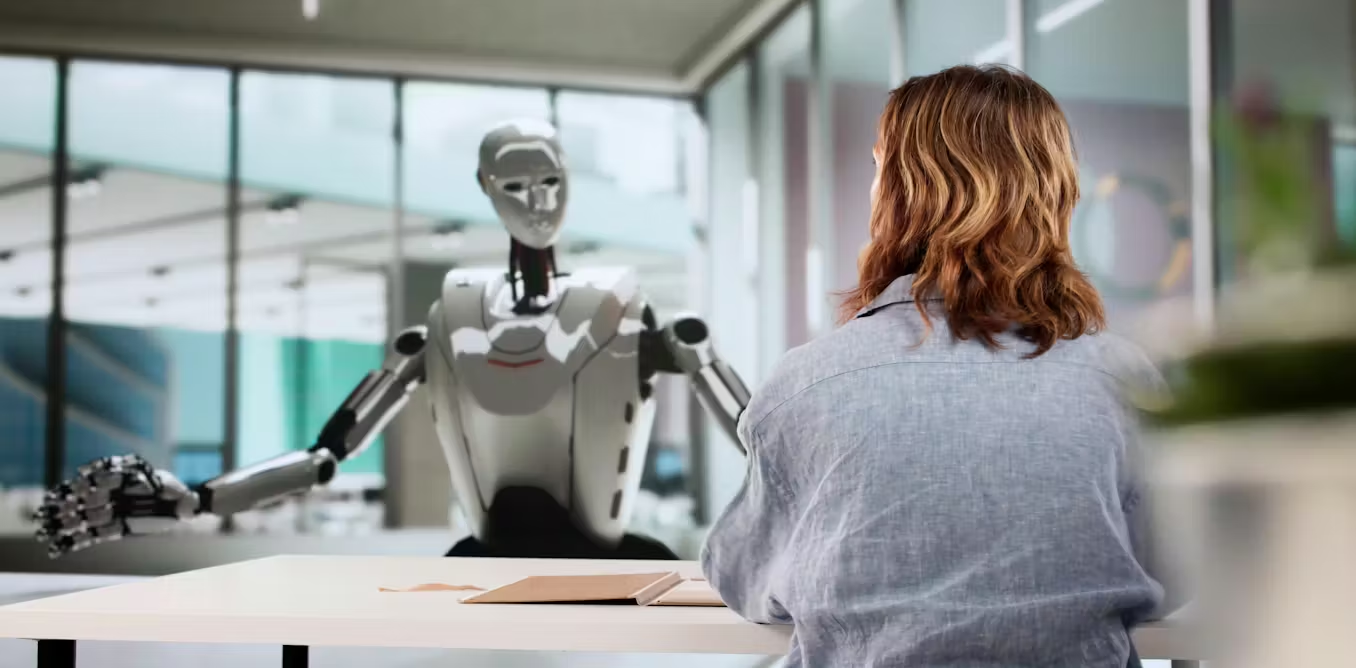
AI is already doing a pretty good job at taking on some of the world’s workload. It has produced academic papers, enhanced space exploration and developed medical treatments.
And AI could soon be used in a managerial role too, making decisions that affect the working lives of human colleagues.
In some ways, this is an expected development. After all, AI is capable of learning, analysing, integrating and producing information.
It outperforms human intelligence in cognition (AI thinks more deeply and more quickly), reasoning (it has a wider scope of analysis and better accuracy) and coordination (it can handle highly complex tasks and process huge amounts of data).
As a result of these professional strengths, AI already has a pretty impressive CV. It has carried out repetitive manual work, intensive tasks on assembly lines and makes risk evaluations in space.
Meanwhile, research confirms that for many of us, AI is already a colleague of sorts, supporting businesses and human workers as they go about their daily tasks.
There are of course also jobs that have been lost, and people who feel justifiably threatened by AI’s increasing presence.
But for many organisations, AI has already proved invaluable. Recent research has shown that AI has increased the efficiency of marketing strategies, improved energy saving, and enhanced problem solving abilities – skills that take humans years of training and experience to match.
AI can also work 24 hours a day, seven days a week. It does not complain and never goes on strike.
Meet the new boss?
But can AI replace human managers? Recent research I was involved in suggests that it can.
We took one of the most important tasks a business can engage in – recruiting the members of its workforce – and entrusted it to an AI system that my colleague and I had developed.
Generally speaking, recruitment is a managerial task, carried out by senior employees or outsourced to specialist firms. But for our project, AI handled the whole recruitment process independently and competently, from selecting candidates to drafting contracts. Using online interviews, questionnaires and filters, over 100 people were offered jobs at an electronic manufacturing plant in China.
Overall, we showed that AI is capable of implementing managerial tasks, at least in the field of recruitment. The success of our project suggests to us that AI could carry out managerial tasks on a much larger scale within the next ten years, supervising, leading and managing human employees.
We also think that AI working at managerial level will first emerge in the tech industry, where it has already been extensively used in operational roles.
People power
But other industries will surely follow. Other research has shown that AI offers businesses much in terms of better performance, financial gain and competitive advantage.
There are downsides too, of course. For all its benefits, AI poses an existential threat to many people’s jobs and careers. And human managers may not be keen to work with technology which impedes on their own decision making freedom – or their status.
Willyam Bradberry/Shutterstock
Nor is AI yet skilled in the kind of relationship building, camaraderie or team spirit which can drive successful organisations.
So while the competition between AI and human colleagues will probably continue to grow in some sectors, people still have valuable strengths which make them attractive as line managers. First, they are are capable of vision, passion and hopes for the future, which provide momentum for social and economic progress and development. AI does not operate in this manner.
Second, AI always needs external – human – power to direct its tasks. For the moment, it cannot manage or reason without the involvement of people.
But some form of AI management is probably heading for many of our offices and work places. It could enhance these places, through pre-programmed reliability and efficiency.
But we need to be ready for it, and to be familiar with its characteristics and functions, rather than fearing or belittling its existence. The more we understand AI, the better we can learn to live with it, even if it is one day tasked with managing our own working lives.



