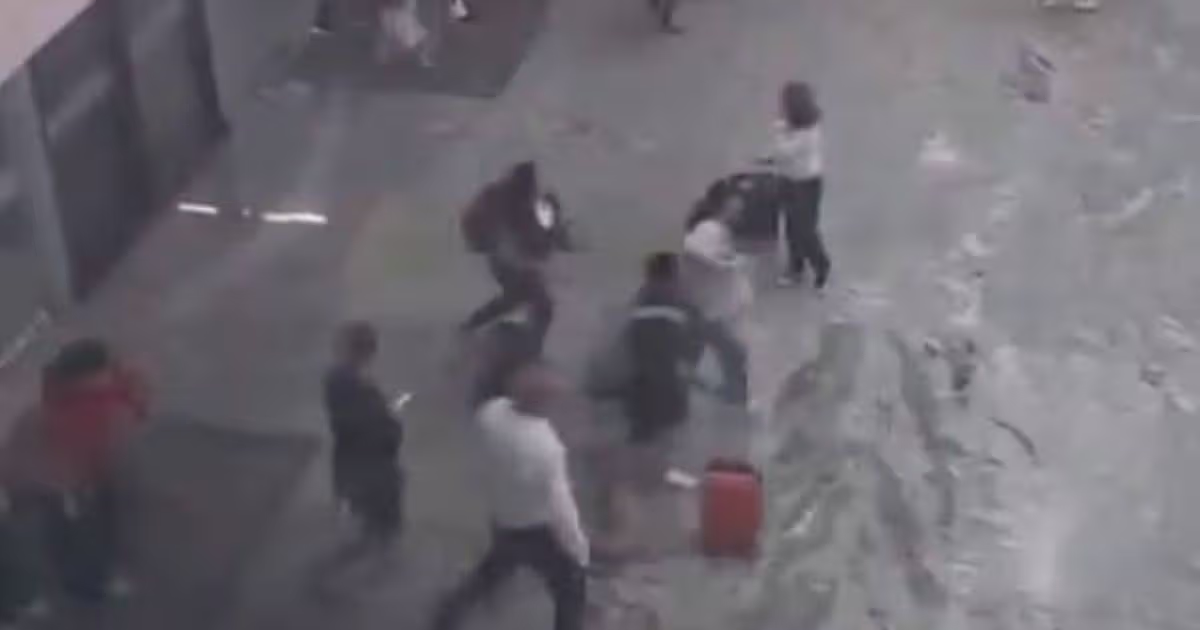
Armed men reportedly stormed Guadalajara International Airport in Mexico, discharging weapons as terrified passengers fled
Kirstie McCrum and Simon Hamalienko Senior Content Editor (Live)
20:05, 22 Feb 2026Updated 20:06, 22 Feb 2026
Panic erupted at a major airport after alleged cartel members reportedly descended on the terminal, with disturbing footage showing terrified crowds scrambling to escape.
Unverified accounts indicate members of the Jalisco New Generation Cartel arrived at Guadalajara International Airport in Jalisco, Mexico mere hours after their leader El Mencho was killed by military forces. It’s thought members are now mounting reprisals following confirmation of the killing.
Advertisement
Distressing incidents have unfolded throughout the area as the Mexican army conducted a major operation in Mexico, which led to the death today (February 22) of El Mencho, whose real name was Nemesio Oseguera Cervantes.
Ensure our latest stories always appear at the top of your Google Search by making us a Preferred Source. Click here to activate or add us as your Preferred Source in your Google search settings.
Multiple videos have subsequently surfaced online depicting several armed individuals, allegedly affiliated with the cartel, entering the airport whilst firing their weapons. It’s currently unknown whether anyone has suffered injuries during the frightening incident, reports the Mirror.
Advertisement
The airport bedlam comes alongside a surge of vehicle blazes, roadblocks, and extensive damage to business properties that has thrown the whole state into disarray.
Harrowing footage circulating across social platforms shows crowds frantically fleeing, with some individuals losing their footing and collapsing as the armed men pursued them. Additional footage captures airport personnel directing passengers behind check-in counters in a bid to shield them from danger.
Numerous frightened travellers could be seen crouching between the desks and baggage conveyor belts, frantically searching for safety amid the chaos.
Warning systems were additionally activated on the airside as employees were observed running whilst passengers seemed to be led out of the building as a precautionary measure.
Advertisement
Whether any casualties have occurred remains uncertain, although accounts suggest gunfire was audible.
According to AirLive, federal officers and the National Guard have been sent to the airport during what has been characterised as an “extremely volatile” situation.
The Alma’s Not Normal creator, 37, shared a candid Instagram post marking what many parents call the “fourth trimester”, writing: “Three months old today.
“We’ve survived the fourth trimester. I’m no longer Googling ‘is this normal?’ 47 times a day. He’s officially no longer a newborn.”

Alongside the heartfelt caption, Willan posted a sweet snap of her smiling baby boy, Elijah.
Advertisement
Fans were quick to comment on how happy and content he looked, with many praising her for sharing the less glamorous side of early parenting.
One wrote: “He’s adorable Sophie! Growing up fast.
“Won’t be long until he will be up here on a visit to Ye Olde Pastie shop sampling our northern delicacies!”
Another said: “He is such a gorgeous little fella, well done on getting through the new-born stage.”
Advertisement
In her trademark honest style, the Bolton comic joked about the realities of early motherhood, admitting there had been “leaks, outfit changes, chaos” before finding a nappy brand that brought “calm”.
The update offers a glimpse into a new chapter for the actress, whose hit BBC Two sitcom Alma’s Not Normal was inspired by her upbringing in Bolton and her experiences growing up in and out of care.
Since winning multiple BAFTAs for the show, Willan has remained open about her roots and working-class background, and now, it seems, she’s bringing that same candour to motherhood.
But while she may be known for gritty realism and sharp humour on screen, her latest post shows a softer side celebrating small wins, surviving sleepless nights, and sharing a moment of pure baby joy.
And judging by that beaming three-month-old smile, things are looking pretty calm indeed.
NATIONAL HARBOR, Md. (AP) — Over and over, the Republicans and former Republicans who gathered just outside Washington this weekend warned that President Donald Trump and his allies in Congress are tearing at the very fabric of American democracy.
A former congressman described the president’s party as an “authoritarian-embracing cult.” A prominent conservative writer said Trumpism is an “existential threat.” And a retired Army general, his voice shaking with emotion, cited post-Nazi Germany as a roadmap for the nation’s post-Trump recovery.
It’s unclear how many people are listening.
The main convention hall at the sixth annual Principles First summit on Saturday and Sunday was half empty. About 750 chairs were set up in a room that could have fit thousands, and many were unfilled. Not a single current Republican elected official participated in the two-day program.
Advertisement
This is what remains of the Grand Old Party’s Never Trump movement, a coalition of Republicans, former Republicans and independents who banded together as Trump consolidated power. They largely remain political exiles — not quite at home among Democrats yet disgusted by how the president has abandoned Republicans’ longstanding commitments to free trade and limited government.
John McDowell, 69, who was a lifelong Republican before Trump’s emergence, acknowledged that the diminished group had virtually “zero” political clout within his former party.
“It’s just a fact. We’re losing good people,” said McDowell, a former Capitol Hill staffer and county Republican official from San Carlos, California. “The party is becoming more and more MAGA-fied.”
White House spokesperson Abigail Jackson dismissed all the criticism from what she called “a bunch of deranged has-been politicians.”
Advertisement
“The only people who will pay attention to this event are the journalists who are forced to cover it,” she said.
Virtually everyone who gathered at the hotel in National Harbor, Maryland, said they are rooting for Democratic victories in this fall’s midterm elections. One of the only Democrats there was Conor Lamb, a former congressman from Pennsylvania who lost his party’s primary to John Fetterman four years ago.
Despite dire concerns, there was a slight sense of optimism among the half-empty convention hall and quiet hotel hallways.
Several people cheered last week’s Supreme Court decision to strike down Trump’s tariffs, the economic tool he has wielded without congressional approval in his attempt to force friends and foes around the globe to bend to his will. Trump insisted he would implement a new round of tariffs despite the ruling.
Advertisement
Former New Jersey Gov. Chris Christie, a former Trump adviser, highlighted recent AP-NORC polling showing that 1 in 4 Republicans nationwide do not approve of Trump’s job performance.
“It’s like any show that’s on TV for a long time — the ratings start to go down. And the ratings are going down,” Christie said. “I am willing to bet you that by next February, this room is going to be twice the size of what it is now. After the midterms, you watch.”
Ex-MAGA diehard Rich Logis, wearing a red “I left MAGA hat,” hopes to see “an electoral revolt against MAGA” in the midterms.
“I think there’s a shift in our country right now,” he said. “It happens slowly.”
Advertisement
Logis was promoting support groups for friends and family of Trump loyalists at a table outside the convention hall. Nearby, someone was selling books about how to escape cults.
At the podium, former Republican Rep. Joe Walsh implored Trump’s critics not to downplay the seriousness of the threat the president poses to the nation.
“He’s everything our founders feared. Say it. Believe it,” Walsh said. He said his former party is “an authoritarian-embracing cult” and “a threat to everything I love.”
Retired Gen. Mark Hertling, who once commanded the U.S. Army’s European forces, said he’s “haunted” by allies who ask him “whether American institutions ever can be trusted again.”
Advertisement
“Our nation’s institutions have been shaken. Our alliances have been strained. Our credibility has been damaged. And our nation’s values have been cast aside,” Hertling said. He suggested the U.S. should look to the reconstruction of Germany after the defeat of Nazism if it hoped to to restore the damage caused by Trump and his allies.
The nation’s recovery, he said as his voiced cracked, would be something people have to earn over many years.
Bill Kristol, who worked in previous Republican administrations and helped found the Weekly Standard magazine, described Trump and his Republican supporters in Congress as “an existential threat” to the nation. But he was also optimistic about the upcoming midterm elections.
Kristol said Democrats are “almost certain to win the House,” “could possibly win the Senate,” and have “a good chance to win the presidency” in 2028.
Advertisement
Brittany Martinez, executive director of the host organization Principles First, also tried to cast an optimistic tone, even after describing the many reasons why she couldn’t bear to continue her career as a Republican staffer on Capitol Hill.
“I hope that Republicans continue to wake up,” she said. “I do think that those folks exist. And I hope that they exist in greater numbers.”
The 2026 BAFTA Film Awards aired an emotional tribute to the stars who died in the last year
Sara Baalla Screen Time TV Reporter
21:51, 22 Feb 2026
The 2026 BAFTA Film Awards broadcast a moving tribute to the stars who passed away over the past year, yet some viewers were left baffled as two high-profile celebrities were absent from the segment.
Hosted by The Traitors US star Alan Cumming, the ceremony drew the biggest names in British cinema to London’s South Bank, with films including One Battle After Another, Sinners, and Hamnet all contending for awards.
Advertisement
Later in the evening, audiences were moved to tears as the ceremony paid tribute to the actors, producers, directors, and other film industry figures who had died over the previous twelve months. Among those honoured were Hollywood actress Catherine O’Hara, who passed away last month aged 71, alongside Rob Reiner, Brigitte Bardot, Val Kilmer, Gene Hackman, and Robert Redford.
However, Dawson’s Creek legend James Van Der Beek, who recently passed away aged 48 following a bowel cancer diagnosis, was notably absent from the tribute. Grey’s Anatomy star Eric Dane, who died this week from ALS, was also overlooked, reports the Express.
As singer Jessie Ware took to the stage to perform Barbara Streisand’s hit The Way We Were during the heartfelt In Memoriam segment, viewers swiftly took to X (formerly Twitter) to voice their bewilderment.
“Poor oversight by BAFTA. James Van der Beek and Eric Dane should have been included in the memorial section,” one person wrote, with another adding: “Where was James Van Der Beek in that tribute to all the actors?”
A third commented: “So far there has been no mention of Eric Dane, not at all amused,” whilst another viewer echoed the sentiment: “Hold on just a minute, why was Eric Dane not in that tribute video then? Actually, in tears.”
Meanwhile, some fans pointed out that the iconic stars would likely be celebrated at the BAFTA TV Awards, due to air on BBC One later this year.
Advertisement
For the latest showbiz, TV, movie and streaming news, go to the new Everything Gossip website
Tonight’s ceremony delivered a huge shock as British actor Robert Aramayo pipped Hollywood heavyweights Leonardo DiCaprio and Timothée Chalamet to the Leading Actor prize.
The 33-year-old Hull native, who appeared in I Swear, was utterly gobsmacked as he claimed the prestigious acting accolade, moments after picking up the Rising Star award.
Advertisement
“I absolutely can’t believe this,” Robert declared whilst accepting the honour. “I honestly cannot believe I have won this award. Everyone in this category blows me away.”
Elsewhere, Irish actress Jessie Buckley claimed the Leading Actress prize for Hamnet, whilst One Battle After Another took home Best Film. Earlier in the proceedings, British talent Wumni Mosaku claimed Best Supporting Actress for her performance in Sinners, whilst Sean Penn secured Best Supporting Actor.
The 2026 BAFTA Film Awards are available to stream on BBC iPlayer
Ensure our latest headlines always appear at the top of your Google Search by making us a Preferred Source. Click here to activate or add us as your Preferred Source in your Google search settings
From biometric EU entry checks to mandatory travel permits and new passport requirements for dual nationals, holidays next year may feel very different, even from last summer.
Industry figures say searches for “summer holiday deals” have jumped by 123% in recent months. But travel professionals warn many people are unaware of the changes coming into force.
Here’s what UK travellers need to know before booking.
New Biometric EU Border Checks (EES)
The EU’s Entry/Exit System (EES) came in last October, and replaces passport stamping with fingerprint and facial recognition checks for non-EU travellers, including Brits.
Advertisement
Nicole Kerr, CEO of transport platform Mozio, said: “While a holiday is meant to be a relaxing and stress-free experience, changes to the travel industry could cause delays and confusion. Although the new system is expected to reduce wait times in the future, Brits have already experienced long delays as the rollout continues.”
Travellers should allow extra time at airports, ports and Eurostar terminals.
ETIAS launching in 2026
The European Travel Information and Authorisation System (ETIAS) is expected to begin operating in late 2026.
Once live, UK passport holders visiting 30 European countries for up to 90 days will need approval before travelling.
Advertisement
Jane Bolton, ski and travel expert at Erna Low, explained: “ETIAS is a new online travel authorisation that UK travellers will need before visiting most European countries in the Schengen area. It’s not a visa, but it will be mandatory once it comes into force.”
“Once it’s live, travellers won’t be able to board flights or ferries without having an approved ETIAS linked to their passport.”
Key facts:
€20 fee
Free for under-18s and over-70s
Valid for three years or until passport expiry
Required before boarding
Importantly, the official system is not yet open, and experts warn of scam websites claiming to sell early approvals.
New Passport Rules for Dual Citizens in 2026
Alongside EU changes, updated UK travel rules are affecting dual nationals.
Advertisement
Dual citizenship is permitted in the UK, meaning you can be British and hold another nationality. However, new travel requirements are tightening how dual citizens enter the UK.
From this month, British and Irish dual nationals must travel to the UK using a valid UK or Irish passport
Alternatively, they must carry another passport with a certificate of entitlement proving right of abode
They cannot apply for an Electronic Travel Authorisation (ETA)
Advertisement
Without the correct document, boarding may be refused
If travelling before 25 February 2026, some dual nationals may still be able to enter using a passport eligible for an ETA without obtaining one – but this transitional flexibility is ending.
Experts advise dual citizens to check passport validity early and confirm entry rules with both governments well before departure.
Crucial warning if you’ve booked or are booking a holiday abroad. Get travel insurance ASAB.
A snip from the new ‘Travel insurance and Life Lessons’ episode of the Martin Lewis Podcast. Listen to it on https://t.co/pwPqP7J49K, Apple, Spotify & all the usual pod players pic.twitter.com/FdSLzL2xy7
Travellers heading to the United States will increasingly be required to use the Mobile Passport Control (MPC) app.
The app requires passengers to:
Create a profile
Upload a photo
Answer arrival questions
Generate a QR code for scanning at passport control
While designed to speed up entry, it adds another step to pre-travel preparation.
Heathrow and some other airports are no longer insisting on the 100ml rule – but many airports still are
Heathrow Airport has scrapped the 100ml liquid rule thanks to new scanners. However, this rule does not apply at all airports, particularly on return journeys.
Advertisement
Hannah Mayfield, a money expert at PayingTooMuch, warned: “Even if you’re no longer required to show prescription details at Heathrow, it’s still important to carry one with you.
“If your medication is lost, stolen or damaged while abroad, replacing it can be costly and time-consuming.”
Dr Asimah Hanif, a GP working with Staysure, added: “Losing access to prescribed medication abroad can be serious.
“I’d still advise patients to carry medicines in their original packaging and keep a copy of their prescription.”
Advertisement
Travellers are urged to check rules for both departure and return airports.
Expect delays beyond Border Control
Nicole Kerr also warned: “Alongside these procedures, travellers will inevitably be met with other challenges which could cause delays, such as airport strikes and long taxi queues when leaving the terminal.”
With another busy year predicted for European airports, advance booking of transfers and allowing additional journey time is recommended.
Recommended reading:
Advertisement
What this means for your 2026 holiday
Between biometric EU border systems, ETIAS authorisation, US entry apps, liquid rule variations and new UK passport requirements for dual nationals, travel in 2026 will require more preparation than many travellers are used to.
Experts recommend:
Check passport validity now
Dual nationals should confirm which passport must be used
Avoid unofficial ETIAS websites
Allow extra time at airports and borders
Carry printed and digital travel documents
Ensure travel insurance covers medical and prescription issues
The message from travel professionals is clear: preparation will be essential.
For many Brits, holidays will still go ahead smoothly – but failing to understand the new rules could mean delays, denied boarding, or unexpected stress at the start of your trip.
A controversial policy of destroying recordings of trials after seven years is to be abandoned, the Ministry of Justice (MoJ) has disclosed.
The policy, affecting courts in England and Wales, had been heavily criticised by lawyers and miscarriage of justice campaigners, who said the destruction of court records makes challenging a conviction almost impossible.
They point to cases like Omar Benguit – now the subject of a BBC Panorama investigation – where vital court records were erased.
As a journalism lecturer carrying out research into court reporting, as well as miscarriages of justice, I was keen to investigate, and requested more information from the MoJ through Freedom of Information requests.
In its responses to me, the MoJ publicly disclosed for the first time that trial records will now be kept for at least as long as the prison sentence – and possibly indefinitely.
The Insights section is committed to high-quality longform journalism. Our editors work with academics from many different backgrounds who are tackling a wide range of societal and scientific challenges.
Advertisement
An MoJ spokesperson said: “This updated policy safeguards continued access to court records for the purpose of appeals, reviews or any other legal proceedings that may arise during the entire period of the sentence.
“Retaining records for the full length of the sentence preserves judicial integrity, and protects the rights of all parties concerned.”
Campaigners who fought for years to halt the policy of destroying court records have welcomed the announcement. Jon Robins, a lecturer at Brighton University and co-organiser of the Open Justice Charter, told me:
This is a sensible result – and a surprising and belated victory for our campaign. We pointed out more than a decade ago that there was no possible justification for such a draconian destruction policy, ever since our courts were dragged into the digital era and began recording proceedings – other than closing off the prospect of challenges from those claiming to be wrongly convicted.
The unnecessary loss of court documents – especially, court transcripts and the audio recordings of court proceedings – has often proved an insurmountable barrier in the investigation of miscarriage of justice cases.
Advertisement
The official guidance for how long records should be retained is set out in the crown court’s Record Retention and Disposition Schedule (RRDS). This currently states that the recordings of crown court trials should be “kept for seven years and then destroyed”.
The MoJ confirmed to me that this policy has now been scrapped. It stated that “effective from October 9 2023 onwards”, staff had been instructed to apply the following retention periods for crown court audio recordings:
One year for not-guilty verdicts;
Seven years for non-custodial sentences;
At least seven years or the sentence length for custodial sentences (whichever is longer);
And 99 years for life imprisonment.
The MoJ said it will officially publish this updated guidance in the new RRDS later this year.
End of a ‘reckless’ policy
For many years, the policy of destroying recordings of trials attracted a great deal of public criticism.
In January 2016, a letter was sent to the then secretary of state for justice, Michael Gove, urging him to change the policy. The letter – signed by 35 lawyers, academics and campaigners – said: “In this digital age, it is both reckless and irresponsible to systematically destroy the record of court proceedings.”
In October 2016, Jerry Buting, the American attorney whose defence of Steven Avery featured in the Netflix docuseries Making A Murderer, told The Justice Gap that destroying recordings of court proceedings was “absolutely ludicrous”, adding: “Digital recordings take virtually no space. There is no excuse for the courts to not store forever – at least as long as the defendant is alive.”
A later campaign called Open Justice Charter (OJC) also highlighted the destruction of court records as a key failing in the justice system, stating: “No recordings of criminal court proceedings should be destroyed until at least seven years after the end of the prison term and any post-release licence period imposed.”
What was heard by the jury?
The key concern for those criticising the policy was what they saw as the deleterious affect it was having on those trying to challenge a conviction.
The way the appeal system works is that if a prisoner wants to challenge their conviction, they need to apply to the Criminal Cases Review Commission (CCRC) in order to be allowed to take their case to the Court of Appeal.
The CCRC will not refer the case unless there is “fresh evidence” – something new which the original jury did not hear. And so, for someone who believes they have been wrongly convicted, their starting point will be to identify exactly what was heard by the jury.
For the prisoner and their legal team, this means getting access to the transcriptions of the trial. Without these, they risk submitting an application based on evidence that is not considered new, or omitting evidence that could be highly significant.
Some applications to the CCRC may come many years – even decades – after trials have happened, meaning that not even the prisoner will be able to fully remember what happened in court. For example, one miscarriage of justice victim, Peter Sullivan, was freed 38 years after a jury wrongly convicted him.
Leading legal figures such as Michael Mansfield KC, who acted for the Hillsborough families, has argued that the destruction of records hugely disadvantages those seeking justice. He told The Guardian: “Equally important is access to the record of proceedings and case documentation, without which injustice can be washed away.”
Advertisement
Emily Bolton, who founded Appeal, the charity and law practice dedicated to challenging wrongful convictions, also described the destruction of court records as “a complete roadblock to investigating miscarriages of justice”. She added: “What is the British system afraid of? It’s a public trial, and there should be an accessible record of it.”
More groundbreaking than it first appears
Despite all of this, the MoJ took years to revise the policy. In response to my FoI requests, it explained the decision had nothing to do with the criticism it had received:
The change from ‘seven years to seven years or the life of the sentence’ was driven by new legislation (at the time) called The Parole Board Rules 2019. Those revisions were of particular importance so as to ensure that audio records remain accessible for the entire duration of a custodial sentence, particularly when the sentence exceeds seven years.
But a close analysis of the MoJ’s responses to the FoI requests reveals something intriguing – that the change may be far more groundbreaking than it first appears.
While the MoJ may be reluctant to spell it out explicitly, it appears that the official policy has quietly moved from a position of court records being routinely destroyed, to one where they will now be retained indefinitely. And the reason for this is not legal or political – but purely down to technology.
Advertisement
The destruction of court records was really a legacy of the analogue age; a time when stenographers quietly tapped away in court and any recordings were kept on physical tapes.
In 2012, all of that was swept away when proceedings in crown courts began to be recorded by the Digital Audio Recording Transcription and Storage (Darts) system, meaning there was no longer any need to physically store recordings on tape, and therefore no logistical reason to destroy them.
So, while the new policy dictates that records will be retained for at least as long as the prison sentence, the new technology has essentially removed the need or justification for ever deleting any more court records. The MoJ came very close to admitting this to me when it said: “Crown court audio recordings are retained within HMCTS Digital Audio Recording Transcription and Storage system. To date, none of these court audio recordings have been deleted.”
If the Darts system had been storing recordings since 2012, and the MoJ policy was to destroy recordings after seven years, then they should have started erasing cases since 2019.
Advertisement
Significant costs
While the change is very significant and should dramatically improve access to court records, one critical barrier remains.
While the audio recording of the trial may now exist, it is not possible – except in very limited circumstances – to listen to it, so it must be professionally transcribed. And this can prove to be very – even prohibitively – expensive.
Many victims, particularly those who suffered sexual violence, are now calling for transcriptions of trials to be made free. This new campaign echoes an argument that miscarriage of justice campaigners like Bolton were making a decade ago. She said in 2016:
Advertisement
In this country, the system was privatised, and now profit-driven transcription firms hold justice to ransom, demanding thousands of pounds to provide sections of transcript of a trial. Neither the Legal Aid system nor individual prisoners or their families can afford this, and so the recordings languish unreviewed, and the system goes unaudited.
Robins told me: “The next step for accountability in our courts is to make the audio recordings or transcripts of proceedings available at an accessible price. In an era when there are free AI transcription services, these costs make no sense.”
The decision by the MoJ to stop destroying recordings of trials means that court records will now be available – as long as someone can afford them. It brings to mind the quip by 19th-century judge James Mathew, who said that “in England, justice is open to all – like the Ritz Hotel”.
To hear about new Insights articles, join the hundreds of thousands of people who value The Conversation’s evidence-based news. Subscribe to our newsletter.
Wolves striker Tolu Arokodare and Sunderland midfielder Romaine Mundle have become the latest Premier League players to be subjected to “abhorrent” racist abuse on social media.
Arokodare missed a penalty in Sunday’s 1-0 defeat at Crystal Palace and subsequently received racist abuse from several accounts, according to a club statement.
The Black Cats later revealed Mundle had been the victim of similar attacks after his substitute appearance in the 3-1 loss to Fulham.
The news follows similar treatment doled out to Chelsea defender Wesley Fofana and Burnley’s Hannibal Mejbri, who were targeted online after their teams drew 1-1 on Saturday.
Advertisement
“Wolves are disgusted by numerous instances of racist abuse, from multiple perpetrators, directed at Tolu Arokodare on social media following today’s fixture against Crystal Palace,” the midlands club said.
“There is no place for racism – in football, online, or anywhere in society. We condemn this abhorrent and unlawful behaviour in the strongest possible terms. Tolu has our full and unwavering support.
“The club has reported the posts to the relevant platforms and will work with the Premier League and the authorities to help identify those responsible and ensure appropriate action is taken.
“We will continue to take a zero-tolerance approach to all forms of discrimination.”
Advertisement
Arokodare said in an Instagram story: “It’s still unbelievable to me that we’re playing in a time where people have so much freedom to communicate such racism without any consequences.
“These individuals should have no place in our game and collectively we have to take action to punish everyone who taints the sport like this, no matter who they are.”
Sunderland said: “The abhorrent behaviour displayed by multiple individuals is unacceptable and will not be tolerated by the club under any circumstances.
“The club is actively working with the relevant authorities and online platforms to identify those responsible, and we will take the strongest possible action available to us.
Advertisement
“These individuals do not represent Sunderland AFC, our values, or our community – and they are not welcome on Wearside.”
Europe’s governing body UEFA last week began an investigation into claims by Real Madrid forward Vinicius Junior that he was racially abused on the pitch by Benfica’s Gianluca Prestianni during a Champions League game in Lisbon. The Argentinian has denied the allegations.
Fofana, who shared images of messages directed to his Instagram account, had earlier offered a pessimistic take on the process.
“2026, it’s still the same thing, nothing changes. These people are never punished,” he posted.
Advertisement
“You create big campaigns against racism, but nobody actually does anything.”
Mejbri had earlier also shared abusive messages he had received and wrote on his Instagram story: “It’s 2026 and there are still people like that. Educate yourself and your kids, please.”
The Premier League issued its own statements on Sunday, vowing to assist Wolves’ and Sunderland’s investigations, committing to “serious consequences” and reaffirming: “Football is for everyone – there is no room for racism.”
Anti-discrimination charity Kick It Out, calling for the platforms to act, said: “Football is working together to tackle this issue alongside the UK Football Policing Unit and Ofcom, but social media companies must do more to offer protections to players and help improve accountability when incidents occur.”
Telling residents on his X account, Burnham said: “This time next week we will have removed the 9.30am restriction on older and disabled people’s bus passes – for good.
“24/7 free bus travel for our older and disabled passengers to be made permanent form march.”
From March 1, older and disabled passengers across Greater Manchester will be able to travel free at any time of day, seven days a week, on Bee Network buses.
Advertisement
The long-standing weekday restriction – which prevents free travel before 9.30am under the English National Concessionary Travel Scheme – is being permanently scrapped on Greater Manchester’s franchised bus network following successful pilot schemes.
Mr Burnham said the change will make 24/7 free bus travel for older and disabled passengers permanent from March.
The move follows two trials in August and November 2025, during which around 400,000 residents were allowed to use their passes without time limits.
Transport for Greater Manchester (TfGM) said the pilots showed the policy helped spread demand more evenly and reduced overcrowding on the first post-9.30am services.
Advertisement
The change means passholders will no longer need to pay for early journeys to hospital appointments, work, caring responsibilities or morning activities.
Passengers using services not yet part of the Bee Network may still face the 9.30am restriction until those routes join the franchised system.
With just a week to go, the mayor has made clear the change is now imminent, and permanent.
Nigel Farage has long been a staunch advocate for strong borders and curbing migration.
Advertisement
However, it was the Reform UK leader’s turn to face border controls when he was refused entry to the Chagos Islands this weekend after travelling nearly 6,000 miles to the restricted military base.
In a video shared on social media, Mr Farage said he was on a mission to bring aid to support four Chagossians aiming to colonise a deserted island.
Mr Farage, 51, had attempted to arrive by boat at Ile du Coin from the Maldives, 300 miles away, on Saturday.
The Reform leader insisted he had been told by a ‘senior figure’ that he had been blocked by the UK government from delivering the food and medicine.
Advertisement
He said: ‘The British government has made every effort to prevent me heading towards the Chagos Islands. They have asked the Maldives government to stop me from leaving here and setting foot on the boat.
Nigel Farage was blocked from arriving at the Chagos Islands on Saturday (Picture: Nigel_Farage/X)
‘This was information conveyed to me by a senior figure in the Maldives government. I cannot believe such an attempt has been made to stop a British citizen from reaching British territory.’
However, according to Foreign Office advice, anyone wishing to travel to the archipelago, home to a joint UK-US military base, requires a permit, with no commercial flights operating to or from the territory.
Advertisement
Ben Wallace, the former defence secretary, accused Mr Farage of attempting ‘MAGA stunts’.
He wrote on X: ‘No Mr Farage you cant just turn up at sensitive military bases either in the UK or abroad.
‘No MP can – no matter what Party you represent. We don’t do open days around the trident warhead or open house for the SAS either.’
Sir Ben further hit out at Mr Farage for failing to recruit a defence spokesperson after the Reform leader unveiled a ‘shadow cabinet’ of comprised of senior party figures, including Richard Tice and Conservative defector Robert Jenrick.
Advertisement
All visitors to the British Indian Ocean Territory (BIOT) require a permit before travelling (Picture: Reuters)
It comes days after Donald Trump again turned on the government’s deal to hand over what is formally known as the British Indian Ocean Territory (BIOT) to Mauritius.
The US president had previously suggested the deal was the ‘best’ Sir Keir Starmer could have negotiated.
However Trump changed his mind this again this week, urging the government not to ‘give away Diego Garcia’.
Reports suggested that the president was swayed by the UK’s refusal to allow US forces to use RAF Fairford in Gloucestershire as a base for a potential military campaign against Iran.
From the Yorkshire Dales to the coastline and sweeping moorland, the county is home to a collection of locations that continue to win praise in travel reviews and online forums for their character, scenery and slower pace of life.
Among the most frequently highlighted is Thornton-le-Dale, on the edge of the North York Moors National Park.
Thornton-le-Dale (Image: PA MEDIA)
Often dubbed one of Yorkshire’s prettiest villages, it is known for its stone cottages, village green and the thatched Beck Isle Cottage, which has become one of the most photographed homes in the region.
Visitors regularly describe the village as “picture perfect” and “quintessentially English”.
Advertisement
As well as independent shops, tea rooms and traditional pubs, Thornton-le-Dale offers easy access to Dalby Forest and a network of walking and cycling trails, making it popular with both day-trippers and outdoor enthusiasts.
Grassington (Image: JONATHAN SMITH)
In the Yorkshire Dales, Grassington continues to attract visitors with its cobbled market square and lively mix of cafés, galleries and small shops.
Frequently praised as “beautiful” and “full of character” in reviews, the village has also found a new audience after appearing as the fictional Darrowby in Channel 5’s All Creatures Great and Small.
Beyond browsing the square, visitors can explore riverside walks along the River Wharfe, head up onto Grassington Moor for panoramic views or take part in its well-known festivals, including the Christmas market and summer arts events.
Advertisement
Osmotherley Show (Image: SARAH CALDECOTT)
Further into the North York Moors, Hutton-le-Hole is another village that visitors often call “quaint” and “peaceful”.
With sheep grazing on the green and a stream running through the centre, it has a timeless feel.
Walkers also use the village as a base to explore the surrounding moorland landscape.
Nearby Osmotherley, on the western edge of the North York Moors, is regularly praised in visitor feedback for its “friendly atmosphere” and “lovely stone houses”.
Advertisement
The village sits close to several long-distance walking routes, including the Cleveland Way and the Coast to Coast path, and offers traditional pubs and cafés that cater to passing hikers.
Its setting between the Hambleton and Cleveland Hills gives it striking views despite its modest size.
Runswick Bay (Image: PA MEDIA)
On the coast, Runswick Bay provides a different take on quaint charm.
Its red-roofed cottages and a sweeping sandy beach create one of the most recognisable coastal scenes in North Yorkshire.
Advertisement
Visitors often describe it as a “hidden gem”, praising both the beach and access to the Cleveland Way coastal path.
Rock pooling, fossil hunting and cliff-top walks are among the most popular activities.
Goathland (Image: VISIT NORTH YORKSHIRE)
Inland again, Burnsall in Wharfedale continues to appear in travel guides and visitor recommendations thanks to its riverside setting and traditional stone cottages.
The village sits beside the River Wharfe and near the 12th-century Burnsall Church, with walking routes stretching into the surrounding Dales countryside.
Advertisement
Reviewers frequently highlight its “postcard views” and welcoming pubs.
Meanwhile, Goathland combines village charm with pop culture appeal.
Known to many as Aidensfield from ITV’s Heartbeat and as Hogsmeade station in the Harry Potter films, the village attracts visitors keen to see the heritage North Yorkshire Moors Railway and explore the surrounding moorland.
Reviews often describe it as “full of character” and “steeped in nostalgia”.
Advertisement
As staycations remain popular and travellers seek out slower, more scenic breaks, North Yorkshire’s so-called “quaint” villages appear to be enjoying renewed appreciation on social media and visitor sites online.
Liam Curwen, 32, was ‘caught up’ in a mob and spat at cops before hurling a brick at officers
A yob who threw a brick at police in scenes of “wanton mob violence” following the Southport stabbings has been jailed.
Advertisement
Liam Curwen, 32, who spat at cops, hurled the missile at officers and picked up paving bricks during the disorder was jailed for 27 months at Stoke-on-Trent Crown Court.
The court heard how Curwen was part of a mob which walked towards the police line in Hanley, Stoke-on-Trent on August 3, 2024, just days after three girls were murdered in a Southport dance studio.
Ensure our latest headlines always appear at the top of your Google Search by making us a Preferred Source. Click here to activate or add us as your Preferred Source in your Google search settings.
Disorder spread across the UK after Axel Rudakubana, 18, murdered three girls in Southport at a Taylor Swift-themed dance class amid false rumours the killer was a Muslim immigrant. The unrest led to around two thousand people being arrested, the National Police Chiefs’ Council said at the time
Stoke-on-Trent Live reported scenes of men wielding gardening forks, baseball bats and timber as mass disorder broke out in the city centre on August 3 in the wake of the Southport stabbings.
Curwen’s lawyer said he had been on his way to meet a friend and “got caught up in the group activity”.
Advertisement
Islamophobic chants could be heard on some video footage of the crowd in Hanley, while others showed officers coming under fire from missiles. The protests, sparked by the killing of three girls at a holiday dance session, forced a local theatre to go into lockdown – the venue had been showing a children’s dance production but the presence of protesters forced it to close to protect the kids, the BBC reported at the time.
Stoke-on-Trent Live reports that Curwen was seen to leave Hanley Bus Station and walk past The Albion pub towards the city centre on the day of the disorder. He joined a group on Town Road. Prosecutor Barry White said: “He and others walked towards the police line. The defendant had his right hand raised. He appeared agitated and angry.
“He spat towards the police line. He continued shouting and pointing at the police line. He moved towards police holding a brick in his right hand, having picked up a paving block. He threw it. It hit a shield in the police line. He went back to the city centre. He covered his face.”
The defendant was arrested on January 24, 2025. He answered no comment to questions in his police interview. Curwen, of Murhall Street, Burslem, later pleaded guilty to violent disorder. Debbie Leadbeater, mitigating, said Curwen is remorseful. Miss Leadbeater said: “He was meeting a friend and got caught up in the group activity. He and his partner are carers for their children.
Advertisement
“There is a very good chance of rehabilitation in his case. I hope you will consider a suspended sentence. He needs further assistance in how to cope with things when they are getting out of control. The work that could be done with probation could ensure he does not appear before the courts in the future.”
Recorder Robert Smith said: “You and members of your group walked towards the police line. You spat towards police on the police line. You ran towards police holding a brick. You are shown on a video to pick up paving bricks. You threw a brick at the police, hitting a riot shield of an officer in the police line.
“I accept any imprisonment would adversely effect your partner and children. You should have thought about that before you involved yourself in a large-scale violent disorder. You participated, spitting at officer, wielding a brick and throwing a brick at the police line.
“What you did was not a peaceful protest. You joined in with wanton mob violence. It was despicable behaviour. I cannot and will not suspend the sentence.”