







This is the text from The Conversation UK’s World Affairs Briefing email. Sign up here to receive weekly analysis of the latest developments in international relations, direct to your inbox.
It’s still not clear who will turn up in Islamabad tomorrow for the first round of talks aimed at turning the 14-day ceasefire in the Iran war into a permanent end to the crisis. Indeed, it’s not at all certain that the ceasefire will still even exist by then.
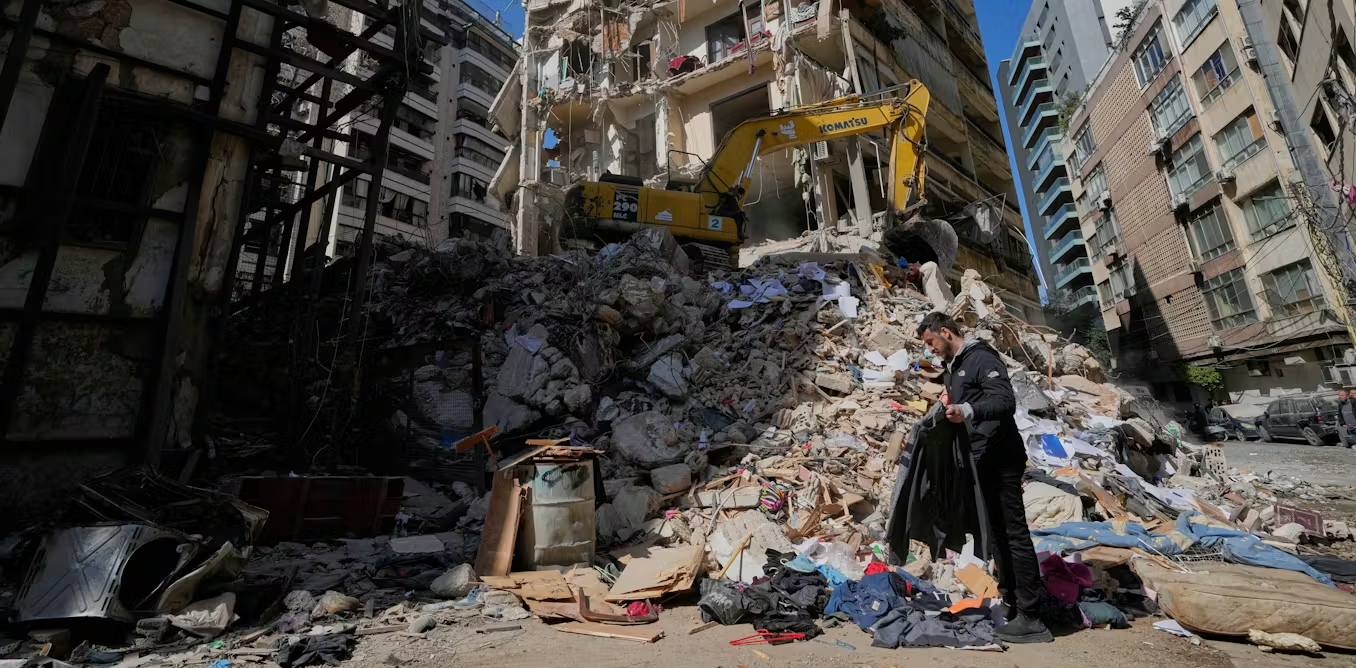
To anyone following events, there seemed little, if any, gap between reports that Pakistan had brokered a truce between the warring parties and news that Israel was continuing to attack Hezbollah in Lebanon. But from then the story followed a depressingly familiar path. Iran – backed by Pakistan – claimed that the ceasefire also covered Lebanon. Israel said that it didn’t and it would continue to pound Hezbollah targets there.
For his part, the US president, Donald Trump, said that as far as he was concerned, Israel’s assault on Lebanon was a “separate skirmish”, albeit one of considerable brutality in which 1,400 people were either killed or wounded.
We asked Scott Lucas, of the Clinton Institute at University College Dublin for his take on some of the most important issues which may affect the talks.
À lire aussi :
Why is Israel continuing to attack Lebanon, despite the ceasefire? Expert Q&A
The ceasefire was always going to be fragile, even without Israel’s intervention. There’s clearly no goodwill or trust between the warring parties. Trump was less than two hours away from launching an attack on Iran’s civilian infrastructure, including its power plants and its bridges – a bombardment so monumental that, as he put it: “A whole civilisation will die tonight, never to be brought back again”.
Tehran, for its part, was spitting defiance back at Washington, while calling on its people to form human chains across bridges and around power plants.
Nicholas Wheeler, an international relations expert at the University of Birmingham who has been investigating the role of trust in diplomacy, believes there’s a big difference between a mutual lack of trust between warring parties, and active distrust. In the former situation there is the potential for trust to develop. But in this case – as Iranian foreign minister, Abbas Araghchi noted recently, the US has now twice attacked Iran during ongoing negotiations, so – he says – there is “zero trust” in the US from Tehran’s point of view.
Trump’s failure to bring the Israeli prime minister, Benjamin Netanyahu, to heel over Israel’s continuing bombardment of Lebanon can only make matters worse.
À lire aussi :
Iran ceasefire: trust will be vital but it’s in short supply right now
And so Iran has not opened the Strait of Hormuz, which was America’s most important demand. We must wait to see what events, both in the Middle East and at the negotiations in Islamabad, will bring. The ceasefire had allowed both Tehran and Washington to declare a victory – which certainly seemed to be something in which the Trump administration placed a great deal of value. Both the US president and his defense secretary, Pete Hegseth, were trumpeting that line on Wednesday – Hegseth going so far as to say that the Iranian military was rendered completely ineffective and that the country’s leadership “begged” for a ceasefire.
Iran also declared victory. And Bamo Nouri and Inderjeet Parmeer of City St George’s, University of London, believe that Tehran has more reason to do so. For one thing, the Islamic Republic has demonstrated resilience in the face of the might of US and Israeli firepower that aimed to destroy it. It has shown that it can use its control of Hormuz to thrown global energy markets into considerable disarray. And, under the terms of the ceasefire accepted by the US president, it is Iran’s ten-point plan which will form the basis of negotiations.
À lire aussi :
Middle East conflict: this ceasefire may have made Iran stronger
Changing world order
The US president, meanwhile, has repeated his criticisms of America’s Nato allies and, according to German news magazine Der Speigel, has issued what European diplomats are calling “an ultimatum” for European member states to send military assistance to the Strait of Hormuz within days.
EPA/Aaron Schwartz/pool
Trump has been highly critical of Nato as a whole – and several of its member states specifically – because he believes they haven’t done enough to help the US and Israel against Iran. On April 1, he raised the possibility of the US quitting Nato altogether.
But he’s unlikely to pull America out of its transatlantic alliance, writes Paul Whiteley, who gives us three reasons why it’s either not in the US president’s interests or America’s to turn his back on the alliance it has led for nearly eight decades.
À lire aussi :
Three reasons Donald Trump won’t pull the US out of Nato
The emergence of Pakistan as a key interlocutor in all this will have come as something of a surprise to many. But the country has emerged, along with Saudi Arabia, Egypt and Turkey, as part of an important power bloc with influence in the Middle East, writes Natasha Lindstaedt, professor in the Department of Government at the University of Essex.
Lindstaedt argues that these countries want an end to the dominant roles played by both Israel and Iran in the region. The war in Gaza has appalled the Islamic world and put paid to any hopes – certainly for the near future – of any normalisation of relations of the sort envisaged by Donald Trump’s Abraham Accords. And all are also tired of the force for tensions and destabilisation that Iran has represented for nearly five decades.
As Lindstaedt points out, they’re a powerful bunch: Pakistan has nuclear weapons, Saudi Arabia has loads of oil, Egypt controls access to the Suez Canal and Turkey is a member of Nato: “Taken together, they represent the most politically and militarily influential Muslim-majority countries in the world,” she concludes.
À lire aussi :
Pakistan, Turkey, Egypt and Saudi Arabia emerge as a new regional power bloc amid Iran war
Meanwhile in Hungary
Hungarians head to the polls on Sunday for elections which will determine who is to be the country’s next prime minister. The long-time incumbent, Viktor Orbán, faces a stiff challenge from his former political ally, Péter Magyar. Polls show he is seriously up against it.
So the US president dispatched J.D. Vance to campaign alongside the prime minister in a bid to mobilise the country’s far-right eurosceptics. Zsofia Bocskay, of Central European University, sets the scene for what she believes could be a turning point for Hungarian politics.
À lire aussi :
Hungary election: how a new opponent has forced Viktor Orbán into the first genuinely competitive race in 16 years
Birmingham University’s Stefan Wolff, meanwhile, believes that the fall in support for Orbán despite all the help from Washington, reflects a Europe-wide disenchantment with Trump, especially in light of the US president’s apparently warm relationship with Vladimir Putin, a leader many feel poses a very real threat to their security.
À lire aussi :
Hungarian election exposes tensions at the heart of Donald Trump’s plans to boost the far-right in Europe

Sign up to receive our weekly World Affairs Briefing newsletter from The Conversation UK. Every Thursday we’ll bring you expert analysis of the big stories in international relations.









































You must be logged in to post a comment Login