

The so-called world order and the international rule of law are both officially dead in the wake of operation “absolute resolve”, the US infiltration of Venezuela to capture its president Nicolás Maduro.
It is true that both have been sick for some time – and Venezuela is a demonstration of this. Maduro was condemned by foreign leaders for illegally seizing power as long ago as 2013 – years before Donald Trump even became president. No concrete action was ever taken.
Operation “absolute resolve”, however, is a red line crossed.
Even when the US invaded Panama in 1989, there was some attempt to preserve a world order that no longer seems to matter. This invasion (more humbly named “just cause”) was anticipated by a declaration of war that came from Panama. The US Congress was, at least, informed and some countries even tried a mediation.
More importantly, the reaction when the US went ahead was much stronger. Even before the capture of Panamanian president Manuel Noriega, the General Assembly of the United Nations, the Organization of the American States (which includes the US) condemned the invasion as illegal. The European Parliament did the same immediately after.
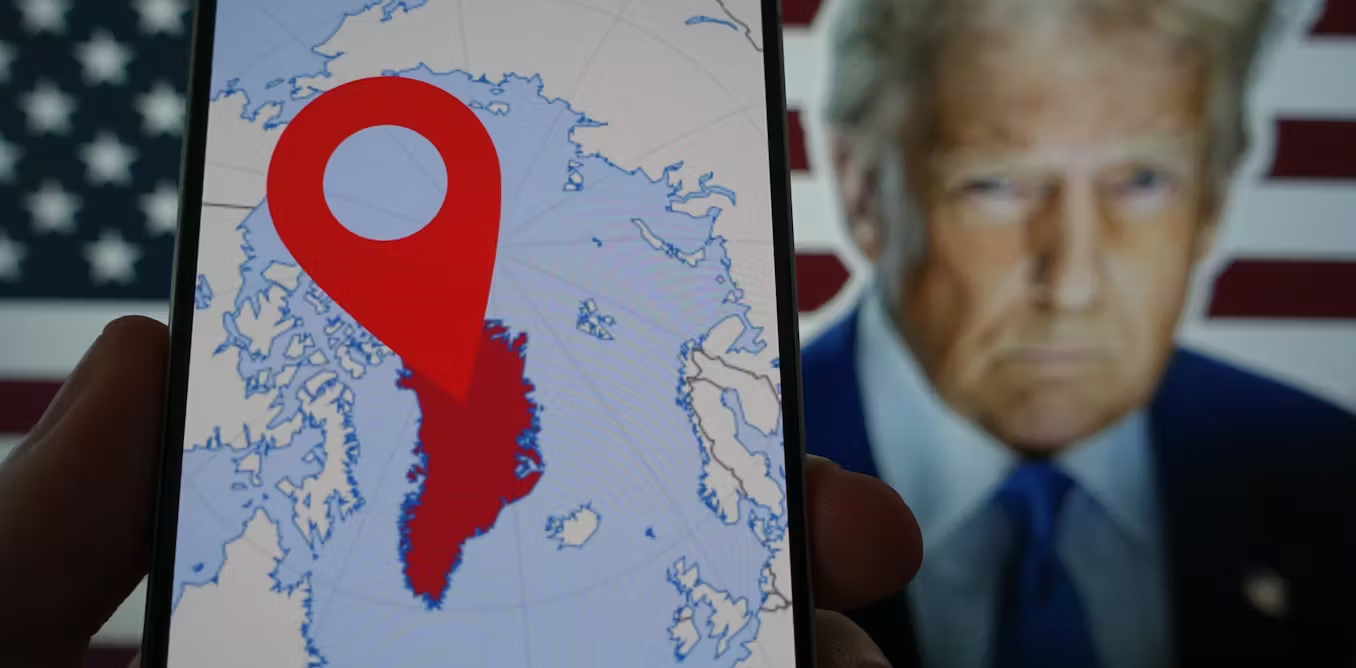
In the case of Venezuela, the silence is deafening. And seeing that no one has challenged it, the US government has immediately started talking about taking Greenland, hinting that it wouldn’t even need to use force. The world order is dead because nobody is willing to defend it.
However, it is equally evident that the alternative to the defunct world order cannot be no order at all. It’s not feasible that the world should operate according to the law of the jungle. It is too complex and big to be governed by just one empire.
This much was acknowledged even in the controversial US security strategy published at the end of 2025, which says that US elites “badly miscalculated America’s willingness to shoulder forever global burdens” and that “they overestimated America’s ability to fund … a massive military, diplomatic, intelligence, and foreign aid complex”.
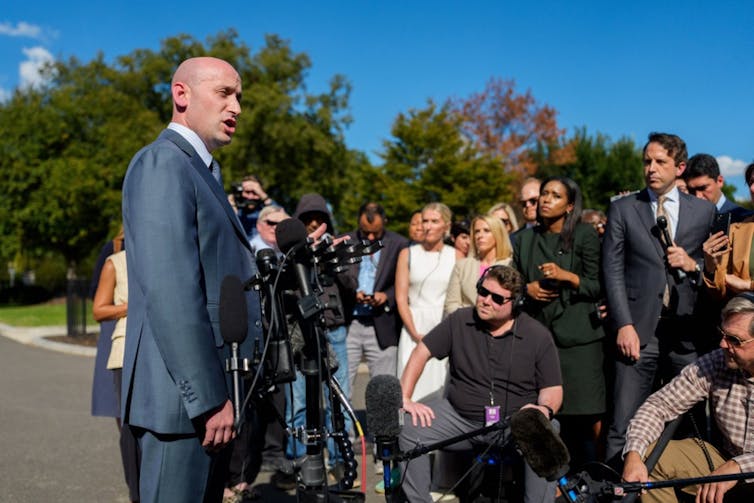
“We live in a world in which you can talk all you want about international niceties and everything else,” Stephen Miller, deputy chief of staff to Donald Trump, now says of the US’s changed vision. “But we live in a world, in the real world…that is governed by strength, that is governed by force, that is governed by power.”
EPA/Aaron Schwartz
But a world governed on these terms is obviously a world heading towards mutual destruction. In such a system, all countries would, legitimately, scramble to defend themselves militarily. For those countries not already equipped, the pursuit of nuclear weapons would be the only obvious route to invulnerability.
Turning crisis into opportunity
So, what should Europe do in the face of this problem? And in the current world order, it’s possible that I do really mean Europe rather than the EU.
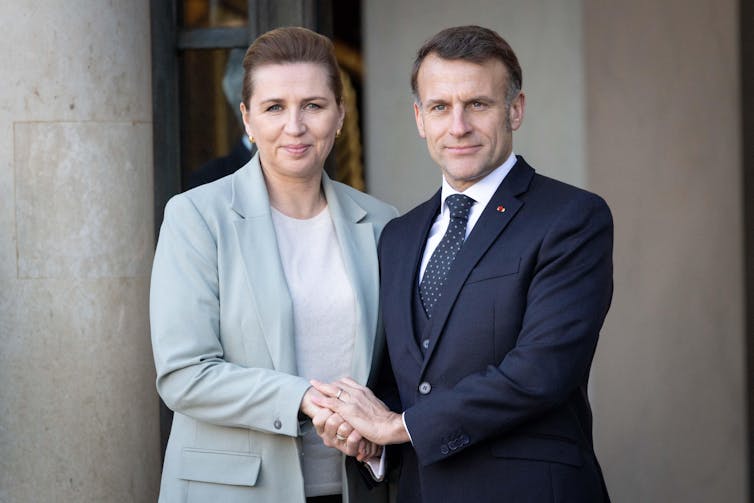
This situation requires cooperation with the UK, Norway, and probably Canada and Switzerland. If necessary, it may require moving ahead without Hungary or whichever other EU countries are still doubtful about the need for an urgent, defence-based European integration.
Alamy/Abaca press
In theory, a world without a world order is a much greater problem for Europe than for any other economy of the world. According to the World Bank, trade with other countries represents more than 60% of the five biggest GDPs in Europe but less than 40% of the GDPs of China, the US and Russia.
However, Europe is also probably the part of the world that is best equipped to try to be the broker a new framework. It has fewer enemies than other contenders and more friends (16 of the 20 countries whose passports enable entry to other states without a visa are European).
It has the strongest tradition of being a global meeting place (the top five host cities for international organisations are all in Europe).
So yes, Europe can, in theory, transform its biggest problem into its biggest opportunity. Indeed, I would even say that the only way to survive the chaos is by being ambitious. Europe must present itself as the only credible broker of a difficult and yet indispensable new world order.
Miller is right that this will take force, strength and power – but it is the force of standing up without double or triple standards over defending those rights that once inspired a “universal declaration” inspired by the United States.
It is about having the strength of ideas for drafting new institutions to reinforce those values. But also, it’s about having the power, even one based on a military deterrence, to defend freedom if somebody wants to impose a different vision of what civilisations are about.
Will Europe find the courage to be strong? It probably needs a trigger to wake up. Greenland could be that trigger.
If Europeans don’t manage to negotiate what they’ve mastered so far – another humiliating compromise that would only serve US interests and reinforce Miller’s worldview – then an incident over Greenland may be the end of an alliance that is already increasingly unstable. But it would also be an opportunity to draft a new vision for governing the world.



