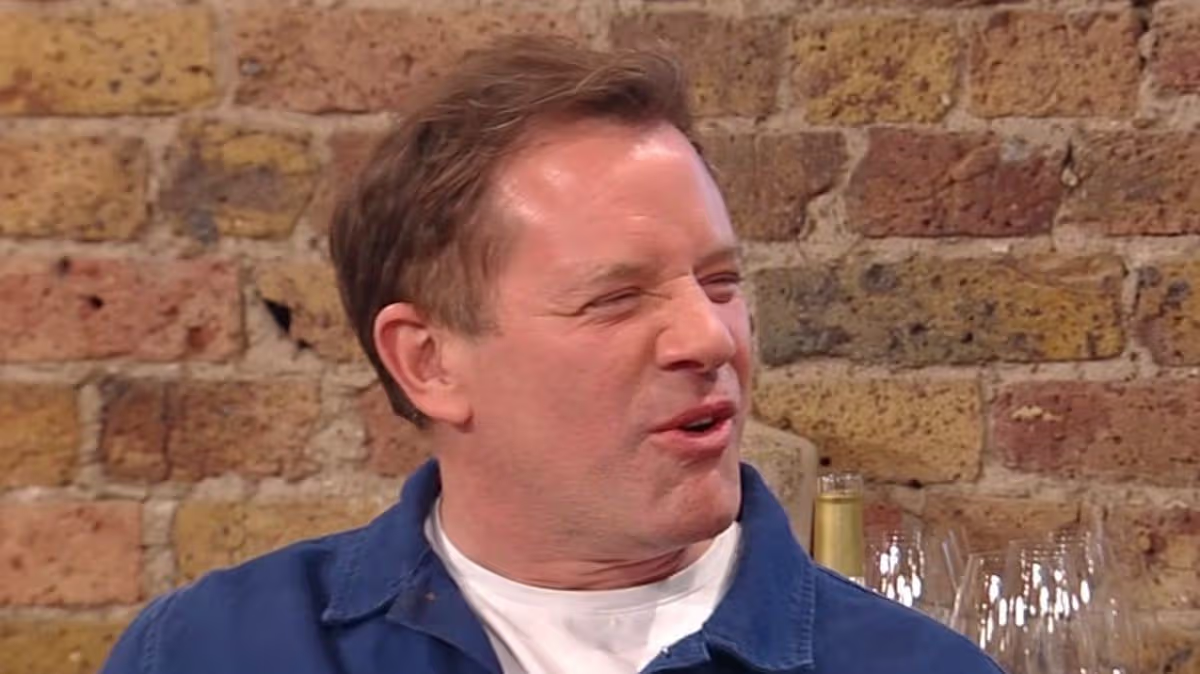
The 79th British Academy Film Awards took place on Sunday night and there were plenty of funny and memorable moments from the star-studded ceremony
The 79th EE BAFTA Film Awards got underway in London on Sunday night with huge stars in attendance including Emma Stone, Leonardo DiCaprio and Kate Hudson joining the likes of Paul Mescal and Jessie Buckley.
Advertisement
Prince William and his wife, Princess Catherine, also made a joint appearance at theawards walking the red carpet together where they awkwardly dodged a question from a heckler. The royal couple’s outing comes just days after William’s uncle, Andrew Mountbatten-Windsor, was arrested at his home on the Sandringham Estate, suspicion of misconduct in public office.
From Kylie Jenner being offered a Jammy Dodger, to K-pop star Rei Ami’s affection for Paddington, these were some of the funniest and most unforgettable moments from last night…
– Alan Cumming’s snack distribution.
Among the most entertaining – and peculiar – highlights of host Alan Cumming’s evening came when he wandered into the celebrity-packed audience armed with British treats.
“People were starting to get a bit peckish. I could tell their blood-sugar levels were crashing so I thought I’d come out and hand out some very British snacks,” he announced, clutching a basket.
After offering best actress contender Emma Stone a bag of Hula Hoops, which she called “divine”, he presented Stormzy with his “favourite” crisps – Skips. Approaching best actor hopeful Timothée Chalamet, who was seated next to Kylie Jenner, he enquired of the slightly bewildered pair: “Can I interest you in a packet of Scampi Fries?”.
“Kylie – have you ever had your gums around a giant Jammie Dodger?” Cumming continued before handing her one. He subsequently offered fellow best actor nominee Leonardo DiCaprio a treat.
Advertisement
“Leo, here you are. I think – how do you like the idea of an Oatie Hobnob Flapjack? That sounds fantastic,” the Hollywood legend responded.
Ensure our latest headlines always appear at the top of your Google Search by making us a Preferred Source.Click here to activateor add us as your Preferred Source in your Google search settings.
– Dame Emma Thompson’s resemblance to a former British prime minister
During the evening’s proceedings, the prestigious 2026 Bafta Fellowship Award was bestowed upon Dame Donna Langley – the first British woman to helm a major Hollywood studio – in recognition of her outstanding contributions to film and television.
Advertisement
A specially recorded message from Dame Emma Thompson was broadcast to attendees, with the camera tightly focused on her face.
Dame Emma quipped: “I haven’t got any makeup on. I look like Boris Johnson. Dame Langley, it’s me Dame Thompson in my kitchen.” She assured Dame Donna that “no one could deserve it more” when speaking about the accolade.
– Paddington’s biggest admirer.
The vocal talents behind the blockbuster KPop Demon Hunters performed at the event – marking their debut live appearance together beyond American shores.
Prior to the ceremony’s commencement, group members spoke with reporters on the red carpet and learned that Paddington had been seen amongst attendees.
Band member Rei Ami appeared shocked before excitedly declaring: “Can we meet Paddington? Where’s Paddington? I want to make a Tik Tok with Paddington.”
– Actress Mia McKenna-Bruce reveals unexpected Ronan Keating fandom.
Advertisement
Persuasion star Mia McKenna-Bruce also spoke on the red carpet, where she was questioned about advice for nominees. McKenna-Bruce, who herself claimed the Bafta Rising Star Award in 2024, responded: “It’s a rollercoaster, so just try to ride it.”
When asked if she was referencing Ronan Keating, she confirmed: “There we go. I knew someone would get it.” When they remarked on his collection of “bangers,” she replied with evident excitement: “Yes. He really does.”
– Cumming’s Zoom call.
The evening kicked off with a pre-recorded sketch featuring Cumming alongside several celebrities including Warwick Davies and young Hamnet star Jacobi Jupe participating in a Zoom conversation. Cumming appealed for their assistance in broadening the Baftas ‘ viewing figures.
Advertisement
Twelve year old Jupe then enquired “what’s BBC One?”, before continuing: “Oh, television – I think I watched that once. It’s like a big phone, right?”.
– Jessie Buckley’s emotional speech.
Jessie Buckley became visibly tearful as she accepted her best actress accolade for portraying William Shakespeare’s wife in Hamnet.
Advertisement
Director Chloe Zhao, who helmed the film, appeared equally moved when cameras captured her reaction from the audience. “I love you,” she silently repeated to Buckley during her acceptance speech.
Zhao herself received a best director nomination for the production, though the honour ultimately went to Paul Thomas Anderson for One Battle After Another.
– Robert Aramayo’s two big wins.
Further emotional scenes unfolded when British performer Robert Aramayo secured the best actor trophy mere moments after claiming the EE Rising Star award.
Aramayo triumphed over Hollywood giants including Leonardo DiCaprio, Timothée Chalamet and Ethan Hawke for the best actor honour, having delivered a powerful performance in I Swear, depicting the true story of a man living with Tourette syndrome in 1980s Scotland.
The surprise etched on his face was evident and was equalled only by the joy displayed by his family as they embraced him in the audience before he made his way to the stage to deliver his second speech of the evening.
Follow our live blog for the latest BAFTA updates by clicking here.
BEIRUT (AP) — Attacks intensified Friday between Israel and the Lebanese militant group Hezbollah ahead of direct talks between the Lebanese government and Israel set to begin next week.
The talks are set to begin Tuesday in Washington and will be mediated by U.S. diplomats, Lebanese President Joseph Aoun’s office said in a statement, citing the outcome of a call Friday among Israeli, Lebanese and U.S. ambassadors. The statement reiterated Beirut’s position that the talks be held under a ceasefire or truce.
Israeli Ambassador to the U.S. Yechiel Leiter later issued a statement describing next Tuesday’s talks as “formal peace negotiations,” but said a ceasefire was not on the agenda, in a stark contradiction to Aoun’s remarks.
“Israel refused to discuss a ceasefire with the Hezbollah terrorist organization, which continues to attack Israel and is the main obstacle to peace between the two countries,” the statement read.
Advertisement
At least 13 members of Lebanon’s State Security forces were killed in an Israeli strike in southern Lebanon on Friday, while Hezbollah claimed an attack targeting a naval base in the Israeli port city of Ashdod some 145 kilometers (90 miles) from the border.
Israel launched strikes across several towns in southern Lebanon, including one on a government building in the southern city of Nabatieh that killed the government security personnel. Hezbollah claimed 31 other attacks on northern Israel and on Israeli ground troops that have invaded southern Lebanon.
Israel launched its latest aerial campaign and a ground invasion of southern Lebanon after Hezbollah fired rockets toward northern Israel in solidarity with Iran, its key ally and patron, on March 2.
At least 1,953 people in Lebanon have been killed in Israeli strikes, according to the Health Ministry. At least 303 were killed in a rapid series of 100 strikes that hit the country — including multiple areas in dense residential and commercial areas in central Beirut — in 10 minutes on Wednesday, the bloodiest day in the latest war between the two sides. Civil Defense first responders are still searching for bodies trapped under the rubble in the Lebanese capital.
Advertisement
Meanwhile, officials at Beirut’s main government-run hospital on the southern edge of the capital fear it could be in the line of fire after the Israeli military issued an evacuation warning for the surrounding suburbs, including the busy neighborhood of Jnah where the hospital is located. Israel has launched attacks in Jnah, both with and without warning.
The World Health Organization has since called for the Rafik Hariri University Hospital to be spared from attacks and not to evacuate, and WHO officials said Friday that they received assurances that it would not be struck. The hospital has not evacuated, though staff are fearful, as getting to work now requires them to drive on roads that can be struck at any time says Dr. Mohammad Cheaito, who heads the emergency department.
“The entire zone around the hospital was threatened and deemed dangerous,” he told The Associated Press. “But at the end of the day, we have a humanitarian duty.”
Advertisement
Sign up for Morning Wire:
Our flagship newsletter breaks down the biggest headlines of the day.
Advertisement
Lebanon hopes for truce while Hezbollah supporters reject talks
Lebanon’s authorities have not yet commented on Israeli Prime Minister Benjamin Netanyahu’s announcement on Thursday of the decision to go ahead with talks. Netanyahu said the talks would revolve around disarming Hezbollah and establishing “peaceful relations” between the two countries.
A Lebanese official in government familiar with the developments said that a halt in the fighting is a critical condition for the country to engage in direct talks with Israel, similar to the one between the U.S. and Iran. It has yet to appoint a representative for negotiations. They spoke on condition of anonymity in line with regulations.
Aoun had initially proposed the direct talks early on in the war on similar terms, at the time hoping for Israel to stop an escalation in airstrikes and to not invade the country. At the time, with only the backing of France, that failed.
Advertisement
On Wednesday, the U.S. and Iran announced a temporary ceasefire in the war that began on Feb. 28. It included Lebanon and other countries impacted in the wider regional conflict, mediator Pakistan announced. However, Israel — and later the United States — denied this. They want to separate the diplomatic tracks of the two wars.
Hezbollah considers Israel’s attacks on Lebanon to be a violation of the ceasefire, while Beirut, in a bid to disarm Hezbollah and assert its full sovereignty over the country, says it wants to be included in talks related to Lebanon.
Hezbollah Secretary-General Naim Kassem in a statement broadcast Thursday did not directly mention the prospect of Israel-Lebanon talks, but called on the Lebanese government to “stop giving free concessions” to Israel.
Dozens of supporters of the Iran-backed group protested outside of the Lebanese prime minister’s office in central Beirut. They see the scheduled direct talks as a surrender to Israel, which says its troops will stay in the country indefinitely.
Advertisement
“Our blood has been spilled on this land, and our state is conspiring against us,” said protester Hassan Shuaib. “Our state wants to kill us; our state wants to strip us of our weapons.”
———
Associated Press producer Malak Harb and video journalist Fadi Tawil in Beirut, and Matthew Lee in Washington contributed to this report.
A CAPACITY FortyFive Vinyl Café hosted Derbyshire singer-songwriter Tom Bright last October in support of his latest album, Young Old Bloke.
The show was described as an excellent, authentic and intimate performance from a classic urban folk artist who will appeal to fans of Paolo Nutini and Frank Turner.
Advertisement
The October show was a real treat as Bright shared tales of how he had honed his craft over a decade of personal and professional challenges.
He’s navigated his pub landlord duties, performed several hundred gigs, experienced record label wranglings, global pandemic setbacks and a life-threatening illness.
Tom Bright heading for gig in York this summer. Photos supplied
Despite this, Bright has performed alongside the likes of Tom Grennan, Ed Harcourt and The Libertines and has recently played at Glastonbury, Shepherds Bush Empire and The London Palladium.
He will be returning to York in June for a gig at Rise @ Bluebird Bakery, Acomb. I caught up with him recently in anticipation of the show.
Advertisement
GJ: What brings you back to York so soon?
TB: I love the city of York and, you know, I love the county of Yorkshire. My life entails going up and down the country, so York is always a city that kind of needs calling in on, really, on the gig circuit.
GJ: In terms of people that don’t know your music or not being exposed to it before influences, what are they, where did they come from?
TB: I’ve got very eclectic taste in music. I was first listening to the likes of Bobby Darin, Frank Sinatra, but in terms of my own writing there’s elements of Jarvis Cocker, Simon Aldred of Cherry Ghost and people like Ray Davies, you know, that kind of quirky wordiness and writing and, you know, I’m very, very much an observational kind of fellow, really, I think.
Advertisement
GJ: What are your early memories of introductions to music, who shared their influences with you and who has really shaped your tastes?
Tom Bright heading for gig in York this summer. Photos supplied
TB: I was late into music myself. I didn’t pick up a guitar until I was 22. But then I just became obsessed. It was like I’d found the tool I hadn’t previously had to share my stories and so after a year in Australia I reinvented myself as Tom Bright, public landlord turned Tom Bright, troubadour. I then moved to London and the first people I was working with really were Mick Jones from The Clash and Glenn Matlock from the Sex Pistols which was pretty wild. I have so many great memories and stories of those days. Getting on the Central Line with Mick after our sessions, and you know, just kind of realise everyone would be looking at him, and I mean, Mick Jones!
GJ: You’ve had a few recent media appearances. Tell me about this.
TB: Yeah, there’s been a few interesting TV appearances. My first introduction to TV stuff was on the One Show. It was a feature on me going back to Great Ormond Street Hospital where I spent a large chunk of my young life. I went back and met Professor Spitz who saved my life following a serious health issue and ended up playing one of my songs. And then I was on Sky News as there was a piqued interest in me as a lad who’d come from what I’d come from and was living this kind of lifestyle now. It built from there and last year I played on Sunday Morning Live on BBC One. It was a live TV feature at 10.30am. It was pretty daunting, but I managed not to swear or mess up.
Advertisement
Tom Bright heading for gig in York this summer. Photos supplied
GJ: There are numerous reports on how tough the music industry is and how hard it is to make a living. What does your world look like in terms of making a living and making music work?
TB: It’s tough. I mean, I literally work flat out. Every hour that I’m not sleeping, I’m working. I’m spinning many plates, the endless admin, booking gigs, constant communications, carving out those opportunities and building those connections. I curate events in London and run a concert series called Bright Nights with several events every month. These are showcase nights for people who are starting out and they’ve built up a really big following over the past six years. I also do some band management and consultancy work for other artists. It’s endless work but it is also a brilliant journey and one that I wouldn’t change anything for.
Tom Bright will play at Rise @ Bluebird Bakery, Acomb, York, on Saturday, June 14
For tickets – www.bluebirdbakery.co.uk/rise and www.seetickets.com/event/tom-bright/rise-bluebird/3573171
Operation Pisces was introduced to tackle organised crime in Enfield, but many sex workers have also felt targeted (Picture: Getty Images)
Maria has been tirelessly working the streets of Enfield as a sex worker on and off for seven years after escaping Romania to try and make a better life for her family back home.
‘Many women like me do this work because we have no other way to survive,’ Maria, 27, tells Metro. ‘Some of us have children. Many of us have left bad or violent relationships. We are all just trying to live.’
While she used to work on well-lit, populated streets and car parks, for over a year, Maria has been forced to work alone on desolated streets, parks, and in dark corners – all in a bid, she says, to get away from the watchful eyes of police.
The shift came about due to a Metropolitan Police initiative called ‘Operation Pisces’, which was introduced with Enfield Council in June 2024 to tackle organised crime and antisocial behaviour.
Advertisement
However, according to Maria and other sex workers in the area, it only put them more at risk.
‘Things got so much worse for us,’ she explains. ‘Police were – and still are – everywhere. They tell us to move all the time. They shout and threaten us with arrest, so we retreat to quiet places, which is very dangerous.’
Lasting until December 2025, Operation Pisces was ‘a clear phase’ within a three-stage Home Office policy called Clear, Hold, Build – an ‘academic, evidence-based approach that seeks to address serious and organised crime, and more broadly improve an area over a long, extended period of time,’ Chief Inspector Rob Gibbs Chief from the Metropolitan Police, tells Metro.
‘This part of London [Enfield] has a lot of challenges in it – the organised element is around drugs and gangs and violence,’ he adds. ‘We are trying to break the cycle around that. The volume of women who have been exploited there is large.’

Advertisement
The police and Enfield Council are trying to break the cycle surrounding drugs and gang violence (Picture: Getty Images)
However, Niki Adams of the English Collective of Prostitutes says that as far as she’s concerned Operation Pisces was effectively a ‘police crackdown against street sex workers in Enfield’s long-established red-light area.’
Although the scheme officially ended in Enfield nearly four months ago, Niki says it’s impact will be ‘long-lasting’.
She tells Metro that she first started receiving phone calls from ‘distressed’ women sex workers asking for her help in January 2025. ‘The policing approach involved heavy patrols and the issuing of ASBOs (Antisocial Behaviour Orders), loitering notices, and cautions,’ says Niki. (The Met insist no ASBOs, Criminal Behaviour Orders or loitering notices have been issued to sex workers in the area.)
As a result, many of the women were forced to disperse to isolated areas, ‘simply to try and earn enough money to survive.’
Latest London news
To get the latest news from the capital, visit Metro’s London news hub.
Advertisement
Dr Binta Sultan, Senior Clinical Research Fellow in Inclusion Health at UCL, has been doing outreach work with sex workers in Enfield and says that prior to the initiative, police ‘worked well’ with sex workers.
‘They took a collaborative approach with outreach services, were more trauma-informed, and treated women who were sex-working as victims of crime,’ she tells Metro. ‘They built trust.’

Advertisement
Organisations working with sex workers say they would like to see more police support (Picture: Getty Images)
However, that changed with Operation Pisces, says Dr Sultan. ‘Women started telling us about their interactions with police – that they were being quite aggressive and rude, and that sex workers were being arrested. We also noticed women disclosing quite serious assaults from clients, but weren’t wanting to go to the police.’
They also noted a drop in women using outreach services because ‘police were located in those areas’ which made them afraid of being identified, arrested, or interrogated – or having their children taken away by social services.
The impact on sex workers has been ‘devastating,’ says Niki.
‘Women say they feel hunted, persecuted and fearful. Many are survivors of rape and other violence and domestic abuse; being shouted at and threatened by police is very distressing and retraumatising.
‘Why aren’t the police and council asking what support women, and particularly mothers, need to survive instead of persecuting and criminalising them?’ she asks. ‘The impact of a criminal record is lifelong. We see women barred from other jobs, from housing, and even losing custody of their children just because they have a prostitute’s caution or conviction.’
Advertisement
Many women say the operation has left them feeling hunted, persecuted and fearful (Credits: Getty Images)
For migrant women like Maria, their increased vulnerabilities also open them up to even greater violence from clients.
‘‘Now we are also afraid of the police,’ she says. ‘We aren’t dangerous people. We are just women trying to survive and support our families. We need safety, not punishment.’
Sarah is the mother of two young children and has lived and worked in Enfield for three years. Like many sex workers around her, she’s had to find ways to support her family in ‘very difficult times.’
‘I started doing street work after losing my job in a shop,’ the 39-year-old tells Metro. ‘I didn’t choose this job because it was easy. I chose this job to make sure my kids are okay.’
Prior to Operation Pisces, Sarah was ‘okay with local police.’
Advertisement
‘They knew who I was, and we all knew them,’ she says. ‘It meant we could work in areas where we could look out for each other. But everything changed and the police are everywhere.’
Fearful of being caught, Sarah says she has to ‘rush things with men and move quickly,’ which ‘increases the risk of violence.’
‘I didn’t choose this job because it was easy. I chose this job to make sure my kids are okay,; says Sarah (Picture: Getty Images)
‘Being treated aggressively by the police just causes more stress and fear to our lives,’ she says. ‘We’re not the problem. We are just trying to get by.’
Dr Sultan claims that when she formally raised her concerns with the police, she was told: ‘that’s not what we do.’
‘They said they are here to protect women, and were focused on exiting sex work as their approach,’ she adds. ‘Every time we have raised it, they say they don’t arrest women. That they don’t criminalise sex work. They say they are taking a trauma-informed approach.’
Advertisement
CI Gibbs says that over the course of 18 months, they made 1,027 arrests as part of Clear, Hold, Build, and of those, 21 were arrests of sex workers.
‘But we’ve not arrested anyone for loitering,’ he insists. ‘The most up to date term for ASBO is Criminal Behaviour Order (CBO), and through this work, we have not used that on any of the women. The women that have been arrested have been for minor or low-level criminal offences.’
Since Operation Pisces was put into place, CI Gibbs says the police has already seen ‘falling crime and antisocial behaviour’ in the area due to Home Office strategy. However, he also admits that it has led to sex workers becoming ‘less visible than they were’ – but that this was an ‘unintended consequence’.
Niki”s response to the success? ‘It has been horrifying to hear the police boast about how they have cleaned up an area when it is women’s safety, health and wellbeing which has suffered as a result.’
Advertisement
Dr Sultan adds: ‘Operation Pisces has been used as an example of good practice of policing sex work. We have serious concerns about this model being rolled out in other parts of London and the country, given the devastation it has caused.’
Sex workers and the law
Prostitution itself is not illegal in the UK, but many related activities are criminalized, particularly in England, Wales, and Scotland. It is legal to sell sex privately, but kerb crawling, operating a brothel, pimping or loitering or soliciting in a street or public place for the purpose of selling sexual services, is illegal.
Advertisement
Meanwhile, Niki is calling on the Met to immediately start prioritising women’s safety, health and survival.
‘After the murders in Ipswich in 2006 (when five sex workers were murdered), agencies came together to provide emergency support that enabled women to come off the street quickly,’Niki explains.
‘They had a dedicated phone line, gave women cash payments so they didn’t have to work to eat, they helped women clear their debts, provided housing and even helped some women get essential dental treatment. There is no reason that this kind of support can’t be available in Enfield.’
CI Gibb says ‘there’s not a lot of point in criminalising a person who is just trying to survive. It doesn’t break the cycle.’ (Picture: Getty Images/Johner RF)
CI Gibbs points out that he has a ‘growing amount of intelligence’ that sex-working women are now approaching police officers for help. ‘In the past six months, 20 women have approached my teams asking for support,’ he says. ‘They feel trapped. We’re trying not to criminalise – there’s not a lot of point in criminalising a person who is just trying to survive. It doesn’t break the cycle.’
When criminal justice among sex workers ‘is necessary,’ Gibbs says his team are trying to ‘make the right referrals’ and have all the ‘support and safeguarding’ they need.
Advertisement
As a long-term solution, the English Collective of Prostitutes is campaigning for the loitering and soliciting laws and for prostitute’s cautions to be scrapped as part of legislation that decriminalises sex work.
‘This would allow women to move off the street if they wanted and work together with others inside in much safer conditions,’ explains Niki. ‘But if this punitive policing devastating women’s lives continues, violent criminals will be given a green light to act violently towards them.
The hotel is famous for its stunning views over a much-loved Welsh beauty spot
A popular hotel that was demolished after being severely damaged in a devastating fire earlier last summer has announced it is ready to reopen. The Worm’s Head Hotel, located in the Gower Peninsula, collapsed after an overnight fire on July 14, 2025.
Advertisement
The hotel, known for its breathtaking views of the iconic Rhossili Bay and the famous Worm’s Head, has long been a beloved destination for locals and visitors alike. The family-owned hotel was left heartbroken after the blaze, which was later determined to be accidental by the Mid and West Wales Fire and Rescue Service.
Following the fire, the hotel’s owner vowed to “raise it from the ashes,” as an outpouring of support from the community and past guests flooded in. The team behind The Worm’s Head have done just that – announcing they are ready to open less than a year after the devastating fire.
The hotel will reopen on Saturday, April 11, after “much blood, sweat, and tears”, the owners said in a Facebook post.Never miss a Swansea story by signing up to our newsletter here
The alarm about the fire was raised in the early hours when a blaze broke out within the accommodation block of the hotel. While no casualties were reported, the fire quickly spread to the entire roof of the building. Emergency services were on the scene, but the damage was extensive.
With some of the hotel having collapsed, the demolition process began in September. At the time, owners said they had “mixed emotions” as they watched the first wall coming down, adding: “We look forward with renewed ambitions. Watch this space.”
Announcing the reopening, The Worm’s Head Hotel said on Facebook: “After much blood sweat and tears we are more than delighted to announce that we will reopen our doors tomorrow Saturday, April 2026 at 11.30 am.
Advertisement
“HOT & COLD DRINKS, BEERS, WINES, SPIRITS, VIEWS and hopefully the odd SPECTACULAR SUNSET! NO FOOD AVAILABLE YET! Please bare with us.
“Thank you all from the bottom of our hearts.”
The owners added that they are not ready to welcome guests to stay just yet, but that is something “in the pipeline”.
Advertisement
The news of the hotel’s reopening was met with love and support from locals and visitors. One person wrote: “Absolutely fab news! Well done to you all. Can’t wait to visit.”
Another shared: “Best news of the week. Well done folks, thanks for making my week. It’s always a joy to witness ‘that’ view with a good beer – so pleased “
A third person simply said: “Our summer is saved!”
Rhossili Sunflowers also sent well wishes to the hotel. They said: “Great news at Rhossili after last year’s fire, and a lot of hard work, The Worm’s Head Hotel is reopening tomorrow. Another one of Rhossili’s great family-run businesses.
Advertisement
“Go and support, not serving food yet but pint and a packet of crisps with a sunset will have to do.”
People have been left heartbroken after discovering the truth about a cat’s memory – with many admitting it’s made them think twice about adopting a pet on a whim
Now, one cat owner has shared a heartbreaking insight into how deeply cats bond with their humans – and how long they may remember them after being separated. The content creator, known as @OreoAndPumpkinSpice online, took to social media to explain how a cat’s memory works, urging people to think twice before giving up their pet.
In her video, she said: “The real answer is surprisingly heartbreaking. A cat’s memory of its owner isn’t short at all.
“Just three months of being with you is enough for it to carve you deeply into its heart, and it will remember you for the rest of its life.
“That’s why abandoned cats often stay in the same place, waiting quietly, even when someone is willing to adopt them. They’re still hoping their old owner will return.
Advertisement
“So please, never give a cat away casually. To you, a cat may be just a small part of your life, but to the cat, you are its whole world.”
Her emotional message struck a chord with viewers, many of whom shared their own experiences in the comments.
One person wrote: “I’d give a kidney for my cat.” Another added: “My cat died Wednesday, and I’m crushed. He lived almost 16 years. I know he was old, but it’s hard to accept.”
Content cannot be displayed without consent
A third user shared how their perspective changed after taking in a stray, saying: “I’ve always been a dog person. Thought I didn’t like cats, then a stray adopted me.
Advertisement
“After months of feeding and bonding, she now lives inside with her three dog sisters. She’s our cat princess living her best life. I hope she doesn’t miss the outside. She’s become my shadow cat.”
Others highlighted just how strong feline bonds can be, even with other animals.
One user wrote: “My cat is 20. He lost his adopted brother in June 2024. He still calls him every day at the same hour before his afternoon nap because that was when they used to nap together – and it’s been 18 months now.”
Backing up the claim, pet care experts at Rover say cats are capable of forming long-lasting memories tied to emotion.
Advertisement
A statement reads: “Cats have a good short-term and long-term memory, indicating that they do remember us. In fact, cats have excellent long-term memories.
“If you are leaving your cat for college or another multi-year trip, they won’t only miss you but also be filled with affection when you return.”
Experts also note that emotional experiences play a key role in what cats remember.
They added: “The closer the bond you build with your cat, and the more positive the associated memories, the more likely they are to remember you for longer.
Advertisement
“On the flip side, people who irritate and disrespect cats are also likely to stay in their memory as someone to avoid – or haunt.”
The message serves as a powerful reminder that while pets may come into our lives for a period of time, for them, that bond can last forever.
A bid from Pivovar to licence a vacant unit in the Guildhall complex for its proposed Mittel River Terrace is set to go before councillors on Monday, April 13.
Director Jamie Hawksworth said the venue would serve a range of lagers produced on-site by the Elvington-based firm and offer the best private views across the River Ouse.
But several companies with offices in the Guildhall complex said opening a bar there would disrupt them during working hours.
It comes after Pivovar lodged a the licensing application for the Guildhall Restaurant unit with City of York Council in February through its company Leeds Tap Ltd.
Advertisement
RECOMMENDED READING:
Planning permission has been granted for the company, which produces Mittel pilsner and lager and operates 14 bars and restaurants including in York, to redevelop the unit.
The council-owned two-storey restaurant space overlooking the River Ouse, off Lendal, has stood empty since it was built as part a £20m refurbishment to the Guildhall complex completed in 2022.
Pivovar boss Mr Hawksworth said in February Mittel River Terrace would serve a range of lagers produced in a bespoke on-site copper brewhouse made in the Czech Republic.
Advertisement
He told the Local Democracy Reporting Service (LDRS) the venue would also offer a range of food including oysters, rotisserie pork and chicken sourced from local suppliers.
But five comments have been lodged including from four companies and organisations based at the complex all voicing concerns about the plans.
York Science Park, which offers offices and co-working space to 23 companies there, called for a ban on outside music and seated drinking only during working hours.
The outside of the Guildhall Restaurant, off Lendal, in York (Image: LDRS)
They said: “Our tenants chose The Guildhall for its prestige and professional serenity.
Advertisement
“The introduction of a gastro-brew pub threatens tenant retention and the first impression for visiting clients.”
The Archaeology Data Service, which is due to move into the complex in June, said the venue’s location was ill-advised, risking bottlenecks along the narrow passageways used to reach it.
The firm said: “The grant of this licence in its current form would be detrimental to our research and development activity and, in the worst case, would force us to reconsider our location in the city.”
XR Stories, run by the University of York, and Colour Urban Design Ltd which are also based in The Guildhall objected over noise, public nuisance and disorder.
Advertisement
North Yorkshire Police and the council’s licensing department have also raised concerns about the plans.
The applicants have agreed close the venue earlier, at midnight rather than the 1.30am originally proposed.
Drinks would not be served after 11.30pm and its outside terrace would be closed at 11pm.
No outdoor speakers would be used at any time and bottles would not be taken to bins off the premises during office hours from Monday to Friday.
Advertisement
A part of the terrace would also be reserved for staff from overlooking businesses from 9am to 5pm, Monday to Friday, to have their own food and soft drinks there.
The venue would be licensed to serve alcohol from 10am to 11.30pm daily if the application is approved.
At least two door supervisors would be at the premises from 7pm until closing time on race days.
He also directed a series of sexually offensive remarks at one police woman called to the scene of a city centre street brawl.
A Belfast man who subjected PSNI officers to a “shocking” tirade of racist and sectarian slurs has been jailed for three months.
Advertisement
Neil Henry, 32, also directed a series of sexually offensive remarks at one police woman called to the scene of a city centre street brawl.
The outburst earlier this month included making offensive and menacing comments about one victim’s relatives and children.
Belfast Magistrates’ Court heard Henry, of no fixed abode, has only spent four weeks outside of prison in the last five years.
He pleaded guilty to new charges of disorderly behaviour and assault on police.
Advertisement
Officers had been dealing with an unrelated incident at CastleCourt shopping centre on April 4 when they were alerted to a number of men fighting outside.
Henry was detained at the scene on Royal Avenue, but immediately became verbally abusive.
“He shouted sectarian slurs such as ‘specky, four-eyed fenian b*****d’ and ‘dirty fenian rebel b*****ds’,” a Crown lawyer said.
The defendant made threats about cutting the throat of one officer, asking if he wanted his family to be short or his children raped.
Advertisement
At one point Henry had to be restrained on the ground due to the level of his aggression.
When a female officer approached he called her a “rat” and then shouted: “F*** up you dirty slut, go take a c***.”
The tirade continued after another constable approached to assist her, according to the prosecution, with Henry directing repeated racist remarks at him.
He told that officer: “Don’t you f***ing come near me, you black c***, you dirty f***ing rat.”
Advertisement
Removing any doubt about his intentions, the defendant then declared: “I’m a racist b*****d.”
During the outburst, he went on: “I f***ing hate blacks, they get everything, they are dirty immigrant c***s.”
Despite the repeated slurs, the charges were not classed as aggravated by hostility or hatred.
Deputy District Judge Gerard Trainor suggested it may have been an oversight by the prosecution.
Advertisement
A defence barrister told the court Henry was keen to get the case dealt with.
“He has an unenviable record… he has spent effectively no more than four weeks outside of prison in the last five years,” counsel disclosed.
Mr Trainor ruled that the offences were serious enough to justify sentencing Henry to a further jail term.
Imposing three months’ immediate custody, the judge said: “Although the aggravator is missing and I can’t rely on that, these facts and the outbursts are shocking to the ears of this court and any other reasonable person.”
Manchester City are short of defenders after Pep Guardiola provided an update on his squad ahead of the Premier League trip to Chelsea.
Manchester City return to Premier League action this weekend with a trip to Chelsea as they seek to keep pace with Arsenal at the top of the table.
Advertisement
Pep Guardiola’s side beat the Gunners in the Carabao Cup final a few weeks ago and returned from the international break in style when thumping Liverpool 4-0 to reach the last four of the FA Cup.
The Blues will now be targeting a win at Stamford Bridge to keep alive their hopes of reeling in league leaders Arsenal. Here’s the injury latest from the Etihad.
Get MEN Premium now for just £1 HERE – or get involved in our City WhatsApp group by clicking HERE. You can also join our City Facebook page by clicking HERE and don’t miss out on our brilliant selection of newsletters HERE.
Ruben Dias
Injury: Ankle
Advertisement
Dias missed the FA Cup win over Liverpool with an injury picked up in training and had a scan last weekend. The Portugal international is not fit enough to return to the squad for the trip to Chelsea and must be considered a doubt for the crunch clash with Arsenal.
“He is getting better but he is not ready for Sunday,” said Guardiola in his pre-match press conference.
Potential return date: Arsenal (H) April 19
John Stones
Injury: Thigh
Advertisement
Stones has suffered an injury-hit campaign and was forced to pull out of Thomas Tuchel’s England squad last month. He missed the weekend win over Liverpool as a result and is unlikely to feature against Chelsea given the centre back has yet to return to full training.
“He will maybe do partial training today,” said Guardiola on Friday.
Potential return date: Burnley (A), April 22
Man City vs Southampton VIP and hospitality tickets
Advertisement
This article contains affiliate links, we will receive a commission on any sales we generate from it. Learn more
Seat Unique offers hospitality packages for Manchester City’s FA Cup semi-final clash with Southampton, including ‘premium’ seats at Wembley and complimentary food and drink.
Josko Gvardiol
Injury: Leg
The Croat broke his leg in the reverse fixture with Chelsea in January and remains a long-term absentee. He might recover in time for the closing weeks of the season but there is no guarantee given he will want to be fully-fit for the World Cup this summer.
Advertisement
“He is getting better too, but still he is not close,” said Guardiola on Friday.
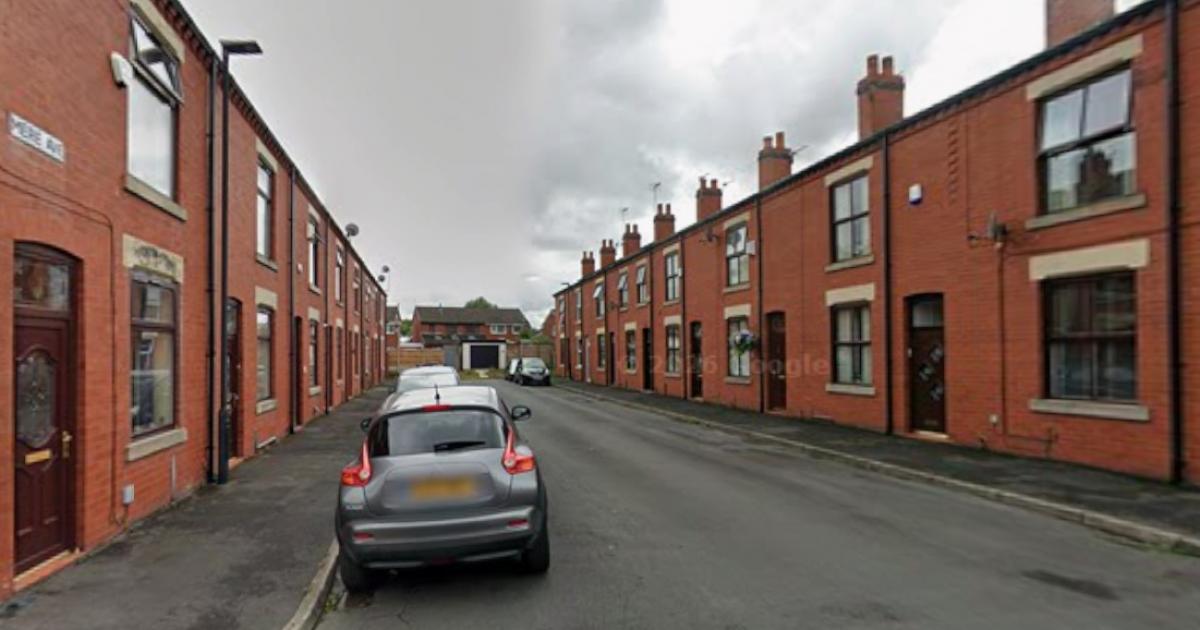
However, on Friday (April 10), Greater Manchester Police said they had charged a 32-year-old Bolton man with Section 18 assault, attempted Section 18 assault and dangerous driving.
Advertisement
Daniel Ashton, of Tattersall Avenue, Bolton, has been remanded into custody ahead of a court appearance at a later date.
A force spokesperson said: “Daniel Ashton, 32, of Tattersall Avenue, Bolton, has been charged with S18 assault, attempted S18 assault, and dangerous driving.
“He has been remanded in custody and is due for a court appearance at a later date.”
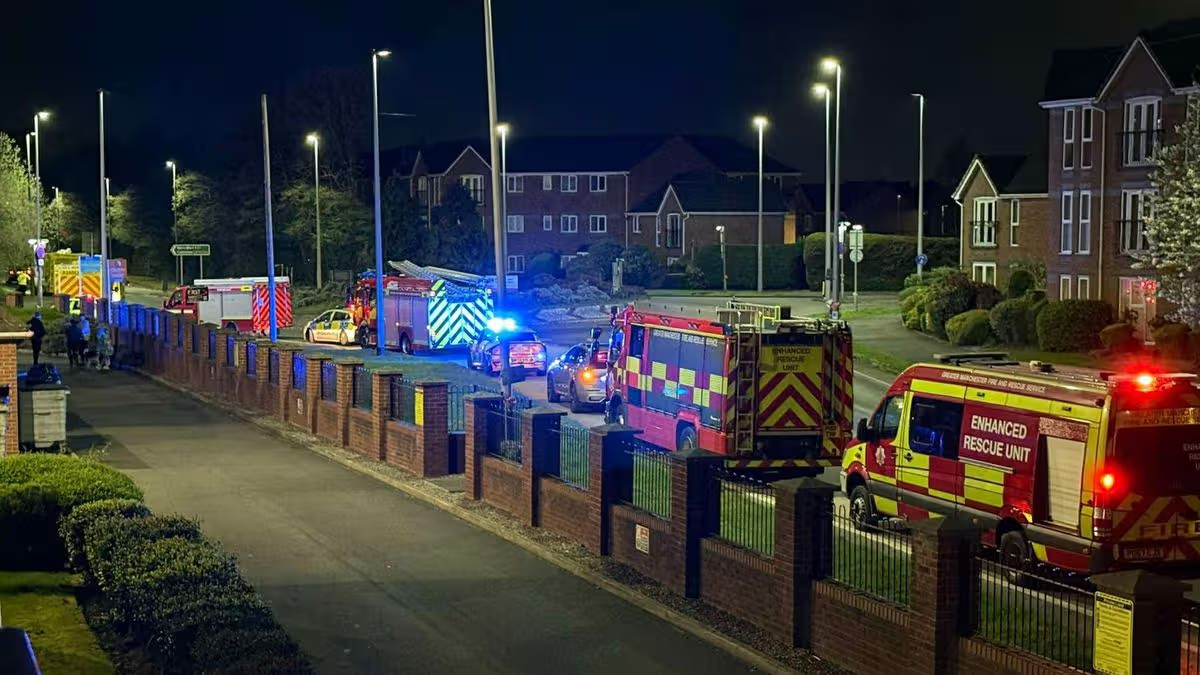
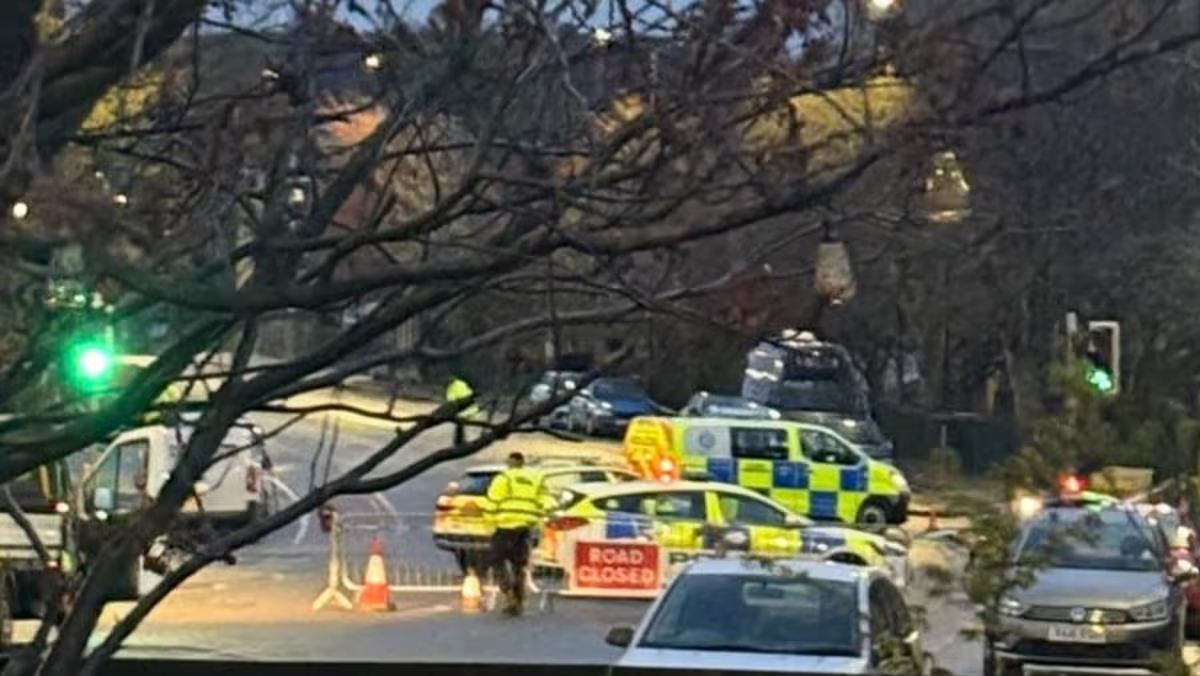
Commenting on the initial incident, GMP added: “At around 10.53pm on Friday, April 3, we were called to reports of a road traffic collision between a car and three pedestrians.
Advertisement
“Emergency services attended, and two men were taken to hospital for treatment.”
The pub did not want to comment on the incident itself due to its sensitivity, but did confirm that one of its staff members had been injured.
“The event has been traumatic for the staff team,” said Kevin Galbraith of the Victoria and Albert, “so we don’t wish to go over it again.
“We have assisted police with their enquiries.”
Advertisement
GMP issued an appeal for CCTV and dashcam footage to aid them in their investigations.
Horwich Cllr Charlotte Moncado-Sears said: “Horwich isn’t a place where we want people driving dangerously – we’re such a small, close-knit town.
“And Horwich is always so busy on Good Friday – everybody goes up Rivington Pike and comes back down into the village for a drink or something to eat.
“I know it was late, but there could be families and kids there.”
Advertisement
Horwich Councillor Ryan Bamforth said: “I really do hope everyone involved in the incident is alright.”
Anybody with information or footage of the incident is advised to contact GMP on 101 or via the online chat facility on the GMP website.
Anybody not comfortable contacting the police directly can call Crimestoppers on 0800 555111 to submit their footage/information anonymously.
The list of exclusions from schools in Wales includes children as young as four and five as teachers warn of violence and behaviour crisis
04:48, 11 Apr 2026
Advertisement
Schools in Wales have permanently excluded 92 children and teenagers this academic year. Most were expelled for assaulting teachers and other pupils or for verbal aggression and threats.
Thousands more have been issued with fixed term exclusions, mostly for disruptive behaviour, but also for violence, including the youngest reception class children aged four to five. Data from local education authorities, provided to WalesOnline under a Freedom of Information request, reveals more than 360 pupils were permanently excluded between September 2023 to March this year, including 92 between September 2025 and March 2026.
The true figure will be higher as only half of councils asked responded to the FOI and one declined to. Read the biggest stories in Wales first by signing up to our daily newsletter here.
The worrying exlusion statisics come as teaching unions warn of a behavior crisis in schools with some walking out in protest. There have also been high profile court cases for pupils attacking staff.
Advertisement
Reasons for the thousands of fixed term exclusions include violence, verbal threats, racist abuse, sexual misconduct, damage to property, theft, drugs and alcohol.
High profile, though unusual cases, include both teachers and pupils being stabbed. The data period covers 2024 when a 14 year-old girl used a knife to stab two teachers and a pupil at Ysgol Dyffryn Aman in Ammanford, Carmarthenshire. She was later found guilty of three counts of attempted murder.
Most fixed term exclusions are half to a full school day, while some run to two and three days. The law states pupils cannot be temporarily excluded for a total of more than 45 days in a school year.
Wales’ largest education authority was only able to provide data for 2023/24 school year. That showed for that year there were 2,712 fixed term exclusions, most for older children, but among them nearly 500 in primaries including 40 for the youngest reception class children aged four to five. Most fixed term exclusions were one day.
The same year there were 53 permanent exclusions for children aged eight to 16.
Advertisement
Reasons for both types of exclusion included 276 assaults on adults, 560 assaults on pupils, 588 cases of verbal abuse and threats to pupils and adults, 36 cases of racist abuse, 752 for persistent disruptive behaviour, 72 for damage and 56 for drugs/alcohol.
Anglesey
Fixed term exclusions:
2023-24: 722
Advertisement
2024/25: 634
2025- March 2006: 389
Permanent exclusions:
2023-24: 17
Advertisement
2024-25: 24
2025-March 2026: 17
Reasons (with number for each of the three school years)
Bullying : six, seven, two
Advertisement
Damage : 20, 13, nine
Drug and alcohol related: 14, 29, 15
Other: 110, 50, 57
Persistent disruptive behaviour: 205, 220, 131
Advertisement
Physical assault against a pupil: 123, 114, 68
Physical assault against an adult: 50, 32, 12
Racist abuse: 18, 15, seven
Sexual misconduct: one, three, one
Advertisement
Theft: two, three, zero
Verbal abuse/threatening behaviour against a pupil: 15, 28, 15
Verbal abuse/threatening behaviour against an adult: 146, 155, 83
Pembrokeshire
Advertisement
Fixed term exclusions:
2023-24: 606
2024-25:563
2025-26: 337
Advertisement
Most exclusions were older pupils but there were also hundreds among primary aged reception to year six.
Permanent exclusions:
There were less than five permanent exclusions in this three year period.
Flintshire
Advertisement
Flintshire only provided the number of exclusions and not the reasons for them. Its data showed that in the 2023/24 school year there were more than 130 exclusions in primaries including 20 in reception and 11 in year one. The same year there were more than 2,000 fixed term exclusions in secondaries.
In 2024/25 there were 230 exclusions in primaries and just under 2,000 in secondaries.
2023-24: 1,893, including 12 in reception and 16 in year one
2024-25: 1,833 including two in reception and 11 in year one
2025-March 2026: 1,034 including two in reception and 17 in year one
Permanent term exclusions:
Advertisement
2023-24: 37, including two in primaries
2024-25: 19, all in secondaries
2025-March 2026: 12, all in secondaries
So far this school year in NPT there have been 76 exclusions for violence to adults and 126 for violence to pupils. In 2023/24 there were 181 exclusions for violence to adults and 318 for violence to pupils while the following year the figures 130 and 234 respectively.
Advertisement
Caerphilly
Fixed term exclusions:
2023-24: two, 180, including 22 for reception pupils
2024-25: 2,033
Advertisement
2025-to March 2026: 1,204
Permanent exclusions:
2023-24: 43 (all secondary)
2024-25: 57 (including eight in primaries)
Advertisement
2025-March 2026: 34 (including two in primaries)
Reasons are given for 2023-24 only. For that school year they include 16 assaults on staff in secondary schools and 48 assaults on staff in primary schools. There were also 285 exclusions for pupils assaulting other pupils and 509 for disruptive behaviour.
Powys
Fixed term exclusions:
Advertisement
2023-24: 811
2024-25: 667
2025-March 2026: 328 (including 17 in year one)
Permanent exclusions:
Advertisement
2023-24: 10 (including two in primaries)
2024-25: 19 (including two in primaries)
2025-March 2026: two
Merthyr
Advertisement
Fixed term exclusions:
2023-24: 687 (including 11 reception classes)
2024-25: 612 (including 15 in reception classes)
2025-26 to date 352 (including two in reception classes)
2023-24: 1,058. Of these 67 were for violence against an adult member of staff and more than 100 for violence against a pupil.
2024-25: 984 (including one in nursery and 10 in reception classes) Of these more than 100 were for violence against an adult and more than 150 violence against pupils.
Advertisement
2025-March 26: 494 (including two in reception)
Three fixed term exclusions over the period were for sexual misconduct, 36 for drugs and alcohol, more than 300 for verbal abuse and more than 300 for physical assault against adults or pupils.
Permanent exclusions:
2023-24: seven (all but one in secondaries) Six were for violence against staff or pupils and one “other” reasons.
Advertisement
2024-25: Three (two in secondaries, one in primary) two for violence against pupils/adults and one “other” reasons.
2025-March 2026: zero
Wrexham
Fixed term exclusions:
Advertisement
2023-24: 1,895 including 17 in reception classes and 546 in year eight.
2024-25: 2,209 including 13 in reception classes and 560 in year nine.
2025- March 2026: 1,651 including 14 in reception and 355 in GCSE year 10.
Permanent exclusions:
Advertisement
2023-24: 17 in years eight and nine and less than five each in years seven, 10 and 11.
2024-25: Six in year nine and less than five each in years six of primary and seven, eight and 10.
2025-March 2026: Less than five each in years seven, eight, nine and 10.
Monmouthshire: Refused FOI request for details of school exclusions.
Advertisement
What the law says about school exclusions in Wales
Exclusion from maintained schools and pupil referral units in Wales is governed by the 2002 Education Act, supported by regulations made under that Act. They state that pupils should only be excluded in response to serious breaches of the school’s behaviour policy and if allowing them to remain in school “would seriously harm the education or welfareof the learner or others in the school”. Only the headteacher or teacher in charge of the school in their absence can exclude a pupil.
On permanent exclusions the regulations say a decision to exclude a learner permanently is “serious”. It will usually be the final step in a process for dealing with disciplinary offences “following a wide range ofother strategies that have been tried without success”. It is an acknowledgement by the school “that it has exhausted all available strategies for dealing with the learner and should normally be used as a last resort”.
Headteachers can permanently exclude a pupil for a first or one-off offence such as serious actual or threatened violence against another pupil or member of staff and use or threatened use of an offensive weapon.
The regulations state that pupils should not be excluded for uniform breaches, more than three days at a time or for more than 45 days in a school year.
“Unofficial” exclusions, where children are sent home or asked not to come in are unlawful. All exclusions must be officiall recorded.
Permanently excluded pupils may be moved to other schools or the education authority arranges out of school learning.
Families can appeal a school’s decision to exclude. If the parent, carer, pupil, governing body or local authority consider that the panel’s decision is wrong they have the right to the High Court for a judicial review.
A Welsh Government spokesperson said: “The Welsh Government expects all exclusions to be carried out in line with the legislation, the regulations and the statutory guidance.”
Reasons for exclusions:
Schools and local education authorities are required to follow a broad set list of reasons for exclusion. These include disruptive behaviour, violence/threats of violence to adults or pupils, verbal abuse, racist abuse, sexual misconduct, drugs/alcohol, theft and damage to property. There is also a broad sweep category for “other”.
Data on weapon-related exclusions is not categorised in Wales. Some councils told WalesOnline that they would need to manually search thousands of records to identify those that reference weapons as a reason for exclusion, which would be outside the statutory 18-hour limit for work on an FOI request.
Get daily breaking news updates on your phone by joining our WhatsApp community here. We occasionally treat members to special offers, promotions and ads from us and our partners. See our Privacy Notice.
You must be logged in to post a comment Login