

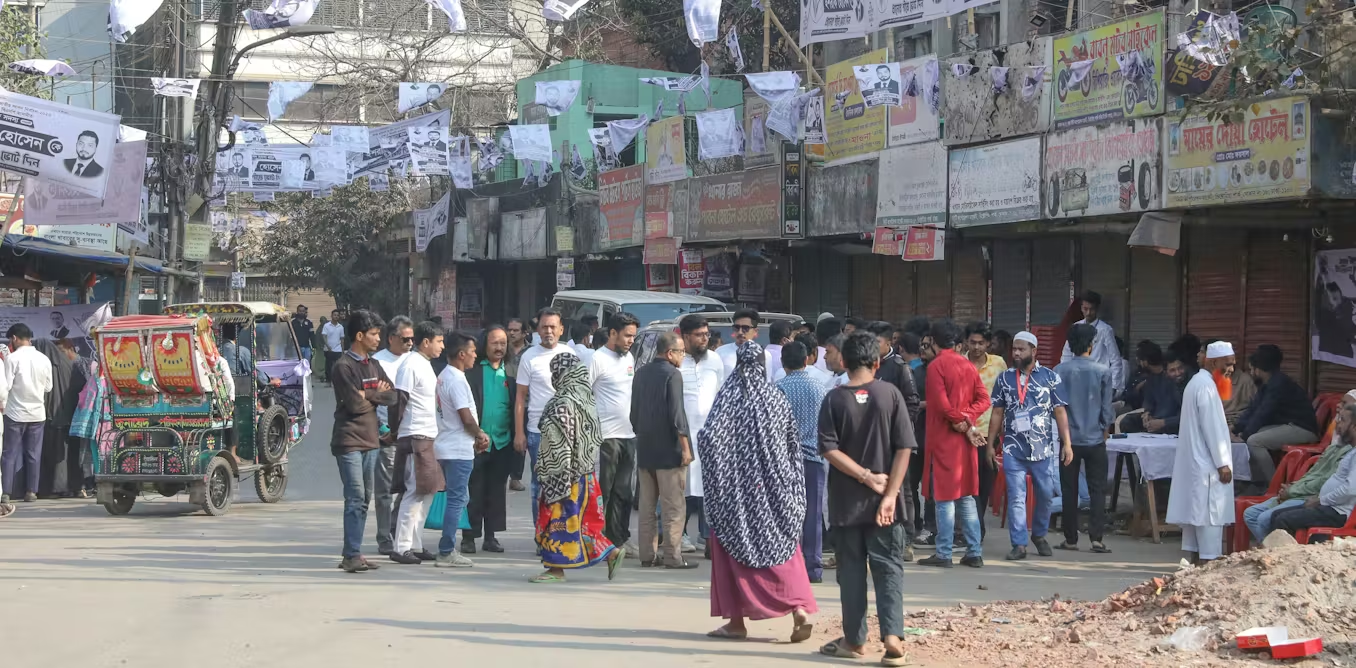
The Bangladesh Nationalist party (BNP) has won a landslide majority in the country’s first election since an uprising ended the 15-year rule of Sheikh Hasina in 2024. Results from the election commission confirmed that the BNP alliance had secured 220 seats in the 350-member parliament. The Islamist party Jamaat-e-Islami, which was banned by Hasina’s government, came second with 77 seats.
Tarique Rahman, the BNP leader who has spent 17 years living in self-exile in London, is set to assume leadership of the government. Rahman is the son of the former Bangladeshi president and BNP leader, Ziaur Rahman, and his wife Khaleda Zia, who previously served two terms as the country’s prime minister.
In its manifesto, the BNP pledged to build what it calls a “welfare-oriented and prosperous” nation. Commitments include expanded financial assistance for low-income families, strengthening the healthcare workforce, reforming education and boosting climate resilience.
Yet the party’s record is mixed. The BNP boycotted previous elections, including one in 2024, arguing they were neither free nor fair. And during earlier periods in office, the party faced criticism over corruption and governance standards. Regardless, the February 12 vote marks a political reset following one of the most turbulent periods in Bangladesh’s recent history.
Monirul Alam / EPA
The uprising in 2024 began with student protests demanding reforms to the government’s job quota system. But these protests quickly expanded into a broader movement challenging the concentration of executive power in the country. Reports from organisations such as Human Rights Watch during Hasina’s rule raised concerns about media restrictions, opposition arrests and alleged enforced disappearances.
Bangladesh’s security forces responded to the unrest violently, killing as many as 1,400 protesters in a crackdown that Hasina’s critics accuse her of ordering directly – an allegation she denies. The protests continued to swell and Hasina was forced to flee the country, entering exile in India.
An interim administration led by Nobel peace prize laureate Muhammad Yunus was formed to oversee efforts to stabilise state institutions and organise the election. The election, which also saw citizens vote on constitutional reforms aimed at preventing politicians from wielding excessive executive power again, was widely seen as a return to constitutional governance after months of provisional rule.
Banned from contesting
A defining feature of the election was that the interim administration banned Hasina’s party, the Awami League, from contesting. For decades, Bangladeshi politics has centred around rivalry between the Awami League and the BNP. So, removing the Awami League from the ballot fundamentally altered the competitive landscape.
With its principal rival excluded, the BNP became the only party with organisational capacity extensive enough to form a government. Smaller parties lacked comparable reach across constituencies, a structural absence that seems to have encouraged consolidation behind the BNP.
Voter turnout also appears to have been lower than many had anticipated for such a consequential election, with unofficial figures putting participation at 61%. In previous Bangladeshi national elections where all major political parties have participated fully, turnout has typically ranged from 75% to 80%.
Competitive democracy depends on there being a viable opposition. And excluding a major political party from contesting has complicated the interim administration’s claims of full democratic normalisation. Whether the Awami League’s absence is temporary or prolonged will shape Bangladesh’s future political stability.
The referendum on constitutional reforms, which supporters argue are necessary to prevent a return to the centralised authority seen under Hasina, passed comfortably. Eight out of ten voters backed the reforms. However, critics question whether constitutional change in the absence of the largest former governing party can fully reflect broad national consensus.
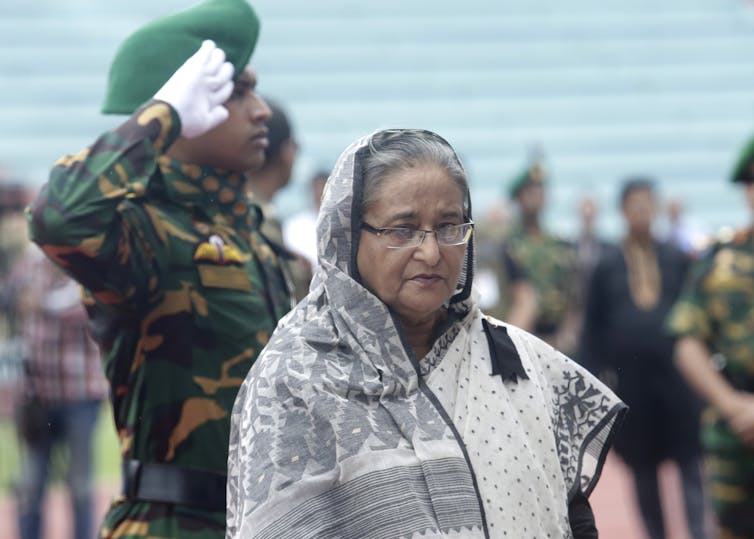
Stringer / EPA
Regional recalibration
India will have watched Bangladesh’s election closely. In recent years, ties between the two countries have sunk to one of their lowest points in decades. India is widely perceived in Bangladesh as having enabled democratic backsliding by supporting Hasina during her years in power.
That perception led to widespread anti-Indian sentiment during the 2024 protests. And reports since then of military standoffs along the border, disputes over water-sharing agreements and concerns over trade imbalances have only added to public frustration. How the new government manages its relationship with India will shape regional stability and Bangladesh’s economic trajectory.
In its manifesto, the BNP steered clear of adopting positions that might unsettle voters or concern regional players such as India. But, at the same time, it has expressed willingness to engage constructively with India on contentious issues such as border killings, insurgent activity and water sharing.
The BNP holds a powerful parliamentary mandate. But the scale of its victory should not be mistaken for unconditional endorsement. Many votes were shaped by the absence of the Awami League and by a desire for reform after a period of violence and uncertainty.
Whether this moment sets in motion a durable democratic recovery for Bangladesh or another cycle of concentrated authority will depend on how power is exercised in the years ahead.



















































You must be logged in to post a comment Login