Connect with us

NewsBeat

BBC The Apprentice candidate forced to leave show immediately after chaos

Published

on

Wales Online

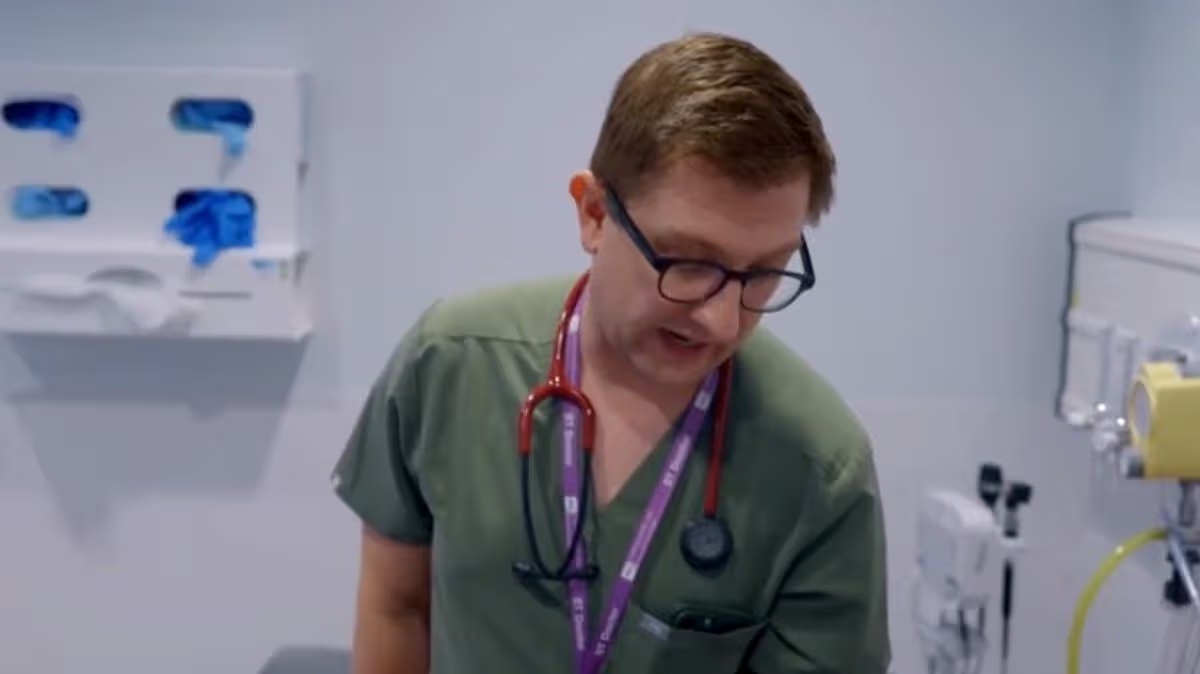
Lord Sugar didn’t hold back in another brutal boardroom showdown as one The Apprentice candidate was forced to leave.

The Apprentice: Teaser clip of contestants trying food

Another contestant has been fired from The Apprentice after a chaotic third task.

Lord Sugar’s BBC competition is well underway, with a shock double firing in the first episode after the candidates were flown out to Hong Kong.

Among those hoping for a £250,000 investment into their business are a Geordie Shore star and the owner of a photobooth company.

In tonight’s episode, a fourth candidate was eliminated from the boardroom after a chaotic challenge.

Advertisement

The contestants had been tasked with a plan to turn poultry into profit, as one team were given 25 kilos of chicken and the other given 25 kilos of eggs. Both teams were asked to create a dish to serve to the public, as well as meet a corporate client looking to place a bespoke order of canapes which the candidates had to prepare and serve at an event.

READ MORE: Strictly Come Dancing star’s ‘personal beef’ with Britain’s Got Talent exposedREAD MORE: Channel 4 999 What Happened Next mum emotional as she forgives daughter’s killer

Advertisement

In teaser clips for the episode ahead of it airing, one team caused chaos in the kitchen as they attempted to cook a carbonara sauce without being able to taste eggs, cheese and pork, leaving them all grimacing at the taste. Another saw the same team fail at simple mathematics, confusing 5g of flour for 1.5kg.

However, despite their kitchen antics, it was a negotiation with a corporate client that left a team failing.

Tanmay, Megan and Carrington found themselves in the firing line, with team leader Carrington blaming the loss on low negotiation, and Tanmay and Megan battling it out for another week.

After securing the low deal, Tanmay became the fourth candidate to leave the competition, later admitting his firing was “unfair”.

Advertisement

He shared: “Ultimately, I am disappointed for it to end this way. When we went into the negotiation, I was looking forward to it, I see negotiation as an art form, but that negotiation didn’t become a very nice piece of art. Karishma started with a monologue which set the tempo and then Megan came through and set the price ceiling by saying £12, and I shook the hand on £11.80 trying to salvage it.

“I did take the bullet in the boardroom and I do think it was unfair. But you win some and you lose some and I can’t do much about it now!”

He went on to say he didn’t believe he deserved being fired, adding: “I think at the time, sitting in the boardroom, it was a lot closer and I remember in the moment thinking it could probably go either way between myself, Megan and Carrington.

Advertisement

“You could have even put an argument forward for Karishma and Andrea but in the boardroom, I was there, and I tried to keep composed but I do think it was unfair.”

For the latest showbiz, TV, movie and streaming news, go to the new **Everything Gossip** website

Speaking of his experience on the show, Tanmay added: “I have learnt that I can probably do anything now. I think I was already confident, but it has given me more confidence that I can do anything I want to do. I can put my mind to it and do it. It has also given me the confidence in my ability to work with people of different backgrounds and temperaments, as you know, some are fierier than others. It was good to handle big personalities.

Advertisement

“I also learnt that I am good at reading people and building rapport. Although the process taught me that there are moments where leadership means pausing the room when momentum is moving too fast, especially when decisions affect value.”

The Apprentice continues on BBC One and BBC iPlayer on Thursdays at 21:00, with The Apprentice: Unfinished Business airing straight after on BBC Two and BBC iPlayer.

Source link

Advertisement
Continue Reading
Click to comment

Leave a Reply

Your email address will not be published. Required fields are marked *

NewsBeat

Nations League draw in full: England handed Spain reunion in tough group

Published

on

Nations League draw in full: England handed Spain reunion in tough group

World Cup-bound Scotland will play Switzerland, Slovenia and North Macedonia in Group B1 of the 2026/27 Nations League after their relegation from League A that followed a dismal play-off loss to Greece, while Wales face Portugal, Norway and Denmark in Group A4 after being promoted last time around.

Source link

Continue Reading

NewsBeat

it’s important to ask why politicians want to sort people into categories

Published

on

it’s important to ask why politicians want to sort people into categories

For Reform parliamentary candidate and former academic Matt Goodwin: “Englishness is an ethnicity that is deeply rooted in a people that can trace their roots back over generations.” By contrast, he argues, liberal progressives believe “anybody can be English as long as they sign a piece of paper and identify with Englishness.”

This is not a novel definition, and for some, it may be completely uncontroversial. It’s not surprising that some people living in England can trace their ancestors back many generations.

But attempting to define a particular “ethnicity” is also an attempt to determine who is (and who is not) part of a given group. Policing these boundaries has serious consequences.

The idea of essential groups

To speak of an identity as one that can be traced “back over generations”, is to speak of human reproduction and generational transmission. These are central ideas in how, historically, people have been categorised into racial groups.

Advertisement

The biological sciences have a long history of dividing humans up. Take 18th-century Swedish biologist Carl Linnaeus’s Systema Naturae, the most influential attempt to classify the natural world, and the basis of contemporary zoological nomenclature. Linnaeus subdivided humans into four varieties that many of us would balk at today and has no basis in modern science: white Europeans, reddish Americans, tawny Asians, and blackish Africans.

In the centuries since, the number of groups has changed, as well as the language used to describe them. But the idea that we can inherit some innate qualities via generational inheritance – essentialism – underwrites these influential ideas. Essentialism would have it that you’re born as part of a group and all the “identifying” in the world cannot change that.

These divisions can also generate a sense of entitlement to certain rights or resources for one group over another. They have been used to justify violence, discrimination – some of the most shameful moments in human history. Indeed, racial essentialism became so dangerous that Unesco published a series of statements to flag the dangers of the impulse to divide ourselves like this.

The limits of categories

The world is in a constant state of push and pull. People move or are moved, for all kinds of reasons all the time. They settle and reproduce in different places. This is an empirical truth that limits the utility of essentialist ideas.

Advertisement

Essentialist thinking requires us to say both where, and when, we are from. Some will find it quite straightforward to demonstrate membership of a particular group but others will not. Many of us won’t be able to say that all of our ancestors (as far back as history allows us to trace) were all born in England.

Dame Kelly Holmes was part of Gove’s discussion with Goodwin.
Alamy

Take Dame Kelly Holmes. She was one of the public figures Spectator editor Michael Gove mentioned when he interviewed Goodwin on this and other subjects. He asked: “Would you say that [she is] not really English?” Holmes is mixed race (a term that also leans on the idea of essential categories that somehow merge). She served in the army, won gold medals for England and Great Britain and received the honorific of Dame. But if only some of her “roots” can be traced “back over generations”, then does she not qualify as English?

Many of us will confound the groups that we are made to squeeze into because, ultimately, our roots long predate contemporary ideas of nation, identity and group.

Why do people invoke these ideas?

For me, what’s important here is not disproving the essential existence of groups, but trying to trace why they are being mobilised. Why do politicians want to define these categories?

Advertisement

Groups, identities and communities are made and remade. We come to feel a part of a collective. And this feeling is generated often in ways that seem somehow naturally occurring. We pray at the same place of worship; we listen to the same kinds of music. But our affiliations to particular groups do not exist in the wild.

Michael Gove interviews Matt Goodwin.

Categories have social power. When you define a collective, it makes it possible to speak to that collective and to mobilise it. Collectives can be delineated in more and less definitive ways. Essentialist thinking is some of the most definitive and inflexible of all. At its worst, those outside a group are denied access to respect and safety.

So, why distinguish between those who belong and those who do not? Why debate whether public figures with ancestors born elsewhere, but born and raised in England, are “actually” English? Why evoke (but not invoke) essentialised ideas of race, using words like ethnicity?

Advertisement

And if we know that cultivating boundaries of belonging can generate a sense of entitlement, then who risks being denied access, and to what? In a period of economic difficulty when public resources are already stretched, what is the next logical step after enough people can be made to agree on a clear definition of who is or is not English?

The essentialist claims we are hearing in the UK are not new, but they are powerful. So when politicians like Goodwin assert a desire to open a public debate on the categories they have selected – and even defined – we have to ask what purpose it serves.

Source link

Advertisement
Continue Reading

NewsBeat

Goldman Sachs’ top lawyer to resign after release of Epstein emails

Published

on

Goldman Sachs' top lawyer to resign after release of Epstein emails

NEW YORK (AP) — Kathy Ruemmler, the top lawyer at storied investment bank Goldman Sachs and former White House counsel to President Barack Obama, announced her resignation Thursday, after emails between her and Jeffrey Epstein showed a close relationship where she described him as an “older brother” and downplayed his sex crimes.

Ruemmler said in a statement that she would “step down as Chief Legal Officer and General Counsel of Goldman Sachs as of June 30, 2026.”

Up until her resignation, Ruemmler repeatedly tried to distance herself from the emails and other correspondence and had been defiant that she would not resign from Goldman’s top legal post, which she had held since 2020.

While Ruemmler has called Epstein a “monster” in recent statements, she had a much different relationship with Epstein before he was arrested a second time for sex crimes in 2019 and later killed himself in a Manhattan jail. Ruemmler called Epstein “Uncle Jeffrey” in emails and said she adored him.

Advertisement

In a statement before her resignation, a Goldman Sachs spokesperson said Ruemmler “regrets ever knowing him.”

In her statement Thursday, Ruemmler said: “Since I joined Goldman Sachs six years ago, it has been my privilege to help oversee the firm’s legal, reputational, and regulatory matters; to enhance our strong risk management processes; and to ensure that we live by our core value of integrity in everything we do. My responsibility is to put Goldman Sachs’ interests first.”

Goldman CEO David Solomonsaid in a separate statement: “As one of the most accomplished professionals in her field, Kathy has also been a mentor and friend to many of our people, and she will be missed. I accepted her resignation, and I respect her decision.”

During her time in private practice after she left the White House in 2014, Ruemmler received several expensive gifts from Epstein, including luxury handbags and a fur coat. The gifts were given after Epstein had already been convicted of sex crimes in 2008 and was registered as a sex offender.

Advertisement

“So lovely and thoughtful! Thank you to Uncle Jeffrey!!!” Ruemmler wrote to Epstein in 2018.

Historically, Wall Street frowns on gift-giving between clients and bankers or Wall Street lawyers, particularly high-end gifts that could pose a conflict of interest. Goldman Sachs requires its employees to get preapproval before receiving or giving gifts from clients, according to the company’s code of conduct, partly in order to not run afoul of anti-bribery laws.

As late as December, Goldman CEO David Solomon described Ruemmler as an “excellent lawyer” and said she had his full faith and backing.

Advertisement

Source link

Continue Reading

NewsBeat

The PS5 State of Play was filled with great games but too few were made by Sony

Published

on

The PS5 State of Play was filled with great games but too few were made by Sony
Kena: Scars Of Kosmora is published by Sony but they aren’t making it (Sony Interactive Entertainment)

GameCentral offers an overview of Thursday night’s State of Play and is disappointed at the lack of new first party game announcements.

Despite almost every State of Play, for the last several years, being a disappointment there was plenty of optimism left for the one on Thursday night, not least because it promised to be the longest one ever, outside of Sony’s not-E3 showcases.

Viewed from a distance it was very good, with a lot of exciting new games, but the one thing it was missing was anything new made by any of Sony’s internal, first party developers.

There weren’t many Sony published games of any kind but the few that were featured had either been announced previously or were made by external third party studios (well, technically we don’t know who’s making the God Of War remake trilogy but it’s unlikely to be Santa Monica Studio).

Advertisement

Without wanting to go over all ground all this stems from the fact that, a couple of years into the current generation, Sony suddenly got it into their heads that all their studios should pivot from primarily single-player games to making live service titles.

That proved to be a complete disaster and while it’s assumed that they’ve since reversed course they’ve never actually said so. Sony hardly talks about anything in the open anymore but while some optimists theorise that they have seen sense it takes at least five years to make a triple-A game and so there’s been chance yet for the change of plan – if it actually happened – to bear fruit.

Expert, exclusive gaming analysis

Sign up to the GameCentral newsletter for a unique take on the week in gaming, alongside the latest reviews and more. Delivered to your inbox every Saturday morning.

Advertisement

The PlayStation 5 is six years old this year and most Sony studios have only released one game on the console. Some, like Days Gone maker Bend Studio, haven’t made anything new for the format at all. Even Naughty Dog hasn’t produced anything but remakes and remasters so far.

We’ve currently no clue what Bluepoint Games, Team Asobi, Polyphony Digital, or Media Molecule are working on at the moment (you can guess but they’ve not announced anything). Even Santa Monica Studio is a mystery as they only seem to be overseeing the two new God Of War games and haven’t announced a new title themselves since 2022’s Ragnarök.

Advertisement

Any hope that Sony would allow a peek behind the curtain during the latest State of Play was quickly dashed, with the vast majority of games being third party. Sony is publishing some of these, such as Kena: Scars Of Kosmora – a sequel to 2021’s not very good Kena: Bridge Of Spirits – but they’re not made by any of their internal studios.

Sucker Punch did unveil free DLC for Ghost Of Yōtei, but while Marathon, Saros, and Marvel Tōkon: Fighting Souls (which is not made by an internal developer) all looked good they’d already been announced some time ago. So we really learnt very little about what Sony themselves are planning for the future.

At this point it seems clear there’s never going to be a big unveiling of multiple new first party titles. The E3 days of three or four new games being announced at once are gone and this State of Play was perhaps the final proof of that.

Advertisement

That leaves a gaping hole in the PlayStation 5’s armoury but the only thing to do is take solace in the third party games that were showcased instead.

The John Wick game looked promising and the tsunami of Konami announcements was great, even if we wish the new Castlevania game had been a bigger budget 3D title.

Advertisement

Legacy Of Kain: Defiance Remastered was a surprise, as was current gen remaster Dead Or Alive 6: Last Round. Control: Resonant looked great (non-humanoid enemies in a Remedy game, at last!), Crimson Moon seemed promising, and the Rayman remaster continues to seem a very strange idea – given it wasn’t very good even 30 years ago.

Yakoh Shinobi Ops appeared to be a cross between Tenchu and Shadow Tactics: Blades Of The Shogun and, like Krafton’s bizarre chicken monster game Project Windless, seems to be a self-imposed PlayStation console exclusive.

With new looks at Star Wars: Galactic Racer and 007 First Light as well it was a good State of Play, it’s just that there was very little about it that was exclusive to PlayStation and nothing that suggested Sony’s first party output is ever going to ramp up beyond just one or two new games a year.

Crimson Moon screenshot of the main character
Crimson Moon isn’t exclusive to PlayStation 5 (ProbablyMonsters)

Email gamecentral@metro.co.uk, leave a comment below, follow us on Twitter.

To submit Inbox letters and Reader’s Features more easily, without the need to send an email, just use our Submit Stuff page here.

Advertisement

For more stories like this, check our Gaming page.

Advertisement
Advertisement

Source link

Continue Reading

NewsBeat

NSPCC reveals 8,000 children in region with alcoholic parent

Published

on

NSPCC reveals 8,000 children in region with alcoholic parent

This figure is part of a wider national concern, with 73,250 children in England who were subject to a Child in Need assessment identified as having a parent who misused alcohol.

Kam Thandi, NSPCC Helpline director, said: “Most parents and carers who drink alcohol do so in moderation, which doesn’t present an increased risk of harm to their children.

“However, when they take it in large quantities over a long period of time it can lead to abuse and neglect with serious consequences for their future.”

Advertisement

The NSPCC also reported receiving 9,192 contacts relating to concerns about parental substance misuse.

Reports included people reporting hearing arguments and furniture being thrown, seeing parents inebriated and collapsed, and children appearing dirty and neglected.

The charity shared its data during Children of Alcoholics Week, which runs from February 8 to 14 and is led by the National Association for Children of Alcoholics (Nacoa).

Hilary Henriques, chief executive of Nacoa, said: “Every child deserves to live a creative and meaningful life.

Advertisement

“Sadly, when alcohol is the family secret, children are more likely to experience difficult situations with family violence, neglect, and other problems.”

Children and adults affected by parental drinking are encouraged to reach out for help.

Childline is available 24 hours a day on 0800 1111, while Nacoa UK can be contacted on 0800 358 3456.

Advertisement

Source link

Continue Reading

NewsBeat

Violet at Dogs Trust Darlington is looking for forever home

Published

on

Violet at Dogs Trust Darlington is looking for forever home

Violet has been in the care of Dogs Trust Darlington since May last year after being found as a stray.

Vets discovered she had bilateral mild hip dysplasia and a luxating patella, an issue which was causing problems with her knee. 

While in Dogs Trust care, Violet underwent successful patella surgery, received regular physiotherapy and has since recovered well.

The four-year-old was found as a stray and has been at the charity since last May (Image: DOGS TRUST DARLINGTON)

The four-year-old also had her ears cropped before coming into the charity’s care. Dogs Trust described the procedure as “cruel and unnecessary”.

Advertisement

Following her operation, “playful” Violet is now ready for adoption.

Nikki Holroyd, manager at Dogs Trust Darlington, said: “Violet is such a special dog, we all adore her. It’s impossible not to fall for her charms when you meet her. 

“Everything she’s been through – surgery, physiotherapy, vet visits – she has taken in her stride, with her happy nature and zest for life. 

“Now Violet is available for adoption, we can’t wait for her to find her forever family as she has so much love to give. Violet is eager to please, and is a big foodie, so she is keen to learn when a treat is offered.  

Advertisement

“She is very playful and is a big fan of toys. She loves to prance around carrying a soft toy, which she has great pride in showing off to everyone she meets.

Violet with one of her many toys (Image: DOGS TRUST DARLINGTON)

“Violet will also happily entertain herself with her toys and loves to snooze with a soft toy in bed.”

Dogs Trust Darlington said Violet is looking for her forever home where she is the only pet.

She could live with older children and would love a garden where she could relax and play.

Advertisement

The Pocket American Bully is still receiving physiotherapy following her operation, which will be shown to adopters so it can continue at home.

If you would like to see Violet and the rest of the dog’s waiting to meet their special someone, you can do so by visiting: www.dogstrust.org.uk/darlington.

Source link

Advertisement
Continue Reading

NewsBeat

Knifeman who killed pal in attack at flats in Port Glasgow jailed for nine years

Published

on

Daily Record

Lewis Mullen was handed an extended 11-year sentence after a jury found him guilty of killing Jack Trainner, 27, near his home in Port Glasgow, Inverclyde.

A 25-year-old man who killed his friend in a knife attack outside his victim’s flat has been jailed for nine years at the High Court in Dundee.

Advertisement

Lewis Mullen was handed an extended 11-year sentence after a jury found him guilty of killing Jack Trainner, 27, near his home in Port Glasgow, Inverclyde. The jury accepted there had been provocation during a row between the friends on April 27 2024 and cleared Mullen of the more serious charge of murder.

However, they rejected his claim that he had acted in self-defence and that he had been carrying the large knife to gut fish. The court heard he had two previous convictions for carrying weapons and the two-year extension was added because he was assessed as posing a high risk to the public.

Lord Renucci told Mullen: “The trial has shown not just that you are prepared to carry a weapon in a public place, but also that you are someone who is prepared to use that knife. Had you not left your house with a knife and removed it from your rucksack, and followed him armed with the knife into flats, then this offence would not have occurred.

“You claimed you were carrying the knife for fishing and you saw no issue with this. You might not see an issue with it, but the court and society does. You were not fishing when you went out to source drugs. No-one requires a blade that size to gut fish. It is disappointing that one thing missing in the report is any real expression of remorse.

“It highlights your propensity to carry weapons. I have read victim impact statements from the victim’s mother and ex-partner on behalf of his children. You should be under no illusion about the scale of their loss and the lifelong impact upon them.”

Counsel for Mullen, Thomas Ross KC, said his client had been “self-medicating” by taking drugs and was under the influence of street valium at the time of the attack. Mullen attacked Mr Trainner by repeatedly stabbing him on the knife and body. The trial heard that Mr Trainner had pulled out a knife initially.

The court had heard how the men would sometimes meet up to play video games together. Mullen said he turned up at Mr Trainner’s flat on the day of the killing in April 2024 thinking “it would be like any other time and he would invite me in”.

Advertisement

But he added: “When I knocked, I could see that he was aggressive right away”. A struggle then spilled outside before Mullen followed Mr Trainner back into the common close of the block of flats.

The killer said his victim went at him with a knife before Mullen struck him with a purple-bladed weapon that he had in rucksack. Mullen said he believed he had only struck his friend once in the chest, but it emerged he also had a cut near his eye.

Asked by his KC Thomas Ross how long he had to “assess his options” that day, he replied: “Seconds – it all happened so quickly”. He said he believed that, had he turned his back, he would have been stabbed.

Advertisement

Mullen left the scene, but later handed himself in to police after he discovered Mr Trainner had died. During the trial, prosecutor Wojciech Jajdelski asked Mullen why he had not simply “walked away” after they had gone outside.

He replied: “We were friends. This was not the Jack I knew. I thought I could calm him down.” After the verdict, the court was told Mullen had a number of previous convictions, but had never previously received a prison sentence.

Source link

Advertisement
Continue Reading

NewsBeat

Strike called at Everton steel maker Severfield in Bolton

Published

on

Strike called at Everton steel maker Severfield in Bolton

Staff at the Severfield PLC site in Lostock are walking out next week after not being given a bump in pay by bosses, according to the GMB union.

It says that more than 90 per cent of GMB members at the site, working as welders, platers and machine operators, voted in favour of strike action.

The company, which has provided the steel work for iconic projects like the Shard and the new Everton stadium, says it suffered a loss and won’t provide a pay rise.

GMB members have been conducting an overtime ban this week, and will start with one full day of strike action next Monday, February 16, followed by two full days of strike action the following week, on February 23 and 24.

Advertisement

Over 100 workers at a steel firm are set to strike (Image: Google Maps)

GMB regional organiser John Weir said: “No worker anywhere deserves to be offered literally nothing.

“GMB members at Severfield do highly skilled work, in an industry where such talent is in short supply.

“Severfield is a huge company, with revenues of nearly half a billion pounds.

“Regardless of losses in a single year, that workers should shoulder the burden is unacceptable.

Advertisement

“GMB has provided a range of options to settle this dispute, but Severfield continues to say zero per cent is their final offer, so our members are left with no choice but to strike.”

Severfield declined to comment.

Source link

Advertisement
Continue Reading

NewsBeat

Victoria Beckham’s 45p-a-day diet secret that boosts weight loss and gut health

Published

on

Daily Mirror

Victoria Beckham is among the many celebs that use this kitchen staple to boost gut health and weight loss, as well as Cheryl Tweedy, Katy Perry and Megan Fox.

Advertisement

One of the most talked about additions to modern wellness routines is apple cider vinegar. But long before it was trending on social media, it was a simple kitchen staple.

Now, thanks in part to celebrity fans including Victoria Beckham and Cheryl Tweedy, it’s in the spotlight as a health supplement. Victoria previously told followers on Instagram that she starts each day with two tablespoons of it on an empty stomach.

The mother of four posted a picture of a large bottle in her story and wrote: “Be brave! Two tbsp first thing on an empty tummy!” Cheryl also shared that she drinks it when she spoke about her workout plan and diet with Dermot O’Leary on his Radio 2 show.

READ MORE:

Advertisement

For those curious to try it, the addition to daily routines can cost as little as 45p a day, based on a tablespoon from a £15 bottle from Manuka Doctor. The actual science behind apple cider vinegar (ACV) is that it’s made by fermenting apples, a process that converts natural sugars into acetic acid.

It’s this compound that researchers believe is linked to many of its potential benefits. Raw and unfiltered versions contain what’s known as “the mother”: the cloudy strands made up of enzymes, proteins and beneficial bacteria. There is growing research around ACV’s role in supporting digestion, helping to maintain balanced blood sugar levels after meals and, when paired with a healthy diet, potentially aiding weight management.

The Apple Cider Vinegar with Manuka Honey is available from Manuka Doctor

Content Image

£20

£15

Advertisement

Manuka Doctor

Buy here

The addition of honey softens the sharp taste, making it easier to drink diluted in water, while still containing the naturally cloudy “mother”.

Nutritionists often stress that if people choose to use it, opting for a raw and unfiltered version is key. “To get the full digestive benefits, it is important to consume raw and unfiltered apple cider vinegar containing ‘the mother,’ ” said Sarah Dumount-Gayle, BANT CNHC Registered Nutritionist.

One option currently attracting attention is Manuka Doctor’s Apple Cider Vinegar range, which blends raw, unfiltered ACV with 300 MGO Manuka honey. The addition of honey is said to soften the sharp taste, making it easier to drink diluted in water, while still containing the naturally cloudy “mother”.

The brand offers several variations, all priced at £15 for a 500ml bottle, which works out at around 45p per tablespoon. These include a classic apple cider vinegar with Manuka honey, a ginger infused version, and a blend with turmeric and long pepper.

There is also a “Fat Metaboliser” option containing added choline and vitamins B5 and B12, as well as a raw and organic version made from apples grown in Hampshire. There is also a 100% Organic Apple Cider Vinegar for £5 which does the same, but does not contain honey.

Now, for some alternatives, there is also the Holland & Barrett Apple Cider Vinegar 250mg with the Mother Apple Flavour 60 Gummies for £8.39 down from £13.99. Each daily dose of this one is said to deliver 500mg of apple cider vinegar, along with ginger rhizome extract. However, this does not come with the added benefits of Manuka Honey.

Back to the Manuka Doctor Apple Cider Vinegar and Manuka Honey, one person said: “I liked this product , firstly I trust the brand , secondly mixing apple cider vinegar with Manuka honey have a great health benefits and I am using it to make a salad dressing.”

Another wrote: “It’s really tasty. I add it to cordial drinks and different foods. It’s fantastic I buy it regularly and I recommend others to do the same.” Not every product will be loved by everyone and some did remove a star, for example, one said: “An acquired taste, but delighted with my purchase as it was on promotion.”

Overall though, most people were pleased: “Good to take with a cold, good mixture with honey. I also love the Manuka honey which especially helps with sore throat.” Another added: “Fantastic product for my health. I drink by the morning, just a spoon with warm water, I used with in my salads and sauces, I sincerely I recommend you to use and you see the benefits with your body, start slimming, Fantastic!”

Advertisement

Source link

Continue Reading

NewsBeat

MPs back calls for Maya’s Law parliamentary debate

Published

on

MPs back calls for Maya’s Law parliamentary debate

Defenceless Maya, two, died in Newcastle’s RVI days after being violently shaken by her mother’s new partner, Michael Daymond, at their home in Shotton Colliery in September 2022.

Daymond was later jailed for life, while Maya’s mother, Dana Carr, received a nine-year sentence for allowing her daughter’s death.

Maya Chappell (Image: FAMILY)

In September last year, Maya’s great aunts, Gemma Chappell and Rachael Walls, set up the Maya’s Law campaign, looking to bring in a Child Risk Disclosure Scheme (CRDS), which would allow families to request information about a partner or caregiver’s violent or abusive history, similar to Clare’s Law and Sarah’s Law.

At the end of January, a petition set up by her family for a change in the law hit more than 110,000 signatures, meaning it will now be considered for a debate in parliament.

Advertisement

While surpassing 100,000 signatures does not automatically secure a debate, it means the Petitions Committee must now consider allocating Parliamentary time.

Maya Chappell (Image: FAMILY)

For the family, that decision is the next crucial hurdle.

In the latest update, MPs from across the region paid tribute to Maya’s great aunts, Gemma and Rachael, whose “relentless campaigning” has propelled the issue from local tragedy to national political agenda.

Liz Twist, MP for Consett and Blaydon, said she was “absolutely delighted” the petition had gone “well above the 100,000 signatures mark”, crediting the pair with “moving heaven and earth” to make it happen.

Advertisement

Consett and Blaydon MP, Liz Twist (Image: PARLIAMENT)

“That’s only happened because of their tireless work day and night,” she said.

Ms Twist confirmed she would work with the family ahead of any potential debate “to carry on making the very best case in Parliament to make Maya’s Law and stronger child protection measures a reality.”

Mary Kelly Foy, MP for the City of Durham, described the breakthrough as “absolutely amazing news”, stressing that surpassing 100,000 signatures ensures the petition will now be considered for Parliamentary debate.

Mary Kelly Foy, MP for City of Durham (Image: PARLIAMENT)

“It’s no exaggeration to say that this petition has only reached this level thanks to the hard work of Gemma and Rachael,” she said.

Advertisement

“They have given everything to reach this milestone.”

But she warned that the real test lies ahead.

“It’s vital that we keep this discussion going in Parliament and ensure that Maya’s Law remains on the agenda,” she added, pledging her continued support to strengthen child protection laws.

Sam Rushworth, MP for Bishop Auckland (Image: PARLIAMENT)

Sam Rushworth, MP for Bishop Auckland, said his thoughts remained with Maya’s family and praised their “immense courage in campaigning for change after such a devastating loss”.

Advertisement

He said he “wholly supports the issue of child safeguarding failures receiving proper parliamentary scrutiny” and welcomed the opportunity for it to be debated so “lessons can be examined and improvements considered”.

“It is vital that Parliament listens carefully to families’ experiences and ensures our systems are doing everything possible to protect children,” he added.

At the heart of the proposed legislation is the creation of a Child Risk Disclosure Scheme (CRDS), which would allow families to request information about a partner or caregiver’s violent or abusive history.

Gemma Chappell and Liz Twist (Image: SARAH CALDECOTT)

It would also introduce mandatory information sharing between police, health, social care and councils, strengthen multi-agency safeguarding protocols and give professionals clearer powers to raise alerts or trigger court action.

Advertisement

Campaigners argue that such measures could close dangerous gaps in the current system, gaps they believe failed Maya.

Maya’s great aunt, Gemma Chappell, has urged MPs locally and nationally to ensure the issue reaches the Commons chamber and has thanked those MPs who have already given the family their support

“100,000 people have now given Maya a voice,” she said.

“But now is the time for MPs to step up.

Advertisement

“MPs give us so much support. With ministers seemingly pushing the School and Wellbeing Bill, we need the support of every MP.”

While Maya’s family has hailed the strength of support across North East MPs, there is a level of “anxiety” and “apprehension”, given that 100,000 signatures doesn’t guarantee a Parliamentary debate.

“It does make us uneasy that the debate could still not happen,” Gemma added.

“There are definitely gaps there. No matter what the government do, it’s not going to stop us.

Advertisement

Gemma ChappelL, Great Aunt of Maya Chappell (Image: SARAH CALDECOTT)

“This campaign is about giving Maya the voice she never had.

“We’re not naive to think that things can change overnight, but we must try to change the tide for other families who have been through the same.

“There is a mountain to climb, but we won’t stop until we get what we want and get change.”

Gemma has also called on Prime Minister Sir Keir Starmer to meet with the family and other bereaved families to make a case for a law change.

Advertisement

While the government’s target is seemingly to move forward with the multi-million-pound Children’s Wellbeing and Schools Bill, Gemma says that she wants to work with the government to make some amendments and “protect children from falling through the cracks”.

But, with the support of MPs across the North East, it has given Gemma hope of securing a debate.

Emma Lewell, MP for South Shields and a former children’s social worker, said she “wholeheartedly” agrees there are gaps in the current safeguarding system and backed the four policy proposals put forward under Maya’s Law.

“There is nothing more heartbreaking than the death of a little one,” she said.

Advertisement

“The family are right that current legislation is highly restrictive on professionals’ ability to share information and data, which could identify safeguarding concerns early on and avoid the loss of another precious little life.

“We should be doing all we can to protect children.”


Kate Osborne, MP for Jarrow and Gateshead East, said Maya and her family were “failed by the system” and gave her full backing to calls for the proposed law to be brought forward.

“Too often, we see failures in information sharing between agencies,” she said.

Advertisement

“Maya’s Law would ensure that safeguarding agencies fulfil their obligations and close the gaps in the current system to ensure no child slips through the cracks.”

Maya’s Law proposes four key changes:

  • A Child Risk Disclosure Scheme (CRDS) allows families to request risk history information about caregivers or partners
  • Mandatory information sharing between police, health, and social care agencies
  • Stronger multi-agency protocols, particularly in cases involving custody or unsupervised access
  • New safeguarding powers for professionals to raise alerts or trigger court action, even without an active investigation

Source link

Continue Reading

Trending

Copyright © 2025