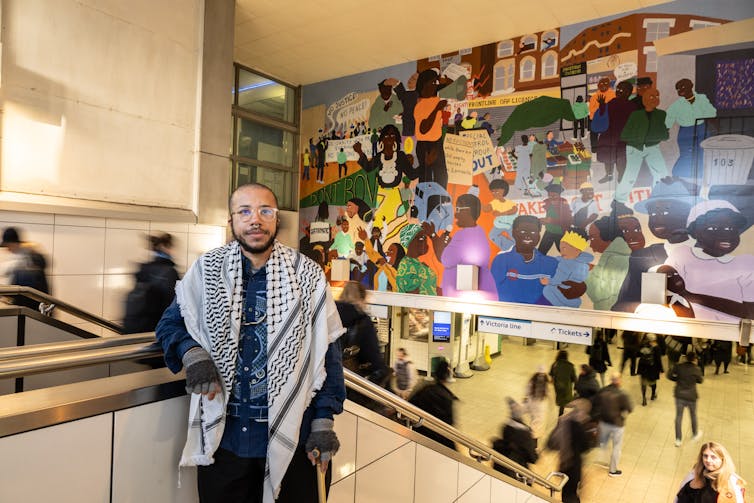
Rudy Loewe’s arresting mural The Congregation sits above the entrance to Brixton Underground station in London. The large-scale painting highlights the people and places that have shaped the area’s history over the last 75 years. It serves as a gateway into Brixton’s past and present for locals and the estimated 22 million passengers that transit through the station every year.
The Congregation is the ninth artwork in the Art on the Underground mural programme since 2000, and has been commissioned specially for Brixton tube station. Loewe is a multidisciplinary artist who blends painting, drawing and sculpture to bring aspects of history to life, unearthing histories through archival research and interviews.
Using bold and colourful imagery, the mural captures the rhythm of the everyday, showing myriad scenes, from intergenerational families to civic resistance. The viewer can move between scenes to form their own unique narrative with the mural. In some ways, it acts like a living family album for the local community.
Situated in south London, Brixton began as a wealthy Victorian commercial hub and is best known today as the symbolic heart of the UK’s Caribbean community. In 1981, the oppressive use of “Operation Swamp 81” and “sus” (suspected person) laws which affected Black youth, led to the 1981 Brixton uprising against police brutality, referred to in the media as the Brixton riots.
Angus Mill Photography
The mural is the result of Loewe’s research from Lambeth, London and TfL archives, as well as interviews with figures who feature in the mural and the artist’s own experience of the area. The mural cements Brixton’s historic role as a dynamic and important gathering space, particularly for Black communities.
Through 20 vivid scenes, viewers are immersed in a rich sensory landscape of Brixton over the years. From the Windrush generation, who arrived in the late 1940s, to the Frontline off-licence, a key site during the 1981 uprising, the mural captures people and places that have shaped and continue to reflect and alter the area.
One such figure is Marcia Rigg, sister of Sean Rigg who died in police custody at Brixton police station in 2008 while experiencing mental ill health. Rigg is a leading campaigner for the United Families & Friends Campaign, working alongside other families whose loved ones have died while in police custody, prison or mental health facilities.
She has been instrumental in the development of the Inquest Skills and Support Toolkit, a resource for those bereaved by a death in state custody. Loewe is conscious not to sanitise the tensions that exist, while also making it clear that “alongside grief and resistance … there is joy and sensuality” at the same time.
A living archive
Significantly, the mural also extends to marginalised voices of the Black community in Brixton and its surrounds. During the mid 1980s, Black lesbians faced isolation as they were often shut out of white queer spaces and faced homophobia within Black women’s circles.
In response to this exclusion, Eddie Lockhart and Yvonne Taylor formed Sistermatic, a Black lesbian-run sound system (which originated in 1940s Jamaica, where DJs loaded up flatbed trucks with enormous speakers, turntables and a generator to provide the music for a street party) and which features on the lower left of the mural.
For nearly a decade, Sistermatic was based at the South London Women’s Centre on Brixton’s Acre Lane. This venue functioned as a dual sanctuary: a site of communal celebration for Black lesbians, and a critical refuge for young Black queer teenagers facing homophobia. To ensure the space remained truly inclusive, the collective prioritised accessibility, offering a sliding scale for entry fees and providing a crèche for mothers.
Loewe’s research highlights that working with archives requires navigating different forms of memory and knowledge. While institutions like Lambeth Archives hold physical records, groups like Sistermatic operated on the margins of both white and Black society and left behind almost no physical archive. The sound system exists primarily as an embodied archive carried by its founders and the women who attended.
By translating these memories into visual form, Loewe performs a crucial act of restorative archiving, giving material permanence to a movement that was largely held within the collective memory of its participants. Loewe ensures that the ephemeral joy of the dancefloor is not lost simply because it was not documented on paper.
Ultimately, the power of The Congregation lies in its ability to make space for different forms of knowledge, placing the weight of institutional record alongside the embodied histories of the community. Loewe refuses to simplify this history, instead capturing the complex simultaneity where grief and political resistance coexist with joy and togetherness. It is the artist’s hope that the mural will spark new community engagement, something I experienced firsthand.
Inspired by the work, I visited Lambeth Archives for the first time to locate the Frontline off-licence documents. When I asked the archivist, she simply replied she would fetch her colleague who was there during the 1981 Brixton uprising. This interaction resonates the power in Loewe’s work, reminding us that the archive is not just a repository of the past, but a living network of people who continue to shape the present.