Some of the items were recovered from the brothers’ address
Two brothers have been jailed for two separate break-ins in Cambridge. Daniel and Piotr Zajechowski were identified using CCTV footage after two separate burglaries last year.
Advertisement
On May 17, the brothers broke into a garage in Austin Court. They stole a Winther Kangaroo cargo bike worth £1000 as well as tools, an electric bike pump, and a security camera they removed from the wall.
On September 14, they broke into a property on Grange Road. They stole a laptop, Garmin watch, headphones and cash.
After the pair were arrested, the laptop and watch were found at their address in Wilson Close. At Cambridge Crown Court on Wednesday, January 28, Daniel, 39, and Piotr, 38, were sentenced to 18 months in prison after pleading guilty to two counts of burglary.
Detective Constable Lee Steeden, who investigated, said: “Thanks to clear CCTV and a thorough investigation, we were able to identify this pair and recover some of the stolen property. Burglary continues to be a priority in Cambridgeshire and we will continue to pursue those involved and bring them before the courts.”
Advertisement
To get more breaking news and top stories delivered directly to your phone, join our new WhatsApp community. Click this link to receive your daily dose of CambridgeshireLive content.
We also treat our community members to special offers, promotions, and adverts from us and our partners. If you don’t like our community, you can check out any time you like. If you’re curious, you can read our Privacy Notice.
“Under no circumstances” can Iran compete in this year’s World Cup, the country’s sports minister has said.
The team’s participation has been in doubt after US and Israeli forces struck Iran, with Tehran retaliating with attacks on American assets and allies across the Middle East.
FIFAboss Gianni Infantino said earlier that he met US President Donald Trump on Tuesday night “to discuss the status of preparations” for the tournament, and received assurances Iranwould be welcome to compete in the World Cup, co-hosted by the US, Mexico and Canada.
Advertisement
However, Iran’s sports minister Ahmad Donyamali told state television that “considering that this corrupt regime has assassinated our leader” – Ayatollah Ali Khamenei – “under no circumstances can we participate in the World Cup”.
According to state news outlet WANA, the head of Iran’s football federation Mehdi Taj also said: “Which rational person would send the national team into such a situation?”
From 3 March: Will Iran play in the World Cup?
Iran’s men’s national team are scheduled to play in the US against New Zealand in June, before facing Belgium and Egypt.
In a post on Instagram on Wednesday, Mr Infantino said that during discussions last night, “President Trump reiterated that the Iranian team is, of course, welcome to compete in the tournament in the United States”.
“We all need an event like the FIFA World Cup to bring people together now more than ever, and I sincerely thank the President of the United States for his support, as it shows once again that Football Unites the World,” Mr Infantino added.
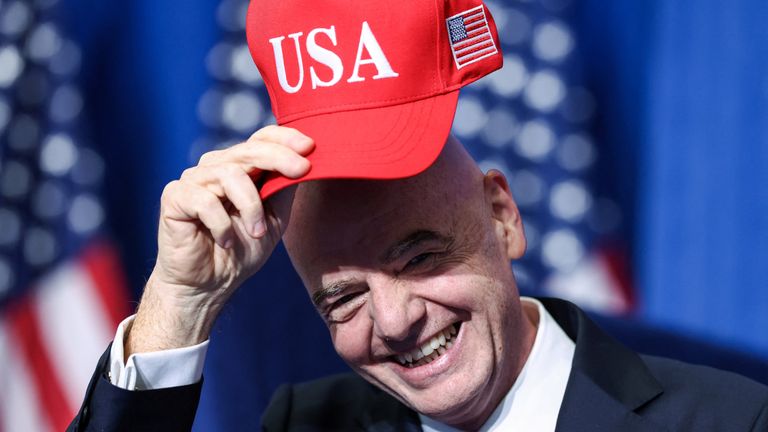
Image: FIFA president Gianni Infantino. File pic: Reuters
It comes after six members of the Iranian women’s football team – five players and one member of staff – were granted humanitarian visas to remain in Australia over fears they could be in danger after they did not sing Iran’s national anthem before a game. They were in Australia for the Asian Cup.
FIFA’s World Cup chief operating officer said earlier this week that the tournament is “too big” to be postponed because of global turmoil caused by the Iran war.
Advertisement
Heimo Schirgi said: “The World Cup will go on obviously, right? The World Cup is too big, and we hope that everyone can participate that has qualified.”
Over the ten days of the renewed conflict in the Middle East, Beirut’s southern district of Dahiyeh has been targeted by Israel, which is looking to deal a knockout blow to Hezbollah. It’s not the first time the area has been bombarded. Dahiyeh was bombed by Israel during its 2006 war with Hezbollah, again in 2014 and yet again in 2024 and 2025. Now the Israel Defense Forces is bombing the area again.
The attacks mark the return of a strategy first developed by the Israeli armed forces in Dahiyeh before becoming a military doctrine, bearing the name of the suburb. The Dahiyeh doctrine is a military strategy that calls for using overwhelming and disproportionate force against civilian infrastructure in areas controlled by hostile armed groups in order to deter attacks on Israel. It has repeatedly put into practice in Gaza. Now the Dahiyeh doctrine is once again being enacted in the place where it was first conceived.
Dahiyeh is a Hezbollah stronghold. It became the main urban centre of Lebanon’s Shia population in the middle of the last century when poor Shia families from Baalbek and south Lebanon migrated to Beirut’s suburbs.
During the civil war between 1975 and 1990, Hezbollah established its urban base in the southern suburbs of Beirut. Dahiyeh – the word means “suburb” – is the heart of Hezbollah’s political, social and service networks. Which is why it has become a target for Israel’s military.
Advertisement
Byword for mass urban destruction
The doctrine was developed in the aftermath of the 2006 Lebanon war between Israel and Hezbollah. Israel’s military leadership realised that Hezbollah had stalled their advance in urban combat.
To respond to this, the director of Israel’s Institute for National Security Studies (INSS), Gabi Siboni, a former senior IDF officer, wrote a paper in the INSS journal in October 2008, arguing for the use of overwhelming force against both fighters and the urban environment in which they operated and lived.
This was developed by the IDF into a working strategy. As Gadi Eisenkot, head of the army’s northern division, explained at the time: “What happened in the Dahiya quarter of Beirut in 2006 will happen in every village from which Israel is fired on. We will apply disproportionate force on it (village) and cause great damage and destruction there. From our standpoint, these are not civilian villages, they are military bases. This is not a recommendation. This is a plan. And it has been approved.”
Dahiyeh, southern Beirut, is a Hezbollah-dominated Shia stronghold. Gunning, Jeroen, and Dima Smaira. 2022. ‘Who You Gonna Call? Theorising Everyday Security Practices in Urban Spaces with Multiple Security Actors – The Case of Beirut’s Southern Suburbs’, Author provided (no reuse)
The primary goal of the doctrine was punishment and deterrence. The idea was to disrupt civilian life and make reconstruction almost impossible to afford. The doctrine’s architects hoped that its outcome would force the civilian population to rebel against the armed groups sheltering among them.
Siboni had made clear in his paper that this strategy was also applicable to Israel’s conflict in Gaza. In 2014, Operation Protective Edge targeted civilian infrastructure, including private houses as well as water, sanitation, electricity and healthcare facilities. Again, after the October 7 Hamas attack on Israel, the IDF has applied the Dahiyeh doctrine in the Gaza Strip, this time destroying between 80% and 90% of its civilian infrastructure.
Critics argue this violates international humanitarian law (IHL). IHL demands that states and groups make a clear distinction between civilians and combatants. It is necessary for armed groups to take all precautions to avoid acts of extreme destruction in heavy civilian residential locations.
Ravina Shamdasani, spokesperson for the UN High Commissioner for Human Rights, has warned that the blanket evacuation orders directed at Dahiyeh’s population risk violating international humanitarian law, saying they risk amounting to “prohibited forced displacement”. While Israeli strategists defend the doctrine as a means to defeat groups like Hezbollah, critics describe it as a template for handing out indiscriminate punishment to combatants and civilians alike.
Advertisement
What this means for Lebanon
The attacks on Dahieyh come at yet another fragile moment for Lebanon. The power-sharing government, led by the prime minister, Nawaf Salam, with the president, Joseph Aoun, as head of state, is still trying to implement economic reforms after the catastrophic 2019 financial collapse (estimated by the World Bank to be among the top three most severe economic crises globally since the mid-19th century). The latest round of conflict will severely set back the Lebanese government’s attempts to rebuild the economy.
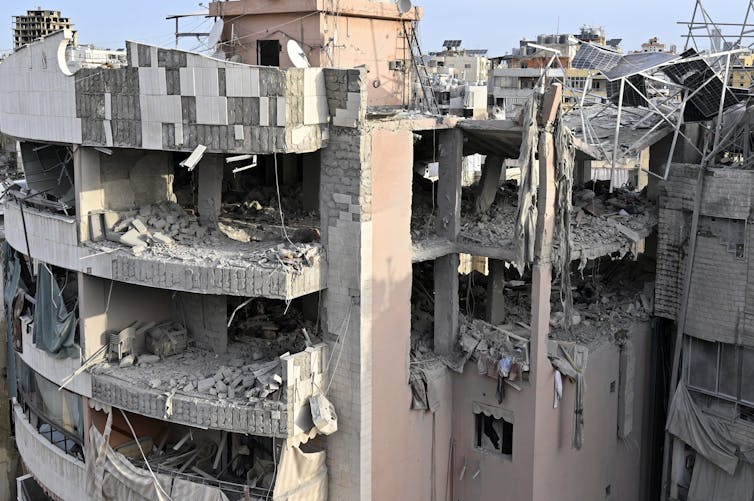
Repeat performance: Dahiyeh has regularly been a target for Israeli bombardment. Before the past ten days, the most recent previous attack was in 2025. EPA/Wael Hamzeh
The brunt of Israel’s assault on Lebanon is being felt in Dahiyeh. UN officials had estimated that the latest Israeli evacuation orders have forced at least 100,000 people to leave the area for shelters across Lebanon.
So far the Lebanese government’s response is to try to pull Hezbollah back from yet another drawn-out war with Israel. On March 2, Aoun formally banned Hezbollah from engaging in military activities and ordered the group to surrender its weapons to the Lebanese army. The government has also postponed the legislative election scheduled for May 2026 by two years.
The Lebanese government has put forward a four-point plan and called for an Israeli ceasefire to allow negotiations to proceed. The plan calls for “establishing a full truce” with Israel, the disarmament of Hezbollah and direct negotiations with Israel “under international auspices”.
But the international community seems incapable of applying any pressure to change the situation in Lebanon. As of March 9, by UN estimates, nearly 700,000 people had been forced from their homes, including 200,000 children. Meanwhile, the IDF continues to carry out strikes in Dahiyeh.
Advertisement
The Dahiyeh doctrine is so effective for the IDF because it is designed to move faster than the often glacial workings of international diplomacy. It can accomplish a military objective before the international community can craft an agreed and workable plan. This is not the only time residential districts have been bombed or civilian infrastructure targeted. Far from it. Modern warfare is full of examples of bombing civilian districts and Hezbollah has also launched attacks against residential areas in Israel.
But in the years since the doctrine was first articulated, it has been observed at work in both Lebanon and in Gaza, where Israel’s approach to operating in civilian areas was was criticised by the UN after Operation Cast Lead in 2008-09 as an official military strategy “designed to punish, humiliate and terrorise a civilian population”. As such, it’s a chilling illustration of the horror of modern warfare as waged in the Middle East today. And once again it appears to have come home to Dahiyeh.
In the first leg of their Champions League last 16 showdown, Los Blancos took a commanding step towards the quarter-finals of the competition with a 3-0 victory at the Bernabeu on Wednesday night.
With Jude Bellingham and Kylian Mbappe ruled out, Valverde took centre stage, scoring all three goals in what was a magnificent performance from the Uruguay international.
The 27-year-old scored an injury time winner against Celta Vigo at the weekend and opened the scoring against Pep Guardiola’s side after 20 minutes, slotting home from a tight angle after beating Nico O’Reilly and Gianluigi Donnarumma.
Advertisement
He doubled his haul seven minutes later before rounding off a hat-trick just before half-time, brilliantly flicking the ball over Marc Guehi before lashing home.
Valverde’s contribution to Real’s success has been invaluable but in a team of stars, is often overlooked. After tonight’s performance, Alexander-Arnold believes he may now start getting the credit he deserves.
‘Even as a Liverpool player I admired him and I think he is undoubtedly the most underrated footballer on the planet,’ Alexander-Arnold told TNT Sports.
Your football fix
Metro‘s Head of Sport James Goldman delivers punchy analysis, transfer talk and his take on the week’s biggest stories direct to your inbox every week.
Manchester City have a mountain to climb heading into the second leg of their Champions League round of 16 tie at the Etihad Stadium, following a damaging 3-0 defeat to Real Madrid at the Bernabeu
Manchester City goalkeeper Gianluigi Donnarumma made his feelings clear to Joe Hart with a private message, claiming the Champions League tie with Real Madrid is far from over.
Advertisement
On TNT Sport, Hart lifted the lid on an interaction between the two after the full-time whistle and the former City goalkeeper said: “He said: ‘Let’s go, it’s not over, let’s go’, It gave me chills, I love that guy!”
Pep Guardiola’s side have a mountain to climb with Real Madrid racing into a 3-0 lead by half-time. A brilliant hat-trick from Fede Valverde has Alvaro Arbeloa’s side in total control ahead of the second leg at the Etihad Stadium next week.
A lot had been made of Los Blancos’ extensive injury list ahead of Wednesday’s encounter with their old adversaries at the Bernabeu, with notable absentees including Kylian Mbappe, Jude Bellingham and Rodrygo.
However, Valverde rose to the occasion and the Uruguayan midfielder tore City to shreds with a ruthless display of finishing.
Advertisement
He netted three times in just 22 minutes and things could have deteriorated further for Pep Guardiola’s men had Donnarumma not denied Vinicius Junior from the penalty spot in the second half.
It capped a miserable 48 hours for English clubs in the Spanish capital following Tottenham’s 5-2 thrashing at the hands of Atletico Madrid on Tuesday.
City, who had entered the tie as favourites, have a daunting challenge in next week’s return leg at the Etihad Stadium.
Advertisement
The away side actually began positively and tried to impose themselves on Real Madrid. Antoine Semenyo unleashed an early effort at Thibaut Courtois whilst the energetic Jeremy Doku fired efforts across the goalmouth.
Nico O’Reilly also came close and Bernardo Silva sent a volley narrowly wide as they tried to capitalise on a depleted Real Madrid side.
But the hosts issued a warning when former City academy graduate Brahim Diaz drew a save from Donnarumma, though it went ignored.
Advertisement
The Premier League side were caught napping by a long delivery from Courtois which sailed over O’Reilly’s head, and Valverde controlled it superbly in his stride. He then glided past Donnarumma and finished superbly while off-balance from a narrow angle.
City had scarcely had chance to recover before Valverde added his second seven minutes later. He may have benefited from fortune as a Vinicius pass deflected into his path, but there was nothing lucky about his touch as he composed himself to fire a low left-footed effort beyond Donnarumma.
The third was the best of the bunch and completed his stunning hat-trick before the interval as Jude Bellingham watched on in awe.
Valverde flicked the ball over the head of Marc Guehi and hammered home a volley to ramp up the pressure on City ahead of the return fixture.
Advertisement
Get MEN Premium now for just £1 HERE – or get involved in our City WhatsApp group by clicking HERE. You can also join our City Facebook page by clicking HERE and don’t miss out on our brilliant selection of newsletters HERE.
The National Weather Service (NWS) expects temperatures to be about 20 degrees warmer than normal for mid-March. This raises the risk of heat illness, with forecasters urging people to avoid outdoor activities during the daytime.
“If you must be outdoors, drink a lot of water,” said Richard Thompson, a meteorologist with the NWS Los Angeles office. “There’s definitely the potential for records being set.”
Thursday is anticipated as the hottest day, with the San Fernando Valley possibly hitting 95 degrees Fahrenheit (35 Celsius). Typical mid-March temperatures are usually around 70 degrees Fahrenheit (21 Celsius).
Advertisement
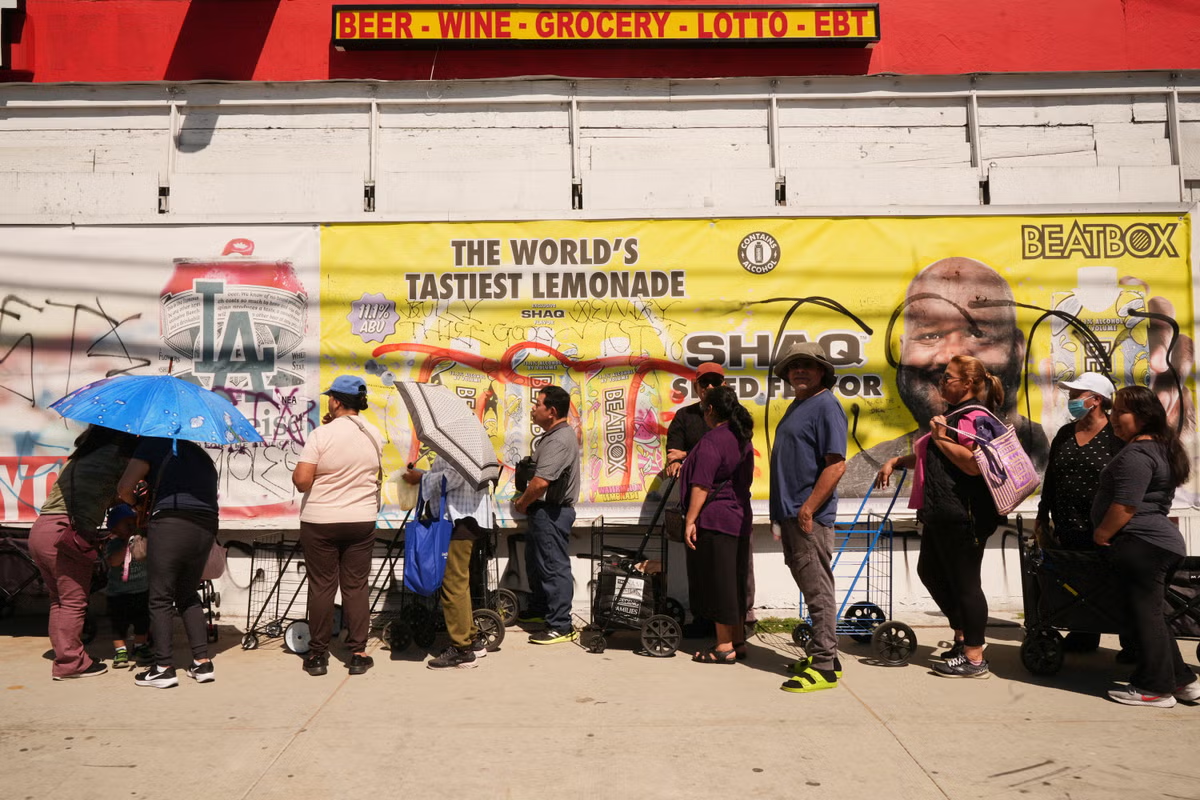
Los Angeles city and county officials planned to open cooling centers for residents without air conditioning (AP Photo/Damian Dovarganes)
Workers at outdoor construction sites will have plenty of drinking water and electrolyte packets available to stay hydrated. They’re instructed to take frequent breaks, said Junior Pineda, a representative with a local unit of the International Union of Bricklayers & Allied Craftworkers.
“And there’s always shade structures, if guys start feeling a little light-headed and need to take a few minutes,” he said.
Los Angeles city and county officials planned to open cooling centers for residents without air conditioning.
Zack Marquez, who uses a wheelchair, was taking care of errands Wednesday before it got too hot in LA’s Koreatown neighborhood.
“Gotta stay hydrated and stay in the shade,” he said.
Advertisement
A sea breeze on Friday should cool down the coast somewhat, but inland areas will still swelter, forecasters said.
Celebrities are streaming into Los Angeles ahead of Sunday’s Oscars, with a bevy of events this week taking advantage of the concentration of stars. But the worst of the weather should be over in time for the ceremony.
The rest of the state will also see hotter-than-normal weather starting next week. Temperatures could top 90 (32 Celsius) on Monday around San Francisco and in the Sacramento area.
Kai Havertz scored a controversial late penalty for Arsenal upon his return to Bayer Leverkusen and the forward has now spoken out after finding the back of the net
Kai Havertz admitted he felt sorry for his Bayer Leverkusen rivals after netting a late penalty against his former side. The German was successful from the spot kick with a minute of normal time remaining.
Advertisement
It had come after substitute Noni Madueke went down under very little contact. Havertz, who made 150 appearances for Leverkusen before a move to Chelsea, muted his celebrations.
Asked about the goal, he revealed he had sympathy for his former employers. Speaking to DAZN, he said: “Penalty in the last minute are not always so easy. But these are the moments I have worked for years for, to be there in such moments.
“That’s why I’m naturally happy. I am glad that I stepped up, glad that I scored. I am naturally sorry for the Leverkusen players. But that is football and I was happy.”
The goal was a crucial one for Arsenal, having battled back from 1-0 down following Robert Andrich’s opener. The Bayer Leverkusen captain hit out at the decision to award Arsenal their spot kick.
He said: “That is already very little. Of course he [Madueke] should not go down like that. I also know such situations: if you go down and maybe have the feeling: ‘Oh s***, now I’m already down.’ But that is already very, very little.
He added: “My feeling was that the small contact comes and he still falls a bit later. If I see it twice more, it is even less. That is surely not enough.”
Advertisement
Meanwhile, Leverkusen boss Kasper Hjulmand was left far from happy with the decision. He said: “There’s no contact and then he goes down.
“It’s not a penalty. That’s a situation where if the referee doesn’t blow his whistle and VAR checks it, then there’s no penalty.”
Arsenal will welcome Leverkusen to the Emirates Stadium next week as they aim to seal a spot in the Champions League quarter finals. Should they find a way past the German side, they will take on either Bodo/Glimt or Sporting Lisbon, the former having won their first-leg 3-0.
Advertisement
Asked about Havertz, Arsenal boss Mikel Arteta said: “Yes, how composed he took and yes, football is a funny game and it brings special stories and him coming back here after such a long time, being part of this club, to come here and score such an important goal, I think it’s a big moment.”
Join our new WhatsApp community and receive your daily dose of Mirror Football content. We also treat our community members to special offers, promotions, and adverts from us – and our partners. If you don’t like our community, you can check out any time you like. If you’re curious, you can read our Privacy Notice.Content cannot be displayed without consent
The release of the “Mandelson files” comes at a difficult moment in relations between the US and UK. It is unlikely to ease tensions.
The UK government has submitted to pressure from MPs to disclose files relating to the hiring and vetting of Peter Mandelson as UK ambassador to the US. Questions have been raised about how much officials, including the prime minister, Keir Starmer, knew about Mandelson’s friendship with paedophile Jeffrey Epstein after his conviction for sex offences in 2008.
The key takeaway from the release doesn’t relate to the US president, Donald Trump. This is that Mandelson tried to negotiate a severance package worth £547,201 after being asked to leave his post in Washington. He ended up getting £75,000. But there are details in the documents that will not be welcomed by the US, and the nature of the release will be of concern to a White House already under pressure for its own approach to Epstein.
Trump has already spent recent weeks publicly criticising Starmer for failing to support him on Iran, saying Starmer is no “Winston Churchill”. The release of these files may well lend further opportunity for Trump to hit out.
Advertisement
Lack of control
The questions about how much Starmer knew about Mandelson and Epstein arose in the first place after the US government partially released the Epstein files in January. These included email exchanges between Mandelson and Epstein revealing a relationship that extended long after the latter’s conviction. They have also led to a police investigation over communications made between the two men while Mandelson was a government minister. These allegedly relate to sensitive government information rather than anything relating sex offences.
Trump will not like the fact that this release has brought the Epstein files back into the spotlight – and particularly that it is happening in circumstances beyond his control.
Trump has repeatedly called for the Department of Justice to “move on” from this story, having faced questions about his own relationship with Epstein. He recently attacked CNN journalist Kaitlan Collins for not smiling as she asked him questions about the Epstein files, in a clear attempt to distract public attention.
There is a risk that the Mandelson document release will renew pressure on Trump to release the full cache of documents held by the US government – and that he will seek to divert attention by lashing out again at Starmer.
Unsurprisingly, given that many of these released documents were written for private consumption, they contain some comments that may be embarrassing for the authors and subjects.
In the documents, we can see the UK government reviewed public comments Mandelson made condemning Trump policies prior to his appointment as ambassador, apparently to consider whether they were a problem during the vetting process.
When speaking to students in Hong Kong, Mandelson said: “it’s also necessary to recognise Mr Trump’s behaviour for what it is: he is a bully and mercantilist who thinks that the US will gain in trade only when others are losing”. Trump will likely be annoyed by this attack on his treasured “tariffs” policy.
Crucially, given that Starmer appointed Mandelson despite these comments, these documents also show that the UK government did not object to Mandelson’s view.
Advertisement
London v Washington
The release from the UK will fuel a debate that has begun on the difference between how London and Washington have both responded to the the revelations in the Epstein files. The Trump administration continues to refuse to release its own files in full – and continues to be accused of covering up Trump’s relationship with Epstein.
The UK government has demonstrated that it is willing to fire people over their relationships with Epstein and that it won’t protect them from police investigation. Now it has shown willingness to release files showing how much the government knew about these relations. This is of course not the full release of files and Starmer insists several key items can’t be released because they are part of an ongoing police investigation, but it still leaves space for criticism of the US.
Trump and his administration will have been hoping that media attention would move on, focusing on the controversial airstrikes on Iran, or continuing ICE raids across US cities. It will not welcome inevitable comparisons between its unwillingness to act on revelations from the Epstein files – or to keep releasing more files – and the UK government’s decision to do both.
Crucially, US government officials will be watching for further document releases to see if this situation gets any worse.
Prime Minister Sir Keir Starmer has pledged that the government “will not tolerate” heating oil suppliers exploiting the Middle East crisis for profit.
During a visit to Belfast on Thursday, Sir Keir will stress that home heating oil costs must be “fair, transparent and justifiable”.
He will meet with political leaders, including First Minister Michelle O’Neill and deputy First Minister Emma Little-Pengelly, amid increasing concerns about the Middle East war’s impact on energy prices.
This issue is particularly pertinent in Northern Ireland, where around two-thirds of domestic properties depend on home heating oil.
Advertisement
Global oil prices have surged sharply due to the conflict, with Iran launching strikes following attacks by the US and Israel, directly contributing to the rise in home heating oil expenses.
The market in Northern Ireland, unlike gas and electricity, is unregulated.
Treasury minister Lord Livermore met with some Northern Ireland MPs on Wednesday to discuss the issue.
This issue is particularly pertinent in Northern Ireland, where around two-thirds of domestic properties depend on home heating oil (PA Wire)
The Government said Sir Keir will use his visit to Northern Ireland to “highlight his relentless focus on cutting the cost of living for working people”.
A statement said: “Recognising that the majority of households in Northern Ireland rely on heating oil to heat their homes, the Prime Minister will send the strong message to companies that prices must be fair, transparent and justifiable, not inflated at the expense of working people.
Advertisement
“If companies hike prices without justification, the Government will act, including through regulation.”
The Prime Minister said: “Global instability has real impacts on the lives of working people across the UK, and I know families in Northern Ireland are worried about what the war in the Middle East could mean for their finances – especially given so many households rely on heating oil to heat their homes.
“Let me be clear, we will not tolerate profiteering or unfair practices.
“If companies fleece customers or rip them off, we will not hesitate to step in, and that includes on regulation.
Advertisement
“This Government stands with working people, no matter the headwinds.
“In Belfast I am spending my time meeting not only the politicians making decisions in Stormont, but also the people whose lives are shaped by conflicts abroad and the approach we take at home.”
The Government has asked the Competition and Markets Authority to look at heating oil prices.
During the visit, the Prime Minister will also meet with members of a local community to discuss the cost of living.
The Girvan company has implemented a structured programme to align people, processes and strategy, building stronger, more resilient operations.
Land Energy, based in South Ayrshire, has been named the winner of the Resilience Award at the 2026 Industry Awards hosted by the Centre for Engineering, Education and Development (CeeD).
Advertisement
The award recognises organisations that demonstrate exceptional ability to strengthen operations, adapt to change and build long-term resilience through effective leadership, strategy and continuous improvement.
The Girvan company implemented a structured programme to align people, processes and strategy, building stronger, more resilient operations.
Early improvements from targeted initiatives and gap analysis are already delivering measurable benefits.
And these results form the foundation for ongoing organisational growth, strengthening internal systems and ensuring the organisation is well positioned to adapt and grow in a rapidly changing energy landscape.
Advertisement
In addition, it illustrates how the company is becoming more adaptable, especially in the current geopolitically uncertain era.
Reg Stewart, Business Excellence Lead at Land Energy, said: “We are incredibly proud to receive this award from CeeD.
“Building resilience is about ensuring the organisation is strong, flexible, and ready for the future.
“Our entire team has been working hard to review our processes, identify opportunities for improvement, and align our people and systems around a clear long-term vision.
Advertisement
“This award reflects commitment across the whole business to continuous improvement and operational excellence.”
Reg added: “We would also like to thank all the other nominees and CeeD for an amazing evening.”
The CeeD Industry Awards celebrate organisations across Scotland that demonstrate excellence in innovation, knowledge exchange, skills development, internationalisation, collaboration and leadership.
Advertisement
Land Energy’s success highlights the strength of Scotland’s renewable energy and manufacturing sectors and the importance of resilient organisations in supporting sustainable economic growth in Scotland and the wider UK.
Founded in 2006, Land Energy is now the UK’s largest producer of sustainable wood pellets and briquettes, supplying low-carbon renewable fuel to homes and businesses nationwide.
The company also manufactures a range of sustainable products, including pizza pellets, cat litter, horse bedding and a new soil conditioner, Solivita.
Filip Jorgensen’s costly error at the Parc des Princes was the pivotal moment as Chelsea suffered a late collapse to lose 5-2 to Paris St Germain in the first leg of their Champions League last-16 tie.
The visitors had twice recovered from a goal down and looked like surviving an intriguing match with a draw when, in the 74th minute, Jorgensen’s pass was cut out easily by Bradley Barcola, substitute Khvicha Kvaratskhelia squared it and Vitinha chipped the stranded goalkeeper.
Malo Gusto and Enzo Fernandez had earlier scored equalisers in answer to goals by Barcola and Ousmane Dembele.
Then came Jorgensen’s awful misjudgement, a blow Chelsea clearly struggled psychologically to recover from. Kvaratskhelia curled in a brilliant fourth soon after then tapped in a fifth in stoppage time as the holders twisted the knife.
Advertisement
Chelsea were brave in coming to the home of the European champions and taking them on but their nativity was their undoing.
They were too casual about the threat posed by PSG, leaving space for Dembele and for Barcola, not giving their all in challenging for second balls and too easily pulled out of shape by rapid transitions.
These are the missing details that will almost certainly mean an exit next week for Liam Rosenior’s side, but they also exposed PSG’s own defensive vulnerabilities – Barcola in particular was horribly at fault for Gusto’s goal – and there remains a sniff of encouragement that the holders can be beaten.
There was no suggestion Chelsea had come to Paris to keep it tight and stay in the tie. They came at the European champions with a high line and plenty pushed forward as they sought to play the game in the hosts’ half.
Advertisement
They could have scored in the first few minutes, Reece James crossing low from the right but Joao Pedro failed to make good contact.
This though is a team prone to defensive lapses. They had already got away once with failing to deal with a ball as it bounced inside their box when PSG punished them.
Dembele was given space on the right to cross, Joao Neves was left with room to nod it down for Barcola who controlled with his chest then thundered it in off the bar.
Chelsea have been accused of wilting in adversity but here they dug in and hit back. Fernandez’s clever switch of the play found Gusto with virtually the freedom of the PSG box after Barcola switched off.
Advertisement
The defender took a touch and drilled it and though Matvei Safonov got a hand on it the ball bounced past him and in.
A wild 14-second spell ended with PSG retaking the lead.
Cole Palmer should have scored with a free effort hit straight at Safonov. The ball was cleared and in a flash Dembele was streaking over the halfway line. Wesley Fofana recovered and got goal side but the Ballon d’Or winner turned him with some ease before sending a low finish into the corner.
Pedro Neto had shown in the first half that he had the beating of Marquinhos for pace and he showed the PSG captain his heels again to set up the equaliser, racing into the box and pulling back for Fernandez who rifled into the top corner.
Advertisement
Then came Jorgensen’s dreadful misjudgement to let in Vitinha to score before Kvaratskhelia’s brace all but finished the tie.