Connect with us

NewsBeat

China set to suffer from turmoil in the Middle East, but it stands to benefit long term

Published

on

China set to suffer from turmoil in the Middle East, but it stands to benefit long term

China has responded to the joint US-Israeli attacks on Iran with strong diplomatic condemnation. In an article published on March 1, China’s state-run Xinhua news agency called the attacks a “flagrant violation” of the purposes and principles of the UN charter. The same article called the intervention a departure from “fundamental norms of international relations”.

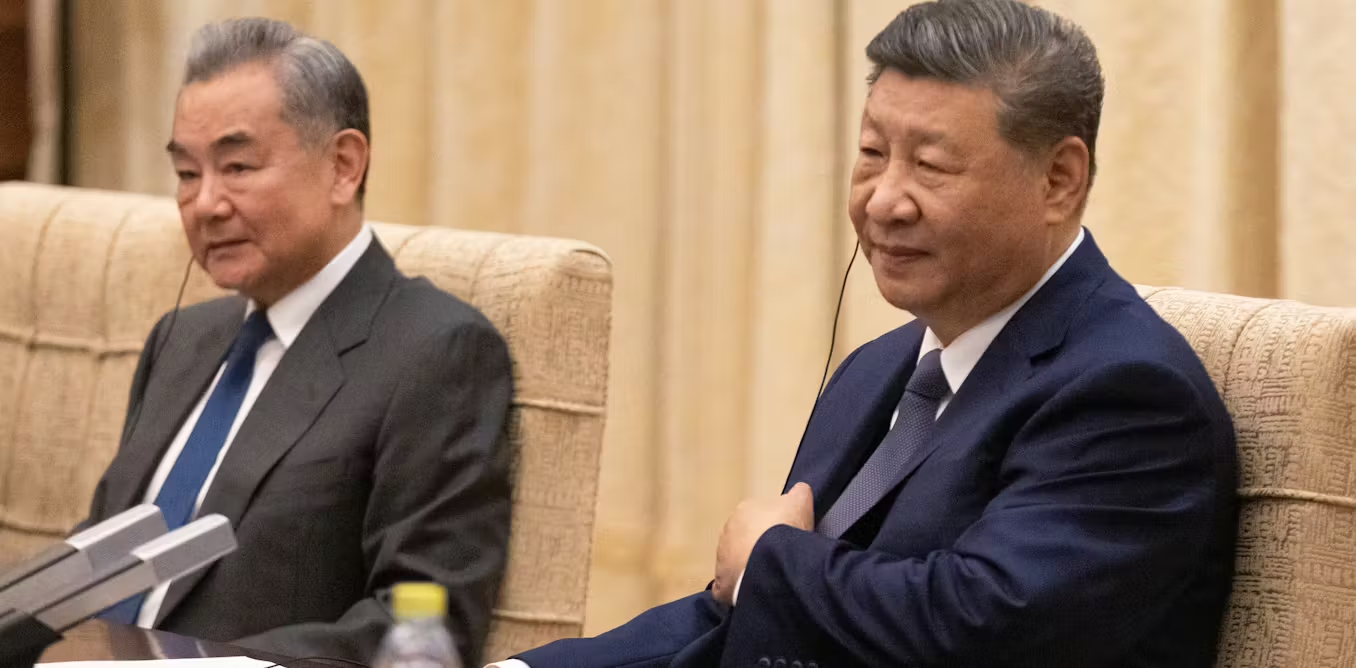
This reaction resembled China’s response to the US capture of the former Venezuelan leader, Nicolás Maduro, in early January. At that time, Chinese officials condemned what they described as a violation of international law. The Chinese foreign minister, Wang Yi, warned that no country should act as a “world policeman” or “claim itself to be an international judge”.

Beyond diplomatic condemnation, China’s most significant contribution to the conflict in Iran so far has come through its satellite navigation system, BeiDou. In recent years, BeiDou has emerged as a possible alternative to the dominant Global Positioning System (GPS), which is owned and controlled by the US government.

During the 12-day war between Iran and Israel in 2025, widespread GPS jamming caused significant disruption to Iranian civilian and military systems. Deactivating GPS and switching to BeiDou has thus given Iran’s military more strategic depth. It has done so by, for example, enabling better monitoring of American military assets.

Advertisement
A vessel anchored off the coast of Dubai, the United Arab Emirates, on March 1.
Stringer / EPA

The conflict in Iran is likely to lead to several issues for China. Iran is a key source of oil for the Chinese government, exporting more than 520 million barrels of crude oil to China in 2025. Only Saudi Arabia supplied China with more oil than Iran that year.

What effect the conflict ultimately has on Iranian oil exports remains to be seen. But it is already causing significant disruption to the strait of Hormuz, the main route connecting Iranian ports in the Persian gulf and also some of the Gulf region’s other major oil suppliers to the open ocean.

The economic pain caused by this disruption is likely to be felt acutely by China, which imports more than half of its crude oil from countries in the Gulf.

At the same time, the perceived weakness of China in failing to respond to the conflict proactively may make some states cautious about pursuing a closer relationship with Beijing. Some countries, particularly in Latin America, have already looked to address their overreliance on China over the past year following pressure and threats from the US government.

Advertisement

In January, for example, Panama’s supreme court invalidated a contract that had allowed Panama Ports Company, a subsidiary of a Hong Kong-based firm, to operate two ports on the Panama canal. The ruling came one year after Trump threatened to take control of the canal to limit Chinese influence over the waterway.

However, it is equally possible that the war assists Beijing’s wider efforts to position itself as a global counterbalance to the US. Countries that had previously maintained frosty relations with Beijing such as Canada, Germany and the UK have already all looked to boost economic ties with China in recent months amid concerns about the reliability of the US as a partner.

And Wang Yi used his appearance at the Munich Security Conference in February to speak of the need for the UN and more global cooperation and collaboration. The unpredictability of the Trump administration, most recently displayed by its decision to attack Iran, may serve to strengthen China’s message of stability.

Meanwhile, Beijing may point to Iran’s retaliatory strikes against the Gulf states as a warning for countries of the consequences of aligning with Washington. This may raise questions among traditional US allies in Asia such as Japan and South Korea over whether the alliance system in the region that has long been maintained by Washington can truly guarantee the security of these states.

Advertisement

Pivot to Asia

While it is difficult to predict how the conflict in Iran will play out, some analysts view a drawn-out war as a possibility. This scenario also has implications for China, as it could distract the US away from its pivot to Asia. The US has long wanted to shift its foreign policy focus away from Europe and the Middle East towards the Indo-Pacific to counter the rise of China.

The US is no stranger to protracted wars in the Middle East, having become bogged down in conflicts in Iraq and Afghanistan since the early 2000s. Both of these wars significantly hindered and delayed the pivot to Asia, leading to what some observers call a “lost decade” for the US that allowed China to expand its influence.
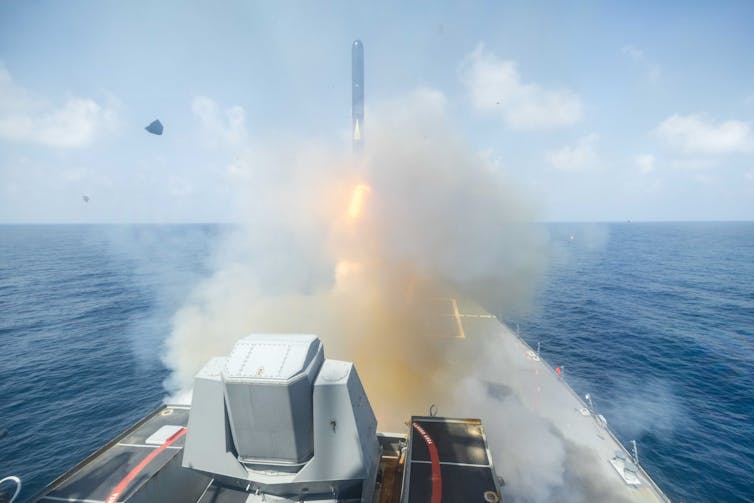
A US warship fires a missile at a target in Iran.
A protracted conflict in Iran could see American military assets redeployed from the Indo-Pacific region.
US Navy Handout / EPA

A long entanglement in Iran would drain resources that might otherwise reinforce US deterrence in the Indo-Pacific, creating an opportunity for China to further to cement its role as the dominant regional player in Asia. And it could also help Beijing with its preparations for future conflicts.

The war in Iran is fertile ground for China to study American and Israeli weaponry. This may inform its future military strategy. The demonstration of the military value of drones in Ukraine, for example, has been key in China’s decision to develop and test new types of drones and drone swarm technologies.

The Iran conflict may inflict short-term damage on China economically. But, as time goes on, we may look back on this moment as a key point in China shoring up its influence across Asia and the world.


Advertisement

Source link

Continue Reading
Click to comment

Leave a Reply

Your email address will not be published. Required fields are marked *

NewsBeat

24 Hours in Police Custody’s chilling episode that ‘shocked experienced detectives’

Published

on

Cambridgeshire Live

The true crime documentary returns tonight with a deeply disturbing two-part special about an investigation that shocked even experienced detectives

The much-loved Channel 4 true crime documentary is poised to make a return to television screens tonight with an episode that promises to be “deeply disturbing”.

24 Hours in Police Custody has garnered a loyal following since its debut in 2014. The groundbreaking documentary immerses viewers in the high-stakes world of criminal investigations, following detectives as they pursue justice for serious crimes.

Advertisement

The programme offers a glimpse into the real-life drama unfolding within a local police force, as detectives race against time to uncover horrifying truths. Over the years, the show has earned the accolade of being the “best ever”, with viewers eagerly anticipating new episodes.

In recent weeks, fans of 24 Hours in Police Custody were disappointed when the show appeared to have been taken off air and replaced with a new series on Channel 4. However, tonight (March 4), two episodes will be broadcast from 9pm, back to back.

Entitled 24 Hours in Police Custody: The Butcher of Suburbia, this two-part instalment delves into the 2024 murder of a 74-year-old woman. Viewers will watch as detectives investigate the killer who dismembered and concealed her body, initially claiming she had moved away, reports Wales Online.

Advertisement

For the first part, set to air at 9pm on Channel 4, the broadcaster teases: “The landmark series brings us the gripping inside story of the murder of a 74-year-old woman – and the killer’s macabre efforts to conceal her death.”

Promising a “deeply disturbing” episode, part two reveals: “The suspect admits to the murder of a 74-year-old woman. But a deeply disturbing tale that shocks experienced detectives has only just begun.”

The two instalments tonight are repeat episodes that previously shocked viewers. Taking to social media, one person said: “Omg that episode of 24 hours in police custody – the butcher of suburbia is HARROWING.”

Another wrote: “Shocking two-part documentary. When a 74-year-old woman is murdered, police uncover the killer’s macabre efforts to hide her death.”

A third added: “Watching the butcher or suburbia episode of 24 hours in police custody. Wow!”. A fourth penned: “Pleased that “24 Hours In Police Custody” returns tonight (C4 9pm). It’s a consistently good series.”

One person commented: “Watched another true life horror. 24 hours in Police Custody: Butcher of Suburbia.”

Another echoed: “#24hoursinpolicecustody is undoubtedly one of the best programs on TV. The Butcher of Suburbia…the chilling calmness, openness, honesty about killing and chopping up a 70-year-old lady. I’m not sure I’ve ever seen anything quite like it.”

Advertisement

24 Hours in Police Custody returns tonight on Channel 4 at 9pm and 10pm. Episodes are also available to stream online.

For the latest showbiz, TV, movie and streaming news, go to the new **Everything Gossip** website.

Ensure our latest headlines always appear at the top of your Google Search by making us a Preferred Source. Click here to activate or add us as your Preferred Source in your Google search settings.

Source link

Advertisement
Continue Reading

NewsBeat

Husband finds out about wife’s 12-year affair from a note on his door

Published

on

Daily Record

James Nielson, 41, was sentenced to prison after a three-week stalking campaign that included leaving a note on his former partner’s door revealing their affair and demanding paternity tests

A 12-year-long affair ended in acrimony, culminating in a man pounding on his former mistress’s door, demanding a paternity test.

Advertisement

James Nielson, 41, pursued his ex for three weeks, insisting on DNA tests to establish the paternity of two of her three children, born during their lengthy liaison.

His relentless pursuit involved late-night visits to her home, banging on the door and leaving a note for her husband revealing their secret relationship.

At Liverpool Crown Court today, March 3, prosecutor Lahraib Iqbal stated that Nielson and the victim had known each other for 15 years. Despite marrying her husband in 2013, she maintained an intermittent affair with Nielson, blocking his number during their breaks.

On December 4 last year, the woman awoke to discover 37 messages from Nielson on her phone. As she left for work that morning, she noticed Nielson tailing her.

Advertisement

Ensure our latest stories always appear at the top of your Google Search by making us a Preferred Source. Click here to activate or add us as your Preferred Source in your Google search settings.

She instructed him to leave her be and carried on, but upon reaching her workplace at 8.40am, Nielson confronted her again, only departing when a passer-by intervened, reports the Liverpool Echo.

At 11.30pm that night, whilst at home in Liverpool with her husband and children, Nielson began hammering on her door. He slipped a note through the letterbox divulging the affair before leaving the premises – only to return in his car at 3am, honking his horn.

Ms Iqbal stated: “At 10.30am (December 5) the defendant was spotted sat outside the address, beeping his horn and waving at (the victim) from his car.”

Advertisement

Three days later, around 6.20am on December 8, the victim once more departed her home for work when Nielson confronted her. After telling him to “go away”, she climbed into her vehicle and set off towards Crosby.

However, Nielson pursued her in his black Volkswagen Golf, forcing her to pull over to prevent a collision with another motorist.

Ms Iqbal continued: “He went around to the front of her car and with his fists began to bang on the bonnet of her car.”

The woman subsequently contacted police.

Advertisement

Nielson, of Carriage Grove in Bootle, entered guilty pleas to stalking, driving whilst disqualified, and driving without a licence. He additionally admitted two violations of a 12-month suspended sentence imposed in September 2025 for involvement in cannabis supply and production.

The violations comprised the stalking and motoring offences, alongside his failure to comply with a curfew requirement between December 1 and December 8 2025.

‘Struggled to lose love of his life’

Olivia Bell, defending, told the court: “I would urge the court to accept his remorse is genuine. he regrets any distress caused to (the woman). I in no way seek to minimise his behaviour but simply provide context for his contacting the complainant. The accused and the complainant had been entangled in an intermittent relationship for 12 years, during which the complainant gave birth to three children.

The defendant, however, has raised doubts over the paternity of two of these children. Whilst his actions were unquestionably inappropriate, this context is provided to shed light on why he repeatedly reached out to the victim.”

Advertisement

She stated: “There were no threats of violence. Simply this was a man who struggled to lose what he called the love of his life following as 12-year affair and wanted to seek information about the paternity of the children.”

Nielson’s criminal record includes 11 previous convictions for 21 offences, many of which are driving-related.

In her sentencing remarks, Judge Louise Brandon observed: “It’s quite clear the fear and distress you caused has had a physical and emotional impact on (the victim). It’s affected how she conducted her day to day activities. She has incurred expenses and she has described the impact these actions have had on her life.

“I’m quite satisfied that the stalking is a high culpability offence. This was a persistent action over a long period. You followed the complainant and your behaviour was conducted in a way to maximise her fear and distress, including turning up at her family home.”

Advertisement

Nielson received an 18-week prison term for stalking and eight weeks for the driving offences. The judge also activated 39 weeks of his existing suspended sentence, resulting in a total custodial term of 65 weeks – equivalent to one year and two months.

Additionally, he was disqualified from driving for a total of 115 weeks, whilst a restraining order was imposed preventing him from contacting the victim for seven years.

Source link

Advertisement
Continue Reading

NewsBeat

Donald Trump tells Iran he doesn’t care if they play at the World Cup | Football

Published

on

Donald Trump tells Iran he doesn't care if they play at the World Cup | Football
It is less than 100 days until America hosts the World Cup along with Canada and Mexico (Picture: Getty)

Donald Trump has branded Iran ‘a country running on fumes’ and doesn’t care if they participate in the summer’s World Cup.

Iran were one of the first nations to qualify for a tournament that is scheduled to start in less than 100 days’ time but their involvement is now under threat as a result of the US-Israeli strikes and subsequent retaliation as the regime clings to power.

In the wake of the initial wave of the attacks, Iranian Football Federation president Mehdi Taj confirmed Team Melli, who are due to play three games in America against Egypt, Belgium and New Zealand, were far from guaranteed to take their place at what promises to be the biggest World Cup in history.

Taj said: ‘With what happened today and with that attack by the United States, it is unlikely that we can look forward to the World Cup, but the sports chiefs are the ones who must decide on that.’

Advertisement

With a military campaign still ongoing, Trump was asked whether it would concern him were a nation of Iran’s stature to pull out.

He told Politico, the American digital newspaper: ‘I really don’t care. I think Iran is a very badly defeated country. They’re running on fumes.’

FIFA are continuing to monitor the situation after Iran were the only country absent from a planning summit for World Cup participants, held in Atalanta.

Your football fix

Metro‘s Head of Sport James Goldman delivers punchy analysis, transfer talk and his take on the week’s biggest stories direct to your inbox every week.

Advertisement

Sign up here, it’s an open goal.

To view this video please enable JavaScript, and consider upgrading to a web
browser that
supports HTML5
video

Advertisement

Mattias Grafstrom, the Fifa secretary-general, speaking at the International FA Board meeting near Cardiff, said on Saturday: ‘We had a meeting today and we will monitor developments around all issues around the world. Our focus is on a safe World Cup with all the teams participating.’

Who Could replace Iran at the World Cup?

Iraq are due to compete in a continental play-off against Bolivia or Suriname later this month with a place at the World Cup up for grabs.

Advertisement

At this stage, the most likely scenario, should Iran withdraw, would see Iraq take their place with the United Arab Emirates replacing them in the play-offs.

Iran’s women’s team, meanwhile, are currently competing at the Asia Cup in Australia and forward Sara Didar struggled to hold back tears when asked her about the escalating conflict in her country, as coach Marziyeh Jafari said her players were doing their best to focus on football, despite concern for their families back home.

FBL-WC-2026-ASIA-QUALIFIERS-IRI-PRK
Iran qualified for the World Cup last year and are due to play three games in America this summer (Picture: Getty)
Soccer Football - FIFA World Cup 2026 - FIFA World Cup 2026 Draw - John F. Kennedy Center for the Performing Arts, Washington, D.C., U.S. - December 5, 2025 General view of the completed groups after all the teams have been drawn during the FIFA World Cup 2026 draw REUTERS/Carlos Barria
Iran have been draw in Group G at the World Cup (Credits: REUTERS)

The fighting erupted after the US and Israel launched air strikes on Iran over the weekend, killing the Islamic Republic’s Supreme Leader Ali Khamenei, after which Iran launched missiles at countries on the Arabian Peninsula.

‘Obviously we’re all concerned and sad at what has happened to Iran and our families in Iran and our loved ones, but I really hope it’s very good for our country, to have good news ahead and I hope that my country would be strongly alive,’ 21-year-old Didar said on Wednesday.

Iran lost their opening Group A game to South Korea 3-0 on Monday and face hosts Australia on Thursday at the Gold Coast Stadium.

Advertisement
FBL-AFC-WOMEN-IRN-KOR
Iran players lined up in silence ahead of kick-off (Picture: Getty)
Korea Republic v Islamic Republic of Iran - AFC Women's Asian Cup Australia 2026
Iran lost their opening group match 3-0 (Picture: Getty)

Australia midfielder Amy Sayer earlier praised the courage of the Iranian players for competing in the continental tournament despite their homeland facing political unrest and military strikes.

Coach Jafari said the Iranian team wanted to make their Iranian-Australian supporters proud.

‘We have so much concern regarding our families and the people in Iran,’ she said. ‘Nobody loves war … but here, we are coming to play football professionally and we do our best to concentrate on our football and match ahead.

‘Iranian-Australians here support us, we are so happy to have a country that all the people are united and supportive and we really love them also as well and we’ll do our best to make them proud.’

Advertisement

Source link

Advertisement
Continue Reading

NewsBeat

Why does Scotland lead the way on football headers?

Published

on

Celtic's Daizen Maeda heads the ball against Rangers

Looking at the combined metrics of Scotland compared to 10 top leagues around the continent, there are more than 35% more heading actions in Scotland.

The figures may not come as a shock to those who watch Scottish football on a regular basis, but they do throw up questions about what it means for the discussion around safety.

Since the death of former England centre-forward Jeff Astle from dementia in 2002, scientists have increasingly linked repeated head impacts to chronic traumatic encephalopathy (CTE), which can also lead to neurodegenerative disease.

In January, a coroner investigating the death of former Scotland and Manchester Utd centre-half Gordon McQueen said: “I am satisfied that, on the balance of probability, repeatedly heading footballs contributed to his developing chronic traumatic encephalopathy.”

Advertisement

A field study by Glasgow University in 2019 found that former professional footballers were three-and-a-half times more likely to develop neurodegenerative disease. That figure was even higher for defenders.

“I actually looked, a few years ago, at the heading rates across World Cups, going all the way back to 1966,” Dr Willie Stewart, who led the study, said.

“The stats actually showed that the amount of headers in games were increasing over that 50-year period, rather than declining, as some people might have thought – so I’m not too surprised.”

In 2022, the Scottish FA introduced a number of changes aimed at minimising the risk.

Advertisement

Heading the ball was banned for under-12s and, in the professional game, there was a ban on heading the ball during training the day before and after a match.

Clubs were also told to limit training exercises that involve repeated heading to one session per week.

The SFA’s chief medical officer Dr Jonny Gordon said: “The Scottish FA has led the way in research into head trauma in sport, working in partnership with the University of Glasgow in a landmark 2020 field study and additional research published in 2022.

“We will continue to monitor guidance based on evolving research as part of the association’s commitment to ensuring the national game is a safe and enjoyable environment for all players.”

Advertisement

Source link

Continue Reading

NewsBeat

A 2,850-year-old mass grave in Serbia reveals a shift in prehistoric violence

Published

on

A 2,850-year-old mass grave in Serbia reveals a shift in prehistoric violence

The earliest mass graves in Europe date back just over 7,000 years. They reveal brutal evidence for violence beyond the simple act of killing. The motives for these events are probably diverse but consistently highlight an intention to kill large numbers of enemies across sex and age ranges.

Our study of a 2,850-year-old massacre and resulting mass grave at Gomolava (modern day Serbia) shows the nature of mass killings evolving. Comprised mostly of women and girls, the grave suggests a shift in prehistoric violence. Here, women and children were not collateral victims, but deliberate targets. Looking at who was killed and how they were related can tell us about changes in ancient attitudes to killing combatants – but also choices in targeting non-combatants.

The site at Gomolava, first excavated in 1971, is the second of two contemporary mass graves. It contained 77 people. Our recent study has uncovered the circumstances surrounding their death.

We found that the original theory – that an epidemic had killed people from a single settlement – is not supported by genetic and isotopic evidence. Our data instead showed that these people descended from the wider region but came from different settlements. Except for a mother and her two daughters, there were no close genetic relationships.

Advertisement

Archaeology and mass graves

Archaeology sheds light on the deep history of conflict. When killings are targeted, mass graves can tell us which members of a society were displaced and killed. Then, we pose the question – why them?

When we study violence in past societies, archaeologists seek to understand how and why things like discord, ambition, belief or rivalry could lead people to plan to kill others. While archaeology cannot provide ready solutions to modern crises, it helps us to better understand the immediate and longer term societal impact of violence, and how more peaceful times were achieved and managed.

Plan view of the burials and select associated finds in Gomolava mass grave two.
Sara Nylund, Author provided (no reuse)

Our detailed study of the bones of the dead in the Gomolava grave exposed a brutal story – these people were mostly killed through blows to the head.

Advertisement

All the bodies had been crammed into a repurposed old pit house. This structure, once part of a small village, consisted of a sunken pit with low walls and a roof. This hole provided a ready space to stow the dead.

It is unclear if that was expedient disposal, or putting them in what was once a home. However, these people were buried respectfully with some of their personal possessions and other offerings. Most of the dead were women and children. Studies of the children’s teeth revealed a disproportionate number were girls. In other prehistoric mass graves, children and young women are often underrepresented because of their value as slaves or for reproduction. Gomolava is a clear exception, inverting this pattern.

In comparison, the Neolithic sites of Asparn-Scheltz, Austria (which contains approximately 200 bodies), and Potočani, Croatia (41 bodies) also contained people with few genetic connections. However, children were underrepresented and males and females equally present.

At Koszyce, Poland, 15 genetically closely related women, young men and children were buried together. These events highlight larger scale conflicts and often relate to periods of exceptional social change, such as the spread of different material conventions and, at times, inward migration of genetically distinct people.

Advertisement

Why women and children?

Mass graves have long informed us of the scale of past violent events. Combining archaeology with newer genetic and isotopic methods better reveals demographics, which has revolutionised the ways we can access stories of the victims. At Gomolava, this enabled us to explore the nature, social context and strategic purpose of this mass killing event. In our study, we suggest the women and children in the Gomolava grave were not incidental victims on the periphery of conflict or its aftermath, but primary targets.

Selectively killing these women and children ended family lines and cut short the future of communities. Possible motives were retribution or establishing dominance in the region. This represents a sea change in the nature of violent conflict, potentially a case where previous taboos on killing were no longer exercised. Though this is only one site in one specific time and place, it demonstrates how the treatment of mass killings can highlight major changes in attitudes to violence as a social strategy.

There is a tension in archaeology between those who argue that violence was a commonplace means of exercising social power and those that concentrate more on characterising the many alternatives to violence for asserting control or authority. In our view, both likely coexisted. In the absence of formal legal systems, the ability to fight could itself function as a deterrent. Violent conflict was therefore an extreme – but ever-present – means of resolving inter-group disputes.

Man stood in a field by a river
Gomolava and the Sava river.
Barry Molloy, CC BY-SA

The targeting of women and children in Gomolava by people from outside their community provides a bridge between perspectives, beyond a view of men enforcing violence over other men on the battlefield. It reveals how those who shaped social trajectories across many fields of social discourse were central to conflict resolution, whether that be peaceful or through dominance and extermination. We argued that different groups were competing over land ownership in this region, and mass killing of enemies was a strategic choice to assert dominance or hegemony over a community spread across many settlements, likely including Gomolava.

Whether such graves represent ethnically, culturally or socially different groups in conflict, the brutality of their selective killing remains a common thread. In seeking to understand how peace was brokered and managed, and how different forms of power played roles in this, working to better understand who was targeted and killed in episodes of violence is a crucial first step.

Advertisement

Our comparative approach takes mass graves beyond specific times and places and shows how we may have underestimated the scale, ferocity and purpose of short episodes of violence.

Source link

Advertisement
Continue Reading

NewsBeat

Pickering – surveillance zone set up after bird flu outbreak

Published

on

Pickering - surveillance zone set up after bird flu outbreak

Highly pathogenic avian influenza (HPAI) H5N1 was confirmed at a commercial poultry farm to the north-west of Pickering yesterday (March 3).

The three-kilometre protection zone imposed by the Department for Environment, Food and Rural Affairs (Defra) from 6.40pm last night until further notice also covers villages including Wrelton, Cropton, Appleton-le-Moors and Sinnington, as well as part of Aislaby.


Recommended reading:

A ten-kilometre surveillance zone has been introduced for an area which includes Pickering, Kirkbymoorside, Newton-on-Rawcliffe and Kirby Mills.

Advertisement

The three-kilometre and ten-kilometre zones were published by Defra last night (March 3) (Image: Defra)

Businesses which keep poultry or captive birds operating within protection zones and surveillance zones are required to carry out a range of measures including the recording of movement of visitors to the site, poultry and poultry movements and of other captive birds.

All poultry birds on the premises will be humanely culled, Defra said.

The news follows multiple outbreaks in January in the York area.

More information and the full range of measures imposed can be found on the Defra website.

Advertisement

Source link

Continue Reading

NewsBeat

Will Iran boycott the World Cup over US strikes and who might replace them?

Published

on

Will Iran boycott the World Cup over US strikes and who might replace them?

After the president of Iran’s football federation suggested the country could boycott the World Cup following the US and Israeli strikes on the country, Donald Trump has said he “really doesn’t care” if Iran play in the tournament.

According to multiple outlets, including the Associated Press, Iran’s top football official Mehdi Taj told sports news portal Varzesh3: “What is certain is that after these attacks, it’s hard to look at the World Cup with hope.”

Iran qualified directly for the World Cup and are scheduled to play three games in the United States in June

Iran qualified directly for the World Cup and are scheduled to play three games in the United States in June (AFP via Getty Images)

The tournament takes place across multiple cities in the United States, Mexico and Canada this summer. Iran’s group games are scheduled to be played in the US, between Los Angeles and Seattle.

Advertisement

“It’s not possible to say exactly, but there will certainly be a response,” Taj also said, according to Reuters. “This will surely be studied by the country’s high-ranking sports officials and there will be a decision on what’s going to happen.”

Fifa continue to monitor the situation. Secretary general Mattias Grafstrom said on Saturday: “It’s too early to comment, but we will monitor developments around the world that could affect the tournament.”

Iran were the only nation to be missing from a World Cup planning event participating teams, held this week in Atlanta. Trump told Politico on Tuesday: “I really don’t care. I think Iran is a very badly defeated country. They’re running on fumes.”

Could Iran boycott the World Cup?

Advertisement

Iran are scheduled to play two World Cup games in Los Angeles and another in Seattle. They will face New Zealand and Belgium in LA on June 15 and June 21, followed by the match against Egypt in Seattle on June 26.

But little is known about how Iran could respond to the US and Israeli strikes in a sporting context. Iran’s supreme leader Ayatollah Khamenei has been killed – while Trump has said the strikes could continue for the next four weeks. Iranian officials have ruled out negotiating with the US, as well.

There has never been a boycott of the World Cup on political grounds and the last World Cup boycott was 60 years ago, when African teams refused to play in protest of receiving just one-third of a qualifying berth.

There has never before been a situation where a World Cup host has attacked a qualified team so close to the start of the tournament, with just four months to go before the opening game.

Advertisement

As the Independent’s Miguel Delaney highlighted, several European countries discussed a World Cup boycott when the United States threatened to annex Greenland in January.

Even before the strikes, there was political tension over Iran’s involvement in the tournament due to visa restrictions. The country’s football federation followed through on a threat to boycott Novembers’s World Cup draw in Washington DC.

At the time, Iranian Football Federation spokesman Amir Mehdi Alavi said the US had granted visas to four members of the Iranian delegation, including head coach Amir Ghalenoei, but had not issued one to its football president Mehdi Taj.

The boycott of the World Cup draw, Alavi said, followed “unsportsmanlike actions” by one of the host countries.

Advertisement

And the situation has only escalated since then. Athletes, teams members and family members were previously excluded from Trump’s travel ban but the US government could also decide to restrict Iran from competing at all if they cited security risks.

(Trump said he ‘doesn’t really care’ if Iran play or if they boycott, in what would be an unprecedented situation)

What could happen if Iran don’t play?

In Fifa’s World Cup regulations, published last year and before the qualifying stage of the tournament was complete, it states: “If any Participating Member Association withdraws and/or is excluded from the Fifa World Cup 26, Fifa shall decide on the matter at its sole discretion and take whatever action is deemed necessary. Fifa may decide to replace the Participating Member Association in question with another association.”

Advertisement

Iran qualified automatically for the World Cup, with the United Arab Emirates losing out on an automatic qualification spot and subsequently going out in the play-off rounds. In the event of Iran not playing in the World Cup, they would be the closest replacement. Iraq could only be an option, if they do not come through their intercontinental play-off against either Bolivia or Suriname in Mexico later this month.

But the uncertainty in the Gulf as a result of the US strikes means that replacing Iran with either the UAE or Iraq could be far from straight-forward, and Fifa’s regulations indicate that they could do whatever they would like, anyway.

There is some precedent from last summer when Mexican side Club Leon were kicked out of the Club World Cup due to multi-club ownership rules. Fifa then announced a play-off between Los Angeles Football Club (LAFC) and Mexican team Club America which was won by LAFC, granting them access to the tournament.

Fifa’s World Cup regulations also state: “Fifa has the right to cancel, reschedule or relocate one or more matches (or the entire FIFA World Cup 26) for any reason at its sole discretion, including as a result of force majeure or due to health, safety or security concerns.”

Advertisement

Seemingly, there is therefore the possibility that Iran’s games could be moved from the US; but there is also the possibility that the US and Iran could play each other at the tournament. This would happen if both teams were runners-up in Group D and Group G respectively, with that fixture scheduled to be played in Arlington, Texas.

Source link

Continue Reading

NewsBeat

Voters are turned away in two Texas counties after change in primary rules

Published

on

Voters are turned away in two Texas counties after change in primary rules

A rule change for primary voting in two Texas counties created mass confusion Tuesday that eventually led to a state Supreme Court ruling, threats of more legal action and the potential that an untold number of voters could find themselves disenfranchised.

The chaos had the most direct potential impact on the Democratic primary for U.S. Senate. The county with the greatest number of affected voters includes Dallas and is the home base for Rep. Jasmine Crockett, an outspoken critic of President Donald Trump who was in a tight race with state lawmaker James Talarico.

Crockett told supporters Tuesday night that the race can’t be settled without the results from Dallas County.

“I can tell you, people were disenfranchised,” she said.

Advertisement

The unfolding chaos — first over the new voting rules, and then over the court decisions and whether late ballots would be counted — stemmed from a change by local Republicans that is unique to Texas’ primary system, but also hinted at the type of uncertainty that many have feared lies ahead for November’s midterm elections.

A Republican change to the primaries leads to ‘severe’ confusion

The problems in Texas began when voters in two counties — Dallas and Williamson, north of Austin — were turned away at polling locations and directed to different precincts after a recent change in how the primary is conducted.

In Dallas County, a judge ordered polls to remain open for two hours past the scheduled 7 p.m. closing time, citing “voter confusion so severe” that it caused the website of the county election office to crash. The judge was acting on a petition filed by the local Democratic Party in a heavily left-leaning county. Democrats in Williamson said they succeeded in getting two precincts to stay open late.

Later in the evening, the Texas Supreme Court acted on requests by the Texas attorney general’s office and stayed both decisions. Its brief orders said ballots cast by voters in both counties who were not in line by the 7 p.m. scheduled close of polls should be separated. The number of ballots affected could not immediately be determined.

Advertisement

Renea Hicks, a longtime Texas appellate lawyer, said the Supreme Court’s action was preliminary and does not say whether the ballots will eventually be counted. That’s something the court will have to sort out in the coming days, he said.

“That doesn’t mean ‘throw them away.’ It doesn’t meant they won’t count,” he said. “We don’t know what it means.”

In both counties, voters had been allowed to cast their ballot anywhere in their county for years. But for this primary, the local Republican parties opted against countywide voting. State law says both major parties have to agree to the countywide system for it to be in effect.

That meant that on Tuesday all voters could cast ballots only at their assigned precinct.

Advertisement

Voters separated by party

Both Crockett and Talarico denounced the effect of the change on voters, with Crockett saying it was an “effort to suppress the vote.” Talarico’s campaign aid it was “deeply concerned” about the reports of voters showing up at polling locations and being sent elsewhere. He told supporters later that evening, as ballots were still being tallied, that every vote must be counted.

Adding to the confusion was the fact that voting locations also might be specific to someone’s party affiliation, said Nic Solorzano, a spokesperson for the Dallas County Elections Department.

“We’re seeing a lot of people that are going to their vote centers that they usually go to … and not realizing they can’t do that anymore. They have to go to their precinct-based location,” he said.

The extensions in Dallas applied only to Democratic voting precincts. Voting also was extended for an hour in El Paso County after problems with voter check-in systems earlier in the day.

Advertisement

Attempt to inform voters

Texas was one of three states kicking off the 2026 midterm elections Tuesday, along with North Carolina and Arkansas. Voting otherwise went fairly smoothly, except for a problem with electronic poll books in one rural North Carolina county that prompted the state elections board to delay the release of statewide results by an hour.

Tomas Sanchez, a student at Dallas College, was among those who showed up at a voting location on campus to cast his ballot in Texas’ Democratic primary. But he was under a “mistaken impression” and told that he needed to vote at his assigned precinct, a location about 6 miles (about 10 kilometers) away and closer to his neighborhood.

“This is something that we were really concerned about, honestly,” Solorzano said. He added that after nearly seven years of voters being able to cast their ballots anywhere in the county, “then we kind of had to retool our entire operation to go back to precinct-based voting for Election Day.”

The county elections department has been putting up signs, running ads and sending text messages and mailers to make people aware of the change. On Election Day former poll workers were stationed outside voting locations with tablets to help people find the correct place to cast their ballot.

Advertisement

Voters turned away by the hundreds

While Solorzano said his department was not keeping track of how many people were been turned away, local Democrats said the number was significant.

Brenda Allen, executive director of the Dallas Democratic Party, said her offices were swamped by hundreds of calls from voters of both parties trying to find their precincts. She noted that congressional districts in the county also were remapped in Texas’ mid-decade redistricting and that new precinct lines were only finalized in December, leaving little time to inform voters.

“Lots of reports of people being turned away, hundreds of people unable to vote. Both parties are affected by this,” Allen said. “It’s not great.”

In Williamson County, the local Democratic Party headquarters was slammed by calls, executive director Madison Dickinson said.

Advertisement

“We’re having significant problems with the precinct-level voting,” she said, adding that, like in Dallas, even Republicans were confused by the change and were calling the Democratic Party for help.

Republicans were less vocal about the changes online, although the Dallas County Republican Party posted a link showing voters where to find their assigned polling places. The Williamson County Republican Party did not respond to a request for comment.

___

Associated Press writers John Hanna and Jonathan J. Cooper contributed.

Advertisement

Source link

Advertisement
Continue Reading

NewsBeat

Dallas star Annabel Schofield tragically dies aged 62 after brain cancer diagnosis

Published

on

Daily Record

The actress and former model sadly passed away in Los Angeles.

Annabel Schofield has died aged 62. The actress, originally from Wales, is best known for her modelling work and role in the hit TV soap opera Dallas.

She sadly died on February 28 in Los Angeles, California. Prior to her television fame, she enjoyed considerable success as a model, becoming a prominent figure in London’s edgy, street-inspired 1980s fashion world, reports the Mirror.

During a 2012 interview, Annabel said: “I honestly think London as far as cutting edge style, due to the New Romantics, the tail end of Punk, Vivienne Westood, Katherine Hamnett, Body Map, Buffalo style which was created by Ray Petrie and all the resulting street styles.”

Advertisement

Throughout her modelling career, she was represented by London’s Take Two Agency, appearing on hundreds of fashion magazine covers. She also featured in major designer and brand campaigns for plush designer companies, including Yves Saint Laurent, Rimmel, Revlon, and Boots No. 7.

Annabel achieved worldwide recognition with her memorable appearance in a Bugle Boy Jeans television advert. She famously delivered the line, “Excuse me, are those Bugle Boy jeans you’re wearing?” whilst driving through the desert in a black Ferrari sports car.

Former owner of London’s Take Two agency, Melissa Richardson, has paid tribute to Annabel, describing how much she was “loved” in a statement obtained by THR.

Melissa said: “She was one of David Bailey’s favorites and appeared in countless shoots for Italian Vogue. She was the forerunner of Take Two – without her, we could never have made it as we did. We loved her because she was funny and real and beautiful and down to earth.”

She added: “She never changed from the sweet little 17-year-old Welsh girl I first met. She was directly loyal, caring, and above all, a raging beauty. She knew her craft. She was the best.”

Whilst her most memorable performance was arguably playing the feisty Laurel Ellis in Dallas, Schofield’s career also spanned numerous other productions, including her portrayal of Alex Noffee in Solar Crisis.

Get more Daily Record exclusives by signing up for free to Google’s preferred sources. Click HERE

Advertisement

Her acting credits also featured roles in Dragonard and Eye of the Widow, before she transitioned into production work on major films including The Brothers Grimm, Doom. and City of Ember.

Following confirmation of her passing, tributes have flooded social media from devastated fans. One mourner posted on X (formerly Twitter): “Rest in peace, Annabel Schofield. Fans of Dallas will remember Annabel as Laurel Ellis in 1988.”

Source link

Advertisement
Continue Reading

NewsBeat

‘New Nostradamus’ chilling prediction for 2026 has just come true and worse could be ahead

Published

on

Belfast Live

Psychic Craig Hamilton-Parker predicted Iran strikes that killed Ayatollah Khamenei and now warns of further targeted attacks in March 2026

A psychic known as the “Prophet of Doom” is receiving fresh scrutiny after one of his most contentious predictions regarding Iran seemed to come true – merely a day after he cautioned about additional precision strikes.

Craig Hamilton-Parker, whom admirers frequently liken to the “new Nostradamus”, has long maintained that Iran would experience direct attacks on its nuclear and military installations. Following a significant escalation across the Middle East, his forecasts are being re-examined.

Advertisement

On Saturday, 28 February, Supreme Leader Ayatollah Ali Khamenei died following a major attack on Iran launched by Israel and the United States, Donald Trump said.

He claimed that Mr Khamenei’s death after aerial bombardment targeting Iranian military and governmental sites is “the single greatest chance for the Iranian people to take back their country”.

The US president also said “heavy and pinpoint bombing” is to continue “uninterrupted” through the week or longer. Mr Trump called Mr Khamenei “one of the most evil people in history”, reports the Mirror.

The killing of the Islamic Republic’s leader, who had no appointed successor, has sparked concerns of prolonged hostilities given Iranian vows of reprisal.

For Hamilton-Parker, recent events mirror alerts he has been issuing concerning Iran’s leadership and nuclear facilities. He had previously forecast strikes on Iranian nuclear installations — which have now taken place — and lately indicated another round of precisely targeted operations.

“I believe this will happen in March 2026,” he stated regarding what he characterised as a second phase. “We will see very targeted attacks-not just on the leadership, but also on the remaining nuclear facilities, because they cannot be left intact.”

He continued: “It will escalate quickly, then stop. A sudden hit followed by withdrawal, leaving the outcome to the Iranian people. I do not sense boots on the ground-rather, airstrikes and swift action.”

Advertisement

Hamilton-Parker has consistently maintained that even if Iran undergoes political transformation, the nuclear capability question would remain problematic. “Revolutions do not always lead to the outcomes people hope for; sometimes worse regimes take control. I’m not saying that will happen here, but it is a risk,” he explained.

He has previously described seeing symbolic imagery relating to Iran during his readings — including yellow and red flags and a lion soaring over the country — which he claims are now “manifesting in reality”.

The psychic, who works alongside his wife Jane and references spiritual readings, including ancient Indian Nadi texts, has cultivated a worldwide audience with predictions covering geopolitics, natural disasters and economic turbulence. He has previously forecast the Queen’s death and the Covid-19 pandemic, and regularly cautions that 2026 will witness converging global crises.

Amongst his most contentious assertions is the notion that Donald Trump might seek a third term should worldwide conflict make a conventional election unfeasible. “To reiterate what I said at the time, I felt there would be some big global conflict, possibly involving Taiwan,” Parker explained.

“Looking at it now, it could be any global conflict. I know a lot of people have criticised this, saying you cannot have a third term because it is written in the Constitution-but who knows? Things have changed so much in the world.”

He has highlighted evolving geopolitical circumstances as proof that previously inconceivable situations can materialise swiftly. “Who would have imagined the possibility of invading Greenland, or kidnapping a country’s leader, as has happened in Venezuela? The world is changing rapidly,” he said.

Parker anticipates that emergency measures could be activated in 2026. “Something will occur that overturns the existing rules, and that period will be a time of great conflict,” he said.

Advertisement

In other predictions, he has issued warnings about a devastating gas cloud over Japan in August 2026 — a premonition he originally recorded in his 2015 publication Messages from the Universe. He has additionally raised concerns about a significant cyber incident affecting cryptocurrencies, industry and artificial intelligence markets, advising supporters to secure important data.

Regarding international partnerships, Parker has consistently predicted strengthened collaboration between China and Russia in opposition to the United States, based on his understanding of Nadi readings. He suspects NATO’s authority may diminish, potentially leading to a fresh global enforcement framework before the decade concludes.

Despite the worrying nature of many of his predictions, he maintains that the future remains malleable.

Advertisement

“The Nadi teachings stress that the future can be changed,” he said. “Part of the reason I’m sharing this is to encourage people to send positive thoughts, prayers, and visualisations to help reduce the impact.”

For the time being, with Iran’s leadership eliminated in an attack that has reverberated across the region, focus has shifted back to his cautionary messages. Should the present military action represent merely the opening stage of what he characterises as a swift, precision-led intensification, 2026 could still witness the additional turmoil he has consistently forecast.

Source link

Advertisement
Continue Reading

Trending

Copyright © 2025