
News Beat
Chinese whistleblower in the US is being hunted by Beijing with the help of Silicon Valley tech

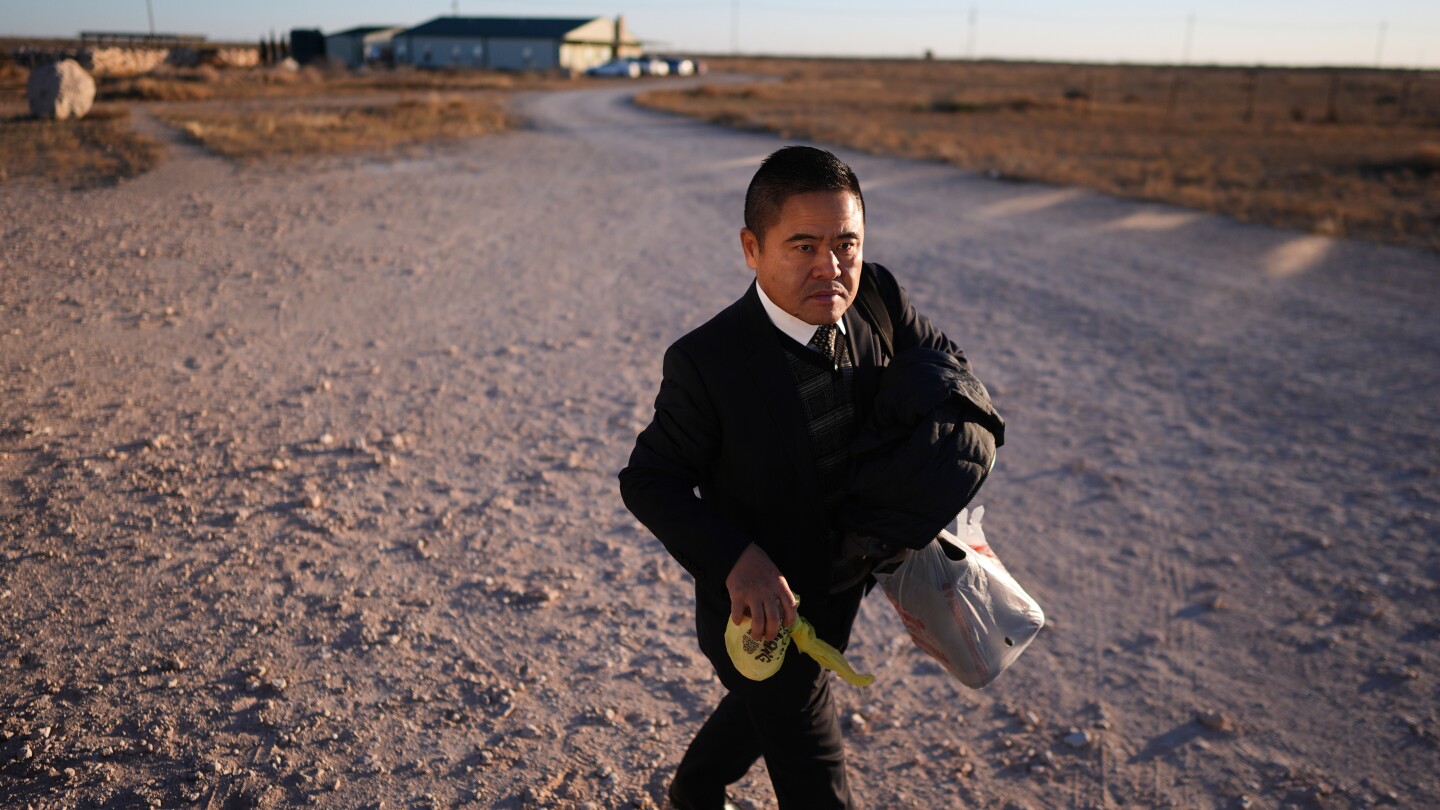
MIDLAND, Texas (AP) — Retired Chinese official Li Chuanliang was recuperating from cancer on a Korean resort island when he got an urgent call: Don’t return to China, a friend warned. You’re now a fugitive.
Days later, a stranger snapped a photo of Li in a cafe. Terrified South Korea would send him back, Li fled, flew to the U.S. on a tourist visa and applied for asylum. But even there — in New York, in California, deep in the Texas desert — the Chinese government continued to hunt him down with the help of surveillance technology.
Li’s communications were monitored, his assets seized and his movements followed in police databases. More than 40 friends and relatives — including his pregnant daughter — were identified and detained, even by tracking down their cab drivers through facial recognition software. Three former associates died in detention, and for months shadowy men Li believed to be Chinese operatives stalked him across continents, interviews and documents seen by The Associated Press show.
“They track you 24 hours a day. All your electronics, your phone — they’ll use every method to find you, your relatives, your friends, where you live,” Li said. “No matter where you are, you’re under their control.”
The Chinese government is using an increasingly powerful tool to cement its power at home and vastly amplify it abroad: Surveillance technology, much of it originating in the U.S., an AP investigation has found.
Stay up to date with the news and the best of AP by following our WhatsApp channel.

Within China, this technology helped identify and punish almost 900,000 officials last year alone, nearly five times more than in 2012, according to state numbers. Beijing says it is cracking down on corruption, but critics charge that such technology is used in China and elsewhere to stifle dissent and exact retribution on perceived enemies.
Outside China, the same technology is being used to threaten wayward officials, along with dissidents and alleged criminals, under what authorities call Operations “Fox Hunt” and “Sky Net.” The U.S. has criticized these overseas operations as a “threat” and an “affront to national sovereignty.” More than 14,000 people, including some 3,000 officials, have been brought back to China from more than 120 countries through coercion, arrests and pressure on relatives, according to state information.
“They’re actively pursuing those people who fled China. … as a way to demonstrate power, to show there’s no way you can escape,” said Yaqiu Wang, a fellow at the University of Chicago. “The chilling effect is enormously effective.”
The technology used to control officials at home and abroad over the past decade came from Silicon Valley companies such as IBM, Oracle and Microsoft, according to a review of hundreds of leaked emails, government procurements, and internal corporate presentations obtained exclusively by AP. This technology mines texts, payments, flights, calls, and other data to identify the friends and family of officials and their assets.
Exiled former Chinese official Li Chuanliang describes how his mother and business associates have been targeted by the Chinese government in an effort to put pressure on him to return back to China. (AP video Serginho Roosblad)
Among the agencies pursuing Li and his family is China’s economic crimes police, which hunts corruption suspects domestically and abroad. IBM said in internal slides that it sold the i2 surveillance software program to this Economic Crime Investigation Bureau, and procurement records show Oracle and Microsoft software was sold to that same division. Leaked emails show i2 software was copied by a former IBM partner, Landasoft, and sold to China’s disciplinary commissions, which investigate officials. None of the sales violated U.S. sanctions.
IBM said in a statement that it sold its division making the i2 program in 2022, and has “robust processes” to ensure its technology is used responsibly. Oracle declined comment, and Microsoft did not respond.
China’s State Council, Ministry of Public Security, National Supervision Commission, and Supreme People’s Court and Prosecutorate did not respond to faxed requests for comment. China’s foreign ministry told AP that Chinese authorities protect the rights of suspects, handle cases lawfully and respect foreign sovereignty.
“We urge relevant countries to drop double standards and avoid becoming a safe haven for corrupt officials and their assets,” it said.
Li’s story is a rare firsthand account from a former Chinese official. Beijing has accused Li of corruption totaling around $435 million, but Li says he’s being targeted for openly criticizing the Chinese government and denies criminal charges of taking bribes and embezzling state funds. A review of thousands of pages of legal, property, and corporate records, interrogation transcripts, and Li’s medical and travel files obtained exclusively by AP, as well as interviews with nine lawyers, support key parts of his story, showing distorted charges, blocked access to evidence, coercive confessions, and altered legal records.
Li drew ire because as a former official, he knew well and exposed the inner workings of local politics, including naming names. While in the U.S., he also started what he called the Chinese Tyrannical Officials Whistleblower Center.
“China places enormous emphasis on the political discipline of even former officials and (Communist) Party members,” said Jeremy Daum, Senior Fellow at Yale Law School’s Paul Tsai China Center. “So when one becomes a vocal critic of the country’s leadership, it doesn’t go over well.”
At a pro-democracy gathering in California in 2020, Li said, he was tailed and questioned by a stranger who knew his identity. That November, an activist secretly working for Beijing asked Li to a meeting and added him to a dissident group chat monitored by China’s police, a 2025 FBI indictment later revealed. In June, an FBI letter identified Li as the possible victim of a crime involving an unregistered Chinese agent.
Both the FBI and the White House did not comment on Li’s specific case. But the White House said it pursues any violations of U.S. law, and the FBI told AP it considers China’s efforts to retaliate against people in the U.S. who exercise their rights “unacceptable.”
Li’s future in the U.S. is unclear. The Trump administration has paused all asylum applications. If he doesn’t return, he could face trial in absentia; if convicted and deported, he could face life in prison.
“Electronic surveillance is the arteries for China to project power into the world … each step that every one of your relatives takes is being monitored and analyzed with big data,” Li said. “It’s absolutely terrifying.”
‘Bulwark against corruption’

Li, a stocky and well-built man who projects authority, rose through the ranks through the 1990s and 2000s, when China’s growing prosperity also brought corruption. Beijing formed a new “economic crime investigation bureau” and established what it called “Golden Tax,” “Golden Finance,” and “Golden Audit” systems to track businesses and officials across the country, using tech from Silicon Valley companies.
Li worked as a state accountant in his hometown, Jixi, in far northeastern China, where he signed off on contracts to purchase American technology. “Bulwark against corruption,” the local media dubbed him.
Li’s family prospered, investing in apartment complexes and renting out forklifts and bulldozers, raising questions over whether he used his position to enrich relatives. Li and his lawyers don’t deny conflicts of interest or civil violations, but say profits were made from legal, regular business operations and deny criminal charges of embezzlement and bribery.
The same technology to fight corruption was also used for surveillance. Police accessed banking records, financial transactions, “Golden Tax,” “Golden Finance,” and “Golden Audit” data along with their own digital policing systems to sift through the finances of wide swaths of the population.
Officials began deploying surveillance technology against each other. China’s former top security official was found to have wiretapped political opponents. And a former vice state security minister colluded with a businessman to leak tapes of a political competitor having sex with a mistress.
In June 2011, Jixi gained a new leader: Xu Zhaojun, a local party boss.
Months later, Li was named vice mayor of Jixi. He soon heard stories about Xu, his new boss.
In January 2012, Xu splurged on an extravagant family getaway to China’s tropical Hainan Island, spending hundreds of thousands of dollars of public money on first-class tickets, lavish seafood dinners, and luxury suites, according to photos and receipts obtained by Li and seen by AP. They brought a maid, bought gold jewelry, and used the VIP airport terminal.
At first Li stayed silent. But Xu kept spending: Luxury cars. Clothes from Louis Vuitton. A high-roller trip to Vegas, with paid escorts and expensive watches.
Xu allegedly colluded with property developers to demolish an apartment complex, a culture center and a thriving shopping plaza for new construction, standing to earn millions in the process, documents show. More than 100 people complained.
But rather than investigate Xu, the Jixi authorities went after the protesters, and police said they were “strictly preventing” residents from complaining to the central government in Beijing, documents show.
The funds Li had earmarked for Jixi’s surveillance apparatus was being turned on ordinary people. He was aghast.
“It only became clear after I became vice mayor,” Li said. “From top to bottom, it’s all corrupt.”
Catch ‘tigers and flies’

It all changed in 2012, when Xi Jinping became China’s top leader.
Gifts of watches, cigarettes and high-end liquor were curbed. Private clubs shuttered, upscale restaurants closed. Banquets were canceled, red carpets rolled up, and thousands arrested.
Back in Jixi, Xu ordered more seizures: Investors wanted to privatize a funeral home. When staff discussed making formal complaints, Xu had some arrested.
Li knew the risks of reporting his boss were high. But in early 2013, Xi called on the party to catch “tigers and flies” in corruption — officials high-ranking and low.
Li gathered evidence: photos, memos, and piles of receipts. He typed out a letter about Xu, accusing his boss and his cronies of embezzling more than $100 million. “They’re not just greedy for the money of the living, but they also eat the money of the dead,” he wrote.
The daring gambit backfired at first.
Also from AP’s investigation into the use of surveillance technology:
The party demoted Xu but didn’t arrest him. Furious, Xu sought revenge, and Li found himself and his relatives the target of state scrutiny. Li’s family was threatened, and his siblings were fired from their government jobs.
But Li’s complaint against Xu had opened the floodgates, with accusations from others mounting. In August 2014, an official from Beijing asked Li for a meeting about Xu. They spoke well into the night.
Within a week, Xu was arrested. He was sentenced to 14 years in prison.
Xu is in prison and could not be reached. Chinese authorities did not respond to a request for an interview with Xu.
Party officials asked Li if he wanted a new post. But he had lost faith in the party.
“I saw through the nature of the system,” Li said. “So I quit.”
Fox Hunt and Sky Net
In 2014 and 2015, the launch of operations Fox Hunt and Sky Net began ensnaring hundreds of former officials and their business partners abroad.
Beijing set up big data centers to track money and relationships and established an online portal to report “fleeing party members and government officials.”
A playbook emerged: Trawl through police databases to find transactions or property that could be deemed suspicious. Identify friends and family who could be coerced to confess. Then announce corruption charges.
A leaked photo of the internal police software used to hunt officials suggests the moniker “Sky Net” was inspired by an American movie, “The Terminator,” about a cyborg assassin that hunts humans.
At first, the U.S. government was open to cooperating with Beijing’s requests for information and extradition, said Holden Triplett, FBI attache in Beijing from 2014 to 2017. But soon, the U.S. realized China’s anti-corruption campaign was often about stifling dissent.
“It was such a low level of information, not even really evidence, it was not enough for us to take any action ever,” Triplett told AP. “What they tended to focus on were things that frankly were threatening to the state and threatening to the party potentially, or somehow would make the party look bad.”
In 2015, Washington complained that Chinese agents were flying to the U.S. and stalking targets without approval, including U.S. permanent residents. Agents brought night goggles from China, snapped photos and taped threatening messages on doors.

Marketing documents and a leaked copy of software used against officials fleeing abroad show how American technology enabled Beijing’s playbook.
IBM marketed i2 to Chinese police to allow them to flag officials based on the value of their assets and that of their families, according to a slideshow whose metadata identifies it as being from 2018. They customized financial software to add a function for Chinese officials to “sign off” on orders.
i2 was also copied by an IBM Chinese reseller, Landasoft, which developed its own software that drew connections to flag “suspicious individuals,” such as relatives connected to a targeted official. A leaked copy of Landasoft software showed one button was called “associated persons management.” Another showed special functions for Valentine’s Day and other holidays, when loved ones were more likely to call.
Landasoft systems flagged suspicious transactions and tracked suspected prostitutes or when two people of the opposite gender booked the same hotel room. Landasoft did not respond to a request for comment.
Monitoring and threatening family was key to getting back anyone who had fled.
“A fugitive is like a kite,” said Li Gongjing, a captain in the economic crime investigation division of the Shanghai police, in an interview with state media. “He may be abroad, but the string is in China, and he can always be found through his family.”
Fear and loathing in the Communist Party

After Li quit the party, auditors trawled through his finances — usual practice for departing officials. Three years later, in 2017, they declared him clean.
The next year, Xi removed term limits, allowing him to rule for life. He used the anti-corruption campaign to sideline rivals and eliminate opposition.
Soon, even those who were hunting other officials fell victim to the government.
In 2018, Chinese police official Meng Hongwei was detained in Beijing, abruptly ending a two-year term as Interpol president during which the international policing organization issued hundreds of Red Notices requested by China. Red Notices alert global law enforcement to look out for a criminal suspect, upon request of a member country, but Interpol has spent years trying to prevent abuse of the system for hunting down political asylum-seekers.
In February 2020, agents came for Li’s friend and former deputy, district chief Kong Lingbao, who had criticized Beijing’s censorship of key information in the COVID-19 pandemic. A rival secretly recorded Kong saying during a private dinner that he could no longer work for the party. Kong was summoned to the local discipline inspection office and never came out: he was being investigated for “inappropriate remarks”.
Kong’s arrest prompted a friend to ring Li in Korea and warn him. That July, Chinese authorities opened an investigation into Li.
A month later, Li told The Epoch Times, a dissident Chinese publication, that he had quit the party, and portrayed himself as a dissident. He says he did not know he was under investigation at the time.
A week after the interview was published, strangers stalked Li at the unveiling of a sculpture dedicated to pro-democracy activists in Hong Kong, asking menacing questions and tailing him by car. Agents identified the address of one of his safe houses.
In early September, the party publicly accused Li of embezzling “huge amounts” of state funds, paying money for sex and fleeing abroad. It was “only a matter of time”, authorities declared, before Li would be arrested.
“We advise all corrupt officials who have fled abroad, including Li Chuanliang, that no matter how cunning a fox is, it cannot escape the eyes of the hunter,” it said.
Official statements and interviews with four people familiar with Li’s case show Xi and the central government got directly involved after Li spoke out.
Beijing tapped phones, seized assets and installed cameras outside the homes of friends and family. Some detained were denied surgery or other medical care, even those recovering from heart disease, cancer, and other illnesses. Li’s aunt was released from a hospital in a vegetative state with bruises on her head and all over her body. Even the Li family grave was dug up.
Li’s friend, Kong, was sentenced to over a decade in prison for allegedly taking bribes. The party claimed he had watched porn and ignored his work, which they blamed for the spread of COVID in his district. Furious, Li kept speaking out.
In December 2020, a man from Shanghai posing as a private investigator approached Zheng Cunzhu, vice chairman of the dissident China Democracy Party. The man offered $100,000 in bribes for information on Li and promised more if he obstructed Li’s bid for asylum, Zheng said in an interview and a letter.
In February 2021, Li learned the Chinese government had asked Interpol to issue a Red Notice declaring to police worldwide that Li was a wanted man. Interpol retracted the Red Notice after Li filed a complaint.
Li began donning masks and hats in public and carrying multiple phones, wary of surveillance. He floated from safe house to safe house with Christians across the United States.
In October 2024, a Chinese court announced that Li was suspected of corruption totaling over 3.1 billion RMB, or roughly $435 million. The government claimed they seized 1,021 properties, 38 vehicles, and 18 companies belonging to Li and charged his relatives and associates with crimes related to Li. The lawyers who reviewed the case told AP there were serious anomalies with the charges.
Many of the lawyers Li has tried to hire were rejected, threatened, and put under surveillance. At least three were summoned by Chinese legal authorities. They were told Li’s case was “political” and important to leaders from Beijing, and warned against speaking publicly, according to memos viewed by AP.
“Once you get to the point that you’re criticizing the party, it’s no holds barred,” said Ryan Mitchell, a law professor at the Chinese University of Hong Kong. “Resistance is punished.”
‘They wouldn’t even show us the accusations’
In a courthouse in China, Li’s friends and family faced legal proceedings tied to his corruption charges. A plainclothes officer outside stopped an AP reporter from taking photos, saying a “sensitive political case” was being heard.
“They didn’t show any evidence. Instead, they told a story,” one of the lawyers told AP, declining to be named because they were warned against speaking to the press. “They wouldn’t even show us the accusations.”
Authorities in Heilongjiang, where the proceedings were held, did not respond to a faxed request for comment.
Li is now cut off from friends and family, denied legal assistance and clueless even to the details of the charges against him. So he is once again resorting to speaking out — this time on YouTube.
Li acknowledges the situation seems hopeless. But he’s pressing on.
“Why am I speaking up?” he said. “Today, it’s me. Tomorrow, it might be you.”
__
Independent investigative journalists Myf Ma in New York and Yael Grauer in Phoenix and AP journalists Serginho Roosblad in Texas, Garance Burke in San Francisco and Byron Tau in Washington contributed to this report.
—-
Contact AP’s global investigative team at [email protected] or https://www.ap.org/tips/.



