Connect with us

NewsBeat

Dad-to-be accused of scheduling fake YouTube ‘live-stream’ of himself as pregnant girlfriend was murdered

Published

on

Daily Record

The prosecution argues Stephen McCullagh put on an ‘act’ to police after his girlfriend was found with horrific injuries in her home

A man accused of murdering his pregnant girlfriend allegedly tried to cover his tracks by pre-recording a clip he said was ‘livestreamed’ online at the time she was killed.

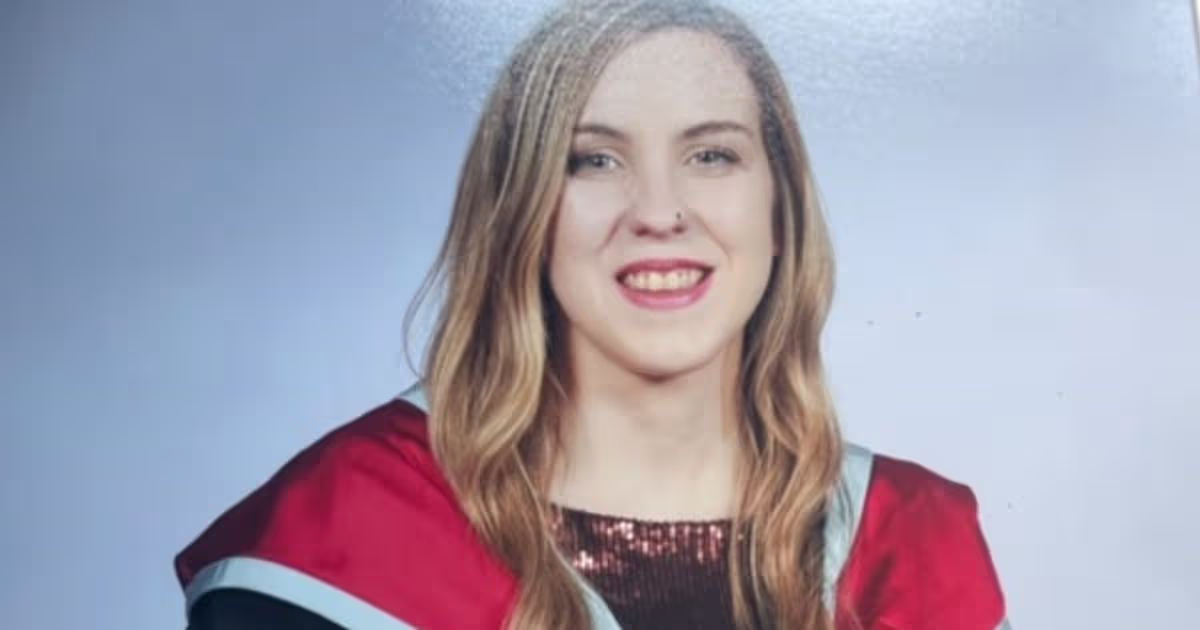
The mum-to-be, Natalie McNally, 32, was brutally attacked and killed in her own home in Lurgan, Co Armagh, just a week before Christmas on December 20 in 2022.

Advertisement

Stephen McCullagh, 36, of Lisburn, appeared before Belfast Crown Court this week on suspicion of her murder, which he denies, reports The Mirror.

The prosecution argues McCullagh murdered his partner and tried to cover his back for the crime – going so far as to suggest an ex of McNally’s was behind the attack. He also reportedly insisted he had been live streaming a game on YouTube for six hours at the time of the attack.

He sat in the dock between two prison guards on Monday morning as the trial got under way. Family and friends of Ms McNally are watching on from the public gallery.

Advertisement

A jury of six men and six women have been sworn to serve during the trial, which is expected to last for around five weeks, before Judge Mr Justice Patrick Kinney.

Prosecuting barrister Charles MacCreanor KC said it is their case that the defendant murdered Ms McNally and then “put on an act” to cover his tracks.

This included suggesting that an ex-partner of Ms McNally’s had been responsible, telling police there was “blood everywhere”, and that “someone had knocked 10 bells out of her by the look of it”.

Giving an outline of the evidence that will be heard during the trial, Mr MacCreanor contended that McCullagh, known on the online platform YouTube as Votesaxon07, concocted a “cover story” that he had been livestreaming himself playing video games on the evening of Sunday December 18.

Advertisement

But it is the prosecution case that McCullagh had pre-recorded six hours of himself playing video games which he broadcast as live that Sunday evening, and instead he took a bus to Ms McNally’s home in Lurgan.

McCullagh’s distressed sounding 999 call on the night of Monday December 19 was also played during the first day of the trial.

“We say that this is a planned, calculated, pre-meditated murder by the defendant,” Mr MacCreanor put to the jury. One which he hoped to get away with. Natalie McNally had suffered serious and multiple fatal injuries.”

Advertisement

He said her cause of death was found to have involved compression of her neck, “suggestive of finger tips grasping”.

She also suffered three stab wounds to her neck caused by a bladed weapon and five lacerations to the back, top and right of her head “in keeping with having sustained at least five heavy blows”.

He said any of these could have caused death alone.

He went on: “Natalie McNally was pregnant at the time and Stephen McCullagh was the father of her unborn child.”

Advertisement

The time of death has been estimated to be between 8.50pm and 9.30pm on Sunday December 18 2022. McCullagh made a 999 call at around 10pm on Monday December 19 from her home in Lurgan, and told police the last time he saw Ms McCullagh had been on Sunday afternoon.

“On the prosecution case, this call is false, it’s an act, it’s put on by him, part of his plan to do the murder and get away with it,” Mr MacCreanor KC said.

He said the ambulance service and police were quickly at the scene, and reported finding McCullagh with Ms McNally.

“Natalie McNally is lying at the top of the stairs … which was the living area of the home,” he said. “It’s clearly apparent to paramedics that Natalie McNally is dead, everything is consistent with this being an attack upon her, presence of blood and the visible injuries.

Advertisement

“Stephen McCullagh is described by the paramedics as performing CPR to the female and he’s described as being quite visibly upset.”

He said police described McCullagh as being “distraught and overcome”.

“Again, we say this is all part of an act, a front,” he said. During the 999 call, McCullagh is heard audibly upset and sobbing as he asked for emergency services to come to Ms McNally’s address in Lurgan, urging: “Please come as soon as you can”.

The operator talks McCullagh through how to position Ms McNally and administer CPR compressions as he waited for paramedics to arrive, encouraging him to “keep going”, telling him he was giving her the best chance.

Advertisement

The trial continues.

Source link

Continue Reading
Click to comment

Leave a Reply

Your email address will not be published. Required fields are marked *

NewsBeat

Ex-Love Islander Camilla Thurlow meets with Prime Minister to discuss Send reform

Published

on

Ex-Love Islander Camilla Thurlow meets with Prime Minister to discuss Send reform

She said she struggled to find questions that would cover every concern she had about the Government’s proposed reforms, adding: “I owe so much to all of you, who have stood with us ever since we have shared Nora’s diagnosis, and have been so generous in sharing your own experiences, both the good and challenging.

Source link

Continue Reading

NewsBeat

Police in Britain arrest former ambassador to US Peter Mandelson in probe into Epstein ties

Published

on

Police in Britain arrest former ambassador to US Peter Mandelson in probe into Epstein ties

LONDON (AP) — British police on Monday arrested Peter Mandelson, a former U.K. ambassador to the United States, in a misconduct probe stemming from his ties to the late Jeffrey Epstein. It came days after a friendship with Epstein landed the former Prince Andrew in police custody.

Both men are suspected of improperly passing U.K. government information to the disgraced U.S. financier, and the high-profile British arrests are some of the most dramatic fallout from the trove of more than 3 million pages of Epstein-related documents released last month by the U.S. Justice Department.

London’s Metropolitan Police force said “officers have arrested a 72-year-old man on suspicion of misconduct in public office” at an address in north London. He was taken to a police station for questioning.

The man was not named, in keeping with British police practice, but the suspect in the case previously was identified as the former diplomat, who is 72. Mandelson was filmed being led from his London home to a car by plainclothes officers on Monday afternoon.

Advertisement

Under U.K. law, police can hold a suspect without charge for up to 24 hours. This can be extended to a maximum of 96 hours. Mandelson could be charged, released unconditionally or released while investigations continue.

Claims of leaked government information

Police are investigating Mandelson over claims he passed sensitive government information to Epstein a decade and a half ago. He does not face allegations of sexual misconduct.

His arrest came four days after Andrew Mountbatten-Windsor, the former Prince Andrew, was arrested in a separate case on suspicion of a similar offense related to his friendship with Epstein. Andrew was released after 11 hours in custody while the police investigation continues.

Mandelson served in senior government roles under previous Labour governments and was U.K. ambassador to Washington until Prime Minister Keir Starmer fired him in September after emails were published showing that he maintained a friendship with Epstein after the financier’s 2008 conviction for sex offenses involving a minor.

Advertisement

The files released in January contained more explosive revelations about Mandelson’s ties to Epstein, whom he once called “my best pal.”

Messages suggest that Mandelson passed on sensitive — and potentially market-moving — government information to Epstein in 2009, when Mandelson was a senior minister in the British government. That includes an internal government report discussing ways the U.K. could raise money after the 2008 global financial crisis, including by selling off government assets. Mandelson also appears to have told Epstein he would lobby other members of the government to reduce a tax on bankers’ bonuses.

British police launched a criminal probe earlier this month and searched Mandelson’s two houses in London and western England.

The decision to appoint Mandelson nearly cost Starmer his job earlier this month, as questions swirled around his judgment about someone who has flirted with controversy during a decades-long political career.

Advertisement

Though he acknowledged he made a mistake and apologized to victims of Epstein, Starmer’s position remains precarious. His future may rest on the release of files connected to Mandelson’s appointment. The government has pledged to begin releasing those documents in early March, though the timeline may be complicated by his arrest.

Mandelson a contentious figure

Mandelson has been a major, if contentious, figure in the center-left Labour Party for decades. He is a skilled — critics say ruthless — political operator whose mastery of political intrigue earned him the nickname “Prince of Darkness.”

The grandson of former Labour Cabinet minister Herbert Morrison, he was an architect of the party’s return to power in 1997 as centrist, modernizing “New Labour” under Prime Minister Tony Blair.

Mandelson served in senior government posts under Blair between 1997 and 2001, and under Prime Minister Gordon Brown from 2008 to 2010. In between, he was the European Union’s trade commissioner. Brown has been particularly angered by the revelations and has been helping police with their inquiries.

Advertisement

Mandelson twice had to resign from government during the Blair administration over allegations of financial or ethical impropriety, acknowledging mistakes but denying wrongdoing.

He later returned to government and was back on the political front line when Starmer named him ambassador to Washington at the start of U.S. President Donald Trump’s second term. Mandelson’s trade expertise and comfort around the ultra-rich were considered major assets. He helped secure a trade deal in May that spared Britain some of the tariffs Trump has imposed on countries around the world.

The status of the deal is now up in the air after Trump announced a new set of global tariffs in the wake of a U.S. Supreme Court decision quashing his previous import tax order.

Earlier this month Mandelson resigned from the House of Lords, Parliament’s upper chamber, to which he was appointed for life in 2008. But he still has the title — Lord Mandelson — that went with it.

Advertisement

Source link

Advertisement
Continue Reading

NewsBeat

Sales of short-term period delay treatments surge, pharmacy reveals

Published

on

Sales of short-term period delay treatments surge, pharmacy reveals

Data from Chemist4U has revealed purchases of Norethisterone and Mexdroxyprogesterone doubled in January compared to the previous year, as women turned to temporarily delaying their period ahead of the end of winter.

The figures were revealed after Google searches for “how to delay my period” jumped 24% the week before valentine’s day, highlighting how women are taking control of their own cycles to avoid inconvenient timing.

Sales of short-term period delay treatments surge, pharmacy data revealsSales of short-term period delay treatments surge, pharmacy data reveals (Image: Newsquest)

Pharmacist Hanna Yusuf, a women’s health expert at Chemist4U outlines how period delay treatments work and the practical way that women can use them.

She said: “Periods can be unpredictable, and their timing isn’t always ideal. For those who want to delay natural bleeding for a short time, period delay medication may be an option.

Advertisement

“Period delay involves using a prescription-only medication to temporarily postpone your period. It’s generally a safe short-term option that can help you avoid bleeding during a trip, a big event like a wedding, or any time it would be particularly disruptive.

“Postponing your period can give you back a sense of control over your body, help manage any period related pain, and give you the freedom to focus when you most need it. It can also offer emotional relief, helping you feel more confident and prepared for whatever you’ve got planned, without the worry of cramps, leaks, or fatigue getting in the way.

“Delaying or skipping a period is generally safe when done correctly, and your period typically resumes within 2-3 days after stopping the tablets. The important thing is to use approved methods and speak to a healthcare professional first so they can help you can choose the right option for your individual circumstances.”

Hanna shares her practical guidance on delaying a period safely:

Advertisement

1.     Plan ahead

·        You usually need to start tablets at least three days before your period is due

·        Track your cycle for at least two to three months before you want to delay your period, so you can predict dates more accurately

·        If your cycles are irregular, discuss timing early with a healthcare professional and allow for a margin of error in case your period is due sooner than expected

Advertisement

2.     Know your options

·        If you’re not on hormonal contraception, Norethisterone, is the primary medication prescribed for period delay because it’s highly effective and acts quickly; medroxyprogesterone may be another option, but is usually reserved for those who have a higher risk of blood clots

·        Both medications work by maintaining your progesterone levels, preventing your womb lining from shedding until you stop taking them

·        If you’re on the combined contraceptive pill, you may be able to delay bleeding by skipping the break but always check with your prescriber first

Advertisement

3.     Check eligibility

·        Period delay treatments aren’t suitable for everyone and are prescribed based on individual risk factors

·        For example, they may not be appropriate if you have certain medical conditions which may put you at risk of complications such as blood clots.

·        Other factors, such as smoking status, migraine history, blood pressure, and personal or family history of clotting disorders, will also be assessed

Advertisement

 Hanna concludes: “While it’s understandable that people want more control over when their period arrives, particularly around important events or travel, it’s essential to approach period delay safely. Always seek advice from a healthcare professional before starting treatment, make sure it’s suitable for you, and follow the instructions in your patient information leaflet carefully.”

Source link

Advertisement
Continue Reading

NewsBeat

What wearables can (and can’t) tell you about your heart health

Published

on

What wearables can (and can’t) tell you about your heart health

Half of people in the UK use a wearable device, such as a fitness tracker or smartwatch. These devices collect data relating to health and physical activity levels – including heart rate, step count and sleep quality. With the emergence of AI, such devices will probably become even more sophisticated – potentially able to diagnose our health problems before our GP.

But while wearables can be really useful when it comes to understanding many aspects of your heart health, they still have many shortcomings – so it’s important not to rely on them for everything.

A key strength of modern wearables is the fact that they record such a wide range of useful data, and track trends over time. This makes them perfect for measuring whether any lifestyle changes you’ve made are working for you, and what effects they might be having. For instance, your wearable can tell you if your health kick has had a measurable affect on your sleep quality or blood pressure.

In addition to measuring step count and physical activity, many of the most commonly worn wearables collect cardiovascular data via photoplethysmography (PPG). This is where a light located at the back of the wearable interacts with tiny blood vessels in the skin to give an estimate of changes in blood volume. These changes can be used to accurately measure heart rate, rhythm and blood oxygen levels.

Advertisement

Many currently available devices are also able to record electrocardiographic (ECG) data. This also records your heart’s electric activity, including heart rate and rhythm.

This is why some wearables, particularly those with ECG technology, could be useful in cardiology consultations.

There are currently limitations to the ECGs a cardiologist would normally use to diagnose heart rhythm issues. These ECG monitors only record heart rhythm data for a limited period, such as 24 or 72 hours. This could mean doctors don’t get a full picture of heart health.

But since many people who own a smartwatch or fitness tracker wear them for many hours of the day and over many weeks, this means their wearable may be recording at the time when cardiac symptoms – such as palpitations – occur. This means wearables may overcome the inherent limitations with clinical ECG recordings.

Advertisement
Wearables may even be able to detect abnormal heart rhythms.
Melnikov Dmitriy/ Shutterstock

For instance, a recent study demonstrated that smartwatches can reliably detect atrial fibrillation (a heart rhythm disorder that increases risk of stroke) in patients at risk of the condition. And wearables can also be useful for regularly and accurately monitoring daytime blood pressure.

So, wearables have the ability to provide data that is highly useful to a cardiologist in helping determine a probable diagnosis. But just how much can we rely on this data?

Wearable limitations

Most wearables that detect blood pressure do so via PPG data, which measures blood pressure differently to an inflatable blood pressure cuff. Wearables may also only provide a blood pressure range rather than absolute results. This means a patient may not know whether their “true” blood pressure is normal or not.

The British and Irish Hypertension Society, which formally validates and endorses cuff-based blood pressure monitors, currently doesn’t have a framework to validate wearables. This means no wearables on the market which provide blood pressure monitoring have been officially validated.

Advertisement

There’s also a lack of standardisation across the market for how different wearables produce data for particular metrics. This means it’s possible different devices could give different readouts – even if they’re looking at the same person. If wearables are to be integrated into the healthcare system in future, then standardised, validated methods would be needed.

There are also potential issues in how wearables are positioned within the market with regard their medical capabilities.

Some are advertised as having medical-grade measuring capabilities. However, the majority of devices on the market have not been approved as medical devices by regulatory bodies. This distinction is important for the average consumer to understand, so they don’t trust the device’s data more than they should.

While wearables can be extremely useful for understanding many aspects of your day-to-day heart health, there’s still much about them that will need to be improved before they become a standard part of cardiac care.

Advertisement

Quality assurance and compatibility across different brands will be key, as will ensuring a patient’s data is both reliable and accessible to healthcare staff on their electronic health records.

These are important issues that must be addressed soon if wearable technology is to become a standard part of NHS treatment by 2035, as outlined in the NHS’s ten-year plan for England.

Source link

Advertisement
Continue Reading

NewsBeat

Kentucky man covered in fur arrested after he is found having sex with a deer, cops say

Published

on

Kentucky man covered in fur arrested after he is found having sex with a deer, cops say

A Kentucky man who was covered in fur has been arrested after he was found having sex with a dead deer, according to authorities.

Allen Osborne, a 32-year-old from Owensboro, was charged with sexual crimes against animals by Central City police on Saturday following the disturbing discovery, according to reports.

A driver had spotted Osborne appearing to have sex with the deer on the side of the road in Muhlenberg County and reported it to police, according to news outlet WEHT, which cited the Central City Police Department.

Allen was found by police with his pants down and blood on his boxers, the Lexington Herald-Leader reported, citing court documents.

Advertisement
Allen Osborne, a 32-year-old Kentucky man who was covered in fur, has been arrested after he was found having sex with a dead deer, according to authorities
Allen Osborne, a 32-year-old Kentucky man who was covered in fur, has been arrested after he was found having sex with a dead deer, according to authorities (Muhlenberg County Detention Center)

The documents alleged Osborne also had deer fur on his hoodie.

Osborne was booked into the Muhlenberg County Detention Center and was being held on a $5,000 bond as of Monday afternoon.

Sexual crimes against animals is a Class D felony, which carries a one to five-year prison sentence if convicted, according to reports.

Information about Osborne’s legal representation was not immediately clear.

The Independent has reached out to Central City police for comment.

Advertisement

Source link

Continue Reading

NewsBeat

Welsh poll on assisted dying plan shows overwhelming support

Published

on

Wales Online

The campaign group which commissioned the poll says it is the largest poll ever conducted on assisted dying in Wales and includes all age groups, socio-economic statuses, and voting intentions

Almost three-quarters of people in Wales back assisted dying being introduced in Wales, a poll has found.

The poll of 4,000 adults across Wales, conducted by Opinium for Dignity in Dying, found 72% support the legalisation of assisted dying compared with just 15% who oppose it. When asked: “To what extent would support or oppose making it legal for someone to seek ‘assisted dying’ in Wales how strong is your view?” 35% said “strongly support” and another 37% said “somewhat support”.

The support group says it is the largest poll ever conducted on assisted dying in Wales and includes all age groups, socio-economic statuses, and voting intentions.

Advertisement

The 4,000 people asked were over 18 and interviewed between December 23, 2025, and January 19, 2026. The key findings were:

  • 72% supported the legalisation of assisted dying in Wales when asked: “To what extent would support or oppose making it legal for someone to seek ‘assisted dying’ in Wales and how strong is your view?”
  • Three-quarters (76%) said if assisted dying were legal in England it should also be legal in Wales while only 12% disagreed.
  • If assisted dying were legal 62% believe it should be accessible as part of NHS Wales services while just 17% think it should be delivered through a separate non-NHS service.
  • If assisted dying were available through the NHS in England but not in Wales 41% said they would consider assisted dying and would be willing to travel to England to access NHS provision and 19% said they would consider assisted dying but would not be willing to travel.
  • Views were evenly split on which level of government should be responsible for designing an assisted dying service in Wales. Around three in 10 favour the UK Government (31%) while a similar proportion prefer the Welsh Government (30%). A further quarter (25%) express no preference either way suggesting no clear public consensus on governance arrangements.

Senedd members will on Tuesday debate assisted dying in the Senedd. There are strong feelings on both sides of the debate. Noah Herniman is one of those campaigning for it saying he wants the same rules in place in Wales as in England.

But opposing it are a host of medical professionals. More than 250 of Wales’ leading medics have urged Senedd members not to back the proposed new assisted dying law.

The law, formally known as the Terminally Ill Adults (End of Life) Bill, would allow adults who are terminally ill, subject to safeguards and protections, to request and be provided with assistance to end their own life.

It is a UK law which has to be passed by Westminster and not directly a matter devolved to Wales but it does have an impact on areas of politics which are devolved to Wales so a vote has to take place here too. Usually that is a formality but this looks at how assisted dying is delivered in Wales should the Terminally Ill Adults Bill pass.

Advertisement

The polling shows support for the law comes across the political spectrum with particularly strong backing among Plaid Cymru voters (78%) alongside Welsh Labour voters (77%), Green voters (85%), Welsh Conservative backers (67%), and Reform UK voters (70%) underlining that assisted dying is not a partisan issue but one that commands consistent high public support across party lines.

Just over three-quarters (76%) say that if assisted dying were legal in England it should also be legal in Wales.

If the Senedd votes to approve the legislative consent motion (LCM) this would enable assisted dying to be implemented in Wales in line with the legislation, including through NHS Wales, ensuring people in Wales have equal access to any service in line with those in England. Terminally ill individuals and affected families have warned MSs rejecting the LCM risks creating a system in which people in Wales face additional barriers including being forced to travel to England or rely on private providers at the most vulnerable time of their lives.

Chief executive of Dignity in Dying Sarah Wootton said the findings send a clear message to the Senedd. “This is the biggest poll ever carried out on assisted dying in Wales and it shows beyond doubt that not only do the public support reform, they want their political representatives to engage and actively shape a service fit for Wales,” she said.

Advertisement

“The legislative consent motion is not about the principle of assisted dying. It’s about fairness and equality for the people of Wales. It’s about ensuring the Senedd has the power to design a system that reflects Welsh values, serves the diverse communities of Wales, and is delivered through Welsh health systems.

“Voting it down won’t stop assisted dying from becoming law – it will only stop the Senedd from shaping it and deny dying Welsh people equal access to choice at the end of life.”

Ensure our latest news and sport headlines always appear at the top of your Google Search by making us a Preferred Source. Click here to activate or add us as Preferred Source in your Google search settings.

Source link

Advertisement
Continue Reading

NewsBeat

Mother of Nottingham killer Valdo Calocane asked for son to be admitted to hospital after outburst

Published

on

Mother of Nottingham killer Valdo Calocane asked for son to be admitted to hospital after outburst

Valdo Calocane’s mother pleaded for her son to be admitted to hospital after a violent outburst three years before he killed three people in a mass stabbing in Nottingham, a public inquiry has heard.

Calocane, who had been diagnosed with paranoid schizophrenia, killed University of Nottingham students Barnaby Webber and Grace O’Malley-Kumar, both 19, and caretaker Ian Coates, 65, and attempted to kill three more people in Nottingham in June 2023.

A series of reports into the incident by the NHS so far have highlighted failings in Nottinghamshire Healthcare Foundation Trust’s management of Calocane, including failures to appropriately assess the risk he posed to himself and others. A public inquiry will now scrutinise prosecutors, police and medical professionals.

During the first day of the hearings on Monday, the inquiry heard that Calocane first had a serious violent episode on 24 May 2020. But mental health professionals ruled Calocane was safe to be treated in the community rather than being admitted.

Advertisement
Ian Coates, Barnaby Webber and Grace O’Malley-Kumar were fatally stabbed by Calocane

Ian Coates, Barnaby Webber and Grace O’Malley-Kumar were fatally stabbed by Calocane (PA)

Counsel to the inquiry Rachel Langdale told the hearing that, during the incident, Calocane, who is referred to as “VC” in proceedings, was found “repeatedly kicking and punching a door” in an attempt to get into a neighbour’s flat.

He was assessed by a mental health professional and found to be suffering from a psychosis mental health episode and “was noted to be presenting with mental health issues, hearing voices, appeared vacant, and had not slept for five days”.

At a follow-up mental health act assessment, Dr Gandhi, along with an approved mental health practitioner, Ben Williams, and a mental health nurse Anna Palmer, agreed he would be offered treatment with antipsychotic medication in the community rather than as an inpatient admission.

Advertisement

According to the statement, Dr Gandhi said he was leaning towards detaining Calocane “given it was the first presentation of psychosis, and a lack of information on risk history”. But he said that the team of professionals also “considered the research evidence that shows overrepresentation of young Black males in detention”.

Dr Gandhi said it is part of his role in assessments to be aware of research, evidence and data including health inequalities but that it would not have affected the decision to admit or treat Calocane in the community.

The inquiry will look at how appropriate that mental health act assessment was.

KC Langdale’s statement later quotes Royal College of Psychiatrist’s evidence stating there is “there is no evidence that psychiatrists are not admitting patients because they are black. The rates of admission are the same as at the time of the publication of the independent review and recent evidence shows that detentions are going up.”

Advertisement

She added that in the specific case of Calocane the inquiry may want to consider whether race was a factor however said the evidence so far received does not suggest it was and that it he was admitted on four on four occasions.

Shortly after being released, Calocane was arrested after attempting to get into another neighbour’s flat and causing the the woman to become so scared she jumped out of her first floor window, causing serious damage to her spine.

Following his arrest, Ms Palmer spoke with his mother, Celeste Calocane, who “noted that she would prefer that her son goes into hospital for treatment, as he’s a risk to others in his current mental state”, the inquiry heard.

Ms Langdale added that the chair of the inquiry Deborah Taylor may ask why Calocane was released at that stage and whether release straight into the community was appropriate.

Advertisement

It was not until the next day, during a further mental health act assessment, that he was recommended for section.

The inquiry will also probe why services deemed, prior to discharging him, that there had been “no incidents of violence” from Calocane despite the episodes in May 2020, as well as a prior incident in which he “had entered a neighbour’s flat to confront those who believed were trying to spy on him and torment his mind”.

Ms Langdale’s opneing statement further revealed in Christmas 2022, Calocane sent his parents files over christmas which included, a document explaining he “had been hearing voices in his head all the time, but this wasn’t the result of mental ill-health”, but it was explained by “mind control technology”, the inquiry heard.

After the attacks on June 13, analysis of Calocane’s phone was undertaken, which show he researched “mind control technology” and watched videos including of a shooting. He also viewed documents with some content relating to the law and police powers, Ms Langdale said.

Advertisement

He largely kept a low profile during his fourth hospital admission in early 2022, spending most of his time on his phone.

Ms Langdale said the inquiry will “explore with treating clinicians whether they ever asked VC what he was viewing on his phone, if not, why not, and whether patients routinely have unfettered access to their phone”.

His risk assessment was updated for the final time prior to the attacks on February 28 2022 – which noted “that given the history of violence and aggression, there should not be home visits, and if a home visit was required it should be a joint visit; no lone working”.

Ms Langdale added: “We will ask why this assessment of the risks to the community medical team did notapply equally to other students and the wider public.”

Advertisement

In September 2022 Calocane was discharged from the early intervention in psychosis team which were responsible for his care in the community at the time. He was discharged back to his GP as the team could not make contact with him despite attempts to.

The inquiry will consider whether discharging him to his GP for non-attendance to appointments should have been a signal of his deteriorating mental health.

In the months leading up to the killings in June 2023 Calocane’s GP sent text messages asking him to arrange an appointment, however he was not seen and was not provided with any medication.

“The Inquiry will consider the role of primary care services following discharge of non-engaging patients, especially where the non-engagement may be an indication of deteriorating mental health and increased risk,” the statement said.

Advertisement

Ms Langdale also said there appears to be a “lacuna” in terms on monitoring patients’ medication as Calocane’s GP claimed this was the responsibility of the trust.

“It does not appear the GP practice took any steps to manage VC’s prescriptions or make any efforts to ensure he received any. VC was essentially in the community disengaged from any health service and unmedicated”, the inquiry heard.

Calocane was sentenced to an indefinite hospital order in January 2024 after admitting manslaughter by diminished responsibility and attempted murder – something which has been widely criticised by the victims’ families.

The inquiry continues.

Advertisement

Source link

Continue Reading

NewsBeat

Silent Witness star says Jack Hodgson will be ‘tested’ after unexpected twist

Published

on

Wales Online

Jack Hodgson faces a dramatic storyline on BBC’s Silent Witness.

Jack Hodgson has been a fixture on Silent Witness for years – but could his tenure on the programme be drawing to a close?

There has been considerable speculation surrounding his future on the BBC drama following major new spoilers.

Advertisement

The upcoming episodes, Grace Of God, suggest a concerning development for Jack. The beloved forensic scientist becomes embroiled in a drunken pub altercation tonight, but matters escalate dramatically when the man he fought with subsequently turns up deceased.

Discussing what his character experiences this series, David said: “Jack and Nikki are settling into a new home in Birmingham and getting used to The Bowman Centre, trying to find a bit of balance.

READ MORE: The One Show host takes swipe at guest’s show as they say ‘this is not work’READ MORE: BBC star issues advice after cancer diagnosis as they admit ‘it creates more problems’

Advertisement

“Jack is still the same stubborn, sarcastic fella, just with a bit more self-awareness. He’s older and more mature. He’s more affected by the trials and tribulations of his work and we see that play out majorly in this series. Jack is really tested in one story, a very personal odyssey he must go on alone.”

In the dramatic instalment, we witness Jack battling to cope as he believes he’s responsible for this man’s death, and matters deteriorate further when he finds himself behind bars. Is Jack in serious peril?, reports the Mirror.

Discussing his character, David Caves spoke candidly about “vulnerable” Jack and his struggles. “The thing I love about Jack is that he’s tough but can be vulnerable. He can fight but knows how to control it. He’s a truth-seeker, a righteous crusader, a bit of a warrior-monk, really,” he said.

Advertisement

“There’s always something new to find with him. And honestly, the cast and crew feel like family now, the kind you don’t mind seeing again every year. It’s got everything, gripping stories, interesting science, and characters people have grown up with. It’s comforting in a strange way, even though it’s about death.”

For the latest showbiz, TV, movie and streaming news, go to the new **Everything Gossip** website.

The concluding instalment of Silent Witness, now streaming on BBC iPlayer, delivers a troubling development for Jack – as his wife Nikki Alexander desperately attempts to protect him using the only means at her disposal.

Advertisement

The question remains, however – will she reach him in time, or is Jack destined for a far darker fate?

Silent Witness is available to watch on BBC iPlayer.

Ensure our latest headlines always appear at the top of your Google Search by making us a Preferred Source.** Click here to activate**** or add us as your Preferred Source in your Google search settings.**

Source link

Advertisement
Continue Reading

NewsBeat

The Bridgerton actress with links to Barnard Castle and Darlington

Published

on

The Bridgerton actress with links to Barnard Castle and Darlington

Darlington Soroptimists are collecting ideas for their exhibition on March 7, and so far have compiled some greats from history, like the first female mayor and councillor and the great female crusaders against slavery and for women’s suffrage.

Lady Starmer is therefore among them. For much of the 20th Century, she was Darlington’s version of the Queen Mother and nothing to do with our present Prime Minister. She was president of 38 local organisations and vice-president of 37; she gave huge amounts to charity, including her West End home which is now a sheltered house for elderly people; she was widely loved by the townspeople, even those she ran over with her Bentley due to her erratic driving.

But the Soroptimists are also highlighting women with connections to the town who are still very much making valuable contributions.

Women like Elspeth Robinson, who founded the Kumi Community Foundation which is absolutely crucial to the running of the Kumi hospital in Uganda, and Beryl Hankin, who for many decades ran the unique Guru boutique, and local historian Jean Kirkland and Olympian Joy Grieveson.

Advertisement

Hannah Dodd as Francesca Bridgerton and Ruth Gemmell as Lady Violet Bridgerton

Plus there are more nationally famous names like actress Wendy Craig, singer Zoe Birkett and actress Ruth Gemmell who plays Lady Bridgerton in the hit Netflix series Bridgerton.

Ruth was born in Bristol in 1967 but her mother, a nurse, was from Barnard Castle and the family moved back to Barney where Ruth grew up. When her parents divorced, her mother moved into Darlington, and Ruth attended Polam Hall school, which regularly put on productions in its own theatre and in the Arts Centre.

“I think it was appearing in the Importance Of Being Earnest and as a fairy which made my mind up,” she told The Northern Echo in 2004, and since then she has appeared in everything from EastEnders to Tracy Beaker and Doc Martin.

More nominations are welcome – about 175 words and ideally a photograph to darlingtonsorops@gmail.com – for the exhibition which will run in St Cuthbert’s Church Hall from 10am to 3pm.

Advertisement

“We really hope people will come along on the day, discover inspirational women, see who they know and then write down some suggestions for next year,” said Barbara Brown, a Soroptimist for 44 years.

By coincidence, Mike Taylor recently sent in this picture of Lady Starmer doing what she did best. She was president of the Darlington Badminton League and allowed them to hold an annual tournament on the lawns of her home Danby Lodge, which is now an Abbeyfield assisted living home off Coniscliffe Road. This picture was taken after a tournament in September 1967. “I am in the second row from the back, second in from the left with my future wife in front of me holding the ‘wooden’ racquet,” says Mike. “I became secretary of the league in 1971 and so got to know Lady Starmer quite well.” She died at Christmas 1979 with no one really knowing her age as that is one thing you never ask a lady.

Source link

Advertisement
Continue Reading

NewsBeat

John Davidson ‘deeply mortified’ by involuntary tics during Bafta Film Awards

Published

on

John Davidson ‘deeply mortified’ by involuntary tics during Bafta Film Awards

“We take the duty of care to all our guests very seriously and start from a position of inclusion. We took measures to make those in attendance aware of the tics, announcing to the audience before the ceremony began, and throughout, that John was in the room and that they may hear strong language, involuntary noises or movements during the ceremony.

Source link

Continue Reading

Trending

Copyright © 2025