

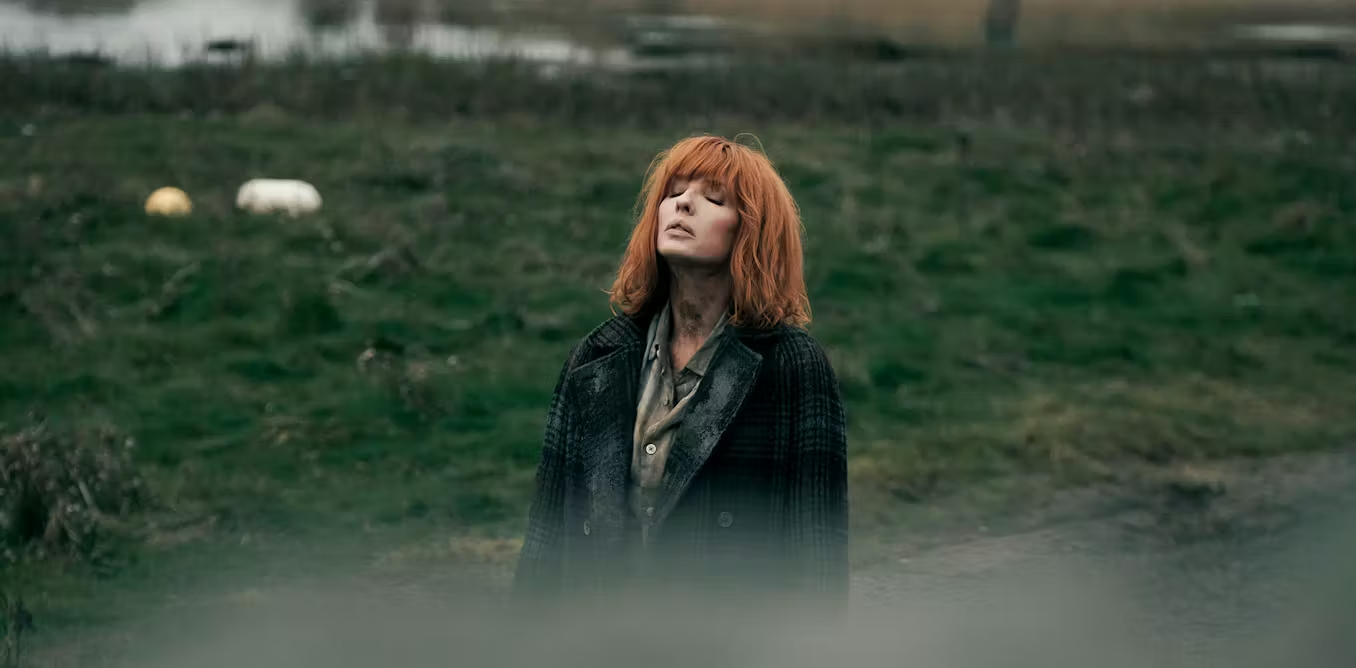
Morfa Halen means “salt marsh” in Welsh. This tidal island is a delicious invention of Sky Arts’ new detective drama, Under Salt Marsh, although it has very real antecedents in north Wales. Shell Island on the Mochras peninsula, near Harlech, inspired writer and director Claire Oakley.
Morfa Halen is cut off from the mainland nightly, when the tide swamps the causeway. This isolation is emphasised through an overhead shot of a car cutting a foamy, white swathe through the blues and browns of saltwater and sunken grasses. Immediately, Morfa Halen is established as the kind of closed community on which the detective genre thrives: think monasteries, country houses and Oxbridge colleges.
Under Salt Marsh uses familiar detective tropes to tell a story about environmental precarity and community displacement – but its treatment of Welsh language and identity is more conflicted than its ecological politics.
The opening moments establish that central character, Jackie Ellis (Kelly Reilly), cares. We see it when the primary school teacher soothes her pupils’ troubles. It is evident when she discovers her student Cefin’s body face down in a drainage ditch, breaks the news to his parents, then babysits their other children. She cares because something similar has happened before. Her niece, Nessa, disappeared at the same age, from the same town, and is presumed dead. A police officer at the time, Ellis was unable to solve the case.
Ellis immediately interferes in the investigation, questioning witnesses and ordering the police team around. They are led by Detective Eric Bull (Rafe Spall). He was Ellis’s junior partner when her niece went missing. She wants him pulled from the case, saying he messed up the investigation then betrayed her. He claims Ellis was suspended for gross professional misconduct.
Their antipathy is complicated: she lies for him on her own initiative, getting him out of a scrap with a local lad. The gesture pays off. By the end of episode two, Ellis drags a reluctant commitment out of Bull to an illicit co-investigation. So far, so standard detective fare: a professional v amateur odd couple.
Furthermore, Bull’s encyclopaedic knowledge of flora and fauna; willingness to work viscerally by tasting ditchwater and chomping on samphire; and queer sexuality repackage classic detective traits from the likes of Sherlock Holmes. However, Bull’s character updates his aristocratic precedent with an urban English accent and football club tattoo.
Imagined communities
Place and its influence on people’s thinking and behaviour has long made for compelling detective television, from the Oxford of Inspector Morse to the Scandinavian borderland of The Bridge.
Morfa Halen’s community faces displacement due to climate change. This is a reality along the north Wales coast. In the short term, a severe storm threatens a forced evacuation. Evidence of the crime will be washed away, making the investigators’ work a race against time.
Sea defences are being built by workers who temporarily swell the village’s population and offer additional lines of inquiry. The earliest clues come when Cefin’s autopsy detects the salinity of the water in his lungs although he drowned in a rainwater ditch, and acid on his skin associated with landfill sites. Illegal dumping is discovered in a former quarry on land owned by Cefin’s grandfather, Solomon Bevan (Jonathan Pryce).
Sky Arts
The community’s “deep connection to the land” is both materialised on the corpse and called into question. The series feels fresh in its ecological concern, but salty in its environmental critique. Oakley told the audience at the preview I attended: “Salt marsh stores carbon, it is a buffer from erosion. If we don’t protect it, it can’t protect us.”
Oakley clearly loves the setting. She nails the rise and fall atmosphere of neglected seaside towns: the seasonal highs of ice cream parlours and lows of seasonal unemployment, the pretty painted cottages and drab pebble-dash bungalows. Oakley pours herself into the speech of a fellow incomer, an Irish engineer who has been motivated to oversee the flood defences by memories of childhood summers.
North Wales is established visually through a familiar repertoire: sea-to-mountain views; heavy rain and sheep. Though the rain was faked by machines, the sheep are real enough. However, the scene in which Solomon herds them into his own village pub to protest resettlement is fantastical (don’t sheep where you eat).
Characters of colour momentarily promise to redress the usual white default in constructions of Welsh identity, especially in the countryside. However, except for Irene, we barely hear from these characters in the first few episodes.
Audibly, the show is dominantly English. There are the Welsh accents of some actors, such as Pryce, although these are mainly south Walian. The few identifiably “Gog”/north Walian accents include those of Cefin’s cousins and mother. This reinforces the skew in media representation to Wales’ southeast.
The Welsh language is spoken occasionally, though more fleetingly than in the show’s nearest geographical and generic rival Hinterland (2013). The latter’s bilingual version was credited as the first BBC television drama featuring dialogue in both Welsh and English.
Sometimes Under Salt Marsh reinforces the Anglophone stereotype of the Welsh language being used as “code speak” to evade English ears. A family discusses what to do with evidence as the English-speaking police pass by unaware. Road and street signs make fleeting contributions but the scarcity of bilingual shop fronts, menus and display boards in the village undercuts its resemblance to north Wales.
Author Saunders Lewis’s proclamation that “Wales without the Welsh language will not be Wales” applies to the sight of Welsh, as well as its sound. The omission is, however, unlikely to be noticed by Sky Arts’ far-flung audience.
Watch Under Salt Marsh because it promises excellent environmentally engaged detective drama, not to learn about Wales or Welshness.

Looking for something good? Cut through the noise with a carefully curated selection of the latest releases, live events and exhibitions, straight to your inbox every fortnight, on Fridays. Sign up here.






















































You must be logged in to post a comment Login