
News Beat
Durham team find shock wave around white dwarf star

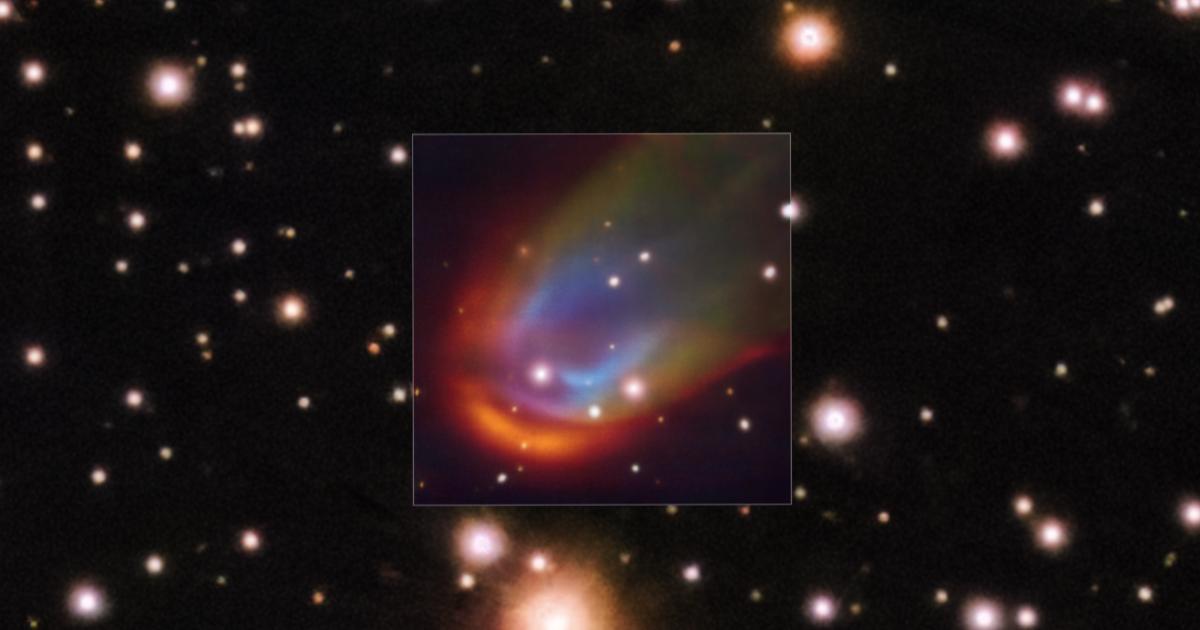
The phenomenon, found around a white dwarf called RXJ0528+2838, challenges longstanding theories about how such stars interact with the universe around them.
RXJ0528+2838, a remnant of a low-mass star located 730 light-years from Earth, is orbited by a companion star.
Typically, material from such a companion forms a disc around the white dwarf, fuelling energetic outflows that can create shock waves when they interact with surrounding interstellar material.

But in this case, no such disc was present.
Dr Simone Scaringi, associate professor in Durham University’s department of physics and co-lead author of the research, said: “This is something never seen before and entirely unexpected.
“This star is known as a polar white dwarf, which unlike other accreting white dwarfs, do not collect a disc of material around them from their companion.
“With no disc, we would not expect this type of star to have any bow shock wave, or nebular, around it.

“The surprise that this supposedly quiet, disc-less system could drive such a spectacular nebula was one of those rare ‘wow’ moments.”
Instead of originating from the more common accretion disc, the mysterious shock wave appears to be the result of the white dwarf ploughing through interstellar material, sweeping it up and making the shock wave visible.
The structure extends approximately 3,800 times the distance between the Earth and the Sun.
The research, published in Nature Astronomy on January 12, 2026, was co-led by Dr Krystian Ilkiewicz, formerly of Durham University and now at the Nicolaus Copernicus Astronomical Center in Warsaw.
It involved physicists from 12 institutions across seven countries, including Warwick, Southampton, and Oxford.
The object was first spotted by a final-year physics student working with Dr Scaringi during a search for nova shells.
However, the presence of a tail quickly ruled out the possibility that it was a typical nova remnant.
To investigate further, the team secured time on the European Southern Observatory’s Very Large Telescope, using its MUSE instrument to map the bow shock in detail and analyse its composition.
Their observations revealed that the white dwarf must have been creating the outflow for at least 1,000 years.
Further analysis showed that the star possesses a strong magnetic field, which channels material from the companion directly onto the white dwarf’s surface.
However, the field alone cannot explain the long-duration outflow.
Dr Scaringi said: “To try and understand this, we really need to try and find more examples elsewhere in the galaxy.
“In this case, this particular white dwarf is quite close to Earth and therefore we can see it well.
“The hunt is on now to try and discover more examples of this, to help develop our understanding and offer a physics-based solution to the mystery.”
The researchers stress that their data suggest the current magnetic field could only sustain such a bow shock for a few hundred years—far less than the estimated age of the structure.
The discovery raises questions about the evolution of binary star systems and suggests there may be an as-yet unidentified source of energy driving outflows from some white dwarfs.
The team now plans to search for similar phenomena elsewhere in the galaxy.
The research was backed by a global team from 12 institutions and seven countries.
The UK team included experts from the universities of Warwick, Southampton, and Oxford.



