Connect with us
DAPA Banner

NewsBeat

DWP announces employment support for anyone born after certain year

Published

on

Cambridgeshire Live

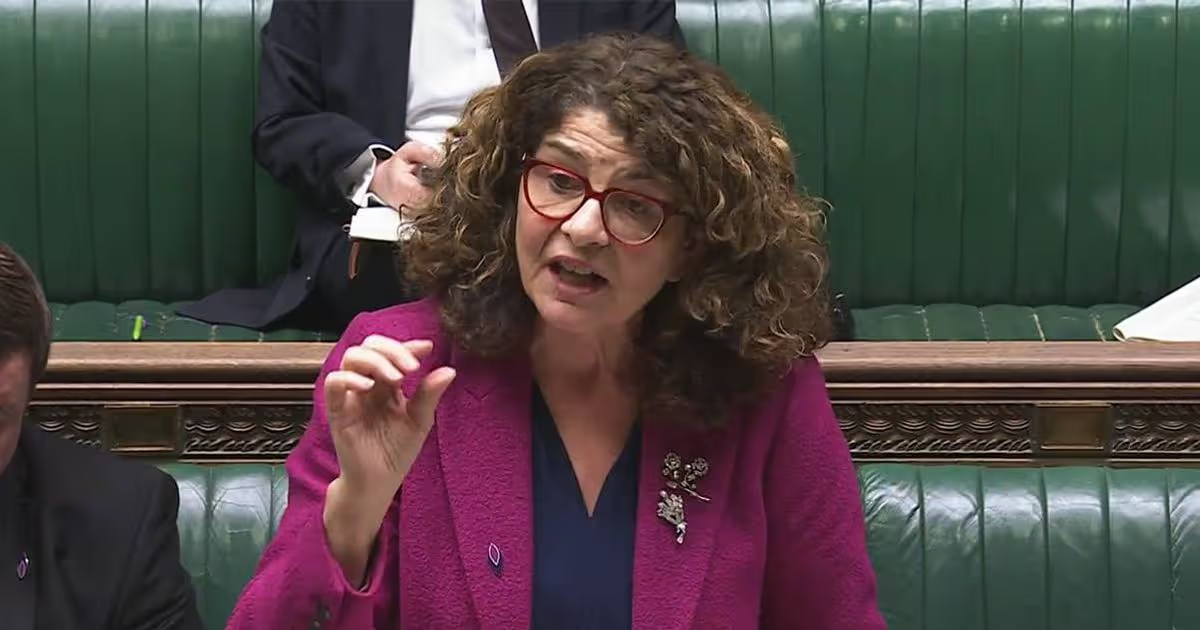
DWP minister Diana Johnson has announced employment support measures for workers over 50, including 50PLUS Champions and the Midlife MOT service.

The Department for Work and Pensions (DWP) has issued a statement about significant changes impacting people within a particular age bracket. DWP minister Diana Johnson discussed upcoming changes that could influence people’s earnings.

Advertisement

The announcement followed a written parliamentary question from Reform UK MP Lee Anderson concerning what measures are being implemented “to help improve employment opportunities for older people”. Ms Johnson delivered the Government’s reply.

She said: “Work helps everyone play active and fulfilling roles in society whilst building financial security for retirement, and we recognise the wealth of skills and experience that older workers bring both to the workplace and the economy.

“We are committed to supporting workers over the age of 50 through a wide-ranging strategy that promotes age-inclusive employment practices, flexible working, and progression and career development.” She proceeded to outline the assistance available for anyone over this age, including anyone born prior to 1976, reports the Mirror.

Ms Johnson added: “We have a dedicated offer for older workers within jobcentres, including our 50PLUS Champions who provide a critical layer of support to ensure the needs of older jobseekers are met. We also offer a Midlife MOT, which helps people to review their health, finances and skills and signpost to suitable support.”

Advertisement

The Midlife MOT is a Government service available to people aged 45 to 65. It provides resources to help you think about your career, health and finances. On the money side, the service can help you budget for your retirement and look at what benefits you may be able to claim, such as Universal Credit or the state pension.

Increasing earnings

Ms Johnson also spoke about other support on offer. She said: “Our employer and partnership teams in jobcentres work with a range of employers and partners to enhance the skills and employment support available locally for customers.”

Looking ahead, the minister also spoke about what further help is being rolled out for older workers. She said: “As part of our plans to Get Britain working and create a new jobs and careers service, we are committed to reforming employment support to ensure it is inclusive and meets the needs of our customers.

“We are considering the support we offer to those aged 50 and over so that they can access support to find good, meaningful work, and help them progress in work or increase their earnings.”

Advertisement

You may wish to check what benefits you can claim using an online benefits calculator. You could try using the one on the Turn2us website.

When planning for your later life, you may wish to factor in how much you will receive with the state pension. The age at which you can access your private pensions is currently 55, though this is set to rise to 57 from April 2028.

Britons face a longer wait to claim their state pension, which becomes available when you reach 66. This access age is rising soon, increasing gradually from April 2026 to reach 67 by April 2028.

The full new state pension currently provides £230.25 a week, and you typically require 35 years of National Insurance contributions to receive this amount.

Advertisement

Payments increase each April in line with the triple lock, which will raise payments by 4.8% this April. You can check how much state pension you are on track to receive using the state pension forecast tool on the Government website.


Source link

Continue Reading
Click to comment

You must be logged in to post a comment Login

Leave a Reply

NewsBeat

Toddler suffered stroke after sickness bug caused ‘massive’ blood clot

Published

on

Daily Record

Hudson Reid, 2, spent four weeks in hospital after a sickness bug developed into a “one in a billion” illness.

A mum has shared a warning after her toddler “nearly died” when a sickness bug caused a deadly stroke.

Advertisement

Hudson Reid was just two when he came down with what mum Amber Davidson, 29, thought was just a sickness bug after he was vomiting and “couldn’t keep fluids down”.

But when Amber spotted her tot’s arm was “stuck up”, his legs were “shooting out straight” and he was making “weird” noises she rushed Hudson to University Hospital Crosshouse A&E.

Amber says “within five minutes” Hudson had five doctors working on him trying to resuscitate her son after he lost consciousness on the drive to the hospital.

Despite a clear CT scan, Hudson remained unconscious for the next five days and an MRI revealed he had a “massive” blood clot and bleed on his brain which had caused a stroke.

Advertisement

He was rushed to Glasgow Children’s ICU the following day after a neurologist realised the clot was caused by a “one in a billion” dehydration from his sickness bug, causing his blood to thicken.

Little Hudson spent four weeks in hospital and was given blood transfusions and put on blood thinners and despite being told he’d never “walk, talk or move again” he was up walking within a week.

Now seven, Hudson is attending school and is not letting “anything phase him” despite his brain being damaged from the severity of his stroke.

Advertisement

Mum Amber says the effects of the stroke “impacts him a lot” through his movement – and he is prone to falling over often, as well as having speech issues, though says he lives a “pretty much a normal life”.

Amber, a self-employed beauty therapist, from Kilwinning, who originally spoke to Sell Us Your Story, said: “He’s a complete miracle.

“Even the doctors are blown away with him he’s proved everyone wrong.

“I first noticed his arm that day.

Advertisement

“He was making a noise, not a cry but just a weird noise.

“I videoed him and sent it to my mother-in-law to see if she had any idea what was happening and because I know it’s common for kids to have seizures so thought it might be that.

“I phoned the doctors and said I think he’s having a seizure.

Advertisement

“They said they’d get a doctor to phone me back.

“Before they phoned me I just looked at him and took him to the hospital.

“Within five minutes there were five doctors working on him.

“They were trying to resuscitate him – he was dying in front of us.”

Advertisement

Hudson came down ill in September 2021 and when Amber spotted the unusual symptoms she sent a video to her mother-in-law and rang her GP for advise – and Amber says they said they would get a doctor to call her back.

A worried Amber took her son to A&E – believing he might be having a seizure – but CT scans came back clear.

He was admitted to the ward unconscious and did not wake for five days and every time he tried to fell into a seizure.

An MRI the following day confirmed he had a blood clot and bleed on the brain.

Amber said: “The hospital told us there was nothing else they could do and that he was an unwell wee boy.

“The last hope was sending the videos I took to a professor in Glasgow – he’s a neurologist and says it was a one in a billion chance Hudson had dehydration from his sickness bug that caused his blood to thicken and caused the bleed on his brain.

“Hudson was rushed to Glasgow Children’s and was in the ICU having blood transfusions, blood thinners, everything to do with strokes.

Advertisement

“We were told Hudson wouldn’t walk, talk or move again.

“Within a week he was up and about.

“He still has a wee speech impediment and brain damage but he’s here, alive, walking and talking.”

Hudson spent four weeks in hospital recovering and had to be fed through an NG tube for six months as he was nil by mouth due to the stroke affecting movement in his mouth.

Advertisement

Now, Hudson sees occupational therapists every six months, a dietician once a month and has speech and language therapy once a week.

He also visits hospital twice a year for check-ups and has regular blood tests and heart scans.

Amber said: “His movement is great but he does fall a lot and as he progresses is the point we’ll see how brain damaged he is going to be.

“We’re now at the point where other kids are progressing and Hudson is not and his brain damage is more apparent.

“We’re just taking it day by day just to see how he’s going to react.

“It’s just a waiting game.

“He’s such a sweet loving wee boy and has a heart of gold.

Advertisement

“He doesn’t let anything phase him.”

Amber wants to raise awareness of strokes in children from sickness bugs, and admits she didn’t know the signs to look out for.

“I think it’s the stigma that strokes happen to older people,” she says.

“Obviously there’s a lot of awareness of strokes with the Face, Arms, Speech thing but I didn’t think a two-year-old would be able to have a stroke which is why in my mind I never even thought that.

Advertisement

“Even now when I tell people my two-year-old has had a stroke they say ‘no way’ or ‘I didn’t know a stroke could happen to child that age’.

“At the time the adrenaline takes over and you go into mum mode.

“I feel like I was probably doubting myself or thinking ‘am I overreacting?’ before I took him to the hospital.

“I had no awareness of how severe the situation was.

Advertisement

“It was only a few months after I thought ‘that actually happened, Hudson actually went through that’ but at the time I was just in mum mode and survival”.

Get more Daily Record exclusives by signing up for free to Google’s preferred sources. Click HERE.

Source link

Advertisement
Continue Reading

NewsBeat

UK tourist Rose Buck dies on holiday in Tenerife after ‘freak wave’ knocks her into rocks

Published

on

UK tourist Rose Buck dies on holiday in Tenerife after ‘freak wave’ knocks her into rocks

A British postal worker has died while on holiday in Tenerife after a “freak wave” reportedly knocked her into rocks during a morning swim.

Rose Buck, 56, was enjoying a break in Costa Adeje when the incident occurred on 25 February.

Her daughter, Chantelle Buck-Forrest, 39, said that her mother, a “strong swimmer”, had gone to the beach after finding the hotel pool closed.

The area, known as the ‘blue lagoon’, is typically calm. However, Ms Buck-Forrest said that an unexpected wave “flung” her mum against the rocks, rendering her unconscious and fracturing her C2 vertebra.

Advertisement

Someone on the beach quickly noticed the unfolding tragedy and alerted lifeguards. Ms Buck was reportedly submerged for five minutes, and it took a further 13 minutes for rescuers to resuscitate her.

Her family rushed to Tenerife to be by her side. However, doctors made the difficult decision to turn off her ventilator on 6 March, citing extensive brain damage that made recovery impossible.

Rose Buck swimming in the sea before the accident
Rose Buck swimming in the sea before the accident (Kennedy News and Media)

Ms Buck died in hospital in Tenerife on 8 March.

Tenerife was hit by a 4.1 magnitude earthquake on 25 February, which Ms Buck-Forrest believes was likely what caused the freak wave.

Ms Buck-Forrest, who lives in Bradford, West Yorkshire, said: “I’m absolutely devastated, I couldn’t stop crying. “It’s been horrendous.

Advertisement

“She’s a really strong swimmer, swimming is actually her sanctuary.”

She said the ‘blue lagoon’ is quite protected from waves and “all kinds of people swim in it”.

“She was swimming the perimeter of the lagoon and it was just one freak wave that’s taken her.

“There was reported an earthquake a couple of hours after what happened so I am guessing this earthquake has caused this freak wave and it just flung her against the rocks.

Advertisement

“She’s suffered a really serious head injury which broke her C2 upon impact and she will have gone unconscious straight away and she was just taken by the sea.”

From left: Rose Buck, her partner Fran Wilde, and her daughter Chantelle Buck-Forrest
From left: Rose Buck, her partner Fran Wilde, and her daughter Chantelle Buck-Forrest (Kennedy News and Media)

Ms Buck-Forrest, who is a children’s playcentre director, said it was heartwarming to hear all the tributes to her beloved mother.

“Everybody who has contacted me has said she is either one of the nicest people they know or the nicest person they’ve ever met,” she said.

“The amount of people far and wide, people who I didn’t even know knew her, it’s been mind blowing, she’s touched so many people’s lives.

“When we were sat having breakfast, my brother was just sat scrolling on Instagram, and he just said ‘oh my gosh it’s International Women’s Day today’, so she died on International Women’s Day which felt like homage to her.

Advertisement

“Although I feel like I’ve got this massive loss and I’m holding so much sorrow, I feel the same amount of love and support and honour in the other hand.

“The amount of people that have contacted me has opened my eyes to what a woman my mum is and I feel honoured to be her daughter.”

Source link

Advertisement
Continue Reading

NewsBeat

Nasa camera accidentally captures moment comet breaks up in real time | News Tech

Published

on

Nasa camera accidentally captures moment comet breaks up in real time | News Tech
This series of images from NASA’s Hubble Space Telescope of the fragmenting comet C/2025 K1 (ATLAS) was taken over the course of three consecutive days – November. 8, 9, and 10 last year (Picture: NASA/Cover Media)

NASA astronomers struck it lucky after the Hubble Space Telescope observed a comet in the act of disintegrating completely by chance.

The event was one that scientists believed they were unlikely to witness in real time.

And it was even more extraordinary as researchers had intended to observe a different comet, but were forced to change plans due to technical constraints.

The findings were published on Wednesday in the journal Icarus.

Advertisement

‘Sometimes the best science happens by accident,’ John Noonan, a research professor in the Department of Physics at Auburn University in Alabama, said.

‘This comet got observed because our original comet was not viewable due to some new technical constraints after we won our proposal. We had to find a new target – and right when we observed it, it happened to break apart, which is the slimmest of slim chances.”

The object, known as Comet C/2025 K1 (ATLAS), can be seen progressively breaking apart in a sequence of images taken between November 8 and 10 last year.

Initially appearing as four bright objects, the largest fragment then splits further, with pieces drifting away from one another.

Advertisement
This diagram shows the path the comet took as it swung past the Sun and began its journey out of the solar system (Picture: NASA/Cover Media)

Noonan, a co-investigator on the study, said he did not realise the significance immediately.

‘While I was taking an initial look at the data, I saw that there were four comets in those images when we only proposed to look at one,’ he said. ‘So we knew this was something really, really special.’

Scientists have long attempted to capture such an event using Hubble, but the unpredictability of comet break-ups has made this difficult.

‘The irony is now we’re just studying a regular comet and it crumbles in front of our eyes,’ said principal investigator Dennis Bodewits, also of Auburn University.

Advertisement

‘Comets are leftovers of the era of solar system formation, so they’re made of “old stuff”—the primordial materials that made our solar system.

‘But they are not pristine – they’ve been heated; they’ve been irradiated by the Sun and by cosmic rays.

‘So, when looking at a comet’s composition, the question we always have is, “Is this a primitive property or is this due to evolution?’”

‘By cracking open a comet, you can see the ancient material that has not been processed.’

Advertisement

Hubble observed the comet splitting into at least four pieces, each surrounded by a glowing cloud of gas and dust known as a coma. While ground-based telescopes saw only faint bright patches, Hubble’s high resolution allowed scientists to distinguish individual fragments clearly.

The observations were made shortly after the comet passed its closest point to the Sun – known as perihelion – when heating and stress are at their greatest. Scientists believe the comet began breaking up about eight days before Hubble captured the images.

However, the team has identified a puzzling delay between the break-up and the brightening detected from Earth.

A series of images from NASA’s Hubble Space Telescope of the fragmenting comet (Picture: NASA/Cover Media)

One theory is that a layer of dust must first form over newly exposed ice before being blown away. Another possibility is that heat builds up beneath the surface before ejecting material into space.

‘Never before has Hubble caught a fragmenting comet this close to when it actually fell apart. Most of the time, it’s a few weeks to a month later. And in this case, we were able to see it just days after,’ said Noonan.

Advertisement

‘This is telling us something very important about the physics of what’s happening at the comet’s surface. We may be seeing the timescale it takes to form a substantial dust layer that can then be ejected by the gas.’

Early observations suggest the comet is chemically unusual, with significantly lower levels of carbon than typically seen. Further analysis using Hubble’s instruments is expected to reveal more about its composition and, potentially, the origins of the solar system.

Now reduced to a cluster of fragments about 250 million miles from Earth, the comet is travelling through the constellation Pisces and is expected to leave the solar system permanently.

Advertisement

Source link

Advertisement
Continue Reading

NewsBeat

Beyond Paradise series 4 makes major change as Humphrey Goodman’s colleague leaves

Published

on

Wales Online

EXCLUSIVE: Beyond Paradise returns to BBC One on March 27 with Kris Marshall discussing major changes, including one character’s departure

Kris Marshall, star of Beyond Paradise, has shared insights into his co-star’s departure from the BBC series. The spin-off from Death in Paradise is set to return on 27 March, with Humphrey and his team tackling a series of crimes in Shipton Abbott. However, one character will be conspicuously absent from the fourth series.

Detective Humphrey Goodman will face a distressing choice in the forthcoming series after being told he must release a member of his police station team. Additionally, Humphrey finds himself under new management after learning that his former superior, CS Charlie Woods (portrayed by Jade Harrison), has transferred to a different division.

Advertisement

Discussing his co-star’s departure and the necessity to dismiss a team member, Kris exclusively revealed to Reach PLC, “I mean, there always has to be some kind of challenge for Humphrey in terms of, because, like I said, you know, otherwise he just wanders around.

“I mean, it’s that paradox, isn’t it, about TV detectives, they’re sort of fish out of water, they don’t really like rules, and yet they exist in one of the most sort of institutional, authoritarian, hierarchies, the police force.

READ MORE: ITV This Morning fans have same response as ‘national treasure’ interviewed on showREAD MORE: Gethin Jones asks ‘are you ok’ after Morning Live co-star’s ‘shameful’ admission

Advertisement

“He hates any kind of authority, he hates rules, he hates being told what he has to do, and so it’s thrust upon him, and it literally comes knocking on his door as it does. You know, he really detests that, really dislikes it, and he doesn’t like the pressure,” reports the Express.

Discussing his character’s new superior, portrayed by Vincent Franklin, the Humphrey Goodman star continued, “And it’s held by the fact that, in terms of the storyline, you know, Vincent Franklin, who is just an absolute genius actor playing his sort of nemesis in this.

“It just adds to that sort of, and he does it with such beautiful greasiness. It’s sort of wonderful. It sort of adds to the pressure for Humphrey, and so it’s a real stress for Humphrey moving forward because he is a kind of, like, bury your head in the sand kind of guy, when it comes to things like that.

Advertisement

“Solving puzzles or crimes or, you know, he’s like a dog with a bone. But, you know, when it comes to sort of real life, he’s like, well, surely if I put my head over here, that will just go away.”

Sally Bretton, who portrays Martha Lloyd, Kris’s on-screen spouse, also revealed insights into Martha and Humphrey’s relationship, and where the current series begins. The actress explained that residing on a boat was never part of Martha and Humphrey’s original vision.

She revealed, “Martha starts reflecting on, ‘Was this a bit of an unexpected twist anyway? Going to live on the boat as it wasn’t really the plan originally’.

Advertisement

“And maybe now that they’re married and they want to focus a lot on settling a little bit more, and maybe it’s time to start having a look at a house, and I think they want to focus on each other and have all of the fun and everything that they always have done, but they’ve been knocked off center a lot.”

Beyond Paradise is set to return on 27 March at 8pm on BBC One.

Source link

Advertisement
Continue Reading

NewsBeat

How BrewDog showed the limits of community capitalism

Published

on

How BrewDog showed the limits of community capitalism

When brewery and pub chain BrewDog invited customers to become shareholders through its “Equity for Punks” scheme, it appeared to represent a new model of capitalism. It invited beer enthusiasts to invest in the company and become small shareholders. This allowed the Scottish firm to present itself as a community built around rebellion, identity and participation.

For a time, the BrewDog model looked remarkably successful – the company was once valued at £2 billion. But after its sale to American cannabis and alcohol firm Tilray for just £33 million, it is clear that there is more to the story.

The real story here is not about one craft brewer. It is about a broader shift in modern capitalism, where companies increasingly use narratives to mobilise communities and raise capital. But at the same time, the institutional rules of finance still determine who gets what and when.

BrewDog raised substantial capital (said to be £75 million) from thousands of small investors who were already loyal to the brand. Instead of relying exclusively on banks, venture capital or institutional investors, the company mobilised its own community to fund growth. Customers became shareholders, while the firm strengthened its reputation as a disrupter within the industry.

Advertisement

Then came the bar closures, job losses and BrewDog’s sale to Tilray. These developments suggest that small investors from the Equity for Punks programme will see little financial return.

In general, supporters tend to see themselves as partners in an entrepreneurial journey. Yet legally they remain minority investors. And minority investors occupy a very specific position within the institutional architecture of capitalism.

The BrewDog story is a reminder that markets run on stories as well as money. The effect of this has been to blur the boundary between customer and investor.

We believe that people rarely invest only because of spreadsheets. Our research on entrepreneurship shows that economic behaviour is shaped by trust, narratives and shared identity as much as by financial indicators. And the American sociologist Mark Granovetter argued that markets are “embedded” in social networks, meaning that people invest in people – and in their stories.

Advertisement

This resonates with our broader research on how economic exchanges, including investments and purchases, are also often sustained through these factors. BrewDog’s Equity for Punks model captured this dynamic perfectly.

But there’s also a question around what it really means to be part of a community when the balance sheet starts to matter.

Cold beer, cold reality

Community narratives may mobilise people to invest their money, but a body of strict rules and regulations shapes the outcome. Three points here are particularly important.

First, while the equity-public model undoubtedly has appeal, it’s also true that companies operate within legal frameworks that determine ownership rights and the order in which creditors are repaid if the company is liquidated or sold.

Advertisement

Second, lenders and structured investors typically enjoy protections that small retail investors, like BrewDog’s punks, do not.

Third, corporate finance works through a hierarchy, so it should be recognised that this places creditors ahead of shareholders when companies face financial stress. Shareholders are last in line to recoup their money from a company – after lenders, tax authorities, employees and suppliers.

When customers invest in companies they admire, they often interpret their role differently from conventional shareholders. Under BrewDog’s Equity for Punks programme, thousands of customers bought small stakes in the company not just for potential financial returns.

This point resonates with our research on how businesses and communities interact. It shows that economic behaviour is often shaped by the rules, expectations and relationships that surround markets. In practice, this means that people do not make decisions based only on prices or profits.

Advertisement

BrewDog’s fortunes have changed, with recent pub closures and layoffs.
photocritical/Shutterstock

None of this suggests bad faith on the part of companies like BrewDog. It simply reflects the fact that markets operate through institutions.

Episodes like the BrewDog one serve as a reminder of a basic feature of modern capitalism. That is, when financial pressure appears, institutional rules take over.

All that being said, community-driven investment models will probably become more common. Digital platforms make it easier than ever for firms to mobilise supporters around shared narratives and identities. But at the same time, the institutional rules that govern corporate finance have not evolved at the same pace as these new forms of participatory capitalism.

Advertisement

If modern capitalism increasingly invites people to invest not only their money but also their faith, the gap between narrative and institutional reality will become harder to ignore. Communities may power the stories that fuel entrepreneurship. But when the balance sheet tightens, it is still institutional rules that decide who gets paid.

BrewDog did not respond to a request to respond to the claims made in this article.

Source link

Advertisement
Continue Reading

NewsBeat

Will the world fill the climate leadership void left by the US?

Published

on

Will the world fill the climate leadership void left by the US?

The Trump administration pulled the rug out from underneath US federal climate policy in February, when the Environmental Protection Agency (EPA) overturned the landmark 2009 “endangerment finding”. Now, the official policy of the US government holds that greenhouse gases do not pose a risk to human health.

The move has opened a new frontier for Donald Trump to govern without being constrained by evidence or in a manner that represents the majority of Americans, who support pro-climate policies. It also follows a year in which the US president and his allies have hollowed out American climate leadership.

Since taking office, Trump and his allies have rolled back clean air standards for almost anything with a tailpipe or smokestack. In January 2026, they even instructed the EPA to stop estimating the value of lives saved in the agency’s cost-benefit analyses for new pollution rules. This could lead to looser controls on pollutants from industrial sites across the country.

As US climate leadership recedes into the rearview mirror, one question remains: will any nation – and China in particular – rush in to fill the gap? I wish there were a simple answer. But enthusiasm for climate leadership is backsliding, and not just from the US government.

Advertisement
The dome of the US Capitol building seen behind the smokestacks of the Capitol power plant in Washington.
Jim Lo Scalzo / EPA

Even as renewable energy installation continues worldwide, there are some signs of retreat. Across the world, companies are quietly shedding their net-zero targets. US car manufacturers Ford and General Motors also recently wrote off more than US$25 billion (£18.5 billion) of investment in electric vehicles because consumer demand has failed to match their forecasts.

It is no coincidence that this breakdown in the global climate consensus comes at a time when tensions are rising worldwide. The global order is reeling over Trump’s war in Iran and sabre-rattling over Greenland. Meanwhile, Russia’s full-scale invasion of Ukraine has dragged into its fifth year without any clear prospect of peace.

Climate collaboration requires a belief that everyone is pitching in. When global institutions and norms look weak, national leaders worry about being the last honest participant in a deal that everyone else has abandoned. This is as true for countries as for human beings: nobody wants to feel like they’ve been duped.

However, there are some signs of hope. Demand for clean energy isn’t going away overnight. Renewable energy is often cheaper than fossil power, even without subsidies. A July 2025 report by the International Renewable Energy Agency found that nine in ten new renewable projects are on track to generate cheaper power than fossil fuel alternatives.

Advertisement

Just as important is the fact that citizens around the world continue to suffer from the effects of breathing polluted air, which the World Health Organization estimates causes 7 million deaths worldwide each year.

Even as climate concern falters, some of the world’s most populous cities, such as New Delhi in India, are under growing pressure to protect their residents’ health. They are likely to continue reducing their use of fossil fuels to heat homes, generate electricity and move people around.

A group of people walk down a street in New Delhi that is engulfed in smog.
A thick blanket of smog engulfs New Delhi in April 2022.
Arrush Chopra / Shutterstock

Meanwhile, China is on a glide path to fill part of the void opened by America’s climate retreat. It already dominates certain clean energy technologies, holding a near-monopoly on battery, solar panel and fuel cell production. Chinese companies now manufacture more electric vehicles than every other nation combined.

Cementing its position as the new global climate leader would also earn China diplomatic “soft power,” especially among developing nations where Beijing can offer clean energy infrastructure plus the loans to finance it.

But, at the same time, China has shown a steady unwillingness to back strong political leadership on climate action. China’s leaders are bullish on renewable energy when it serves their economic interests. However, they are broadly resistant to the sort of strong international pressures that could stabilise global temperature rise.

Advertisement

It wasn’t until 2025 that China promised to actually reduce its emissions. And its recent commitments, which include a pledge to reduce greenhouse gas emissions by as much as 10% below peak levels by 2035, fall well short of what analysts say will be necessary to keep global warming below 1.5°C.


À lire aussi :
When China makes a climate pledge, the world should listen


With US credibility rapidly eroding, the 21st century seems poised to slide deeper into a style of governance that is characterised less by rigorous analysis than by the whims of its leaders.

The silver lining is that demagoguery has a shelf life. Trump’s approval rating has fallen to second-term lows, with polls showing him at -17 points. The demand for clean air, cheap energy and competent governance doesn’t go away because one administration decides to ignore it.

Advertisement

One day Trump will eventually fade from the political landscape. Climate change will not.

Source link

Advertisement
Continue Reading

NewsBeat

Hunt for capybara named Samba running wild after escaping Marwell Zoo in Hampshire | News UK

Published

on

Hunt for capybara named Samba running wild after escaping Marwell Zoo in Hampshire | News UK
Samba bust out of her temporary enclosure just a day after being taken to Marwell Zoo (Picture: Marwell Zoo/Solent News)

One of the world’s largest rodents could be running around your feet as you read this.

Capybara Samba and Tango were moved to Marwell Zoo in Hampshire from Jimmy’s Farm & Wildlife Park on Monday.

But just a day later, the pair escaped their temporary home – despite having a pond ‘made for capybara life’ in their future enclosure.

While her escape partner, fellow capybara Tango, was found rummaging around nearby bushes, Samba remains on the lam.

Advertisement

The furry fugitive was spotted on Wednesday night in Owlslebury, a village two miles north of the zoo.

Sign up for all of the latest stories

Start your day informed with Metro’s News Updates newsletter or get Breaking News alerts the moment it happens.

Advertisement

A missing capybara poster shared by the zoo says Samba is ‘not dangerous but could be stressed’.

tapir and a capybara that had developed a strong bond were put to sleep on the same day so neither would be lonely
Capybaras are roughly the same size as some dogs (Picture: Newquay Zoo)
tapir and a capybara that had developed a strong bond were put to sleep on the same day so neither would be lonely
The giant rodents (centre) are known for their laid-back nature (Picture: Newquay Zoo)

Marwell Wildlife, which runs the zoo, has asked people to call if they spot the escaped capybara and to send her location.

Police are aware of Samba’s grand escape, it added.

The charity said on Facebook: ‘As always, animal welfare is our highest priority, and our team are working hard to bring Samba back as quickly and safely as possible.

‘Capybaras are intelligent, gentle animals, with a taste for adventure. They do not pose a risk to the public, we strongly advise against approaching Samba or disturbing any area she may be hiding, to prevent causing her stress.

Advertisement

‘Under no circumstances should a member of the public try to capture her by themselves.’

Marwell Wildlife added yesterday that teams are combing the area overnight for Samba, but have yet to post an update.

Capybaras are plump, mellow, dog-sized rodents native to South America.

These cuddly rodents spend their days munching on grass and water plants growing around bodies of water. They can grow up to four feet long.

Advertisement

Capybaras have become internet stars in recent years for their cuteness – there are even cafes in Japan where people pay to feed them carrots.

Marwell Wildlife said on Monday that the two female capybara would live in a private habitat area while they ‘complete their quarantine and get used to their new surroundings’

‘Once they’ve settled in, they’ll move into their new habitat – which we’re currently finishing, including a pond for them to enjoy.’

Get in touch with our news team by emailing us at webnews@metro.co.uk.

Advertisement

For more stories like this, check our news page.

Advertisement
Advertisement

Source link

Continue Reading

NewsBeat

More rapid electric vehicle chargers for South Shields

Published

on

More rapid electric vehicle chargers for South Shields

South Tyneside Council has placed the units at South Shields seafront as part of its ongoing programme to improve EV infrastructure.

The chargers are part of a wider programme with Connected Kerb and the North East Mayor Kim McGuinness.

Councillor Tracey Dixon, leader of South Tyneside Council, said: “We are committed to making it easier for people to choose cleaner and greener ways to travel.

Advertisement

“Through our work with Connected Kerb and the Combined Authority, we are bringing more modern, reliable charging options to communities right across South Tyneside.

“This investment is part of a wider regional programme to expand the network and ensure residents and visitors have access to the right infrastructure as demand continues to grow.”

Five of the new rapid chargers are being installed at South Shields seafront, with two more at Jarrow Focus.

The new chargers are currently awaiting grid connection and are expected to be operational in the coming weeks.

Advertisement

Once live, they will offer a rapid charge of around 30 minutes.

The installation is part of Mayor McGuinness’ plan to deliver 92 new charging points across the North East to support the transition to electric vehicles, including in rural areas.

South Tyneside currently has 68 public charging points.

Councillor Ernest Gibson, lead member for neighbourhoods and climate change, said: “These chargers will make a real difference to people who rely on electric vehicles for day-to-day travel or who are visiting the foreshore.

Advertisement

“Quick and convenient charging helps give people confidence that they can make the switch to cleaner transport.


Read more:


“We will keep working with partners to bring more charging points online and make sure the network is reliable and easy to use.”

The council is also working with Connected Kerb on a long-term partnership to deliver up to 2,000 additional charging points over the next 20 years.

Advertisement

More information about electric vehicle charging in South Tyneside can be found on South Tyneside Council’s website.

Source link

Advertisement
Continue Reading

NewsBeat

Iran war energy crisis is a renewable energy wake-up call

Published

on

Iran war energy crisis is a renewable energy wake-up call

HANOI, Vietnam (AP) — The war in Iran is exposing the world’s reliance on fragile fossil fuel routes, lending urgency to calls for hastening the shift to renewable energy.

Fighting has all but halted oil exports through the Strait of Hormuz, the narrow waterway that carries about a fifth of the world’s oil and liquefied natural gas, or LNG. The disruption has jolted energy markets, pushing up prices and straining import-dependent economies.

Asia, where most of the oil was headed, has been hit hardest, but the disruptions also are a strain for Europe, where policymakers are looking for ways to cut energy demand, and for Africa, which is bracing for rising fuel costs and inflation.

Unlike during previous oil shocks, renewable power is now competitive with fossil fuels in many places. More than 90% of new renewable power projects worldwide in 2024 were cheaper than fossil-fuel alternatives, according to the International Renewable Energy Agency.

Advertisement

Oil is used in many industries beyond generating electricity, such as fertilizer and plastics production. So most countries are feeling the impact, while those with more renewable power are more insulated since renewables rely on domestic resources like sun and wind, not imported fuels.

“These crises regularly occur,” said James Bowen of the Australia-based consultancy, ReMap Research. “They are a feature, not a bug, of a fossil fuel-based energy system.”

China and India built renewable buffers, but China’s is larger

China and India, the world’s two most populous countries, face the same challenge of generating enough electricity to power growth for over a billion people. Both have expanded renewable energy, but China did so on a far larger scale despite its continued reliance on coal-fired power.

Today China leads the world in renewables. About one in 10 cars in China are electric, found the International Energy Agency. It’s still the world’s largest importer of crude oil and the biggest buyer of Iranian oil. But electrifying parts of its economy with renewables has reduced its reliance on imports.

Advertisement

Without that shift, China would be “far more vulnerable to supply and price shocks,” said Lauri Myllyvirta of the Centre for Research on Energy and Clean Air. China also can rely on reserves built when prices were low and shift between using coal and oil as fuel in factories, he said.

Advertisement

India also has expanded its use of clean energy, especially solar power, but more slowly and with less government support for manufacturing renewable energy equipment and connecting solar to its power grid.

After Russia’s invasion of Ukraine in 2022, India prioritized energy security by buying discounted Russian oil and boosting coal production. It also ramped up solar and wind, helping to cushion supply disruptions but not avoid them entirely, said Duttatreya Das of the think tank Ember.

“Everyone cannot be China,” Das said.

India is now facing a shortage of cooking gas. That’s driving a rush to buy induction cooktops and raising fears of restaurant shutdowns. Fertilizers and ceramics industries may also be hit.

Advertisement

Rich countries fallback on fossil fuels

The energy shock is familiar to wealthy countries in Europe and East Asia.

Advertisement

In 2022, some European governments tried to cut dependence on fossil fuels. But many soon focused on finding new fossil fuel suppliers instead, said Pauline Heinrichs, who studies climate and energy at King’s College London.

Germany rushed to build LNG terminals to replace Russian gas with mostly American fuel while the energy transition, including efforts to cut demand, slowed, she said.

Europe’s excess spending on fossil fuels since the Russia-Ukraine War amounted to about 40% of the investment needed to transition its power system to clean energy, according to a 2023 study.

“In Europe, we learned the wrong lesson,” Heinrichs said.

Advertisement

In import-dependent Japan, policy responses to past shocks have focused on diversifying fossil fuel imports rather than investing in domestic renewables, said Ayumi Fukakusa of Friends of the Earth Japan.

Advertisement

Solar and wind make up just 11% of Japan’s energy production, on a par with India but behind China’s 18%, according to Ember. Japan’s energy use is much lower than both nations.

The Iran war led the agenda during Japanese Prime Minister Sanae Takaichi ‘s meeting this week with U.S. President Donald Trump. Trump, who has long urged Japan to buy more American LNG, recently called on allied nations like Japan to “step up” in assisting secure The Strait of Hormuz.

South Korean President Lee Jae-myung said the crisis could be “a good opportunity” to shift faster to renewable energy.

Poor countries are the most exposed

Poorer nations in Asia and Africa are competing with wealthy European and Asian countries and big buyers like India and China for limited gas supplies, pushing up prices.

Advertisement

Import-dependent economies — such as Benin and Zambia in Africa and Bangladesh and Thailand in Asia — could face some of the biggest shocks. Costly fuel makes transport and food more expensive, and many countries have limited foreign-exchange reserves, restricting their ability to pay for imports if prices stay high.

Africa may be especially exposed because many countries rely on imported oil to run their transport and supply chains.

It makes strategic sense for African countries to build their long-term energy security by investing in cleaner energy, said Kennedy Mbeva, a research associate at the Centre for the Study of Existential Risk at the University of Cambridge.

Advertisement
FILE - Women push wheelbarrows atop a coal mine dump at the coal-powered Duvha power station, near Emalahleni east of Johannesburg, Nov. 17, 2022. Humanity still has a chance, close to the last one, to prevent the worst of climate change’s future harms, a top United Nations panel of scientists said Monday, March 20, 2023. But doing so requires quickly slashing carbon pollution and fossil fuel use. (AP Photo/Denis Farrell, File)

Women push wheelbarrows on a coal mine dump at the coal-powered Duvha power station, near Emalahleni east of Johannesburg, Nov. 17, 2022. (AP Photo/Denis Farrell, File)

Advertisement
A shepherd watches livestock near Khi Solar One, a solar thermal plant that converts the sun's light energy into electricity, outside Upington, South Africa, in the Northern Cape province, Friday, Aug. 29, 2025. (AP Photo/Themba Hadebe)

A shepherd watches livestock near Khi Solar One, a solar thermal plant that converts the sun’s light energy into electricity, outside Upington, South Africa, in the Northern Cape province, Friday, Aug. 29, 2025. (AP Photo/Themba Hadebe)

Advertisement

But not all are opting for renewables: South Africa is considering building an LNG import terminal and new gas-fired power plants.

Others, like Ethiopia which banned gasoline and diesel fueled cars in 2024 to promote electric vehicles, are doubling down on renewables.

The real challenge is not just to withstand the next shock, but to ensure it doesn’t “derail the country’s development trajectory,” said Hanan Hassen, an analyst at Ethiopia’s government-linked think tank, the Institute of Foreign Affairs.

Advertisement

Renewables provide a cushion for some

Increased use of renewable energy has helped shield some Asian countries from the energy shock.

Advertisement

Pakistan’s solar boom has preempted more than $12 billion in fossil fuel imports since 2020 and could save another $6.3 billion in 2026 at current prices, according to think tanks Renewables First and the Centre for Research on Energy and Clean Air.

Vietnam’s current solar generation will help the country save hundreds of millions of dollars in potential coal and gas imports in the coming year, based on current high prices, according to the research group, Zero Carbon Analytics.

Other countries are stretching tight supplies.

Bangladesh has closed universities to save electricity. It has limited storage capacity to absorb supply shocks, so the government started rationing fuel after a flurry of panic buying at filling stations, said Khondaker Golam Moazzem, an economist with the Centre for Policy Dialogue in Dhaka.

Advertisement

For now, governments must just manage shortages and control prices. Thailand has suspended petroleum exports, boosted its gas production and begun drawing on reserves.

Advertisement

If the conflict bleeds into April, Thailand’s finite reserves and limited budget for subsidies mean prices will shoot higher, warned Areeporn Asawinpongphan, a research fellow with the Thailand Development Research Institute.

“The time for promoting domestic renewables should have happened a long time ago,” Asawinpongphan said.

___

Delgado reported from Bangkok, Thailand, and Olingo reported from Nairobi, Kenya.

Advertisement

___

The Associated Press’ climate and environmental coverage receives financial support from multiple private foundations. The AP is solely responsible for all content. Find AP’s standards for working with philanthropies, a list of supporters and funded coverage areas at AP.org.

Advertisement

Source link

Continue Reading

NewsBeat

Netflix Boss Shuts Down Prince Harry And Meghan Markle Rumours

Published

on

Netflix Boss Shuts Down Prince Harry And Meghan Markle Rumours

Netflix is once again shutting down speculation about its relationship with Prince Harry and Meghan Markle.

The streaming giant famously signed a big-money deal with the Duke and Duchess of Sussex in 2021, around a year after their announcement that they were stepping away from their responsibilities as senior royals.

In the five years since, the couple have collaborated with Netflix on a number of occasions with varying levels of success, most notably on the documentary Harry & Meghan, a behind-the-scenes series about the Invictus Games and the polarising lifestyle series With Love, Meghan.

Earlier this week, Variety published a lengthy piece suggesting there’d been a “falling out” between Netflix and the Sussexes, which it blamed on poor viewing figures for the couple’s projects and bosses supposedly being “blindsided” when Meghan chose to do a sit-down TV interview with Oprah Winfrey in 2021.

Advertisement

Bela Bajaria, the chief content officer at Netflix, responded on Wednesday, urging people not to “believe whatever you read”.

Bela Bajaria at the Golden Globes earlier this year

“Maybe we should all do a little fact-checking,” she said, as reported by People magazine, insisting that the two parties still have a relationship and that Netflix is currently developing multiple films with Harry and Meghan.

She also pointed out that Netflix deals “come and go all the time”, but few have received as much attention in the media as Harry’s and Meghan’s “for obvious reasons”.

“I guess there’s no juicy story there,” she added.

Advertisement

Meanwhile, a spokesperson for Harry and Meghan said earlier this week that it was “categorically false” that Netflix was not made aware of the couple’s plans to be interviewed on network television by Oprah Winfrey.

In Variety’s original reporting, a Netflix spokesperson also said it was “not accurate” that details from the documentary Harry & Meghan were requested to be removed so that they would be fresh in the subsequent release of Prince Harry’s memoir Spare.

Undisclosed “sources” told the outlet instead that these details were asked to be omitted from the doc out of respect for the Royal Family in light of Queen Elizabeth II’s death.

Advertisement

Source link

Continue Reading

Trending

Copyright © 2025