April is around the corner, and with it a new financial year that promises to bring lots of change to households across the UK.
Cost of living concerns have grown as conflict in the Middle East suddenly threatens to hit Britain’s economy. The situation has severely disrupted the global oil trade, bringing knock-on effects to the price of essentials like energy and food.
Economists say that the worst impacts can be avoided should the conflict end soon, but uncertainty remains as the exchange of fire continues.
In positive news for household finances, inflation saw a steep drop in January to 3 per cent, marking a 10 month low. Some analysts now predict the rate could hit the Bank of England’s target of 2 per cent by April, which was last seen briefly in 2024.
Advertisement
The downward trend means prices are rising less quickly, but for many the cost of living still remains too high.
Meanwhile, 55 per cent of households living in poverty now contain at least one working person, according to the Resolution Foundation think tank, which revealed the scale of the issue.
The state pension is expected to rise by 4.8 per cent from next April in line with annual earnings growth (PA)
Against this difficult economic backdrop, households should claim all the support they are entitled to. There are now around 24 million people in the country claiming some combination of Department for Work and Pensions (DWP) administered benefits, which include those drawing a state pension, representing around one in three people.
Get a free fractional share worth up to £100. Capital at risk.
Yet research by Policy in Practice shows that £24bn worth of benefits goes unclaimed every year – you can use its helpful calculator to work out what you might be entitled to.
Are you struggling with the DWP or the cost of living? Share your story: albert.toth@independent.co.uk
Here is an overview of the financial support available to households this April and key dates for benefit and state pension recipients to look out for:
Advertisement
Benefit payment dates in April
Benefit payments will go out as usual in April, except on two key dates. Anyone due a benefit payment on Friday 3 April (Good Friday) or Monday 6 April (Easter Monday), should instead receive this on Thursday 2 April.
The DWP is aiming to complete the migration of all “legacy benefits” to universal credit by the end of March 2026. Those receiving tax credits, income support, jobseeker’s allowance, and housing benefit should have received a notice about moving to universal credit already.
Advertisement
Are you having issues with universal credit, PIP, or any other benefit? Get in touch via email: albert.toth@independent.co.uk
Pension payment dates in April
The basic state pension is paid straight into bank accounts, similar to how benefits are paid. It is usually paid every four weeks, with the exact day you receive it corresponding to the last two digits of your national insurance (NI) number.
Here’s when you should be paid based on those numbers:
Advertisement
00 to 19: Monday
20 to 39: Tuesday
40 to 59: Wednesday
60 to 79: Thursday
80 to 99: Friday
The same bank holiday payment date changes that apply to most benefits will also apply to state pension payments.
When will benefit rates go up?
In April 2026, all universal credit claimants will receive an above-inflation income boost of around 6.2 per cent to the standard allowance. For a single person over 25, this will be a £6 per week increase, rising from £92 to £98.
For couples with one or both partners over 25, it will be an increase of £9 per week, rising from £145 to £154.
Most other benefits should be uprated by September’s inflation rate alone, increasing by 3.8 per cent. This includes PIP, DLA, attendance allowance, carer’s allowance, ESA and more.
Advertisement
However, at the same time, the monthly payment rate for the health-related element of universal credit for new claimants will be cut from £105 to £50. The rate for existing claimants will also be frozen until 2029.
This is a reduction of more than £200 a month, cutting the additional rate by around half. This means it is advisable for anyone who thinks they might be eligible to apply as soon as they can.
The state pension will rise by 4.8 per cent from next April in line with annual earnings growth, the government has confirmed. This will bring the weekly amount to £241.05.
From April, councils will be able to administer Labour’s new ‘Crisis and Resilience Fund’, designed to support low-income households at times when affording the essentials becomes a struggle.
It will replace both the household support fund and discretionary housing payments.
Advertisement
Crisis payment
The first part of the new scheme will be a ‘crisis payment’ to to support low-income households that have experienced a financial shock, or are at risk of entering crisis.
Like the Household Support Fund, councils will continue to have discretion over the exact eligibility criteria. However, the government’s guidance says it should not be limited just to those in receipt of benefits.
The DWP has asked that councils take a ‘cash-first’ approach to the crisis payment, meaning cash payments should be awarded unless there is a fair reason not to do so.
Advertisement
Housing payment
A new ‘housing payment’ will also be introduced across the UK, aimed at providing financial support towards housing costs for those in need.
This will usually be related to rent, such as needing rent in advance, a rental deposit, or shortfall. It could also cover a lump sum associated with housing, like the cost of moving.
Unlike the crisis payment, the housing payment will be restricted to those in receipt of certain benefits. These are either housing benefit, or universal credit with the housing element for rental costs. However, DWP says those who do not qualify but are still in need could be considered for a crisis payment instead.
Advertisement
Budgeting advance loans
The government offers a “budgeting advance loan” for people on universal credit who face an emergency lack of money. The loan has a maximum repayment period of two years.
These loans are interest-free and are automatically deducted from universal credit payments. You can borrow an ‘advance’ of up to:
£348 if you’re single
£464 if you’re part of a couple
£812 if you or your partner claims child benefit
Following Labour’s 2024 Budget, a new cap was introduced on the amount the DWP can deduct from benefit payments to repay loans and debts, including budgeting advance loans.
Beginning in April 2025, deductions from universal credit have been capped at 15 per cent of the standard allowance, down from 25 per cent.
Advertisement
Charitable grants
If you are struggling financially, you may be eligible for certain charitable grants. There is a wide range of grants available depending on your circumstances.
However, these grants will typically require you to meet specific criteria and will only be able to offer limited funds.
Charitable grants are available for people who are disabled or ill, carers, bereaved, unemployed, students, and for many other reasons. The charity Turn2us has an online tool to search for grants which may be available to some.
Advertisement
Some energy suppliers offer assistance to those who aren’t able to afford their bills, including Octopus and British Gas (PA)
Energy provider help
A number of energy suppliers offer help for those struggling with their energy bills. These include British Gas, Scottish Power, EDF, E.ON, OVO and Octopus. It is worth contacting your energy provider to find out if you are eligible.
For those struggling with household costs, social tariffs are available for both broadband and water bills. This will mean a reduced rate for certain eligible households.
Advertisement
For water, every company operating in the UK has a social tariff by law. However, the amount on offer can vary between regions and, because water providers can’t be chosen like energy providers, the support has been criticised as a “postcode lottery”.
For instance, some offer as much as 90 per cent off bills, while others cap support at a 20 per cent reduction.
To find out what support your water company offers, it is worth checking on its website or contacting the helpline. In all cases, households will need to be deemed to be on a low income and/or in receipt of certain benefits.
Similarly, many broadband providers offer social tariffs to those on certain benefits like universal credit or pension credit.
Advertisement
Council tax reduction
If you meet certain criteria or are on certain benefits, you may be able to apply for a discount on your council tax of up to 100 per cent (this is sometimes called council tax support).
Your local council may still be able to offer you a discretionary reduction if you can demonstrate you are facing severe hardship and can’t afford to pay your council tax.
To apply for a council tax reduction, contact your local council via the government’s website.
Advertisement
Up to 30 hours of free childcare
From 1 September 2025, all working parents in the UK became entitled to 30 hours of free childcare for children up to the age of four. This concluded a gradual set of expansions that began in April 2024.
Parents must apply online and reconfirm their eligibility every three months, in time for each school term. Working parents can also apply for tax-free childcare, giving back 20p for every 80p you put towards childcare, up to a maximum of £500 a year.
Energy price cap: Is it going up?
Advertisement
Ofgem’s energy price cap will drop to £1,641 for 1 April to 31 June 2026 – decreasing by around seven per cent, or £117. It will remain at £1,758 until 31 March.
The energy price cap is the maximum amount energy suppliers can charge you for each unit of energy if you’re on a standard variable tariff. That includes most households. It is expressed as an annual bill for an average home.
Many experts – including Ofgem itself – are recommending households consider a fixed tariff energy deal, with many on the market offering lower than the price cap rate.
Ofgem will announce its cap for July to September by 27 May. This could be a steep increase of as much as 10 per cent, or £160, increase due to the situation in the Middle East, energy consultancy Cornwall Insight has warned.
Advertisement
Will there be another cost of living payment in 2026?
The DWP has not announced any continuation of the cost of living payment scheme that ran between 2022 and 2024. The final payment should have been made to eligible households between 6 February and 22 February 2024.
Mental health support
In the UK and Ireland, Samaritans can be contacted 24 hours a day, 365 days a year. You can call them for free on 116 123, email them at jo@samaritans.org, or visit samaritans.org to find your nearest branch
Mind runs a support line on 0300 102 1234 which provides a safe and confidential place to talk about how you’re feeling. There is also an information line on 0300 123 3393 for nearby support, and a welfare benefits line on 0300 222 5782 to support the mental health of those navigating the benefits system
Disability charity Scope has a forum where people can have supportive chats with others going through the same experiences
The NHS offers an online mental health triage service
WARNING: DISTRESSING CONTENT The terrible crash led to the deaths of all 170 people on board, and the frantic final moments in the cockpit were recorded in precise detail, including some of the pilots’ final words
One of the most chilling facts about aviation disasters is that, due to the fact that cabins and cockpits are meticulously monitored, the panicked last moments of those involved are recorded in precise detail.
Advertisement
Such is the case with the final seconds of Pulkovo Aviation Enterprise Flight 612, a flight which tragically crashed mid-journey on its way from southern Russia to St Petersburg in August 2006.
Things starting to go wrong when, around 30 minutes into the flight, the plane hit a severe thunderstorm. In a desperate attempt at reaching safety, the pilot requested permission to climb to 39,000 feet in order to avoid the turbulence.
Clearance was granted and the aircraft reported reaching cruising altitude shortly before 3:35pm.
Seconds later, the situation inside the cockpit began to unravel.
The autopilot was disengaged at 3:35:02pm. Almost immediately, the stall warning activated. The aircraft’s angle of attack surged to 46 degrees while its forward airspeed dropped to zero.
The jet entered a deep stall — a perilous aerodynamic condition from which recovery becomes increasingly difficult at high altitude.
Advertisement
In the cockpit voice recording, the rising panic is unmistakable. As the aircraft was battered by the storm, the captain can be heard turning to his co-pilot and asking: “Can we move a little away from the thunderstorm, Igor?”
Several crew members can then be heard asking the pilot to descend, only for him to ignore them and call them “idiots.”
He can then be shouting orders at the others in and around the cock pit, demanding they stay calm. Clearly realising the gravity of the situation, another voice can be heard saying “We are really going down.”
Advertisement
A person described as a trainee pilot in the official transcript then utters the following chilling words “I don’t want to die, I don’t want to die… Don’t kill us, please.”
According to Anatoli Samoshin, Vice Flight Operations Director at Pulkovo Aviation Enterprise, “At an altitude of 37,000 feet, the aircraft sent three SOS signals, dropped sharply in altitude and sent another SOS at 9,800 feet.” After that, there were no further communications.
Two of the aircraft’s three engines flamed out during the stall. Air traffic controllers were aware the plane was descending, but the crew were unable to regain control.
At 15:38:29, just minutes after the first signs of trouble, the Tu-154 slammed into the ground near the village of Sukha Balka in eastern Ukraine, about 45 kilometres northwest of Donetsk.
Advertisement
Witnesses on the ground later reported seeing the aircraft fall from the sky before bursting into flames on impact. The debris field stretched roughly 400 metres.
Investigators later concluded that the crash was caused by the aircraft being flown manually at excessive angles of attack, leading to a stall and subsequent flat spin.
The final report also cited inadequate training and poor crew resource management as factors that allowed the emergency to escalate into a fatal loss of control.
Taxi drivers across Cambridge have said they are living in “fear” after several break-ins over the last few months. Maninder Singh, the General Secretary of the Cambridge Taxi Driver Association, said more than 40 taxi drivers have had windows smashed and belongings stolen since the start of February.
Mr Singh said taxi drivers in the city are under constant stress due to the break-ins. He said: “I’ve spoken to a lot of drivers and they’ve said they can’t go to sleep at night because they are constantly worrying about their cars. They are scared to leave their cars and that’s a burden on the driver.
“They don’t just use these cars for work. They are for private use as well such as the school run, shopping, taking their children to clubs. Their lives are being impacted but they are stuck. They can’t do anything about it.”
One taxi driver, who asked to remain anonymous, said he left his car for a few minutes to get something from a shop before being told his taxi’s window had been smashed and the vehicle broken into.
Advertisement
He said: “I was just standing there. I didn’t know what to do. I called someone and they couldn’t fix the glass for another three days so I couldn’t work. It cost me £240 for the window and all they took was around £30 and some change.”
The driver also has a contract to take special needs school children to and from school. He lost around £500 after he was unable to work for a few days after the incident.
Advertisement
He said: “I had to tell the mums and dads that I couldn’t pick the kids up and they had to find someone else to do it. For the children, they don’t like being with different drivers. It disrupted their day.”
The driver said the situation has made him ‘angry’. He continued: “I think if the guy had knocked on my window and asked for the money in my car, I would have given it to him. That would’ve saved me a lot of hassle. To the police, it’s a petty theft. But the money I’ve lost out on in terms of trade, that’s part of my mortgage payment.”
Cambridgeshire Police has confirmed the force is investigating the incidents and enquiries are ongoing to identify those responsible. Police have received reports about break-ins across the city, including on Graham Road, Garden Walk, Coldham’s Lane, and Coleridge Road.
Mr Singha added the trade is “already struggling financially” because of inflation and these break-ins are only adding to drivers’ stress, as “they can’t make a living”. Some drivers have lost around £1,000 from missing out on weekend trade and having to pay to fix their car, he said.
Many taxi drivers believe they are being targeted because it is “very easy to identify” taxis by signs they are required to have on their vehicles. Mr Singh said he believes that people breaking into taxis search them for items to steal and if they don’t find anything, they look for other taxis to target.
Drivers have said they understand why taxis have to have signs on the vehicle but believe it is “ridiculously unfair” for drivers to be ‘penalised’ if they take them off their vehicles when not at work. Mr Singh said drivers feel like they have to choose between having their cars broken into or having points added to their private hire driver licence.
Cllr Natalie Warren Green, Lead Cabinet Member for Licensing for South Cambridgeshire District Council, said: “The requirement for taxis to securely display their ID plates and Council and Operator signage has been part of our Taxi Licensing Policy for several years. We are aware that Police are investigating a recent general rise in vehicle break‑ins, including incidents involving taxis.
“As this is an active investigation, it would be inappropriate to speculate on the causes but we would urge everyone to follow the Police’s advice and ensure they do not leave personal belongings on show in cars when they are unattended.”
The centre, for up to 20 youngsters, would aim to ‘reintegrate pupils back into education, employment, or training’
A former office building is set to be used as an education centre for children who find it difficult to attend mainstream schools.
Advertisement
Crown House, Walmesley Road, Leigh is the subject of plans submitted to the council in the past week by Intervention Academy, an Atherton-based education provider who aim to reintegrate pupils back into education, employment, or training.
They plan to educate and support up to 20 children at Crown House. A supporting letter from Lisa Alston and Yvonne Miller, directors at Intervention Academy has been published on Wigan council’s planning portal.
Get MEN Premium now for just £1 HERE – or get involved in our WhatsApp group by clicking HERE. And don’t miss out on our brilliant selection of newsletters HERE.
It said: “We are an alternative provision, providing part-time, alternative education to students who find attending their usual school full-time difficult.
Advertisement
“There will be a maximum of 20 students attending on any one day and a maximum of eight full-time staff. “We currently only have five students per day and have three members of staff, which includes the directors.”
Intervention Academy opened premises at Church Street in Atherton in September, 2024.
At that time director Yvonne Miller, said: “We want to create a supportive and inclusive environment that empowers children to reach their potential academically, socially, and emotionally.
“Our dedicated team will work closely with each student to develop a bespoke learning plan that aligns with their individual needs and goals.
Advertisement
“Whether a student excels in hands-on activities, creative arts, or needs support to become more independent, we are committed to creating a tailored educational experience that empowers them to thrive.”
The change of use application for Crown House states that ‘we are proposing no changes, internally or externally, to the building’.
Previous marketing for Crown House describes it as an ‘extensive, detached and single storey office building’ of approximately 0.28 acres, which includes car parking for 15-20 vehicles.
It is next to Sacred Heart RC church and Sacred Heart Catholic school and opposite Leigh St Mary’s CE primary.
Advertisement
Planners at the council will decide on the proposals in the coming weeks.
Monniky Fraga, who claimed she and her husband Lucas were ambushed by three armed men outside their home, has now been arrested for allegedly trying to stage her own kidnapping
An influencer has been arrested over claims she staged her own kidnapping – all to boost her followers online.
Advertisement
Monniky Fraga, 27, claimed she and her husband Lucas were ambushed by three armed men outside their home in Igarassu, Brazil, last April. But now, almost a year since the incident, she has been arrested in a dawn raid by cops – who have said her husband, who was beaten and robbed, was unaware of the plot.
At the time, Fraga told her 48,000-plus followers it was a terrifying ordeal. In a video she said the gang threatened to torture them unless a ransom was paid and that Lucas was assaulted as they handed over their belongings. The pair were allegedly dragged to a wooded area, held for hours and only freed once cash was handed over.
Police now believe she staged the kidnapping to gain media attention. She secured coverage in several outlets to tell her story. Detective Cley Anderson told local media: “As the investigation progressed, it found indications that the alleged kidnap-for-ransom was in fact nothing more than a plot between the supposed victim and one of the perpetrators.”
Advertisement
Thirty police officers took part in the operation, dubbed ‘Smokescreen of Likes’. Officers said three people, in addition to Fraga, were involved in the fake kidnapping.
Detective Anderson said: “The investigation suggests she not only knew about it, but agreed things in advance and stayed in contact with one of those involved afterwards.”
In a bizarre twist, Fraga’s husband, Lucas – who was also kidnapped, assaulted and robbed – was reportedly unaware of the plot. Detective Anderson said her husband knew nothing of the plot: “At all times, he has maintained that he genuinely believed it was a real kidnapping.”
Advertisement
Fraga’s lawyers have requested she be released from custody and placed under house arrest, citing that she has young children. She maintains she was genuinely kidnapped.
She is expected to face charges of blackmail, perverting the course of justice and wasting police time. At the time in an online video she said: “I spent hours in the woods.
She add: “I didn’t know if I’d make it back. There was a river there, and the whole time I thought they were going to kill me and throw me in here, and I’d never see anyone again.
“All I could think about was my children. They beat up Lucas. They were after some gold chains I had posted about. And I said, ‘Those gold chains weren’t mine’.”
Manchester United have enjoyed a resurgence since Michael Carrick replaced Ruben Amorim at the helm, climbing into the top three and with only Arsenal and Manchester City having now lost more league games this term
United have enjoyed a remarkable turnaround since Carrick was installed as interim boss following the dismissal of Ruben Amorim. The ex-Middlesbrough boss has led them to seven wins in 10 Premier League matches, pushing them into third in the table and closing in on a return to the Champions League.
It is clear that Carrick, who spent over a decade at the club as a player, making 464 appearances, winning five titles and the Champions League, has strong backing from the dressing room. Maguire insists it is down to the players to ensure they reclaim a spot at European football’s top table, before trusting the club’s hierarchy to make the right decision.
Get MEN Premium now for just £1 HERE – or get involved in our United WhatsApp group by clicking HERE. You can also join our United Facebook page by clicking HERE and don’t miss out on our brilliant selection of newsletters HERE.
And he believes that Carrick deserves to be “right in the mix” when it comes to appointing the next permanent manager – while predicting another “big summer” in terms of recruitment.
Advertisement
United defender Maguire said: “Listen, Carrick coming in, he’s been amazing. He speaks really, really well. He’s tactically very, very good. He’s brought in some amazing staff. Steve Holland, amazing to bring his experience in and someone he can lean on.
“He’s got Jonathan Woodgate and Jonny Evans there helping the younger defenders at the club and all the defenders giving us tips.
“Listen, it’s not up to us. I think there’s seven games left. We’ve put ourselves in a great position. I think we’ve got to finish the season strong, and I think he should go right into the mix of the other candidates and let the process begin.
“I’m sure it will do and I’m sure it’s going to be a thorough process, and it’s going to be a big summer. We know that for Manchester United. We need bodies in, bodies to help the squad. We know that. We need improvement in the squad. We need more bodies.
Advertisement
“It’s going to be a big recruitment in the management department, and I’m sure that the hierarchy will get it right.”
Despite the impressive way Carrick has led United, it is far from certain he will become the club’s next boss, but other candidates have fallen by the wayside.
Thomas Tuchel, much admired, committed himself to England until 2028, the chances of Crystal Palace boss Oliver Glasner have faded and Paris Saint-Germain boss Luis Enrique – a dream appointment for some – looks set to stay in the French capital.
Advertisement
They are also planning to spend big in the market with United keen to sign midfield talent with Nottingham Forest’s Elliot Anderson at the top of their hit-list.
England’s 2026 World Cup kits
This article contains affiliate links, we will receive a commission on any sales we generate from it. Learn more
England and Nike have launched the new home, away and goalkeeper kits to be worn at this summer’s FIFA World Cup. You can get free delivery on all orders with the code: ENGFREEDEL
On Tuesday, Trump signalled the US may pursue both strategies at once. In a matter of hours, the Pentagon ordered ground troops to Iran, and US negotiators sent the Iranian regime a new 15-point peace plan. By Wednesday, the White House was urging Iran to accept the deal while threatening to hit the country harder than ever if it didn’t, stoking further confusion about Trump’s intentions.
Train services between Manchester Piccadilly and Manchester Airport are affected due to the incident near Mauldeth Road.
⚠️Services between Manchester Piccadilly and Manchester Airport are being disrupted due to Emergency Services dealing with an incident near Mauldeth Road.
🎫You can travel on the following train operators and routes at no extra cost: -Number 43 Bee Network bus between Manchester…
Northern say passengers can travel oon the following train operators and routes at no extra cost: -Number 43 Bee Network bus between Manchester Airport to Manchester Piccadilly -Manchester Metro between Manchester Airport to Manchester Piccadilly -TransPennine Express between Manchester Airport to Manchester Piccadilly
Northern also announced this morning that yesterday’s disruption caused by trees falling on the lines at Lostock has now ended. Trains were cancelled throughout the day, with passengers being urged to check before travel yesterday.
A spokesman said: “Disruption caused by damage to the overhead electric wires at Bolton has now ended. Services are no longer affected by this problem.”
She was soon put right. In one of Harvard’s lecture theatres, the women’s rugby captain Maya Learned put on a video of a United States’ match.
“They were running at each other, hitting each other, full tackle professional paid athletes,” says Jarrell-Searcy.
“And I was like ‘whoa, that looks awesome’.
“My brother was a wrestler. Growing up, I loved to wrestle, but girls weren’t allowed to do that – it was a very vindicating experience as a little tomboy athlete.
Advertisement
“Our first practice started by just getting the new recruits to run at a tackle pad and seeing how we reacted.
“My team-mates still make fun of me now because I was just grinning, getting a full run up, and sprinting at this stationary girl holding a pad.
“After that, it was it was rugby or bust.”
Which was fine when Jarrell-Searcy was at Harvard.
Advertisement
Harvard had a dedicated rugby pitch, a state-of-the-art weights room, indoor facilities and a slate of fixtures against other college sides.
Title IX – a landmark piece of legislation – stipulates that all educational institutions in the United States spend equal amounts on women’s sports provision as they do on men’s.
However when she graduated, the reality of life outside the college bubble bit hard.
Jarrell-Searcy would go to a public gym before 5am, work a 12-hour ambulance shift transporting non-emergency patients to hospital, before travelling to training at night under shonky floodlights.
Advertisement
On her days off, she would find parks and tracks to do solo speed work. At the weekends, she would gather with the few national-standard players in her state and do some contact work at a mutually inconvenient central location.
“It was almost impossible,” she says. “If I wasn’t obsessed, I would have just been like, ‘alright, time to grow up, let’s get a real job’.
“That is what it is like to be a developing player in the USA, it is total bootstrap stuff.”
It is that reality which has made the PWR – the biggest domestic women’s rugby league anywhere – a magnet for talented players around the world.
Advertisement
As soon as Jarrell-Searcy left Harvard, it was her aim. In January 2024, just before her 25th birthday, she made it, signing for Sale Sharks.
“I remember coming to Carrington [Sale’s training base] and just hearing them say ‘we are on pitch four’ which meant there were four pitches,” she says.
“Just little things like that, people here don’t even think about.”
The change was big, and the curve was steep.
Advertisement
“I was watching these girls smashing each other into the mud on and thinking I’m a United States international but I’m not actually as good as the average person here,” she says.
“In my first season, it was very much like trial by fire. In my first game involvements, I was just getting smoked. I think I lost the ball in contact every other time I carried.
“But just being in a practice squad with Holly Aitchison, Courtney Knight, Morwenna Talling, Amy Cokayne, – I could list the entire team – it is iron-on-iron stuff.”
At the Women’s Rugby World Cup in August, England were cut apart by those sharpened skills.
Advertisement
From just inside the opposition half, Jarrell-Searcy shrugged off Jess Breach and scorched in for the Eagles’ only try of the tournament opener.
The mental health effects of climate change are receiving growing attention, including how children and young people are uniquely affected. Supporting young people to build and sustain good mental health and wellbeing, and to feel prepared for life and work in an uncertain world, has never been more urgent. However, action is still lagging behind need – including in education.
My colleagues and I at the Compass Project, coordinated by the Climate Cares Centre at the University of Oxford and Imperial College London, are exploring how combining climate change education with consideration of mental health and wellbeing can better equip young people for their futures.
We wanted to know how students and educators experience climate change education now, and what they want to see change. Through focus groups and a survey, we heard from over 200 students aged 16-29 and their educators in schools, further education and sixth form colleges and universities in England. They told us why and how emotional resilience – the social and emotional skills to build and sustain good mental health and wellbeing in the face of challenges – should be part of climate change education.
Status quo: disconnected and disempowered
For many young people, climate change education is disconnected from solutions, and from what they see as helpful to everyday life and enjoy learning about. Students report lacking agency, meaning they don’t feel they have the ability to make change. These are not only barriers to meaningful climate change education. Our study highlights this is also driving both distress and disengagement, and missing opportunities to protect and promote mental health and wellbeing.
Advertisement
Students described a wide range of emotions associated with climate change, including worry, fear, guilt, anger and powerlessness. We heard that education can exacerbate these feelings. One university student said:
[My education] increases my worry because despite being a biology course, and many of my modules being based around ecosystems, the environment, animal behaviour, climate change is not a central theme or something brought up regularly in my learning.
What surprised me was just how much students spoke of climate denial and disengagement, mental health stigma, and stigma around engaging with climate action. Students highlighted these as barriers to discussion and community building. One said:
There seems to be a passive feeling amongst my age cohort and, despite most accepting the truth of climate change, they feel removed and disempowered. This is obviously quite demoralising.
Educators spoke of feeling unsupported and lacking time and resources when it came to teaching about climate change and navigating diverse emotional responses. “We want to teach about climate change,” one said, “but there’s anxiety for the educator to say, what if I set some sort of chain reaction of concern amongst these children, how do I deal with that?”
Such experiences have been reflected through a film by the Climate Majority Project, highlighting the emotional reality of climate change education through the eyes of a teacher.
Advertisement
The Hardest Lesson, a film by the Climate Majority Project.
Change is possible, and already underway
Students and educators had clear, aligned, views on action to better prepare young people for a climate-changed future. This included strengthening connection with nature and curriculum reform to include psychologically informed climate change education in every subject.
Students wanted support to cope with their emotions, and opportunities to take part in meaningful and collective climate action. More time, funding, training and support for educators underpins these actions. A school student said:
It gets to a point where it’s like, this statistic, this statistic. These animals are dying. This country’s just had a flood. If you give [young people] concrete ways, more opportunities to do things that genuinely would help a lot of people, and it also does help the environment, but it takes away that powerlessness and frustration and fear.
I was struck by examples students and educators gave of initiatives that did anecdotally support climate change education and build emotional resilience, but hadn’t been designed this way. Inter-school climate action competitions built community, agency and joy. General peer support systems for university assignments led to discussions about climate emotions.
Insufficient attention on the links between climate change education and mental health and wellbeing may mean wider, perhaps unintended, benefits of what schools, colleges and universities are already doing are missed. Particularly given scarce resources and overburdened educators, learning about and investing in how to enable these positive ripple effects – and consistently embed such practices across the education system – is a crucial opportunity.
The transformational societal changes that the climate crisis demands can only take place by considering the emotions, thoughts and beliefs that shape our actions, including support to minimise burnout. Our actions, in turn, shape our emotions and can influence our health and wellbeing. Recognising and resourcing these connections in education systems is critical to truly equip young people for life and work in a changing climate.
Holyrood wrapped up on Wednesday after a dismal five-year session which saw two first ministers resign and little in the way of substantial legislation passed.
04:30, 26 Mar 2026Updated 06:38, 26 Mar 2026
The Scottish Parliament election campaign kicks-off today with party leaders setting out their opening pitches to voters left feeling disillusioned with politics.
Holyrood wrapped up on Wednesday after a dismal five-year session which saw two first ministers resign and little in the way of substantial legislation passed.
MSPs were frequently left scrambling to react to major events like the end of a covid pandemic which hammered businesses, while rampant inflation and soaring fuel prices triggered by the war in Ukraine caused misery for households across the country.
Advertisement
The NHS has continued to struggle since the pandemic and serious questions have been raised about the safety of the £1bn Queen Elizabeth University Hospital in Glasgow.
Roz Foyer, STUC general secretary, said: “This past session of the Scottish Parliament can point to some successes, most notably legislation to pardon striking miners, implement safe access buffer zones and the aim to develop community wealth building across Scotland.
“But this Parliament, like those before it, is still falling short of delivering the change that Scotland’s communities are desperately seeking.
“For too many workers, power remains concentrated in the upper echelons of society, with wealth and resources in the hands of the few.
Advertisement
“As parties formally launch their campaigns, candidates should be cognisant of the demands of Scotland’s workers.
“There is a clear and viable call from our movement to the political class for far greater action on redistributing wealth, delivering a credible industrial strategy for our national infrastructure, and standing with those in Scotland targeted and persecuted by divisive forces in our communities.”
A change of government at Westminster in 2024 has done little to help Scottish Labour which has not won a Holyrood election since 2003.
And despite multiple resignations of senior figures since the last time Scots went to the polls in 2021, it’s the SNP who remain clear out in front in all recent opinion polls – with John Swinney on course to lead the Nationalists into a third decade in power.
Advertisement
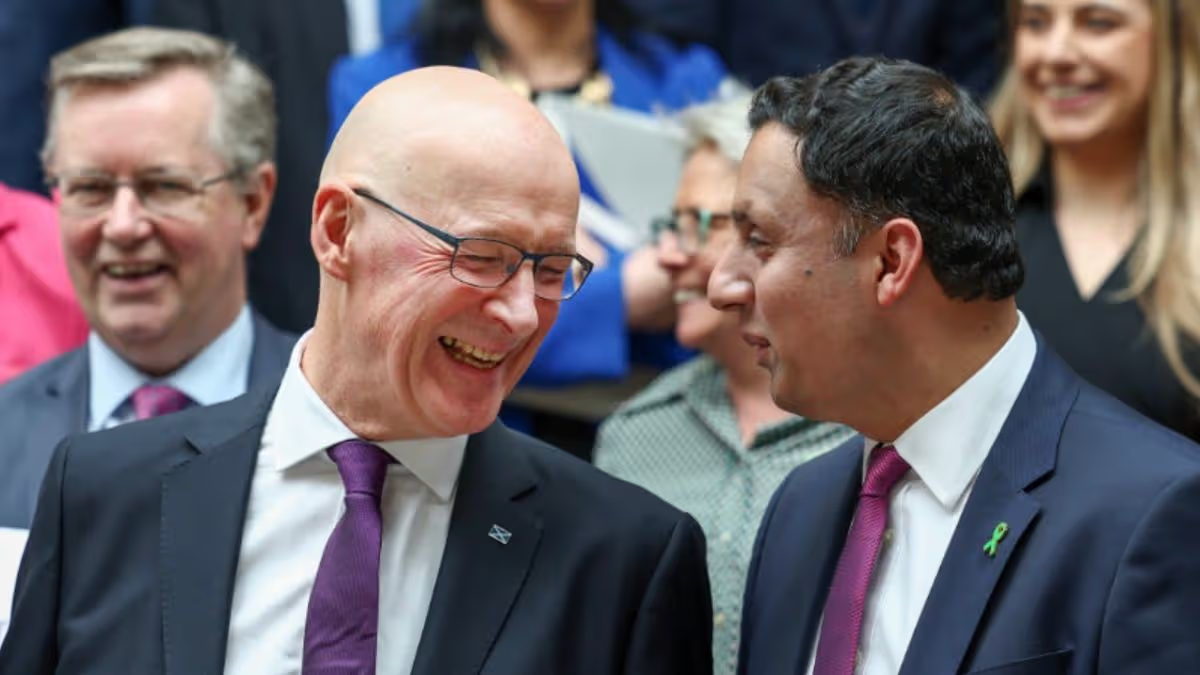
The First Minister will make a speech in Glasgow at 10am to officially launch the SNP’s campaign, where he is expected to insist his party offers a “fresh choice” – despite having been in office since 2007.
Anas Sarwar will also make a speech in Scotland’s largest city this morning with Labour left trailing in the polls.
Speaking ahead of his speech in Glasgow, Sarwar said: “After 20 years of SNP government, Scotland needs change, and this is the only party that can deliver it.
Advertisement
“This is the first opportunity in a generation to change the Government in Scotland and it is not one we can afford to miss.
“People are fed up of the old politics of division. They want a more positive and hopeful government and a more positive and hopeful future for Scotland.
“Scotland’s choice is a simple one: a third decade of SNP Government with John Swinney as First Minister, or a Scottish Labour Government with me as First Minister.
“If you agree that Scotland needs change, and that it needs a new government that will fix the mess, get the basics right and build a better future, then on May 7 – cast both your votes for Scottish Labour.”
Advertisement
Russell Findlay, the Scottish Conservatives leader, is also facing a gruelling campaign with his party facing the prospect of losing half of its MSPs, according to recent polls.
He said: “John Swinney has made it clear that he will use an SNP majority on May 7 to push for another independence referendum.
“Recent polling suggests that he is on the brink of achieving that nightmare prospect. He is already boasting about winning a majority.
“But over the next six weeks, if Scots get behind the Scottish Conservatives, we can stop Swinney and his push to break up the United Kingdom.
Advertisement
“That is his lifelong ambition. He says he will use a majority to deploy his ‘secret plan’ to deliver independence.”
To sign up to the Daily Record Politics newsletter, click here



















































You must be logged in to post a comment Login