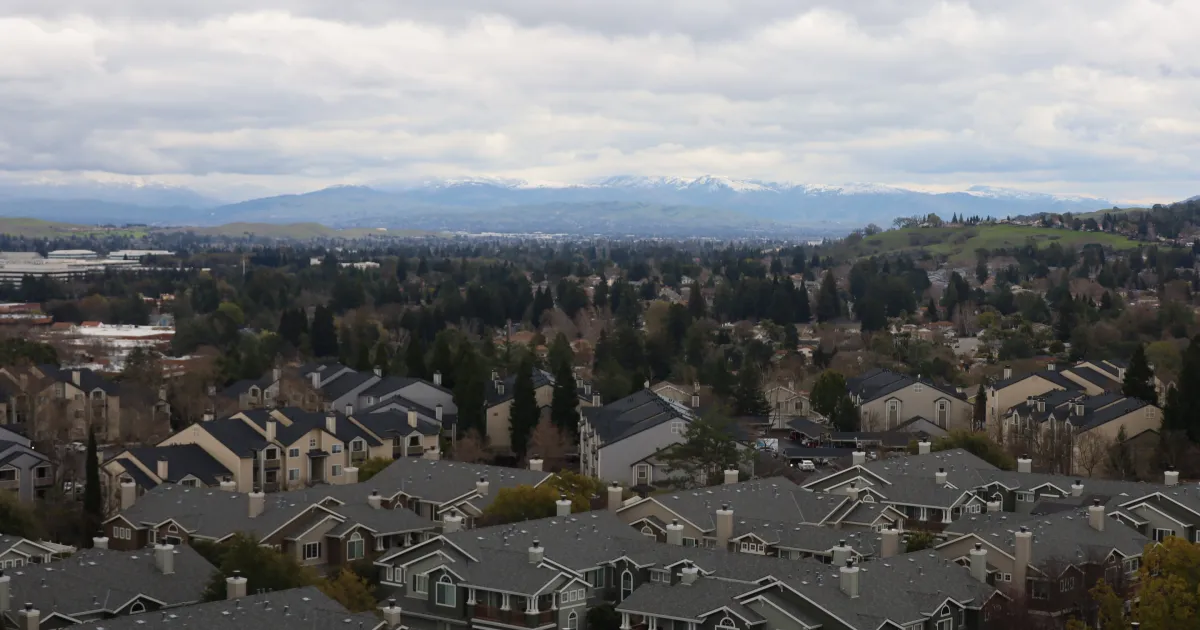
For the past four days, California has been inundated with earthquake swarms, with the latest hitting on Tuesday. The US Geological Survey (USGS) reported a 3.1-magnitude quake at 5.53am PT (8.53am ET) near San Ramon, the epicenter of the recent seismic activity, where the tremor followed a dozen smaller quakes ranging from 1.1 to 1.6 magnitude. Experts have played down fears of a larger earthquake to follow imminently, while also warning devastating one is likely to occur in the next two decades. (Picture: Getty)
The area has been shaken by multiple earthquakes, including magnitudes 2.9, 2.3, and 2.2 on December 13, a 2.8-magnitude quake on December 14, and 2.4 and 2.1 on December 15. Data from the USGS revealed San Ramon has recorded at least 21 earthquakes that ranged from magnitude 2.9 to 4.0 over the past two months. In the last month, the city has been shaken by at least 90 earthquakes – but most of them were too small to cause damage. The quick succession of seismic activity has raised concerns among some residents, with fears that the clusters of quakes could be a warning sign of a much larger earthquake. (Picture: USGS)
However, experts say that the small tremors do not mean that a major event is imminent. Dr Annemarie Baltay, a USGS research geophysicist, said he is not unusually concerned that the recent earthquakes signal anything larger on the horizon for San Ramon. Dr Baltay told Patch: ‘These small events, as all small events are, are not indicative of an impending large earthquake.’ (Picture: USGS)
However, she did warn about what is nicknamed The Big One. She continued: ‘However, we live in earthquake country, so we should always be prepared for a large event. There is a 72 percent chance of a magnitude 6.7 or larger earthquake occurring anywhere in the Bay Area between now and 2043. So we should all be aware and be prepared.’ An earthquake with a magnitude of 6.7 on the Calaveras Fault would be classified as a major seismic event capable of causing significant damage in densely populated East Bay communities. (Picture: Getty)
San Ramon sits on top of the Calaveras Fault, where a network of smaller interconnected fractures branches off the main fault line, which is capable of producing a magnitude 6.7 earthquake. Researchers say that a movement of fluids such as water or gas through these narrow cracks can destabilise the rock setting off clusters of minor earthquakes that strike in rapid succession. (Picture: Getty)
USGS records highlighted similar swarms in 1970, 1976, 2002, 2003, 2015 and 2018. However, Dr Sarah Minson, a research geophysicist with the USGS’s Earthquake Science Center at California’s Moffett Field, told SF Gate: ‘This has happened many times before here in the past, and there were no big earthquakes that followed. We think that this place keeps having earthquake swarms due to a lot of fluid-filled cracks, thanks to very complex fault geometry, unlike, say, the San Andreas Fault, which is this nice clean edge.’ (Picture: Getty)
The seismic activity in San Ramon started in early November with a 3.8 magnitude, and the tremors have not stopped since. Researchers have found that the area contains several small, closely spaced faults rather than a single big one, and the quakes moved along these faults in a complex pattern, suggesting the faults interact with each other. They discovered evidence that underground fluids may have helped trigger the tremors, but after looking into other possible causes, like tidal forces, they found no clear connection. (Picture: Getty)
Advertisement
News Updates
Stay on top of the headlines with daily email updates.