
News Beat
European leaders expected to cement support for Ukraine amid US pressure to accept peace deal

BERLIN (AP) — European leaders are expected to cement support for Ukraine Monday as it faces Washington’s pressure to swiftly accept a U.S.-brokered peace deal.
Peace talks between U.S. envoys and Ukrainian President Volodymyr Zelenskyy, as well as Ukrainian and European officials, continued Monday morning as part of a series of meetings in an effort to secure the continent’s peace and security in the face of an increasingly assertive Russia. The second day of talks in Berlin began shortly before noon local time.
Finnish President Alexander Stubb, one of the key European interlocutors between U.S. President Donald Trump and Zelenskyy, was spotted Monday morning in downtown Berlin.
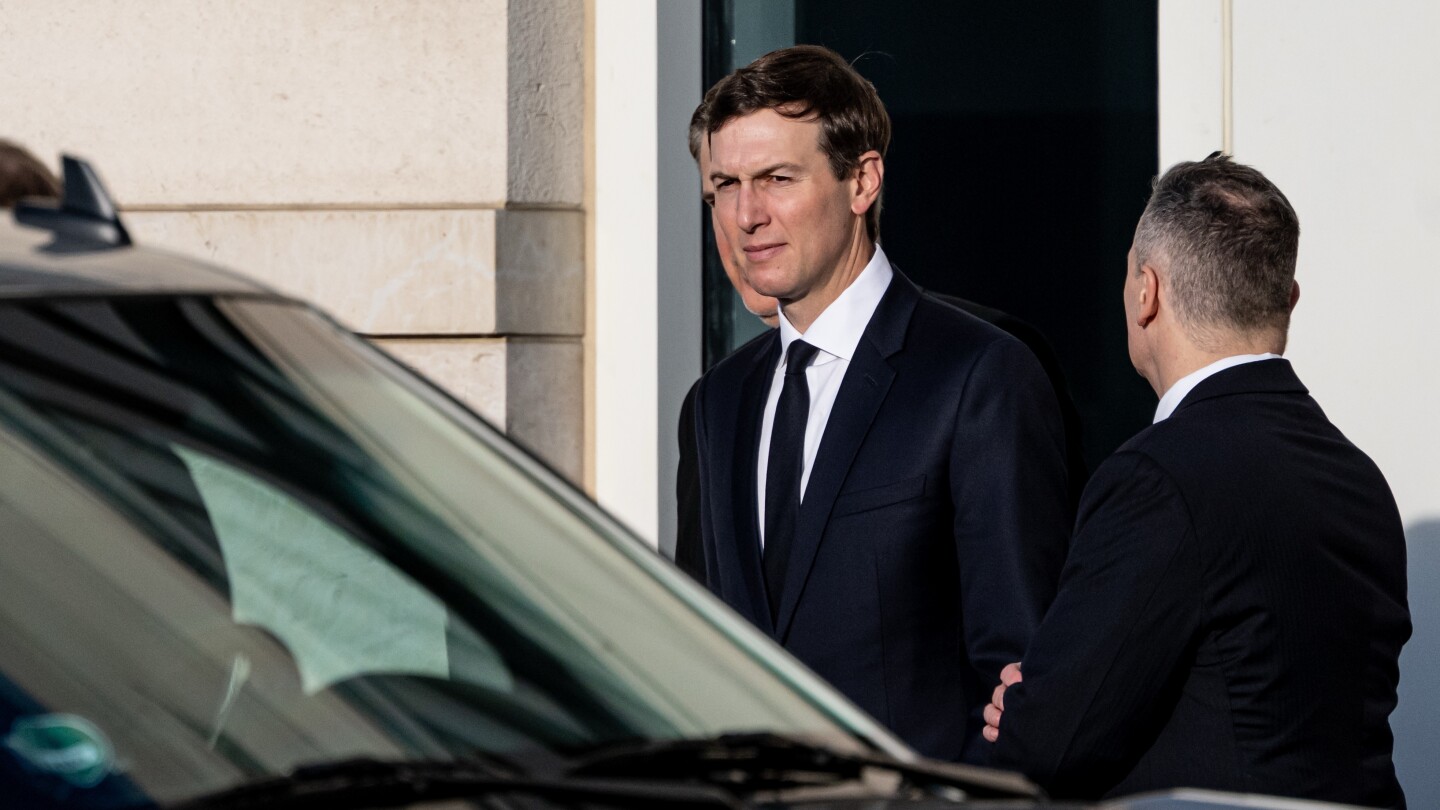
Zelenskyy sat down Sunday with Trump’s special envoy Steve Witkoff and Trump’s son-in-law Jared Kushner in the German federal chancellery in the hopes of bringing the nearly four-year war to a close.
Washington has tried for months to navigate the demands of each side as Trump presses for a swift end to Russia’s war and grows increasingly exasperated by delays. The search for possible compromises has run into major obstacles, including control of Ukraine’s eastern Donetsk region, which is mostly occupied by Russian forces.
The U.S. government late Sunday said in a social media post on Witkoff’s account after the five-hour meeting that “a lot of progress was made.”
Earlier in the day, Zelenskyy voiced readiness to drop his country’s bid to join NATO if the U.S. and other Western nations give Kyiv security guarantees similar to those offered to NATO members. But Ukraine continued to reject the U.S. push for ceding territory to Russia.
Putin wants Ukraine to withdraw its forces from the part of the Donetsk region still under its control among the key conditions for peace.
The Russian president also has cast Ukraine’s bid to join NATO as a major threat to Moscow’s security and a reason for launching the full-scale invasion in February 2022. The Kremlin has demanded that Ukraine renounce the bid for alliance membership as part of any prospective peace settlement.
Zelenskyy emphasized that any Western security assurances would need to be legally binding and supported by the U.S. Congress.
The Kremlin said Monday that it expected to be updated on the Berlin talks by the American side once the talks had finished.
Asked whether the negotiations could be over by Christmas, presidential spokesperson Dmitry Peskov described trying to predict a potential time frame for a peace deal as a “thankless task.”
“I can only speak for the Russian side, for President Putin,” Peskov said. “He is open to peace, to a serious peace and serious decisions. He is absolutely not open to any tricks aimed at stalling for time.”
In London, meanwhile, the new head of the MI6 spy agency is set to warn on Monday of how Putin’s determination to export chaos around the world is rewriting the rules of conflict and creating new security challenges.
Blaise Metreweli will use her first public speech as chief of the United Kingdom’s foreign intelligence service to say that Britain faces increasingly unpredictable and interconnected threats, with emphasis on “aggressive, expansionist” Russia.
Drone strikes continue
Russia fired 153 drones of various types at Ukraine overnight Sunday into Monday, according to Ukraine’s Air Force. The air force said early Monday that 133 drones were neutralized, while 17 more hit their targets.
In Russia, the defense ministry on Monday said forces destroyed 130 Ukrainian drones overnight. An additional 16 drones were then destroyed between 7 a.m. and 8 a.m. local time Monday.
Eighteen drones were shot down over Moscow itself, the Russian defense ministry said.
Flights were temporarily halted at the city’s Domodedovo and Zhukovsky airports as part of safety measures, officials said.
Damage details and casualty figures were not immediately available.
‘Pax Americana’ is over
German Chancellor Friedrich Merz, who has spearheaded European efforts to support Ukraine alongside French President Emmanuel Macron and U.K. Prime Minister Keir Starmer, said Saturday that “the decades of the ‘Pax Americana’ are largely over for us in Europe and for us in Germany as well.”
“Pax Americana” refers to the U.S.’s postwar dominance as a superpower that has brought relative peace to the globe.
Merz warned that Putin’s aim is “a fundamental change to the borders in Europe, the restoration of the old Soviet Union within its borders.”
“If Ukraine falls, he won’t stop,” Merz warned during a party conference in Munich.
Macron, meanwhile, vowed Sunday on social platform X that “France is, and will remain, at Ukraine’s side to build a robust and lasting peace — one that can guarantee Ukraine’s security and sovereignty, and that of Europe, over the long term.”
Putin has denied plans to attack any European allies.
__
Ciobanu reported from Warsaw, Poland. Pietro De Cristofaro in Berlin, Illia Novikov in Kyiv, Ukraine, and Katie Marie Davies in Manchester, England, contributed to this report.



