

Emerald Fennell’s film adaptation of Wuthering Heights has been pulling in the crowds recently, which is quite a feat in troubled times for cinema. Published in 1847, Emily Brontë’s tale of psycho-sexual power dynamics is just one of many enduring female-authored 19th century novels exploring female sexuality and desire for autonomy. These characters existed within a system that allowed women few education or career opportunities.
The ever-popular work of canonical British female writers such as Jane Austen, the (other) Brontë sisters and George Eliot were very different in style and tone. But they also draw attention to various forms of gender inequality.
Their novels focused on issues such as inheritance and property laws, the pressure on young women to marry for financial security, the sexual double standard and the lack of career prospects for women. In doing so, they gave voice to the frustrations of an expanding female readership in the 19th century.
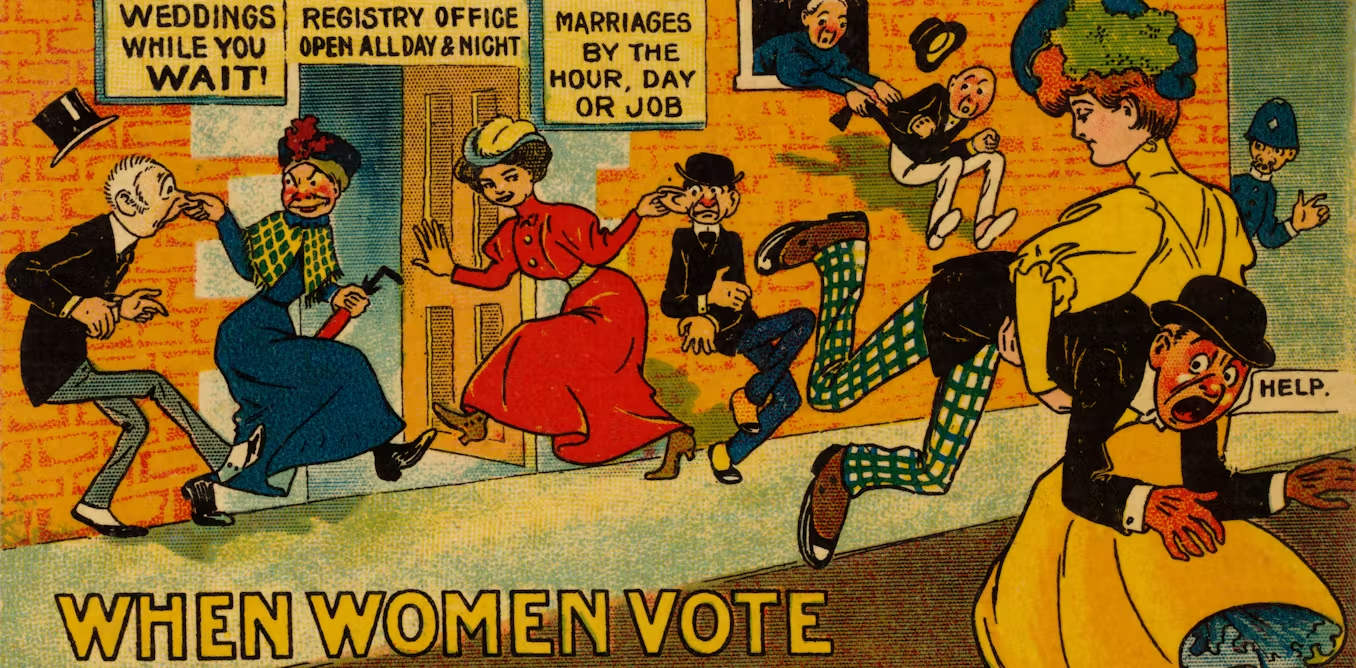
The work of these and lesser-known female authors was crucial in shaping and fuelling public debates on what was referred to in the mid-Victorian period as “the woman question” (women’s right to vote). It later became the first-wave feminist movement in the late 19th and early 20th century.
The emergence of two inventive new literary forms in the early 20th century were key. One was modernism and the other the new printed paperback; both were intertwined with the expansion of women’s concerns and desires in the social and cultural sphere.
Modernism saw the burgeoning of experimental female writers such as Virginia Woolf and Jean Rhys in the 1920s. Then came popular genres such as mass market romance and what is now described as “cosy” crime fiction in the 1930s. Women writers and readers were creating spaces in high art and mass culture that centred female experience and domestic and personal life from the beginning of the 20th century.
The second wave
Given the importance of novels and reading to the history of feminist struggle, it is not surprising that second-wave feminism drew heavily on women’s literary heritage. This saw the publication of landmark academic studies of women’s writing such as Elaine Showalter’s A Literature of Their Own (1977), and Sandra Gilbert and Susan Guber’s The Madwoman in the Attic (1979). And with them came the proliferation of university courses on women’s writing.
The 1960s and 1970s also witnessed the birth of polemical feminist bestsellers. This included Germaine Greer’s The Female Eunuch (1970) and “consciousness raising” popular novels, such as The Woman’s Room (1977) by Marilyn French.
In the 1970s and 1980s, a more diverse group of feminist writers came on the scene. Writers like Margaret Atwood, Angela Carter, Alice Walker, Audre Lorde, Toni Morrison, Octavia Butler and Rita Mae Brown, continued to shape and expand the political and cultural scope and influence of women’s writing into queer, black and postmodernist forms.
Bookgroups, BookTok and the feminist novel
In our own era, while men are reading fewer and fewer novels, female writers and readers are keeping the world of fiction alive. Aside from being the major purchasers of fiction, women are far more likely to enhance and socialise their literary interests. Local book groups and online review and recommendation communities such as Booktok are popular spaces for exploring new literature.
They are also the driving force in the creation and consumption of successful new literary cycles. For example, one of the publishing success stories of the last ten years in English language fiction was the female-centred psychological thriller/domestic noir crime novel. This included the likes of Gone Girl (2014), The Girl on the Train (2016), Big Little Lies (2017) and The Housemaid.
As feminist literary critics have pointed out, not only are these novels predominantly written and narrated by women. Through widespread circulation and screen adaptations, they have also continued to bring to light key gender and power issues such as coercive control, domestic violence and the murder of women. At the lighter end of the spectrum, the recent explosion of “romantasy” fiction (a romance-fantasy hybrid) focuses on female desire and pleasure.
The boundary between literary and genre fiction is becoming increasingly blurred. But contemporary female writers such as Rachel Cusk, Bernadine Evaristo, Anna Burns and Eimear McBride continue to produce innovations in style and form. And younger female writers of “rage” and “sad girl” novels like Ottessa Moshfegh, Oyinkan Braithwaite, Rachel Yoder, Raven Leilani and Aria Aber are not afraid to explore edgy and unsettling accounts of women’s experience.
In life-writing, creative non-fiction and autofiction, women’s stories have also proliferated. Post #MeToo bestsellers such as Acts of Desperation (2022) by Meghan Nolan, and Three Women (2020) by Lisa Taddeo, tearing down comfortable myths of equality and exposing the persisting inequalities in women’s personal relationships.
For more than two centuries, women’s writing has not only reflected the constraints of patriarchy but actively challenged and reshaped them. As long as women continue to write, read and reimagine the world through fiction, novel reading will remain a vital site of feminist resistance and possibility.
This article features references to books that have been included for editorial reasons, and may contain links to bookshop.org; if you click on one of the links and go on to buy something, The Conversation UK may earn a commission.















































You must be logged in to post a comment Login