For the Democrats, state representative James Talarico defeated Dallas-based US Congresswoman Jasmine Crockett and will advance to the general election. The Republican race was not decided on Tuesday, as Texas Attorney General Ken Paxton and US Senator John Cornyn, the incumbent, each finished with less than 50% of the overall vote. The two men will advance to a run-off election on 26 May.
Kate and Rio Ferdinand appear to have moved to Portugal, leaving Dubai not long after the region was hit by missiles due to the ongoing conflict between Iran and the US
06:10, 25 Mar 2026Updated 06:12, 25 Mar 2026
As war in the Middle East continues, TV star Kate Ferdinand and her footballer husband Rio are said to have swapped their home in Dubai for the dreamy Algarve in Portugal.
Many celebs who live in Dubai have spoken about how scary Dubai has become since tensions escalated, including Rio, who said: “It’s frightening when you hear missiles, planes and fighter jets – I don’t know what it is – going above us, and you’re hearing big bombs, and what that is we don’t know as we don’t know the details of what they are.”
Ensure our latest headlines always appear at the top of your Google Search by making us a Preferred Source.Click here to activateor add us as your Preferred Source in your Google search settings.
This comes months after Kate broke down in tears following the Christmas break, revealing how much she missed her family in the UK. “I just miss my family and friends,” she said. She added: “I do feel happy in Dubai, but I’m just missing a part of me.”
Advertisement
As such, some might have expected the family to return to the UK when they left Dubai, but they have instead chosen Portugal. Kate and Rio moved to the country with their younger children, Cree, 5, and Shae, 2, along with Rio’s daughter Tia, 13, rater than the UK, where the footballer’s eldest two, Lorenz, 19, and Tate, 17, still live. A source has revealed to the Mirror the real reason they chose the Algarve as their new home.
The source revealed that there was “nothing appealing” about England, but the family wanted to be closer to the country so that it was easier for family to visit.
“Why be in England when there’s nothing appealing? There’s nothing appealing for them to come back to. Portugal is also easier for the families to get to die to the shorter flights. They’ll eventually return back to the UK, but at the moment, there’s more for them as a family in Portugal.” They added that the whole family “is flying over to Portugal for Easter”, meaning everyone will be together very soon.
Portugal may also offer up more business opportunities. Rio left his role as a sports pundit for TNT last year and now pals say the ex-footballer, who already invests in other business and set up the charity The Rio Ferdinand Foundation, is thinking about getting into the booze business.
“They’re loving it in Portugal,” said the source. “They don’t get hassled, unless Rio is on the golf course where he does his business. He’s thinking about getting into vineyards and wines.”
They added that “day to day, Kate does mum things and Rio works”. As such, Portugal works well for them, and was the right choice for their young family.
The source said: “Portugal has always been a sort of second home as well. And there’s a lot more, there’s some really good schools there. And they’ve got good friends there, so it’s a really good expat area they’re going into.”
Advertisement
Portugal is famed for being a hotspot for digital nomads and has become the place to go for Americans looking to leave the US, according to The Guardian. This is reportedly because it ranked seventh in the Global Index, has a low cost of living and freedom of movement in the EU. Now, it appears to be drawing in UK expats as well.
For Kate, the key draw is the country’s proximity to the UK. “Kate loves having her family closer, Portugal is much more commutable,” the source said. “
It makes her more accessible to family and friends. Being able to have them over is a massive plus. And it’s a much better expat community. It’s not so ‘do you know who I am and how much I’m worth?’. Dubai is very bling, Portugal is where people live. Its a home not a posing pad. Kate won’t be on her own much anymore and she’s got a network, so she’s happy.”
Warning this article contains spoilers about the new Amazon Prime series Young Sherlock.
I’ve read the whole Sherlock Holmes canon multiple times over. I love how Holmes uses analytical reasoning to unravel problems that look mysterious, but ultimately prove to have simple explanations. So I was excited when I saw Guy Ritchie’s Young Sherlock appear on Amazon Prime. My excitement was quickly tempered when I started watching, though.
A key part of the plot relies on mathematics. Holmes first meets his sidekick Moriarty (yes, he is working together with his future adversary) at the blackboard after a maths lecture at Oxford. Despite some mistakes in the dialogue, the maths on the blackboard is interesting enough. It is finding the solutions to the equation x5 + x4 + x3 + x2 + x + 1 = 0. As shown nicely in this video, the equation has five solutions.
Advertisement
In the maths many of us will have learned at school, we are taught that a positive times a positive makes a positive and that a negative times a negative also makes a positive. For example, 3 times 3 equals 9, but -3 times -3 also equals 9. Squaring a number (when you multiply a number by itself) should always give a positive result. The reverse operation – finding the number(s) you multiply together to give a positive number – is called taking the square root. The two square roots of 9 are 3 and -3, since when you square either of these numbers you get the answer 9.
If we want to take the square root of -1, say, then we need to venture into the realm of imaginary numbers. Imaginary numbers are the square roots of negative numbers. Mathematicians defined the imaginary number i to be the square root of -1 (technically -1 has two square roots i and -i). The square roots of other negative numbers are multiples of i. The square roots of -9, for example are 3i and -3i. Some of the solutions from the equation on the blackboard involve imaginary numbers (this will turn out to be an important plot point).
Mathematical blunders
It’s plausible that the equation on the blackboard might appear in an early first year undergraduate tutorial. Something approaching a passable solution is given, but in excruciating detail (the sort of detail you wouldn’t use at school, let alone in a maths degree at Oxford). And there are mistakes in the maths.
Advertisement
Young Sherlock Holmes contemplates the incorrect solutions on the blackboard. Amazon Prime screenshot
Towards the end of the lecture, the professor sets the students homework to find all the solutions to the equation, even though they are already written on the board (although incorrectly). Despite this, the end of the scene sees Sherlock spending some time trying to think of the solutions before Moriarty comes up and shows him two of the five solutions (as if they were the only ones). Moriarty too writes these down incorrectly, but in a different way to the incorrectness already on the board.
As Moriarty writes down the complex solution (complex means the answer contains both real and imaginary numbers) he says “These solutions, they’re not real. They’re imaginary.” which we can allow (although technically he means complex).
What we can’t forgive is Moriarty going on to say, “That means even if you can’t see the target, you can still shoot for it.” Which is nonsense, even as a metaphor. Complex numbers aren’t targets you can’t see, but well-defined, mainstream (even in the 1870s) mathematical quantities and there’s no sense in which you “aim at” a complex solution to an equation.
Advertisement
Death by numbers
In the last episode, Holmes and his team are battling to halt the distribution of a deadly chemical weapon known as the “creeping death”. They find a scrap of paper in a secret room which they say is the “equation for creating the creeping death.”
I was expecting to see some complex chemical reaction formulae sketched on the page, but when it’s held up to the camera, we see instead a mathematical equation: z3 + 4 z2 – 10 z + 12 = 0.
What does this have to do with the chemical process for creating the deadly nerve agent?
Nothing, it turns out. Or at least nothing I can imagine. In fact it’s a device to allow Holmes and Moriarty to hark back to that moment in the lecture theatre when they first met. What follows goes beyond artistic license into the realm of gibberish.
Advertisement
“If we have the positive equation”, they say, “then we can come up with the negative. And thus create a compound to neutralise the threat of creeping death.” Perhaps they meant “positive solution”, because equations themselves aren’t positive or negative. Either way, the idea that this simple mathematical equation or its solutions are the secret formula for making a weapon of mass destruction doesn’t make sense. There’s no context, no sense in which this equation could be the secret recipe for creating the nerve agent.
Moriarty points out that they have a problem. “This equation is not finished.” By this I think he means that the three solutions to the equation are not written out explicitly.
One solution, z = – 6 is given. And it’s correct. The rest of the scrap of paper contains a reformulation of the equation (a factorisation), which shows that the remaining solutions can be found by solving a quadratic equation: z2 – 2 z + 2 = 0.
A quadratic equation is just an equation built around a squared term (in this case z2), which has two solutions. The formula for the solutions may be familiar to GCSE students (normally aged 15 to 17 years old). For a general quadratic equation: a z2 + b z + c = 0, the two solutions are given below.
Advertisement
Yet, we are supposed to believe that, despite having supposedly solved a far more complicated equation than this in the first episode, Moriarty can’t find the solution to this much simpler equation. So stumped is Moriarty – the future maths professor – that he spends precious time, as a bomb is about to detonate, searching for a piece of paper with this missing solution. He almost loses his life when he could have just used a GCSE-level formula.
The piece of paper he eventually finds contains an incorrect statement of the quadratic formula alongside some nonsensical text, although the solutions are at least correct: z = 1 + i and z = 1 – i (where i, remember, is the imaginary number).
I appreciate my dissection of the maths is high-grade nerdery. Most people will have watched the series without pausing it like I did to look at the maths and probably won’t have noticed. But, if maths is going to be a pivotal plot point in your blockbuster series, then you’ll probably want to make sure you get it right.
Crews from Bolton Central Fire Station and Greater Manchester Police attended the scene on Bridgeman Place, opposite Subway, just before midnight on Monday evening, March 23.
A fire officer at the station told The Bolton News that three fire engines and a turntable ladder were deployed to the incident.
The surrounding roads were closed while the rescue took place (Image: A D Schofield)
The four teenagers were rescued from the roof of Commerce House, which is currently covered in scaffolding.
The teens had climbed five floors of the building (Image: A D Schofield)
The teens were safely brought down from the roof by the turntable ladder.
Advertisement
Firefighters were seen scaling the building (Image: A D Schofield)
A spokesperson from Greater Manchester Police told The Bolton News: “Four youths climbed up scaffolding, five floors up, and got stuck.
“Greater Manchester Fire Service were called and got the boys down.
“Officers assessed the building and no damage was caused.
“No arrests were made and officers took the boys home.”
Advertisement
The emergency services reported no serious injuries.
A fire officer said the incident served as a reminder of the dangers of accessing rooftops, describing it as “lessons learned” for those involved.
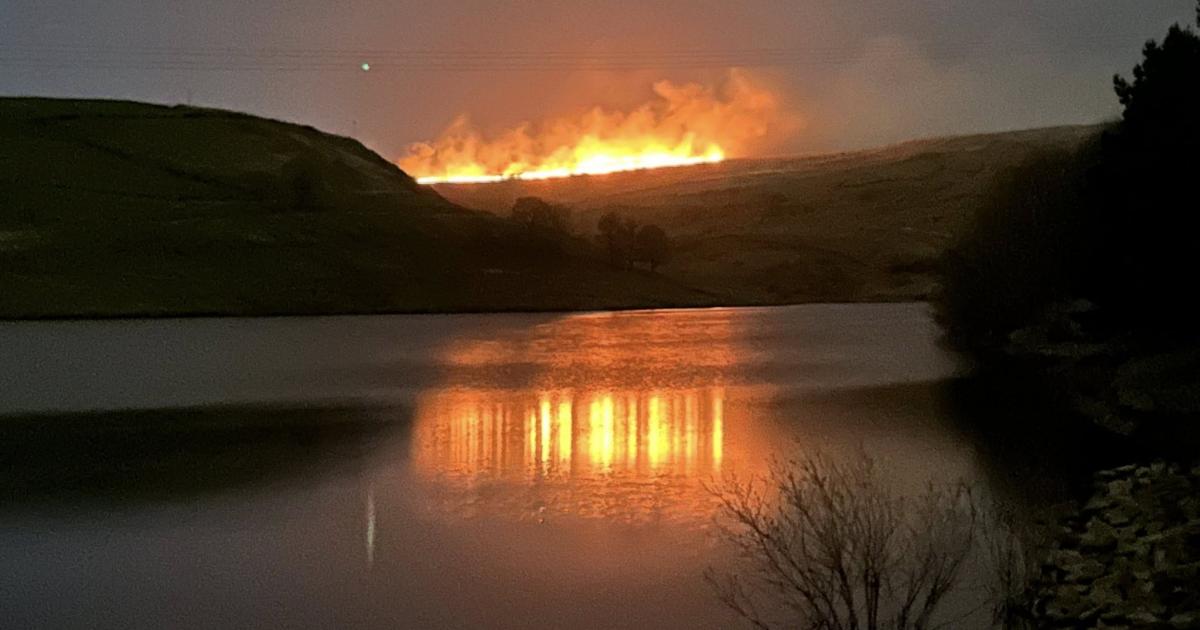
Several fire engines and the drone team were working with Greater Manchester crews to bring the fire under control last night at Scout Moor.
The cause of the fire is not yet known, with fire crews attending Gin Croft Lane, Bury, just before 6pm.
In an update this morning a Lancashire Fire and Rescue spokesperson said: “At 5.44pm on Monday March 23, four fire engines from Lancashire Fire and Rescue, one fire engine from Greater Manchester Fire and Rescue, and a wildfire unit from Lancashire Fire and Rescue attended a moorland fire at Gin Croft Lane, Edenfield, Bury.
Advertisement
“Firefighters used beaters to extinguish the fire. Crews were in attendance for approximately four hours.
“We would like to take this opportunity to stress the importance of not igniting wildfires. These incidents are challenging and place people, property, and large areas of land at significant risk.
“They also divert valuable and limited emergency resources away from other incidents where they may be urgently needed.
“The recent incidents on Scout Moor are currently subject to a joint investigation between Lancashire Fire and Rescue Service and the Police.”
Advertisement
Greater Manchester Fire Service said last night it was assisting Lancashire Fire and Rescue Service to bring a wildfire, under Scout Moor wind turbines, under control.
A spokesperson said: “Please try to avoid the area at the moment, while firefighters carry out their work.”
Lancashire County Councillor for Whitworth and Bacup, Daniel Matchett, shared an update on Monday saying two fires were being dealt with.
One was covering approximately two hectares and had been extinguished. The larger fire, covered around four hectares.
Advertisement
He said: “This is a significant incident and has required the deployment of a Hagglund all-terrain vehicle, which is specifically used for tackling moorland fires.
“Crews are also making use of infrared drone technology to help identify hotspots and monitor the spread of the fire. Lancashire is leading the way in deploying this kind of advanced technology to support firefighting efforts.
“This is the third moorland fire reported across the North West in recent days, with other incidents also recorded in Manchester and West Lancashire.”
The Wednesday letters page is concerned what the decline of Fortnite means for gaming, as one reader has some ideas for Pokémon Pokopia DLC.
Games Inbox is a collection of our readers’ letters, comments, and opinions. To join in with the discussions yourself email gamecentral@metro.co.uk
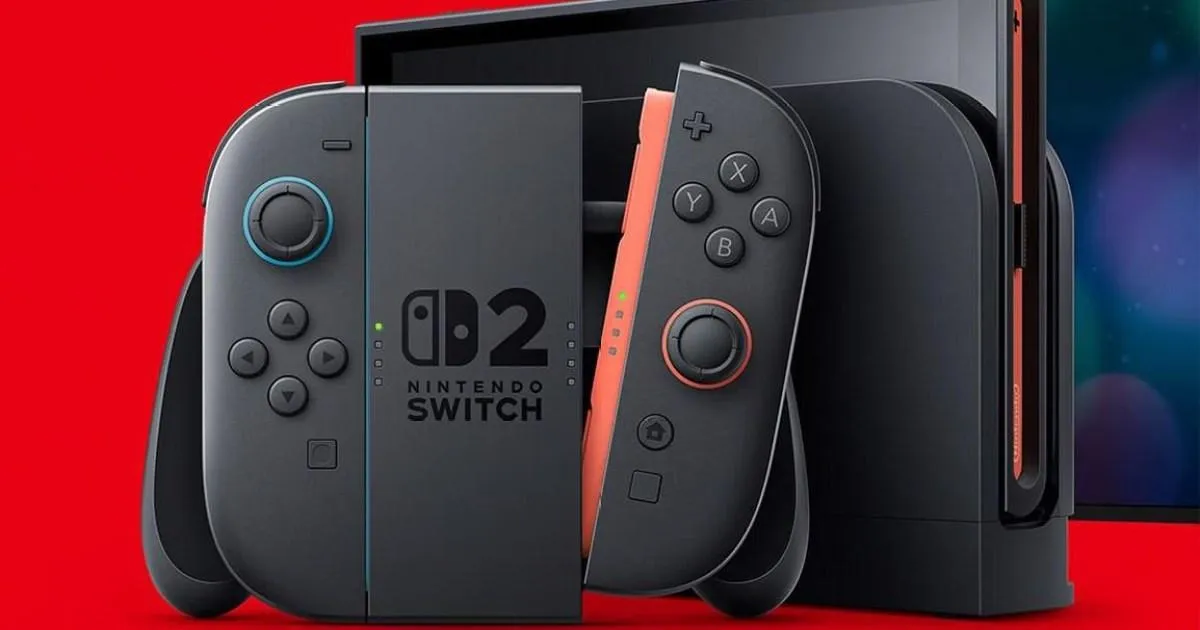
Expensive times So that Nintendo Switch 2 news was a bit of a surprise, huh? I thought something was up when it turned out US sales were down over Christmas, which was clearly not a good sign. As for what’s going wrong, it’s obvious the price is the number one problem, especially when Nintendo is known for cheaper hardware and games. I think the games line-up is a big issue too though and it seems madness to me that we have virtually no idea what’s coming out on the console this year, and it’s already nearly April.
Nintendo knew these sales figures long before we did so surely they could see the damage that this secrecy is doing. How do they expect anyone to want to buy their new console if there’s literally nothing to look forward to on it?
Advertisement
That and no real Christmas game are definite mistakes, but I think the biggest issue is just that nobody’s in the mood for buying expensive consoles – or expensive anything – right now. And that definitely is going to affect Project Helix and PlayStation 6. If I was Sony I’d just keep the PlayStation 5 going for another five years and try and make it cheaper each time. I bet they don’t though. Focus
Blaming Nintendo Woof to the idea of the Switch 2 being the fastest-selling console ever. I guess it was at launch but cutting production plans by 30%? That’s a lot! There’s obviously a lot going on here, but I think many people have said that the Switch 2 has seemed off since it was first announced. All the reveals have been bad, a lot of the games have been weird choices for a first year, and no hint of a new Mario or Zelda is just silly.
Expert, exclusive gaming analysis
Sign up to the GameCentral newsletter for a unique take on the week in gaming, alongside the latest reviews and more. Delivered to your inbox every Saturday morning.
Advertisement
Fans can exist on just a tiny amount of hype for years, just ask any Rockstar Games fan, so all Nintendo had to do was have a few seconds of footage, or a name, or a bit of artwork or something. Instead, they’ve given us nothing but Metroid Prime 4 and Mario Tennis 34, or whatever it is.
I have the console and it’s great but I’m not happy with the marketing or the games. It was an expensive machine and I want to see my purchase be justified, which his not happening at the moment. Nintendo might not be able to control wars and RAM prices, but they have absolute control of what they say about the console and its games. Kascogine
Price conscious This Nintendo news should be a wake-up call to the whole games industry. Microsoft and Sony would be crazy to release expensive next gen consoles at the moment, because Trump and AI and all the other problems are still going to be here next year and probably the year after too.
Advertisement
You can’t react to a cost of living crisis by increasing prices instead of lowering them. I mean, you can but then you’re going to regret it, as Nintendo is proving right now. Games and consoles are too expensive and the company that recognises that problem is going to clean up. In the meantime, indie devs are the solution that already exists. Zeiss
Day of reckoning Epic Games is laying off 1,000 people? After doing almost the same thing two years ago? If it wasn’t obvious by now the games industry is in deep trouble right now. Everything is too expensive to make and buy and the market is not growing at all.
If Fortnite falls then companies are going to be in an absolute shambles working out what to do about it. For a start it’s going to make the games industry look like a failing state and investors aren’t going to touch it with a barge pole.
Advertisement
Fortnite failing means there are no guarantees at all, especially as this happened the same day that the Switch 2’s bubble burst. We are in for rough times ahead, gamers, and as usual no company seems to be doing anything about it. Royston
GTA who? I’ll be honest, I genuinely forgot GTA 6 is coming out this year. It’s been so long, with so many delays, that it doesn’t feel like a game that’s actually coming out. Especially as the graphics look so much better than anything else, and by such a long way.
I honestly can’t imagine a future where it’s out and it’s just another video game, like the way we think of GTA 5 at the moment. If it’s as successful as we all know it’ll be it’s going to dominate everything else for months, maybe years.
Advertisement
We might as well number the years of the games industry as before GTA 6 and after GTA 6, like BC and AD. It’s going to be crazy when it all kicks off. Fybo
Things can only get worse Something with the Switch 2’s success hasn’t been passing the vibe check for a while. Firstly, it’s blockbuster success in Japan seems to be built on a much cheaper Japanese language model. The price discrepancy is so large I think Western buyers have a right to know for how much they are basically subsidising that machine. When buying the console Nintendo may as well just ask you to post £50 to some random dude in Tokyo.
Then in the UK at least the Black Friday price cut from last November seems to have been stealthily introduced as the new price point (i.e. £385 for the base and £409 for the Mario Kart bundle) for retailers. That combined with the fact the Mario Kart bundle still hasn’t sold out (it was a time limited launch window product) did make me wonder how popular Nintendo’s machine was really proving beyond diehard fans?
Continued poor third party game and accessory sales being another factor in that conversation. I mean the attachment rate for the webcam is less than 4%! GameChat should be put out of its misery, like Kinect on the Xbox One was.
Advertisement
Saying all that… If you are thinking of getting the console (it will see new iterations of Zelda and Mario eventually after all) now is the time to buy. The Iran War and RAM crisis mean prices are only going to rise in the year ahead, and if Nintendo have warehouses of stock the chance of a revision of the console that would still need to be manufactured reduces. So it is worth jumping now. Marc
Gotta add ‘em all Just to add to the Pokémon Pokopia love but you can’t help but notice there’s a lot of environments that just aren’t in the game. There’s no snowy area at all, not really a proper desert or water area, and not much in terms of ghosts or metal. There’s some of these pokémon types in there but not as much as some others (so many fighting types!) so I think it’s pretty clear what they could do in terms of expansions.
I’d be there day one though as this is one game where it won’t seem forced and people are actually wanting more of what it’s selling. It’s been one of the best surprises I’ve played in a long time. Gordo
Don’t miss Gaming news! Add us as a Preferred Source
As a loyal GameCentral reader, we want to make sure you never miss our articles when searching for gaming stories. We have all the latest video games news, reviews, previews, and interviews, with a vibrant community of highly engaged readers.
Advertisement
Click the button below and tick Metro.co.uk to ensure you see stories from us first in Google Search.
GameCentral has been delivering unique games news and reviews for over a decade
Marathon not a sprint I was not surprised to see someone writing in to comment at how Marathon’s structure has put them off playing the game. I was surprised we haven’t seen more people commenting one way or another on what is surely to go down in history as one of the most Marmite games of this generation.
Advertisement
Cards on the table, I adore it and have been amazed at how it’s pulled my old group of online friends back to regularly playing together multiple times each week. I’ve even enjoyed quite a bit of solo running and playing as a rook, even if my aging reflexes mean I’m unlikely to complete Cryo Storage until three days before reset, if ever.
What is strange is how Bungie have taken everything they learned from Destiny and focused on a single game mode seemingly designed solely for the 10% of their player-base who were ever able to complete raids.
Destiny’s genius was that at its core, it catered to so many players and play styles. That large player-base would all find something they enjoyed in the game and for those who were hooked, offered difficult activities such as Master Nightfalls, raids, and dungeons.
Marathon feels like they nailed that endgame content yet did not build out the game to appeal to a more casual audience, potentially confining Marathon to a small but hardcore player-base.
Advertisement
I do highly recommend you at least give it a try if you’ve ever enjoyed a Bungie title. The gunplay is great, the level design and objectives feel tight, and as long as you treat all your weapons as disposable, or start your night with a free kit, losing all your kit doesn’t feel too bad. DarKerR (gamertag)
Inbox also-rans Personally, I can’t foresee any problem with a man driving a giant truck while also playing a racing game at the same time. I mean, what could possibly go wrong? Tension
The thing that makes me laugh is that it’s called Crimson Desert but there isn’t actually a crimson desert in the game, because they didn’t think of that at the time. What a mess. Kuros
The small print New Inbox updates appear every weekday morning, with special Hot Topic Inboxes at the weekend. Readers’ letters are used on merit and may be edited for length and content.
You can also submit your own 500 to 600-word Reader’s Feature at any time via email or our Submit Stuff page, which if used will be shown in the next available weekend slot.
You can also leave your comments below and don’t forget to follow us on Twitter.
Here is the winning picture and four “highly commended” photos which impressed wildlife lovers in the public vote.
Advertisement
Image: Flying Rodent by Josef Stefan, from Austria. Pic: Natural History Museum
Conservation efforts mean the Iberian lynx, which was on the brink of extinction in the early 2000s, has now recovered to number more than 2,000. Good news for the lynx, bad news for the local rodents.
This game lasted 20 minutes before the cat got bored and took its prey behind a bush to eat it.
Image: Beauty Against the Beast by Alexandre Brisson, from Switzerland. Pic: National History Museum
A group of flamingos stands out against a stark industrial backdrop of power lines at a bird sanctuary in Walvis Bay, Namibia.
Image: Family Rest by Christopher Paetkau, from Canada. Pic: National History Museum
A mother polar bear and her three cubs resting in the summer heat along the Hudson Bay coast in Canada.
Image: Dancing in the Headlights by Will Nicholl, from the UK. Pic: Natural History Museum
A silhouetted pair of young bear cubs rearing up and play-fighting in the middle of a quiet road in Jasper National Park, Canada.
Image: Never-ending Struggle by Kohei Nagira, from Japan. Pic: National History Museum
A sika deer carrying the interlocked severed head of a rival male that had died after their battle on Notsuke Peninsula in Hokkaido, Japan.
Monterosa
This content is provided by Monterosa, which may be using cookies and other technologies.
To show you this content, we need your permission to use cookies.
You can use the buttons below to amend your preferences to enable Monterosa cookies or to allow those cookies just once.
You can change your settings at any time via the Privacy Options.
Unfortunately we have been unable to verify if you have consented to Monterosa cookies.
To view this content you can use the button below to allow Monterosa cookies for this session only.
The winner and four runners-up will be shown on the voting screens at the Wildlife Photographer of the Year exhibition in London until it closes on 12 July. The top image will also be on the gallery wall alongside the winning images in the main competition.
DUBAI, United Arab Emirates (AP) — An Iranian military spokesperson mocked U.S. attempts at a ceasefire deal Wednesday, raising questions about whether a 15-point plan proposed by Washington has a chance to succeed.
The comments from Lt. Col. Ebrahim Zolfaghari, a spokesperson for the Iranian military’s Khatam Al-Anbiya Central Headquarters, which jointly commands Iran’s regular military and paramilitary Revolutionary Guard, came after the plan was submitted to Iran by intermediaries.
U.S. President Donald Trump has said that American officials are negotiating with Iran on the plan, but Zolfaghari, in a recorded video statement that aired on state television, suggested there were no talks.
“Have your internal conflicts reached the point where you are negotiating with yourselves?” he said.
Advertisement
“Our first and last word has been the same from day one, and it will stay that way: Someone like us will never come to terms with someone like you,” Zolfaghari said. “Not now, not ever.”
The 15-point plan was submitted to Iran by intermediaries from Pakistan, who have offered to host renewed negotiations between Washington and Tehran, according to the person, who spoke on condition of anonymity because they were not authorized to speak publicly.
The New York Times was the first to report that the plan had been delivered to Iranian officials.
The Pentagon is also in the process of deploying two Marine units that will add about 5,000 Marines and thousands of sailors to the region. The moves are being framed as Trump maneuvering to give himself “max flexibility” on what he will do next, the person added.
Advertisement
Israeli officials, who have been advocating for Trump to continue the war against Iran, were surprised by the submission of a ceasefire plan, the person said.
The White House did not respond to requests for comment.
Meanwhile, airstrikes battered the Islamic Republic while Iranian missiles and drones targeted Israel and sites across the region.
With oil prices rising and consumers feeling the pain at the pump, Trump has been under increasing pressure at home to bring the war to an end.
“The strategic power you used to talk about has turned into a strategic failure,” said Zolfaghari, the Iranian military spokesman. “The one claiming to be a global superpower would have already gotten out of this mess if it could. Don’t dress up your defeat as an agreement. Your era of empty promises has come to an end.”
_____
Madhani reported from Washington. Rising reported from Bangkok, and Magdy reported from Cairo.
The company, which featured on TV’s Dragon’s Den has shipped out nearly 1,000 of its Inhaler Tailor cases to Australia.
The Inhaler Tailor was launched in 2022 producing colourful inhaler cases to boost the use of inhalers, especially among children who might be put off from using traditional inhalers.
The company says 76% of its customers agree the cases encourage them to use their preventer inhaler more frequently.
In addition, 87% of customers agree they feel more confident using their inhaler with the cases, and 99% says the colourful cases makes their inhaler easier to find.
Will Hogge, who founded the business, appeared on tv’s Dragon’s Den in 2024 and has been joined by wife Harriet in the business.
Director Harriet says the couple were approached by Asthma Australia at the end of last summer after they had seen their inhaler cases on social media.
Harriet Hogge in York City Centre showcasing a leopard print cover (Image: Pic supplied)
They trailed them and then placed an order for nearly 1,000 cases.
Advertisement
Harriet told the Press: They were keen to show them at conferences. They were very pleased with the cases. They agreed to list us on their shop.”
“It is so gratifying. It’s fantastic. It’s just the start of what will be a long-term partnership and getting distribution to far flung places.”
Asthma Australia CEO Kate Miranda said: “We are always looking for ways to support people with asthma, particularly in overcoming barriers to using their medicines.
“Innovations like Inhaler Tailor covers can boost confidence and make it easier for people to carry and use their inhaler when they need it most.
Advertisement
“We’re proud to make them available to the Australian community through the Asthma Australia shop.”
Inhaler Tailor has also been in touch with Asthma New Zealand, who is also keen to get involved.
Harriet continued: “This is a test bed to expand in a similar way across the globe. It’s a really good way to expand.”
The orders from Australia build on a successful 2025, where the products were also launched in Walmart and on Amazon in the US.
Advertisement
Closer to home, however, whilst individual NHS trusts have received free samples and made ad-hoc purchases through charity funding, the inhalers have yet to make official NHS procurement lists.
Further research is still needed, Harriet explains, but she is convinced the cases will save the NHS money by reducing the hospitalisation of asthma sufferers.
She added the company is innovating with its products, including releasing a glow-in-the-dark case.
“We continue to throw everything at it. We have been going a few years.”
Emma Henson had her leg amputated at the age of one because of a rare condition that made her right leg swell to twice the size of her left leg
A Peterborough woman with one foot is searching for a fellow amputee to share shoes with – so two bin bags full of unwanted right shoes don’t go to waste. Emma Henson, 20, has a rare condition called Klippel-Trenaunay syndrome (KTS).
Advertisement
When she was born, her right leg had swelled to double the size of her left one. When Emma turned one, her parents made the decision to have the leg amputated, as she would never be able to walk on it.
Her leg causes her too much pain to wear a prosthetic, so Emma only ever needs to wear one shoe as she uses crutches or a wheelchair to get around. She said that throughout her life, she has struggled to find companies that will sell her a single shoe, leaving her feeling as though she is not accepted.
She is now searching for a left foot amputee, who is a size six shoe, with whom she can share pairs of shoes. Emma, who originally shared her story with Talk To The Press, said: “My leg is constantly swelling and getting infected, so wearing a prosthetic is so painful and makes me bleed.
“I’ve got a whole bin bag, if not two at home, full of right foot shoes. I would love to find a left leg amputee who is also a UK size six so that we could share shoes.
Advertisement
“I’ve tried to give my odd shoes to charities, to help other amputees, but nowhere will accept them. It makes me feel not accepted in the world. I was born like this, I didn’t choose it.”
KTS is a rare congenital condition with symptoms including port-wine stain birthmarks, varicose veins, and limb overgrowth. When she was one, doctors told her parents that they could either choose to have the leg amputated from the knee down, or that she would be in a wheelchair forever.
She said she has emailed countless shoe companies but is always told that she will have to just buy a pair of shoes. She added that she doesn’t think it’s fair that she has to fork out for two shoes, when one will just end up in the back of her wardrobe.
Advertisement
Emma said: “A pair of shoes sometimes costs £150, and I can’t afford that if one of them is just going to sit in the wardrobe. I think companies should give you the option of just buying one shoe, and paying half price for it.
“It would make companies look good, and make everyone feel included. There’s probably a lot of people out there who are having the same issue as me, and it’s so unfair that one shoe just goes to waste.”
She feels that there must be many people like her in the same predicament, so is searching for someone, not only to share shoes with, but also to relate to.
Emma said: “One of my goals is to find someone out there who is like me to talk to about our similarities and help make each other feel better about ourselves.”
The Clitheroe Country Market, held at Clitheroe United Reformed Church on Moor Lane, is open every Tuesday from 9am to 12pm and will run until mid-December.
The market features home baking, crafts, jewellery, cards and prints, home produce, plants, flowers, and preserves.
The market features homemade baking, crafts, jewellery, cards and prints (Image: Supplied)
A spokesperson for the market said: “All the baking and savouries are guaranteed homemade.
“The preserves, including jams, marmalades, jellies and chutneys, contain no preservatives, and the same can be said of the handmade savouries.
Advertisement
“All have that unique good old-fashioned taste.”
Customers can also enjoy refreshments during their visit.
READ MORE:
The spokesperson added: “Coffee and tea will also be available, as will the popular cake of the week feature, when customers can purchase a slice of cake, toasted tea cakes or buttered scones to go with their drinks.”
Advertisement
Handmade cards, pictures, and gifts can be made to order.

























































You must be logged in to post a comment Login