

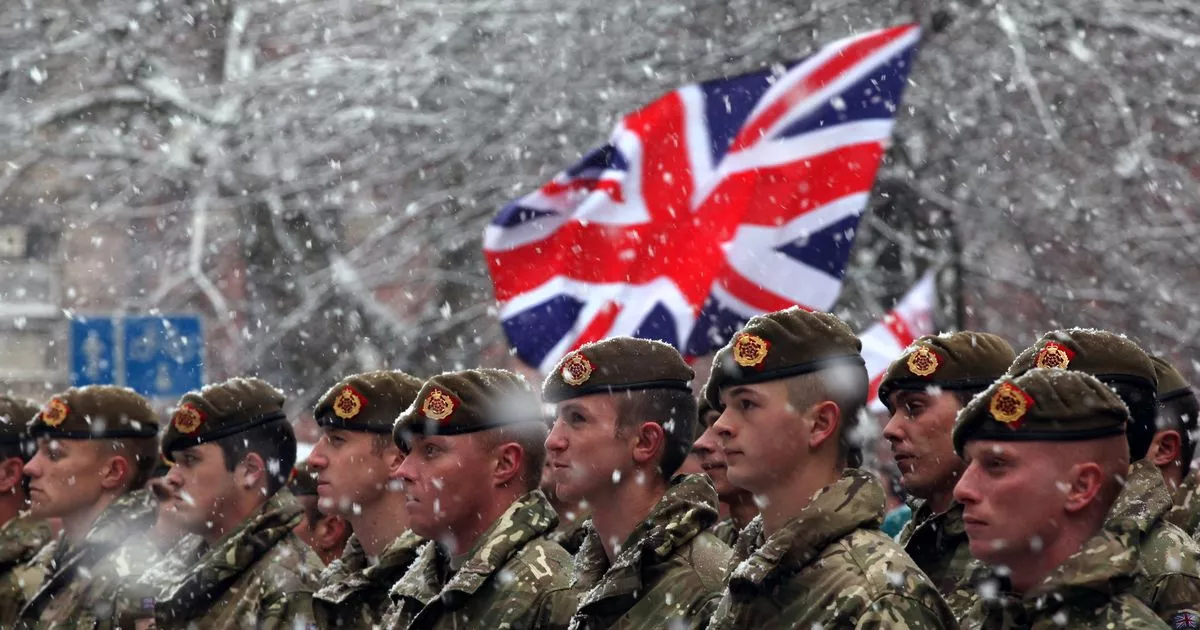
Brits under the age of 25 will be able to access a brand new gap year military programme from March onwards.
Ongoing global tensions mean that national conscription is a subject that can no longer be avoided. Brits under the age of 25 will be able to access a brand new gap year military programme from March onwards.
This is aimed at boosting army recruitment and building all-important life skills as sinister threats from Russia rumble on. This scheme will see young civilians introduced to life in the military or, should they opt not to enlist, leave equipped with transferable skills.
It’s understood there is no commitment to join up full-time – but those who do choose to stay with the Armed Forces will receive additional training for deployment on operations. British citizens have been expected to leave their ordinary lives behind, picking up weapons in defence of their country, during previous global conflicts.
And, as reported by the Mirror, while such an eventuality may sound like something from the pages of a history book – the prospect of widespread conflict feels all too frighteningly real. So the question is, in the face of World War III, would your job make you too valuable an asset for conscription?
Whilst the contemporary version of conscription remains unclear, history offers valuable insights. During World War II, key workers who were essential to maintaining the nation’s infrastructure were exempt from conscription, including bakers, farmers, doctors, nurses, and engineers.
During that period, Britons who held moral objections to fighting, known as ‘conscientious objectors’, underwent tribunals and, instead of serving on the front lines, contributed through non-combat roles that still supported the war effort.
Males aged between 20 and 22 were initially called up for conscription in 1939 in World War II, as much as six months before hostilities actually commenced. The UK Parliament website clarifies: “During the spring of 1939, the deteriorating international situation forced the British government under Neville Chamberlain to consider preparations for a possible war against Nazi Germany.
“Plans for limited conscription applying to single men aged between 20 and 22 were given parliamentary approval in the Military Training Act in May 1939. This required men to undertake six months’ military training, and some 240,000 registered for service.”
But the moment war was declared, the age bracket was swiftly widened to encompass all men aged 18 to 41. It states: “On the day Britain declared war on Germany, 3 September 1939, Parliament immediately passed a more wide-reaching measure.
“The National Service (Armed Forces) Act imposed conscription on all males aged between 18 and 41 who had to register for service. Those medically unfit were exempted, as were others in key industries and jobs such as baking, farming, medicine, and engineering.”
By late 1941, women and “all childless widows” aged between 20 and 30 were enlisted, whilst men up to the age of 51 were also summoned for military duty. Even those between 52 and 60 were obliged to participate in “some form of military service”.
It explained: “The main reason was that there were not enough men volunteering for police and civilian defence work, or women for the auxiliary units of the armed forces.”
Speaking about what contemporary conscription might look like, Afghanistan veteran and Tunbridge Wells MP Mike Martin previously said: “There’s a significant chance that it [war with Russia] might happen, so we must be prepared.”
The Liberal Democrat delivered a stark warning: “Obviously, if we get involved in a general war with Russia, we’ll be conscripting the population – there’s no question about that,” whilst stressing that military strength serves as a crucial deterrent.
“Being prepared generates deterrence, which decreases the likelihood [of war]. The whole point about building the military up is that it decreases the likelihood of this happening. I think that’s an important caveat. I’ve fought in wars, I’m not a warmonger. But I recognise that you’ve got to [pursue] peace through strength.”



