
News Beat
Focus turns to future of Gaza after final hostage remains returned to Israel | World News

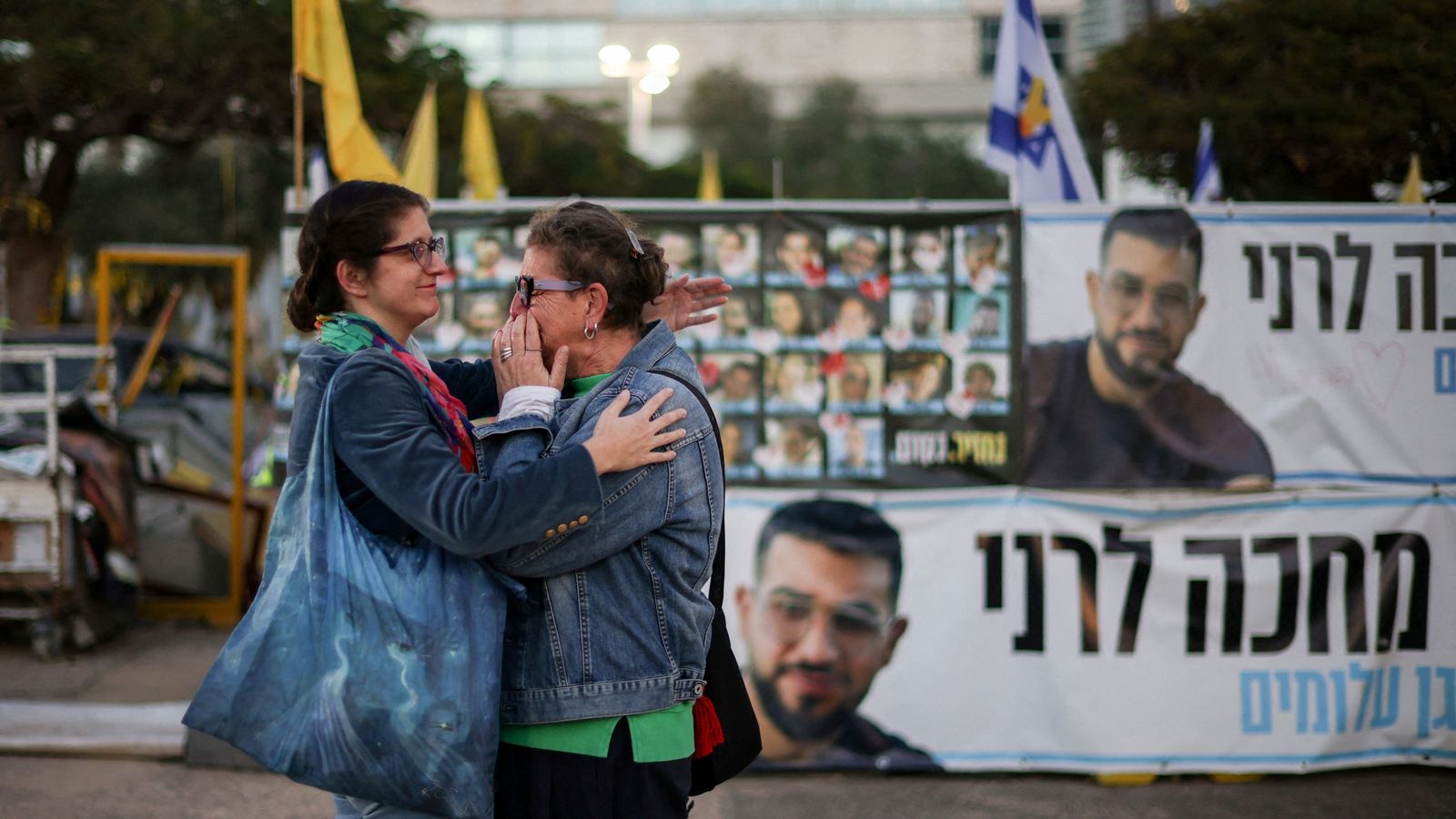
Ran Gvili was one of the first Israelis killed on 7 October 2023 when Hamas fighters poured into Israel and launched their ferocious attack.
His body was taken to Gaza, and there it remained.
“First in, last out,” was the comment from the forum representing the hostages’ families.
It was a refrain taken up by plenty, a mark of respect not just for his life, but also for the miserable suffering of his family, who have waited so long to get back a body to bury.
And for many in Israel, it is also the end of a chapter. The nation’s president, Isaac Herzog, released a video of himself removing the yellow ribbon badge that has become a staple for many in this country.
The demand for hostages to be returned has now been achieved. In fact, for the first time in more than a decade, there are no Israeli hostages, alive or dead, being held in Gaza.
But Mr Gvili’s return to Israel is not simply the balm for the agony of a family and the enduring pain of a nation. It is also the key to starting the second phase of a peace plan that is changing and morphing with every passing day.
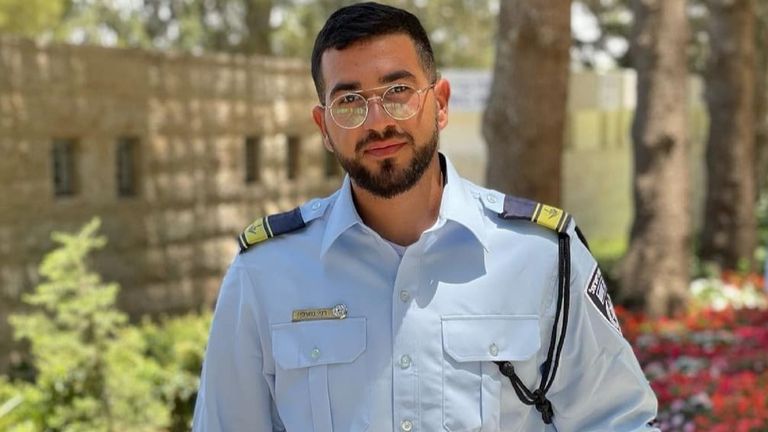
The remains of Ran Gvili, a police officer, have been found in Gaza and returned to Israel. Pic: Hostages and Missing Families Forum
Now the focus is supposed to be on the future of Gaza – the delivery of more aid, the long-term reconstruction, the governance of the Strip, disarmament of Hamas, security and the withdrawal of Israeli forces.
And that’s just to get us going.
None of these actions will be remotely straightforward to achieve, and some will be fiendishly difficult. And political fault lines, which are beginning to emerge, may widen.
Jared Kushner’s skyscraper plan
For one thing, you might wonder about the end goal. Well, we know what the US wants from this, because Jared Kushner put up a PowerPoint presentation at Davos and displayed computer-generated images of skyscrapers and new cities, ripe for investment.
“New Gaza” is what he proclaimed, to be built on the rubble of the old one. But even that rubble will take years – maybe half a decade – to clear. So Mr Kushner’s claim that the development could come quickly seems at best optimistic.
Yes, Middle Eastern countries are skilled at going fast. But no, they don’t normally build on land that has been devastated by war, which has no meaningful infrastructure – and which is peppered with unexplored ordnance.
So the electricity needs to be returned, so does the water and sewage system. Roads have to be built. Bombs have to be cleared. This will not be easy, and nor will it be cheap. If there is change from $100 billion, that would be a surprise.
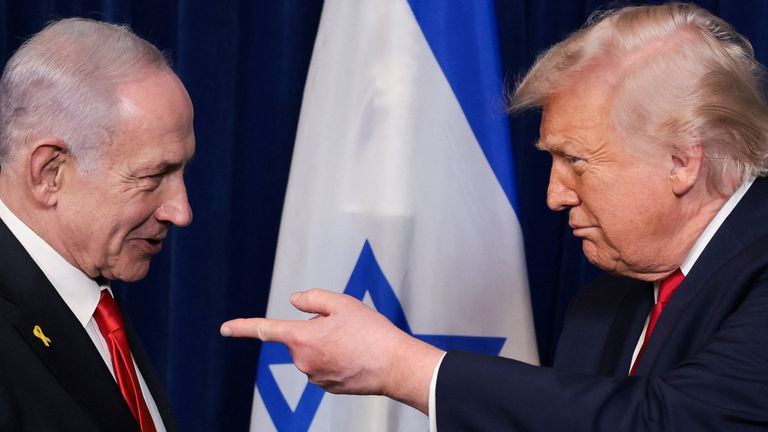
US President Donald Trump points his finger towards Israeli Prime Minister Benjamin Netanyahu in Florida on 29 December 2025. Pic: Reuters
Governance is inevitably going to cause friction, not least with a Board of Peace that is largely composed of people who are either friends of US President Donald Trump already, or desperate to become his friend in the future.
Disarming Hamas sounds clear, but then again nobody can quite tell you what it means, or how it will happen, or who’s going to do it, or who’s going to check. And so it goes on.
What Donald Trump wants in Gaza
What’s quite clear is that Trump and his team want things to happen fast, they want them to happen to a US plan, and they want to take as much credit as possible.
The news that Mr Gvili’s remains had been returned was greeted by the White House with the immediate claim that “President Trump made this possible”, and by the president thanking “his great team of champions”.
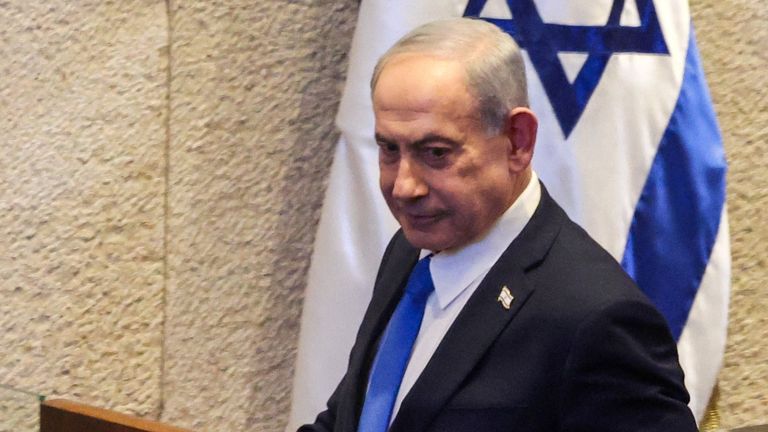
Benjamin Netanyahu, Israel’s prime minister, attends a session of the Knesset, Israel’s parliament on January 26. Pic: Reuters
Benjamin Netanyahu, the Israeli prime minister, was not mentioned.
The relationship between the two men has long been close, and Trump’s profile in Israel is unquestionable. He is probably the most popular politician in the country, but there is tension now between him and the Israeli leader.
Read more:
Israel says Rafah crossing will have ‘limited’ reopening
UN accuses Israel of ‘unprecedented attack’
For one thing, Mr Netanyahu was aghast that figures from Turkey and Qatar were invited to join one of the executive boards overseeing Gaza. For another, Mr Netanyahu is facing ever louder criticism that he is “kowtowing” to the White House.
For the archetypal strongman leader, that is an awkward position to be in, but it’s much worse when he is facing a general election in nine months time.
Like everything touched by the past few years, Israel’s vote will be complex, uncompromising, and heavily shaped by the actions of the US administration.



