Connect with us

NewsBeat

Four years of bitter conflict in Ukraine

Published

on

Four years of bitter conflict in Ukraine

This article was first published in The Conversation UK’s World Affairs Briefing email. Sign up to receive weekly analysis of the latest developments in international relations, direct to your inbox.


It would be wrong to say Russia’s full-scale invasion of Ukraine, four years ago this week, came out of the blue. For months there had been worrying reports of a huge build-up of Russian troops on Ukraine’s border. Through the winter of 2021/22, Moscow scoffed at suggestions it was planning to invade its neighbour as “alarmist”. But at the same time the Russian president, Vladimir Putin, was making aggressive noises, issuing demands for Nato to pull its troops back from its eastern front and calling for a ban on Ukraine’s accession to the western alliance.

And on February 21, he made a speech in which he called Ukraine “an inalienable part of our own history, culture and spiritual space” which had been taken over by a neo-Nazi “puppet regime” that should be removed.

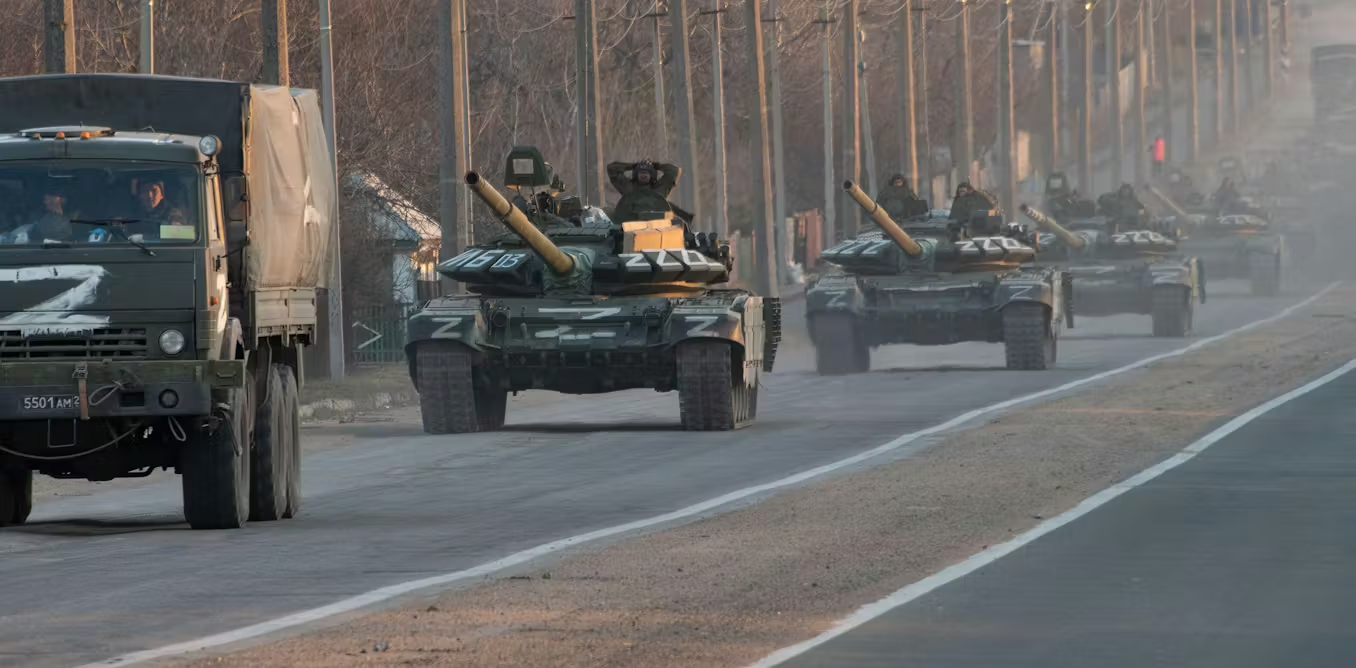
Still, it was a shock to wake in the early hours of Thursday February 22 to learn that Putin had launched what he called a “special military operation … to protect people who have been subjected to abuse and genocide by the Kyiv regime for eight years”. Images began to emerge of tanks and armoured vehicles with the now-familiar “Z” (a Russian victory symbol) streaming across the borders from Russia and Belarus, the latter the shortest route to the Ukrainian capital Kyiv.

Advertisement

How Russian forces assembled in the winter of 2021/22, according to US intelligence sources.
US intelligence reported in the Washington Post.

Four years and about 1.8 million casualties later, Russia has gained about 75,000sq km of territory, about 12% of Ukraine to add to the 7% it had occupied since it annexed Crimea and parts of eastern Ukraine in 2014. The war has developed into a “meat-grinder” – Russia’s advances have been glacially slow and very costly, an estimated 78 casualties per square kilometre in 2025.

But if, as many insist, the war on the battlefield itself has slowed into something resembling a stalemate, the geopolitical shifts that have accompanied the conflict have been considerable – particularly since Donald Trump was elected for a second term as US president, promising to end the conflict, “in a single day”. Of course, like many of his campaign promises this has proved to be pie in the sky, but the US president’s cordial relations with Putin, his decision to curtail US financial aid to Kyiv and his apparent support for many of the Russian president’s war aims have come as an unpleasant surprise for Ukraine and its allies.

Another big feature of this war, the biggest armed conflict in Europe since 1945, has been the huge technological changes we’ve seen employed on the battlefield. Stefan Wolff and Tetyana Malyarenko call it the “drone war”, as both sides have become heavily reliant on unmanned autonomous vehicles (UAVs) for both combat and reconnaisance. Wolff – an expert in international security at the University of Birmingham – and Malyarenko – of the National University Odesa Law Academy – have been regular contributors to our coverage of the conflict since February 2022.

Advertisement

This week they are part of a panel of experts analysing the four years of conflict, alongside Wolff’s colleague Mark Webber as well as Scott Lucas of University College Dublin, both also regular contributors. They have looked into the key issues raised by the four years of conflict, including the way the war has been prosecuted, the involvement of the US president and the potential for China and/or Europe to break the stalement: Beijing potentially abandoning its support for Moscow or Europe vastly increasing its support for Ukraine in an attempt to tip the balance in Kyiv’s favour.


À lire aussi :
Ukraine war: after four surprising years, where does it go next? Experts give their view


It’s hard to imagine any reasons to be cheerful about the conflict. But optimists may take heart at the prospect of trilateral talks in March between Ukraine, Russia and the US. Realistically the prospect of the talks achieving anything significant seem pretty bleak at present. Russia continues to take Ukrainian territory and even if these are snail’s pace advances, Putin will consider that they add leverage to Russia’s negotiating position. Ukraine’s president, Volodymyr Zelensky, meanwhile, will consider that the cost of this slow pace of advance, both in terms of casualties and the damage the war is now certainly doing to Russia’s economy, are good reasons to keep going. Surveys suggest he is supported in this by the majority of Ukrainians.

In the end it will probably be sheer exhaustion that forces and end to the conflict, writes Alex Titov of Queen’s University Belfast. Without the wholehearted support of the US president, Ukraine cannot defeat Russia on the battlefield. And, despite the massive advantage in manpower, Russia is really beginning to feel the
effects of this war of attrition – both on the health of its economy and its ability to attract enough new recruits to replace the casualties who are being either killed or wounded faster than they can be replaced. For this reason alone, Titov sees chinks of light in what is a very dark time.

Advertisement


À lire aussi :
Ukraine: after four years of war, exhaustion on both sides is the main hope for peace


Let’s share Titov’s cautious optimism for the present. Say a peace deal is struck sometime soon, Ukraine is faced with a massive task of rebuilding. The most recent World Bank estimate is that this will take more than a decade and cost around US$588 billion (£435 billion). The biggest and most immediate question facing Kyiv and its allies, writes Olena Borodyna, a senior geopolitical risks advisor at ODI Global is how this can be funded.

The consensus is that Ukraine will need to find ways to incentivise private-sector investment in reconstruction, something for which Borodyna sees varying amounts of enthusiasm for from Ukraine’s partners and friends. Part of the problem is the volatile security situation, which represents a considerable risk moving forward. Add to that the corruption which has dogged Ukraine since well before the invasion and the incentive to invest looks very shaky indeed.

Another big problem, she writes, is that so many Ukrainians left the country since February 2022, which has caused acute labour shortages. The challenge of persuading people to return will be paramount and here again, the lack of security will work against Ukraine.
Advertisement
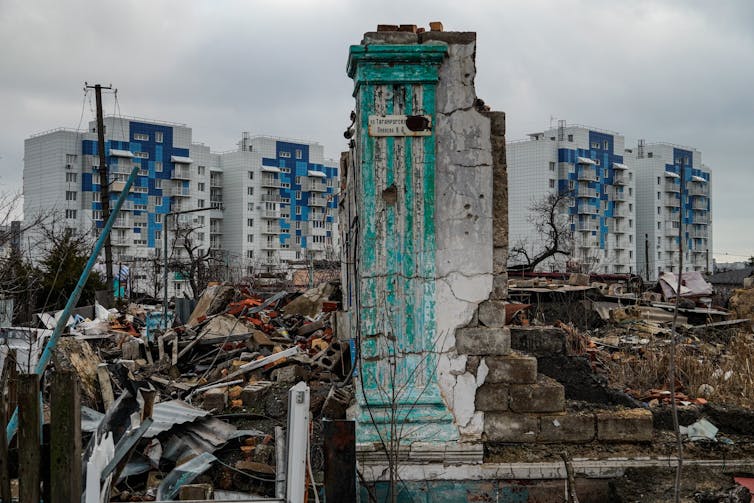
Mariupol cityscape devastated by Russian bombardment.
Devastation: the south-eastern city of Mariupol, four years after the invasion.
EPA/stringer

There is also the strong possibility that political developments in Europe could affect the level of support for Kyiv, with elections in countries such as France, Italy and Denmark. There are already several EU members which are pretty openly hostile to the notion of supporting Ukraine, including Slovakia, the Czech Republic and Hungary – the latter is already trying to obstruct a vital €90 billion (£78 billion) to help cover Ukraine’s needs for 2026 and 2027.

Peace deal or not, it’s a long and hard road ahead for Ukraine.


À lire aussi :
The three big challenges facing Ukraine when the war ends


But adversity can often be inspiring. Hugh Roberts, an expert in language and culture at the University of Exeter, has been charting the upsurge in Ukrainian poetry since the invasion. He has unearthed two poets who have come to represent this cultural renaissance: Yaryna Chornohuz and Artur Dron’.

Both have served in Ukraine’s armed forces. Chornohuz is still a drone operator of the Ukrainian Marine Corps in the frontline city of Kherson. Dron’ signed up in February 2022, four years before he reached the age of conscription. He’s now a veteran following serious injury. The words of both are available in English and both have been recognised with major literary awards in their home country.

Advertisement

Roberts gives us some of their most moving lines.


À lire aussi :
Lines from the frontline: the poet soldiers defending Ukraine


Death in Mexico

Also this week, we heard of the death of Mexican drug kingpin Nemesio Oseguera Cervantes, also known as El Mencho, in what was reportedly a massive military operation involving what appears to have been hundreds of troops and the killing of 74 people, including 25 national guard officers.

Wanted posters, confiscated drugs and other evidence against Mexican drug kingpin Nemesio
Nemesio
K.C. Alfred/San Diego Union-Tribune/TNS)

Repercussions will continue for some time, writes Raul Zepeda Gil, an expert in crime and conflict at King’s College London. The apprehension or killing of a cartel boss often causes a spike in violence as other criminal groups try to cut in on the cartel’s operations. There also likely to be a bitter and violent power struggle within El Menche’s organisation, the Jalisco New Generation Cartel (CJNG).


À lire aussi :
Mexico may pay a steep price for the killing of Jalisco cartel leader El Mencho

Advertisement

There has already bee speculation that Oseguera may be succeeded by his wife, Rosalinda González Valencia. Otherwise known as “La Jefa” (the boss), she is alleged to control the cartel’s finances, although apart from a five-year jail spell for money laundering, there has reportedly never been enough evidence of the wrongdoing of which she is suspected to charge her with anything else.

Adriana Marin, who specialises in terrorism, organised crime, and transnational threats in Latin America, examines the prominent role some women have played in organised crime gangs.


À lire aussi :
La Jefa: the wife of slain drug kingpin El Mencho and the women at the heart of the cartels



Sign up to receive our weekly World Affairs Briefing newsletter from The Conversation UK. Every Thursday we’ll bring you expert analysis of the big stories in international relations.

Advertisement

Source link

Continue Reading
Click to comment

Leave a Reply

Your email address will not be published. Required fields are marked *

NewsBeat

Dog trainer settles debate on whether pets should be allowed on furniture

Published

on

Wales Online

Will Atherton, a canine behaviourist based in Derbyshire, has years of experience in his field

Should dogs be permitted to sleep on furniture? It’s an age-old question that frequently splits pet owners down the middle, but a recent perspective from one trainer could finally resolve the dispute.

Will Atherton, a canine behaviourist based in Derbyshire, has years of experience in his field, having worked with numerous dogs exhibiting various behavioural problems, including aggression. He revealed people regularly enquire whether dogs ought to be permitted on sofas, beds and other household furniture – and gave a detailed answer.

Advertisement

“Should your dog be allowed on the furniture?” he asked in a TikTok during 2025. “And that’s a question I get all the time. And for me, it completely is up to you. I have a few little rules about it.”

First, Will urged viewers to consider whether their canine has any persistent behavioural concerns. Whilst he didn’t specify what these might encompass, they could range from hostile to overly enthusiastic or boisterous behaviour.

Content cannot be displayed without consent

When a dog proves particularly troublesome at home, Will suggested it might be wiser not to permit them on the sofa. However, if the dog demonstrates good manners generally, it should be acceptable, provided firm boundaries are set.

He said: “If you don’t have any big behaviour problems with your dog, then I think you can absolutely have them on the furniture if you want them. If you don’t want them on the furniture, that’s completely fine.

Advertisement

“But if they are going to go on the furniture, my thought is that they shouldn’t be allowed to have free access to jump up and off whenever they want. It should look like this.”

To illustrate his point, Will gestured towards Sully, a large dog sitting on the floor beside his sofa. Will then continued: “They should wait with good manners, sitting, looking up to you for guidance and direction, and waiting for you to say, ‘up’.”

Upon command, Sully leapt up to join Will on the settee. “And they can jump on and they can have a cuddle,” he said. “And the most important thing is that just as well-mannered as getting on the furniture with you, it should be just as easy – Sully, off.”

Within moments, Sully dutifully returned to the floor as instructed. With this in mind, Will concluded: “If you can do that and you don’t have any problems with your dog elsewhere and you want them to come and have a cuddle on the sofa, then do so.”

Advertisement

Despite attempting to settle the dogs-on-furniture debate, Will’s video still sparked division among viewers online. Among those disagreeing, one individual commented: “I don’t have to ask anyone to have access to my sofa, why should my dog?”

At the time, another person also wrote: “I am not a control freak,” as someone else said: “My dogs are a part of my family, so they can go wherever they want to without asking to go there.”

However, others completely agreed with Will’s perspective. One user wrote: “My boys love being on the couch and I love having a snuggle with them on the couch, but they know when I say they need to get off, they do! And same for coming up!

“It’s so refreshing to hear a trainer who doesn’t want to just limit a dog’s life and surroundings and doesn’t guilt owners for wanting to share the space.” Meanwhile, another wrote: “Mine has free access to the furniture but when I tell him to get off, he does.”

Advertisement

What do you think? Let us know in the comment section below

Ensure our latest headlines always appear at the top of your Google Search by making us a Preferred Source. Click here to activate or add us as your Preferred Source in your Google search settings.

Source link

Advertisement
Continue Reading

NewsBeat

What advice did you receive as a child that has stayed with you?

Published

on

What advice did you receive as a child that has stayed with you?

“If you want to be a good writer, son, you must read. Read, read, read. Read everything.” 

I can still picture my grandfather imparting those words of wisdom to me from the green leather chair in my grandparents’ living room. He was not always a man to heed advice himself – he was smoking a cigar at the time – but he had plenty to offer. That nugget stuck. And lo, he was right. 

As we explore youth and education in the next issue of Positive News magazine, we thought we’d ask readers about the life lessons they received as a child that have stuck with them. 

All inherited nuggets of wisdom are welcome. It could be a fable that changed  how you see the world, a simple gardening tip or a style secret that helped you dress well. We’ll publish the best responses in an upcoming article, providing a knowledge base for other readers to dip into. 

Advertisement

To take part, fill out the form below.

Main image: iStock

Source link

Advertisement
Continue Reading

NewsBeat

Clinton urges Congress to question Trump under oath over ‘tens of thousands’ Epstein file mentions

Published

on

Clinton urges Congress to question Trump under oath over ‘tens of thousands’ Epstein file mentions

“If this Committee is serious about learning the truth about Epstein’s trafficking crimes, it would not rely on press gaggles to get answers from our current president on his involvement; it would ask him directly under oath about the tens of thousands of times he shows up in the Epstein files,” she wrote.

Source link

Continue Reading

NewsBeat

Prime Minister refuses to respond to ‘paedo defenders’ jibe

Published

on

Prime Minister refuses to respond to 'paedo defenders' jibe

During Prime Minister’s Questions on Wednesday (February 25), Mrs Badenoch told Sir Keir Starmer he should “ask why his backbenchers are saying that they’re being called the ‘paedo defenders party,’ and followed that up by saying she would “absolutely not apologise” later in the day.

Her jibe followed reporting by The Times that female Labour MPs had told Sir Keir earlier this month that voters had “screamed” the phrase at them in the street over the Peter Mandelson scandal.

Prime Minister Sir Keir Starmer (Image: Scott Heppell/PA Wire)

On Wednesday evening, the Conservative leader said she would “absolutely not apologise” for claiming Labour was being called a “paedo defenders party”.

Today, (Thursday, February 26), during a visit to Warbottle Academy near Newcastle, the Prime Minister refused to respond to Mrs Badenoch.

Advertisement

When asked about the term paedo defenders, he said: “I came into politics to change the lives of millions of people for the better, so I concentrate on what action the government needs to take to do that.

Conservative Party leader Kemi Badenoch (Image: James Manning/PA Wire)

“We’ve been focusing on tackling the cost-of-living crisis.

“That’s why this week we’ve been working hard to make sure that energy bills are brought down.

“Yesterday, we had the energy price cap announcement. That’s 117 pounds off energy bills, which will be for every household across the country, which is very, very important.”

Advertisement

The Prime Minister added: “And look, there are other measures, rail fares have been frozen, prescription charges have been frozen, wages, minimum living wages, will be going up here.

“And of course, inflation is dropping now to three per cent, and I hope it will drop even further. These are the issues that I think matter most to the country, matter most to me.

“For many people across the country, that’s what they want the government to be focused on, because that’s what their priorities are.”

Lord Peter Mandelson (Image: James Manning/PA WIRE)

Mrs Badenoch’s comments have drawn strong criticism from Labour MP Natalie Fleet, who was groomed as a teenager, and Katie Amess, the daughter of murdered Tory MP Sir David Amess.

Advertisement

Ms Amess said it had been “very inflammatory” and called for Mrs Badenoch to apologise, adding: “It’s not the way that our politicians should be talking, unfortunately.”

But appearing on a phone-in on LBC on Wednesday evening, Mrs Badenoch stood by her comments.

She said: “I will absolutely not apologise.


“I remember when Keir Starmer and the Labour Party were putting out posters saying Rishi Sunak was supporting paedophiles so that they wouldn’t go to prison.

Advertisement

“These people know how to dish it, but they don’t want to take it.”

Mrs Badenoch declined to say whether she thought Labour was a party of “paedo defenders”, saying: “It wasn’t my words, a female Labour MP used that language.”

She added: “Nobody would be calling them that if they held themselves to higher standards.”

Advertisement

Source link

Continue Reading

NewsBeat

Sainsbury’s puts 300 jobs at risk amid restructure

Published

on

Sainsbury’s puts 300 jobs at risk amid restructure

Sainsbury’s, which has its main York store in Monks Cross Shopping Park and around 10 ‘local’ stores throughout the city, has said more than 300 jobs are at risk across the country.  

The company said most of the cuts are going to impact its technology and data divisions, as it restructures into one team for Argos and two for Sainsbury’s. 

A Sainsbury’s spokesperson said: “By maximising the power of our data and technology, we’re freeing up our teams to concentrate on what matters most – delivering great food, brilliant service and fantastic value for our customers.”

Advertisement

According to the company, delivery driving jobs are not at risk. 


    Recommended reading:


The firm is also rolling out changes across its store leadership, creating four new regional store director roles dedicated to convenience shops, as well as overhauling its Argos delivery model and creating a separate leadership board for the Argos business.

Sainsbury’s said the overhaul comes as it enters the third year of its so-called Next Level strategy. 

Advertisement

The announcement comes after a recent spate in the supermarket sector, with Tesco on Wednesday (February 25) unveiling plans to cut 180 roles amid a head office shake-up that will also see some created, while retail tech.

It also follows Sainsbury’s, which employs around 140,000 staff overall, announcing last January it would cut more than 3,000 jobs, including 20 percent of management roles. It also closed its remaining 61 cafes, including at the Monks Cross store.

Source link

Advertisement
Continue Reading

NewsBeat

Dog trainer shares ‘rules’ on whether your pet should be allowed on your sofa and bed

Published

on

Daily Mirror

Canine behaviourist Will Atherton shared his verdict on whether dogs should be allowed on furniture

Should you allow your dog to sleep on the furniture? It’s a long-running debate that often divides pet owners, but a recent perspective from one trainer could finally resolve it.

Advertisement

Will Atherton, a canine behaviourist from Derbyshire, has years of experience in his field, having worked with numerous dogs displaying various behavioural problems, including biting. He revealed that people regularly ask him whether dogs should be permitted on sofas, beds, and other furniture – and provided a thorough response.

“Should your dog be allowed on the furniture?” he asked in a TikTok during 2025. “And that’s a question I get all the time. And for me, it completely is up to you. I have a few little rules about it.”

Content cannot be displayed without consent

First and foremost, Will urged viewers to consider whether their pet has any ongoing attitude problems. While he didn’t specify what these might entail, they could range from aggressive behaviour to overly excitable jumping.

When a dog is causing significant disruption at home, Will suggested that it might be advisable not to allow them on the sofa. However, if the dog is generally well-behaved, it should be acceptable as long as clear boundaries are set.

Advertisement

He said: “If you don’t have any big behaviour problems with your dog, then I think you can absolutely have them on the furniture if you want them. If you don’t want them on the furniture, that’s completely fine.

“But if they are going to go on the furniture, my thought is that they shouldn’t be allowed to have free access to jump up and off whenever they want. It should look like this.”

To demonstrate his point, Will gestured to Sully, a large dog perched on the floor beside his sofa. Will then continued: “They should wait with good manners, sitting, looking up to you for guidance and direction, and waiting for you to say, ‘up’.”

Upon command, Sully leapt up to join Will on the settee. “And they can jump on and they can have a cuddle,” he said. “And the most important thing is that just as well-mannered as getting on the furniture with you, it should be just as easy – Sully, off.”

Advertisement

In no time at all, Sully was back on the floor, following instructions. With this in mind, Will concluded: “If you can do that and you don’t have any problems with your dog elsewhere and you want them to come and have a cuddle on the sofa, then do so.”

Despite attempting to settle the dogs-on-furniture debate, Will’s video still sparked division among viewers online. Among those disagreeing, one individual commented: “I don’t have to ask anyone to have access to my sofa, why should my dog?”

At the time, another person also wrote: “I am not a control freak,” as someone else said: “My dogs are a part of my family, so they can go wherever they want to without asking to go there.”

Advertisement

However, others completely agreed with Will’s perspective. One user wrote: “My boys love being on the couch and I love having a snuggle with them on the couch, but they know when I say they need to get off, they do! And same for coming up!

“It’s so refreshing to hear a trainer who doesn’t want to just limit a dog’s life and surroundings and doesn’t guilt owners for wanting to share the space.” Meanwhile, another wrote: “Mine has free access to the furniture but when I tell him to get off, he does.”

What do you think? Let us know in the comment section below

Ensure our latest headlines always appear at the top of your Google Search by making us a Preferred Source. Click here to activate or add us as your Preferred Source in your Google search settings.

Advertisement

Source link

Continue Reading

NewsBeat

Darlington’s Abu’s to open Indian restaurant in Harrogate

Published

on

Darlington's Abu's to open Indian restaurant in Harrogate

ABU’S will be opening at 19 Cheltenham Crescent, next to the Cattlemens Grill, where the Kinara Tandoori restaurant and take-away used to be, in a part of the town that is dominated by food and drink outlets.

It follows Abu Raihan and his father Chef Abdul Mannan running Abu’s in Duke Street, Darlington, since 2019.

The family-run restaurant is the home of “Apna” Indian Cuisine, where “Apna” means ours, reflecting the family’ dedication to bringing diners “the most delicious Indian food that celebrates our heritage and culture.”

Advertisement

The menu will feature the regular Indian favourites including tikka, baltis, kormas, tandoori, karahi, plus a wide range of signature dishes.

Abu told the Press: “We are a family run restaurant. My father is the chef. I ( Abu) run the front of the house.

“The restaurant we are taking over first opened in 1987 called AliShaan and my father was the head chef who opened it.”

Abu’s father also had businesses in Harrogate during the early 1980s.

Advertisement

Abu continued: “Both my younger brothers also work with us in the family business. My sisters also help out on weekends. We will be serving Indian Food. My father has 53 year’s experience as a chef.”

Abu says the family are coming to Harrogate as this is where he was born. There is no confirmed opening date yet for the new restaurant, which will undergo a makeover before it opens, likely to be in around six weeks, once the renovations are completed.

If the Harrogate restaurant is as good as the Darlington original, diners look set for a treat. Darlington diners will also be relieved to know their own restaurant will remain open.

Tripadvisor awards Abu’s 4.8 stars out of five, based on 569 reviews, ranking it third out of 239 restaurants in Darlington.

Advertisement

One recent comment said: “My family went to Abu’s for the first time. The food was absolutely amazing and very good portions. Very friendly staff, and we will definitely be returning in the future. Also the toilets were sooo posh and clean, so clean I wouldn’t have minded eating my curry on the bog.”

Another said: “Went early doors on a Saturday and was fairly busy for the time of day. Welcoming and friendly staff, food was tasty with good size portions. Pretty impressive toilets as well.”

Google awards Abu’s 4.5 stars out of five based on 246 reviews.

Advertisement

Source link

Continue Reading

NewsBeat

First look inside the new TK Maxx store in Sunderland

Published

on

First look inside the new TK Maxx store in Sunderland

The retailer opened its latest location at The Bridges shopping centre in Sunderland today (Thursday, February 26), offering visitors a fresh shopping experience after relocating from its previous site nearby.

The new store, spanning 16,200 sq ft, promises the same mix of discounted designer labels and high-street finds, with stock updated weekly in typical TK Maxx treasure-hunt style.

The store had their grand opening today (Thursday, February 26). (Image: Run Free PR)

A spokesperson for TK Maxx said: “We’re thrilled to relocate our Sunderland TK Maxx store to this prime location in The Bridges Shopping Centre.

“This exciting move gives customers a fresh, modern space to explore our fantastic brands for less, making every visit even more enjoyable than ever. At TK Maxx, we’re committed to delivering the very best for our customers and can’t wait for everyone to discover the treasures our new store has to offer”

Advertisement

The opening day kicked off with a bit of fun, as TK Maxx hosted a treasure hunt for shoppers with the chance to win gift cards valued at £50, £20, £10, and £5.

Shoppers were eager to explore the new store. (Image: Run Free PR)

Karen Eve, centre director at The Bridges, said: “We’re absolutely delighted to welcome TK Maxx to their fantastic new store at the Bridges. As a valued anchor retailer for many years, their move into this brand-new space marks an exciting new chapter.

“It not only enhances the shopping experience for our visitors but also reflects both their continued success and our ongoing commitment to investing in and evolving the centre.”

The store features fashion for the entire family, accessories, and homeware for visitors to explore.

Advertisement

Source link

Continue Reading

NewsBeat

Danish PM calls snap election after surge in support over Greenland crisis | World News

Published

on

Mette Frederiksen has held office since mid-2019. Pic: AP

Denmark’s Prime Minister Mette Frederiksen has announced the country will hold an early election next month.

It comes as the country continues a standoff with the US over President Donald Trump’s designs on Greenland, with Ms Frederiksen seeking to capitalise on a surge in support for her defiant stance.

“I have recommended to King Frederik that elections be held on March 24,” Ms Frederiksen told the Danish parliament in Copenhagen on Thursday. The country was due to go to the polls no later than the end of October.

The Folketing, or parliament, has 179 seats – 175 of which are allocated to lawmakers representing Denmark and two apiece to lawmakers from Greenland and the Faroe Islands, its two semi-autonomous territories.

Advertisement

Ms Frederiksen, 48, has spent recent months discussing with European leaders ways to counter the US president’s renewed interest in annexing the Arctic island.

Opinion polls suggest this has provided a much-needed popularity boost for the Danish prime minister after public dissatisfaction over rising living costs and welfare pressures.


Denmark believes UK will ‘stand behind them’

“This will be a decisive election, because it will be in the next four years that we as Danes and as Europeans will really have to stand on our own feet,” Ms Frederiksen said.

Advertisement

“We need to define our relationship with the United States, and we must rearm to ensure peace on our continent.”

She added: “As everyone knows, the conflict over Greenland is not over yet. The government will of course continue to look after Denmark’s interests.”

Mr Trump’s push to annex Greenland resulted in his short-lived threat last month to impose new tariffs on Denmark and several other European nations.

Read more from Sky News:
Jimmy Lai’s fraud conviction quashed but he remains in jail
NASA reveals details of incident that led to historic evacuation

Advertisement

The US, Denmark and Greenland subsequently held discussions on an Arctic security deal, though Ms Frederiksen and other Danish and Greenlandic officials have refused to negotiate on sovereignty.

After the negotiations, the US leader said he had “formed the framework of a future deal with respect to Greenland”.

A general election must be held at least every four years in Denmark – but the prime minister can call one at any point.

The last election of the NATO and European Union member country was held on 1 November, 2022, and resulted in a three-party coalition staggering the left-right divide.

Advertisement

Ms Frederiksen, a centre-left Social Democrat, has held office since mid-2019.

Advertisement

Greenland situation is ‘very emotional’

She currently heads a government with the Liberal Party of Defence Minister, Troels Lund Poulsen, and the centrist Moderate party of Foreign Minister Lars Lokke Rasmussen, a former PM.

The Social Democrats suffered a significant setback in the 2025 municipal elections, losing the Copenhagen mayoralty for the first time in 87 years.

Advertisement

However, although the party’s support fell to 18% in polls in December, it has since rebounded to 22%, the highest of any party, as Ms Frederiksen’s approval ratings were boosted by her handling of the Greenland dispute.

Discussing the Greenland crisis earlier this month, Ms Frederiksen said she remains wary, though the situation has calmed.

The standoff has further raised Ms Frederiksen’s profile on the international stage, where she gained attention for her swift response to the COVID-19 pandemic and for bolstering European support for Ukraine.

Advertisement

Source link

Continue Reading

NewsBeat

Benfica deny reports Gianluca Prestianni admitted racially abusing Vinicius Jr

Published

on

Benfica deny reports Gianluca Prestianni admitted racially abusing Vinicius Jr

Benfica have categorically denied that Gianluca Prestianni admitted to his team-mates he racially abused Real Madrid’s Vinicius Junior.

Portuguese media had reported the Argentinian winger, who denies the accusation, had confessed his guilt to the rest of the squad.

However, his club insisted that was not the case.

“Benfica categorically denies that player Prestianni communicated to the squad or the club’s management that he had uttered a racist insult against Real Madrid player Vinicius Junior,” said a statement.

Advertisement

“As has already been made public, the player apologised to his team-mates for the incident that occurred during the match against Real Madrid, regretting its magnitude and consequences and assuring everyone, as he has done from the very beginning, that he is not racist.”

Prestianni was provisionally suspended for Wednesday’s Champions League play-off defeat against Real after Vinicius alleged he was racially abused by the Argentinian in the first leg.

The Brazilian left the field and refused to return, resulting in a stoppage in play that lasted 10 minutes in Lisbon.

Benfica boss Jose Mourinho was roundly criticised for his comments about the incident after appearing to intimate the winger had brought any abuse upon himself with his goal celebration, saying “a stadium where Vinicius plays, something happens, always”.

Advertisement

Source link

Continue Reading

Trending

Copyright © 2025