




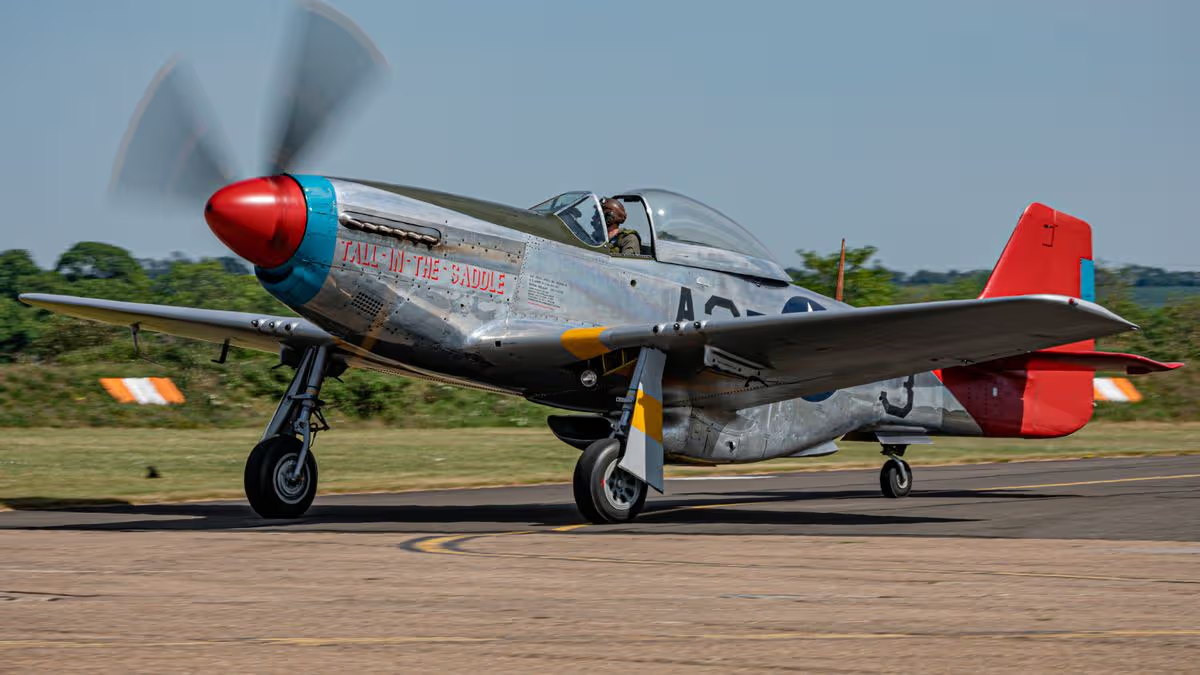
Here are some of the aircraft you might be seeing at the next IWM Duxford flying day.
The Imperial War Museum (IWM) Duxford’s flying season has started with the next event at the start of June. The iconic museum has a range of events happening from May through to October, including themed flying days.
On Saturday, June 6, the IWM Duxford will be holding the Flying Days: D-Day event that will celebrate the air base’s role in Operative Overlord that provided “air support for D-Day operations”. While the display is the main event, visitors will be able to take a look around the museum and its exhibitions.
If you already have tickets or are thinking about whether to buy some, you might want to see what planes will be performing in the display. The impressive line-up includes classic Spitfires as well as aircraft that flew in the Korean War.
Spitfire Mk 1
The Spitfire Mk I N3200 is the museum’s only airworthy aircraft and played an important role in the Dunkirk Campaign. The aircraft was restored to flying condition in 2014 and was donated to the IWM by Dr Kaplan and his family.
Bücker Bü 131 Jungmann
Described as ‘sporty’, the Jungmann was used as a basic trainer for the Luftwaffe as well as featuring in aerial performance competitions. The plane proved to be quite popular with private pilots too, who have opted to have the Jungmann refitted with modern engines.
LeVier Cosmic Wind
The LeVier Cosmic Wind was designed and built by the Lockheed Corporation in 1947 and was originally created for Formula 1 class racing. The plane did not successfully race in the US but has won the premier cross-country competition in the UK in 1964.
Republic P-47D Thunderbolt
The P-47D Thunderbolt, also known as ‘the Jug’, was one of the largest single-engine fighters of the Second World War. It was popular in Europe as an escort fighter and was well-suited to high-altitude air-to-air combat as well as an in the ground-attack role.
Spitfire Mk XIV
Only 957 production Mk XIVs were built with the first entering service in 1944 and were the most successful of the variants at destroying V-1 flying bombs. The MV293 was built after the Second World War for the RAF and served with the Indian Air Force.
Fieseler Storch (replica)
The Storch, also known as Stork, was used by the Luftwaffe as a liaison and spotting aircraft during World War Two with multiple variants of the aircraft being made. The plane was famed for its low speed flight and STOL abilities.
Grumman F8F Bearcat
The Grumman F8F Bearcat was introduced to the Second World War late and served in the mid-20th century in the United States Navy, the United States Marine Corps, and the air forces of other nations. Adaptations of the Bearcat have broken speed records for piston-engined aircraft.
Grumman Wildcat FM2
The Wildcat FM2 is described as the “ultimate version” of the aircraft and was a collaboration between Grumman and Eastern Aircraft to operate from escort carriers. The plane flew for all active U.S Navy fighter squadrons throughout the Second World War.
Hawker Fury FB11
This British fighter aircraft was designed and manufactured by Hawker and was the last-propeller-driven fighter to serve with the Royal Navy. The plane was popular with overseas militaries and was also used during the Korean War and in the Bay of Pigs Invasion of Cuba.
Aeronca L-3
The Aeronca L-3 was used as an observation and liaison aircraft by the United States Army Air Corps during the Second World War. The L-3 series were adapted from Aeronca’s pre-war Tandem Trainer and Chief models.
L-4 Cub
The L-4 Cub is an aircraft with a simple, lightweight design, which helps give it “good low-speed handling properties and short-field performance”. The L-4 was used for reconnaissance, artillery spotting, and moving personnel behind the lines.














































You must be logged in to post a comment Login