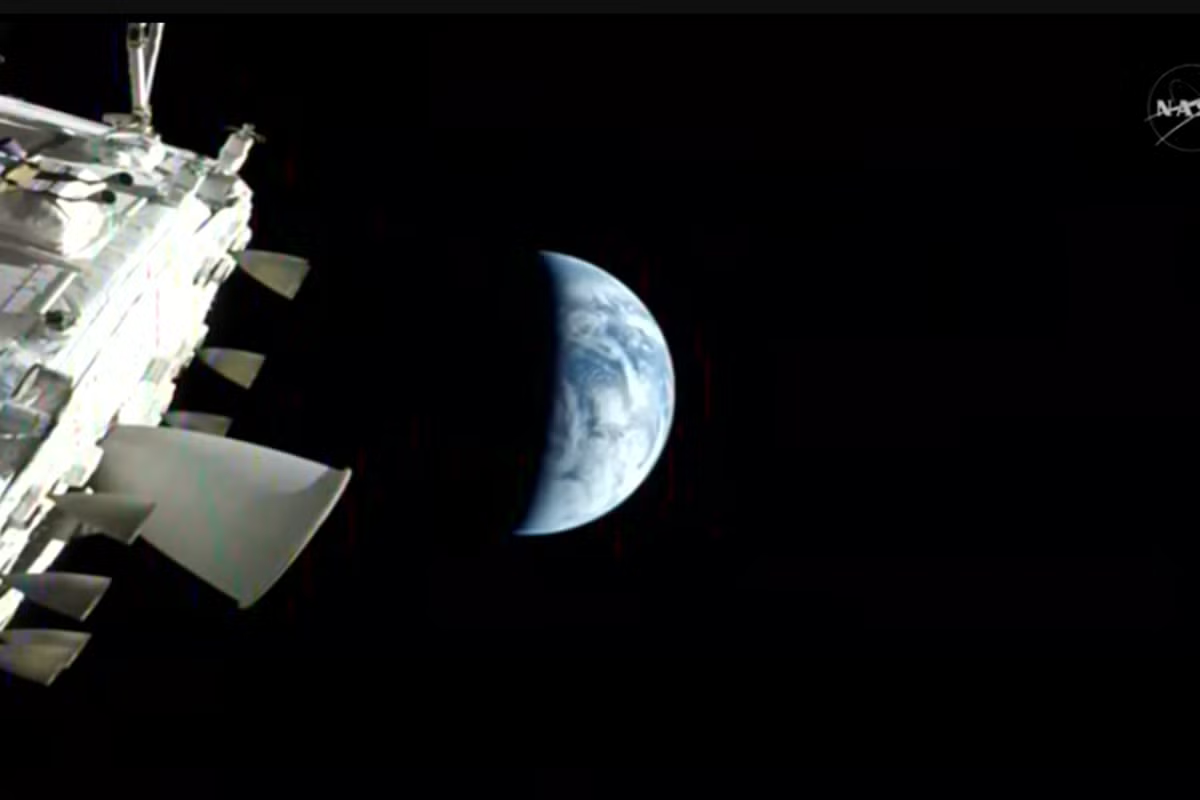



The Artemis II mission to the Moon is a voyage unlike any other in more than half a century. As the first crewed lunar flight since 1972, Artemis II marks the beginning of a new chapter in our relationship with the Moon.
Nasa’s goal is to establish a sustained human presence on the Moon. As the Artemis II ten-day journey concludes, it will be remembered as a profound moment in the history of human spaceflight. Stunning photos and video downlinked to Earth have provided a human perspective on this historic encounter with our celestial neighbour. The experience has rekindled the optimistic spirit of the Apollo era for a new generation.
The mission did not orbit the Moon. Instead, the Orion spacecraft carried the astronauts on a gravity guided loop around Earth’s natural satellite. During their flight, the crew – Reid Wiseman, Victor Glover, Christina Koch and Jeremy Hansen – travelled further into space than any previous human mission.
They reached a maximum distance of 252,756 miles from Earth, exceeding a distance record set by Apollo 13. Afterwards, mission specialist Jeremy Hansen challenged the next generation of explorers “to make sure this record is not long-lived”.
This challenge underscores the current focus of human space exploration. After decades sending its astronauts to low Earth orbit, the US space agency is looking outward again, not just to the Moon, but also Mars.
The mission began with a textbook launch of the Orion spacecraft on the Space Launch System (SLS) rocket from Kennedy Space Center in Florida. After a day in Earth orbit, Orion’s main engine performed a nearly six minute burn, known as the translunar injection (TLI), to send the capsule on its lunar trajectory.
As Orion headed to the Moon, commander Reid Wiseman captured a stunning view of our home planet. The beautiful image, dubbed Hello, World, shows Earth at night, illuminated only by reflected sunlight from the Moon.
Nasa / Reid Wiseman
The mesmerising green light of auroras at the poles and the arc of zodiacal light (a faint glow of sunlight scattered by interplanetary dust) highlighted how thin Earth’s atmosphere is.
The image immediately drew comparisons with the iconic Blue Marble photograph taken during the Apollo 17 lunar mission in 1972; the last time humans viewed the entirety of Earth with their own eyes.
Lunar flyby
On the morning of April 6, as the lunar flyby approached, mission control played the crew a special message from astronaut Jim Lovell, recorded before his death in 2025. Lovell is a link to Nasa’s trailblazing past, having flown on both the Apollo 8 mission, the first to reach the Moon, and Apollo 13.
“Welcome to my old neighborhood!” Lovell said. “When Frank Borman, Bill Anders, and I (flew) on Apollo 8, we got humanity’s first up-close look at the Moon… I’m proud to pass that torch on to you.”
His words must have inspired the four astronauts as they began scientific observations of 30 key sites on the lunar surface. These included impact craters and volcanic features on the Moon’s near side and its far side – the face pointed away from the Earth.
The astronauts found the time to name a crater after Reid Wiseman’s wife Carroll, who died of cancer in 2020. In a touching moment, Jeremy Hansen was overwhelmed with emotion as he informed mission control of their suggestion.
Discovering Earth
As Orion travelled behind the Moon, the crew witnessed the blue crescent of Earth setting below the lunar horizon. A photograph, named Earthset, has already become a classic space image. It recalls the legendary Earthrise photograph taken by astronaut Bill Anders during Apollo 8 in 1968.
Earthrise was a defining picture of the Apollo era – credited with inspiring the environmental movement in the 1970s. As Bill Anders commented: “We came all this way to explore the Moon, and the most important thing is that we discovered the Earth.”

Nasa
Anders may have been one of the first astronauts to articulate the “overview effect”. This affects some astronauts while viewing Earth from space. They describe being awestruck by our planet’s beauty and fragility. An enhanced sense of connection to humanity is often reported, as well as a profound feeling of responsibility for the environment.
After Orion emerged from behind the Moon, the crew was treated to a spectacular hour-long solar eclipse. As a mostly darkened Moon blocked out our parent star, the astronauts photographed the Sun’s faint atmosphere, the corona, which was made visible by the eclipse.
They also witnessed flashes of light from meteoroids (small space rocks) impacting the Moon – to the visible delight of scientists at mission control in Houston. Researchers want to understand the dynamics of these impact events, as well as the risk they could pose to future missions.

Nasa
In his message, Lovell had reminded the astronauts to enjoy the view during their busy flyby. The astronauts later described the strong emotions they felt. Christina Koch said: “I just had an overwhelming sense of being moved by looking at the Moon. It lasted just a second or two… but something just threw me in suddenly to the lunar landscape and it became real.”
Victor Glover added: “I went straight where Christina went, and I was walking around down there on the surface, climbing and off-roading on that amazing terrain.”
Artemis II has shared the astronauts’ sense of wonder with people around the world. Those who have followed the mission will be left with a new appreciation of humankind’s place in the cosmos. The incredible images and human moments offered an unprecedented window into a voyage of pure exploration.
Earlier this year, Nasa’s administrator Jared Isaacman announced a bold new vision for the agency’s Artemis lunar programme, including an increased launch frequency for the SLS rocket and concrete plans for a permanent Moon base.
That vision of the future is off to an extraordinary start. For humanity, a new adventure is just beginning.


You must be logged in to post a comment Login