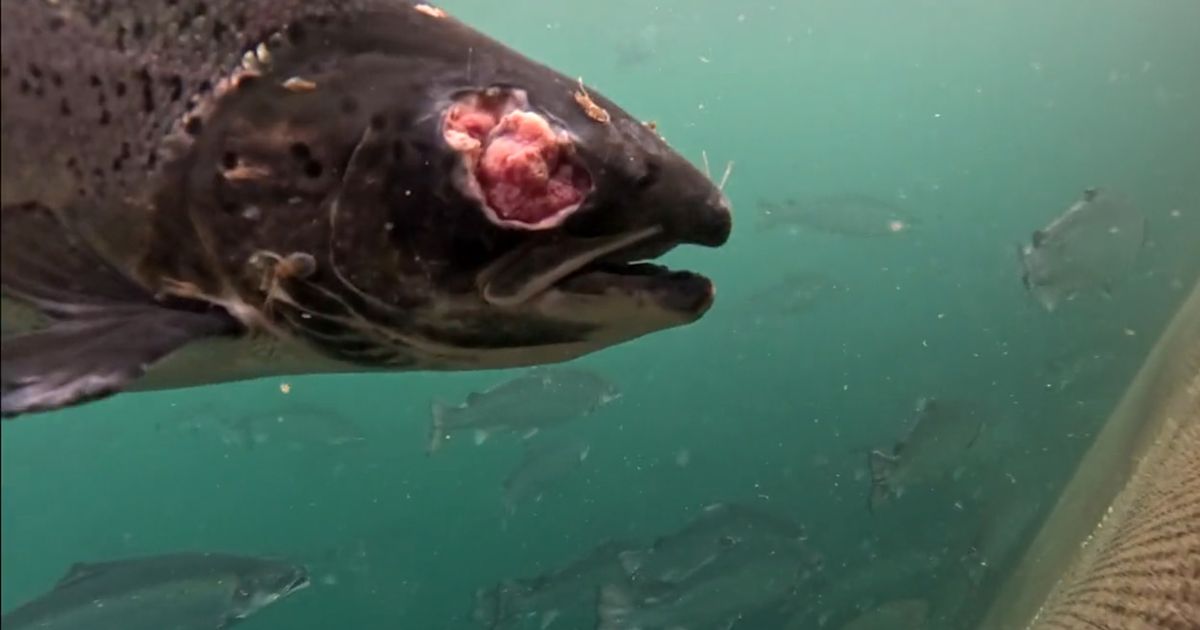
Footage provided to the Sunday Mail at three facilities off the west coast show farmed salmon with gaping wounds, blindness and lice infestations.
Gruesome images of salmon with gaping wounds, facial disfigurement and blindness at fish farms linked to Sainsbury’s and M&S have prompted calls for an investigation.
Campaigners say footage provided to the Sunday Mail at three facilities off the west coast shows the impact of rampant parasites such as sea lice “eating away at the salmon”.
One disturbing underwater clip at a Scottish Sea Farms (SFF) site off Kerrera, west of Oban – a company which supplies M&S and other retailers – shows a salmon with a chunk of skin ripped off its face and an eyeball exposed. M&S said it does not source from this facility.
It comes amid mounting welfare concerns over the £1billion-a-year farmed salmon industry which employs thousands of people in Scotland and produces the UK’s top food export.
Activists have long warned about cramped conditions in at-sea cages which they claim allow lice and disease to spread, with many millions of fish dying prematurely every year.
A probe by anti-cruelty group Animal Equality included one farm at Scalpay, in the Outer Hebrides, operated by controversial seafood giant Mowi which supplies Sainsbury’s, and two SFF facilities near Oban.
But after submitting a legal complaint to the Animal and Plant Health Agency (APHA) watchdog in August, regulators have refused to disclose if they have taken any action.
Abigail Penny, executive director of Animal Equality UK, said: “Nearly a quarter of salmon farms breach the industry’s own lice rules. Sick and helpless fish are caged in filthy waters teeming with lice. Parasites cling to their bodies, literally eating away at the salmon. Would anyone really want to put that on their plate?
“We followed the proper channels, yet regulators still refuse to comment on what action, if any, they plan to take. So we’re making this extreme animal suffering public, so consumers can see the truth for themselves.
“No M&S or Sainsbury’s shopper would ever expect salmon to be raised in such miserable conditions. These supermarkets must suspend these suppliers.”
According to trade body Salmon Scotland, the APHA dismissed the complaint. Speaking on behalf of both companies, a spokesman said: “Expert vets from the regulatory body investigated and dismissed these complaints, confirming they were satisfied with the health and welfare of fish in farmers’ care.
“Animal Equality UK is an extreme anti-farming lobby group with a history of trying to mislead the media – and repeatedly fails to include location, date or time stamps on its footage so there is simply no evidence to back up its claims.
“Scotland’s salmon farmers work to the highest welfare standards anywhere in the world. As in all farming sectors, it is inevitable that some fish within a population of tens of thousands will become unwell, but nobody cares more about the animals in their care than our farmers.”
The Sunday Mail has verified GPS data confirming the dates and locations of the footage.
Animal Equality UK investigated the three farms between May and August with some in breach of the Code of Good Practice on sea lice for weeks.
Norwegian firm Mowi, which also supplies other supermarkets like Tesco and Asda, was stripped of its Royal Warrant last month following controversies around animal cruelty claims. Footage from its Scalpay farm gathered in August show fish with large raw wounds in their flesh and missing eyes. A substantial number of dead wrasse – so-called “cleaner fish” used to eat lice – were seen.
Campaigners said “on paper”, Scalpay looks like a good site with low mortality and low lice levels but claimed reporting loopholes have obscured the reality.
A probe into the Kerrera B facility in Loch Linnhe in May, operated by Norwegian-owned SFF, found more salmon ravaged by wounds and lice infestations. Animal Equality said Kerrera B’s lice levels remained well above official guidelines of 0.5 per fish for every single week between February and June – and during the week of filming it was more than six times over the limit.
This coincides with the four-month “sensitive period” when juvenile wild Scottish salmon and trout pass by, raising fears of lice spreading to the endangered species.
Sir David Attenborough previously warned that Scotland’s iconic leaping Atlantic salmon may only have 20 years left before extinction. Animal Equality’s analysis has found more than 600 breaches of permitted lice levels this year during the sensitive period.
The industry says the decline of wild salmon long predates fish farms and is due to habitat loss and climate change.
At a third salmon farm, Shuna Point in Loch Linnhe, also operated by SFF, Animal Equality UK said the site spent 13 straight weeks with elevated lice levels.
Its footage, gathered in May, showed fish with flayed and disfigured mouths and gaping wounds along their flanks. Mortality data shows thousands of salmon caged at Shuna Point perished in the weeks following filming until the site was harvested out at the end of June.
M&S exclusively sources its salmon from SFF facilities like Shuna Point, although SFF also supplies other retailers like Co-op and Waitrose.
It comes as MSPs last week challenged SNP ministers over new data showing October was the second-worst month of all time for fish farm mortalities in Scotland.
In the first 10 months of 2025, some 10million farmed salmon are estimated to have perished. However, the industry says overall survival rates are improving.
An APHA spokeswoman said: “APHA treats all reports of suspected cases of poor welfare at salmon farms seriously. We work closely with local authorities and the Fish Health Inspectorate to manage each case.”
Andrew Opie, of the British Retail Consortium, which includes Sainsbury’s and M&S, said: “Our members take their responsibilities to animal welfare very seriously and are dedicated to sourcing seafood products responsibly, working closely with trusted suppliers so that high welfare standards are upheld.
“They regularly review farming practices in their supply chains to ensure they meet the highest standards. Salmon production is really important to British consumers and we work constructively with welfare groups to improve welfare standards.”