

Henry VIII is not remembered as a loving husband. Any English schoolchild can recount the unpleasant fates of most of his six wives with the rhyme: “Divorced, beheaded, died, divorced, beheaded, survived.” But though the end of his relationships are famous, less is known about Henry in love.
Now, a rare jewel discovered by an amateur detectorist and bought by the British Museum for the national collection may force us to reconsider the king’s brutal reputation.
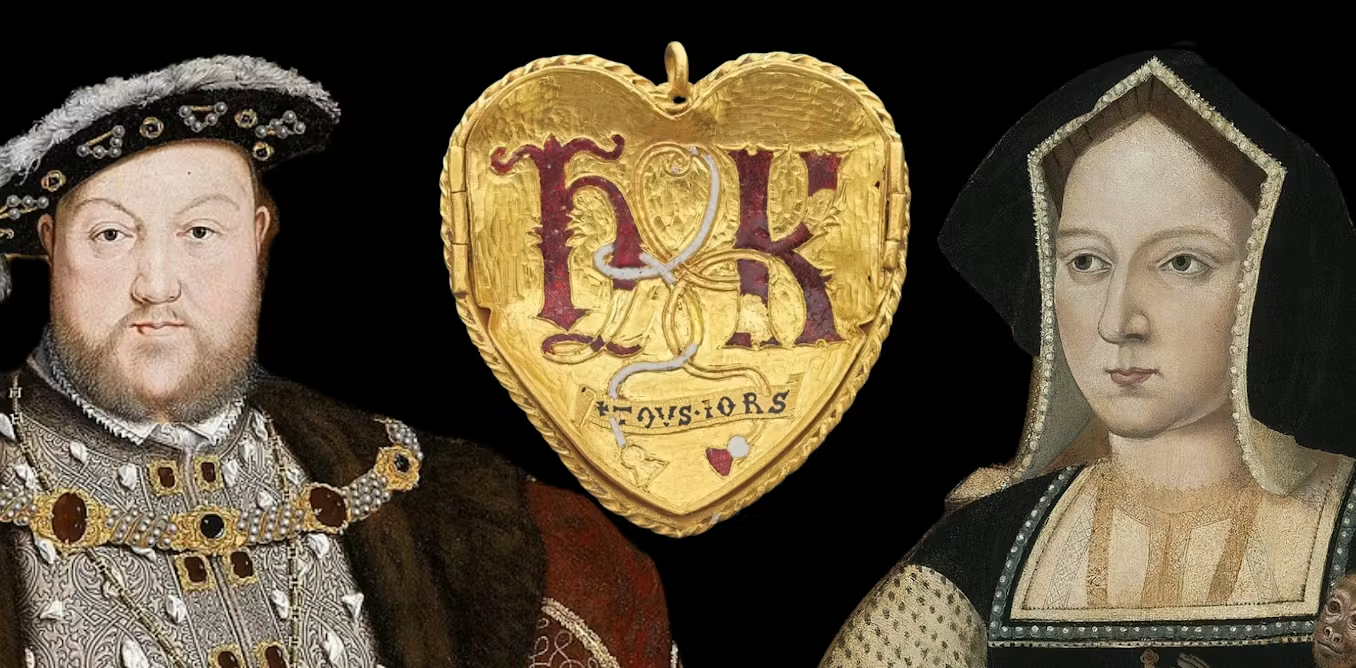
The jewel is a heart-shaped locket, crafted in gold with red enamel decoration, and attached to a solid gold chain. On the face are the letters H and K linked together by the stems of a Tudor rose and a pomegranate, which was the symbol of Katharine’s Spanish royal family. It is a reasonable deduction that this remarkable jewel was connected directly to Henry and the first of his wives, Katherine of Aragon.
Katherine was the subject of Henry’s first and most shocking divorce, which precipitated England’s breach with the Roman papacy and the transformation of religion which we now know as the Reformation. In many ways Katherine also suffered the worst of the king’s personal cruelty. Although not executed, she was consigned to virtual house-arrest, much of the time separated from her only living child, Mary.
If this was indeed Henry and Katherine’s jewel it could be a vital clue to quite different moment in their relationship, and to a dimension of the king’s character that his otherwise notorious conduct has completely obscured.
In late medieval and Renaissance society, monograms – the linking of people’s initials – were often created to represent a personal connection, a marriage, a betrothal or even a secret love-match. Beneath the linked letters on the locket is the French word “Toujo(u)rs”, meaning “always” – a natural choice for a pledge between lovers. Here, the letters surely stand for Henry and Katherine.
Birmingham Museums Trust
The locket’s flower and fruit decoration seal the royal connection. The pomegranate symbol swept into English public life after the two families were joined through Henry’s marriage. Decorations for the coronation of the king and queen, just two weeks after the wedding, paired the Tudor rose with golden pomegranates. A woodblock print published to mark the occasion under the title A Joyful Meditation to All England, showed Henry and Katherine receiving their crowns under a twin canopy of the flower and the fruit.
Accounts of textiles commissioned for the royal household show dozens of different pieces – upholstery, wall-hangings, and livery to be worn by servants – all featuring the rose and the pomegranate prominently in their design.
Devoted designs
The decoration of the heart pendant is matched in a wide variety of treasures described in Henry’s household inventories. These contain descriptions of a bag of crimson satin, a silver comb case and standing cup all marked in the same way for the king and his queen. These lists also identify several collars or necklaces – described by the archaic term carkeynes – with heart-shaped pendants. One of these, coloured blue, is also inscribed, “H K”.
Henry spent prodigiously on beautiful, bespoke furnishings, but jewellery was his greatest passion. The inventories of his jewels and plate (gold, gilt and silver objets d’art) compiled shortly after his death in January 1547 record almost 4,000 individual pieces.

Thyssen-Bornemisza Museum
This Tudor heart pendant is a prime example of this level of investment. The locket itself is formed from 24-carat gold; the wide chain found with it is weighty and long – more than 40cm. Together they amount to 317 grams of precious metal. It is no wonder that the British Museum’s purchase price was £3.5 million.
It is clear from his wardrobe accounts – which record the purchase of decorative pieces for his household – that Henry took a personal interest in the material and design of many of these pieces. Surviving examples of designs for jewellery drawn by Hans Holbein, the German artist active at Henry’s court in the 1530s and early 1540s, may have come from a pattern book made to influence, or illustrate, the king’s developing tastes. He bought, or commissioned pieces, not only for his own household but also as gifts – often marking the new year – to family members and court favourites.
This may well be the origin of the heart pendant. Since it came to light, it has been spoken of as associated with Henry’s great pageant in the Pas-de-Calais in 1520, the so-called Field of the Cloth of Gold. Here he, Katherine and his court staged a ceremonial meeting with the French King, François I. A great many furnishings from the royal residences and chapels did cross the Channel to decorate the pop-up canvas palace and tents.
But I am convinced the message conveyed by this jewel is not political but profoundly personal. Toujours is an expression of deep, heartfelt attachment. An alternative theory, advanced by the British Museum itself, is that the pendant was made to mark the betrothal in October 1518 of Katherine’s only living child, Princess Mary, aged two, to the eight-month-old heir to the French throne.
But given the presence of pieces of very similar design in the royal household soon after the marriage and coronation, it must be possible that the pendant belongs to the early years of Henry and Katherine’s relationship. At first, she and the king were inseparable. Five months from the wedding she was pregnant. She conceived again each year from 1510 to 1513. One of these pregnancies resulted in a son, named Henry, born in January 1511. He lived for a little under two months.
In the late summer of that year, the king and queen embarked on a progress through the Thames Valley and on into the West Midlands, culminating at Warwick. It was in a Warwickshire field that the detectorist, Charlie Clarke, uncovered the heart pendant in 2019.
Could it be that a jewel gifted to Katherine at the time of the birth of Henry’s longed-for male heir was carried with the royal party – as so many of their personal jewels were – as they made their way into Warwickshire? It gives the locket an edge not just of romance, but of tragedy. Here, perhaps, Katherine was parted from a present that was, already, a memento mori of her lost son.

Looking for something good? Cut through the noise with a carefully curated selection of the latest releases, live events and exhibitions, straight to your inbox every fortnight, on Fridays. Sign up here.



















































You must be logged in to post a comment Login