

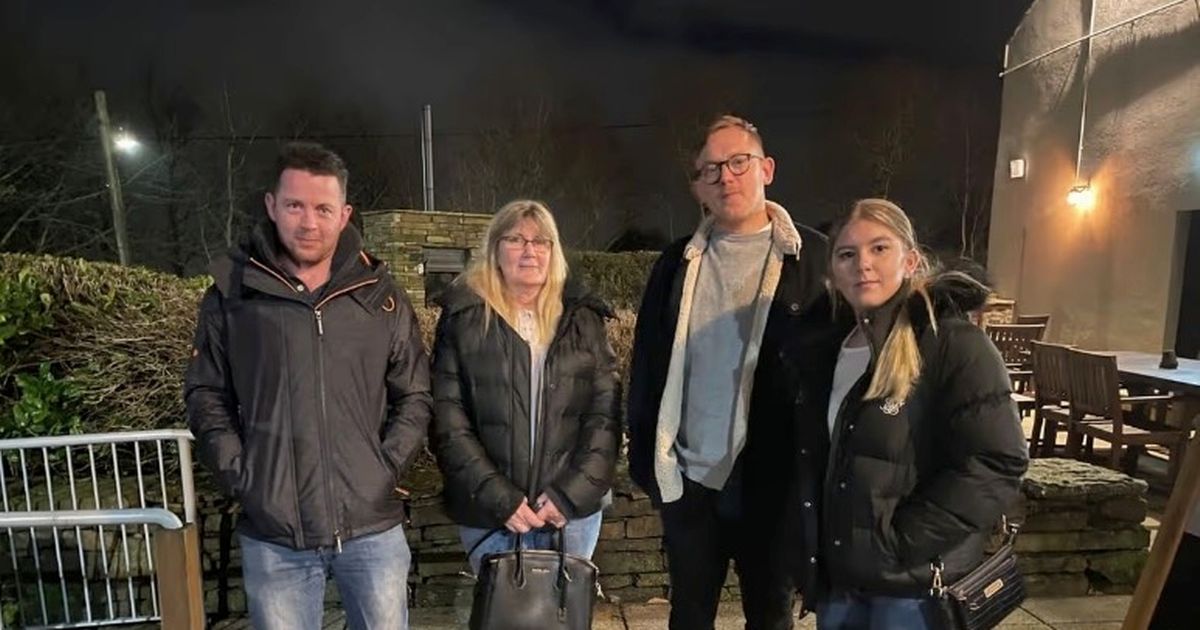
A family say they have been given no further answers after an inquest determined the events leading up to a man’s death were “unclear”.
The family of a man who died unexpectantly following a “rare” event in hospital while waiting for a heart transplant say they have had some degree of “closure” after an inquest into his death was held today (Wednesday).
Luke Barnes. from Mapperley, Nottingham, had his life support machine turned off on March 17, 2023, while on the waiting list for a heart transplant at Royal Papwoth Hospital, Cambridge.
The father-of-three had been under the hospital’s continued care since 2022, during which time he was fitted with a mechanical pump, BiVad, to help support the blood flow in and out of his heart muscle, reports Cambridgeshire Live.
He had previously been diagnosed with cardiomyopathy – a chronic disease of the heart muscle – in 2018.
On the first day, the inquest heard of how an “unexpected” disconnection in a pump flowing blood through his body is believed to have led to his death.
Coroner Elizabeth Gray gave a narrative conclusion for Luke’s death today (Wednesday, January 21) from Vantage House in Huntingdon.
She said that Luke died of a “catastrophic hemorrhage” at around 5.40am on March 16, 2023, as a result of a “disconnection” on part of his BiVad at Royal Papworth Hospital, while awaiting a heart transplant.
The coroner added that the “catastrophic hemorrhage couldn’t have been predicted”, it was a “rare” event and the reason for disconnection was “unclear”.
Coroner Gray said Luke’s medical cause of death was due to multi-organ failure, severe haemorrhage and dilated cardiomyopathy as a result of the “unexpected disconnection”.
Luke’s mother Amanda Barnes and his brother Glen Barnes shared a tribute to Luke on the last day of the inquest, as well as their reaction to the two-day hearing.
Glen said the family were a “bit anxious” on the first day of the inquest, as they “didn’t know what to expect”.
He added: “Yesterday, we went away feeling we would not take away any closure.” However, he said that listening to the evidence, he believed the family were “never going to know what happened to him”.
Glen added: “But, we are going to have some closure that everything was done to standard.” Amanda said Luke’s death and the inquest has “hit us all hard”. In tribute to Luke, Amanda said he had a “personality no one could forget” and he was “always up for a laugh”.
Amanda added: “Luke had no filter. What you saw is what you got. Whether people wanted to hear about what he wanted to say, he just said it.
“He didn’t pretend to be someone he wasn’t.” Amanda added that Luke loved to play football as a child, and played rugby in later life.
“He will be in our hearts forever,” she added. Amanda also said Luke’s younger sister Tia missed him a lot.
On the second day of the inquest, two more witnesses appeared. These were Ben Goddard, a former clinical profusion scientist who worked at Papworth at the time.
Mr Goddard told the court of his responsibility of preparing the circuit change alongside previous witness Aimee Blunt. The other witness was Dr Aurovind, who worked as part of the transplant team at Papworth.
He explained his role, which was looking over the change of circuit on March 14, and checking circuits on a daily basis. Mr Goddard appeared first via video link in Australia.
He told the court about the process of preparing circuits, which the court had previously heard from Ms Blunt. Coroner Gray questioned Mr Goddard about the connecting of equipment. Mr Goddard said it was surgical teams that connected the equipment and he, alongside Ms Blunt, prepared the equipment.
Family barrister Mr Thomas asked Mr Goddard about steps taken to ensure the circuits are “soundly” connected to tubing. Mr Goddard told the court when assembling the circuits, they are “pretty close and should be able to see if there are any malfunctions”.
The second witness called was Dr Aurovind. He told the court of his involvement in the circuit change on March 14, as well as his role and responsibility.
He told the court he looked at Luke’s BiVad “everyday”, by checking if there are any issues with flow and connections. The doctor also told the court that it is “very difficult” for the tubing to be disconnected, as the court also heard in the previous day by Dr Pettit.
The court heard that a meeting took place on March 13 about the preparation for a circuit change. Dr Aurovind confirmed he was not at the meeting, but it was spoken about a “possible blood clot” being removed.
Mr Aurovind told the court about suction involved to remove a blood clot during the circuit change process. He said there is around “30 seconds to connect the pipes” because Luke’s heart was “complicated”.
He added: “There is not much time to reconnect the pipes as he can’t be off support for too long”. Mr Aurovind also told the court the suction is “soft”.
Mr Thomas asked Mr Aurovind how big the clot was, and he described it as 1cm by 2cm. Mr Thomas also asked if the “manipulation” of suction would affect the tubing. However, Mr Aurovind said it was “very safe”.
After witnesses spoke, submissions were made by the family barrister and barrister for Papworth, Miss Mackley. Reminding Coroner Gray that the conclusion would be done on facts of balance of probabilities, Mr Thomas said this was due to a “disconnected mechanism” that led to a “catastrophic bleed”.
However, Mr Thomas said the court had heard “no evidence” to how the disconnection happened. When coming to a shortform conclusion, Mr Thomas said it would be “very difficult” to determine it was an accident or medical misadventure.
Mr Thomas concluded to ask Coroner Gray to consider a Regulation 28 report, which is a prevention of future deaths report. This can be issued when it is believed actions need to be taken to prevent further deaths.
Mr Thomas called for NHS England to have “considerable vigilance” in the future to “minimise or alleviate risk of disconnection”. In her submissions, Papworth’s barrister Miss Mackley asked for Coroner Gray to come to a short form conclusion of an accident or medical misadventure.
She said it was an “extremely rare event” and it had “never happened at Papworth before or since”. Before today’s inquest was heard, the court was informed of evidence that came in overnight from Chalice Medical, manufacturers of the tubing.
In an email read out to the court, a Chalice representative said tubing packets supplied go through a “rigorous process” before being distributed. It said Chalice worked with the hospital during the investigation.
It was found there was “nothing wrong with the product supply”. Chalice also offered advice during the investigation, such as adding cable ties to the tubing.
It concluded that the “product was not at fault”. In Coroner Gray’s conclusions, she told the court that correct procedures had been followed by medical staff for circuit changes, blood clot removal, and there were no faults with the equipment needed for the BiVad.
She said she found “no evidence” to prove these points otherwise. She also supported Chalice Medical’s statement that there was “no fault” with the product.
The coroner will now prepare a prevention of future death report.



