News Beat
History of 15-year-old Eldon Arms in Ferryhill struck by fire

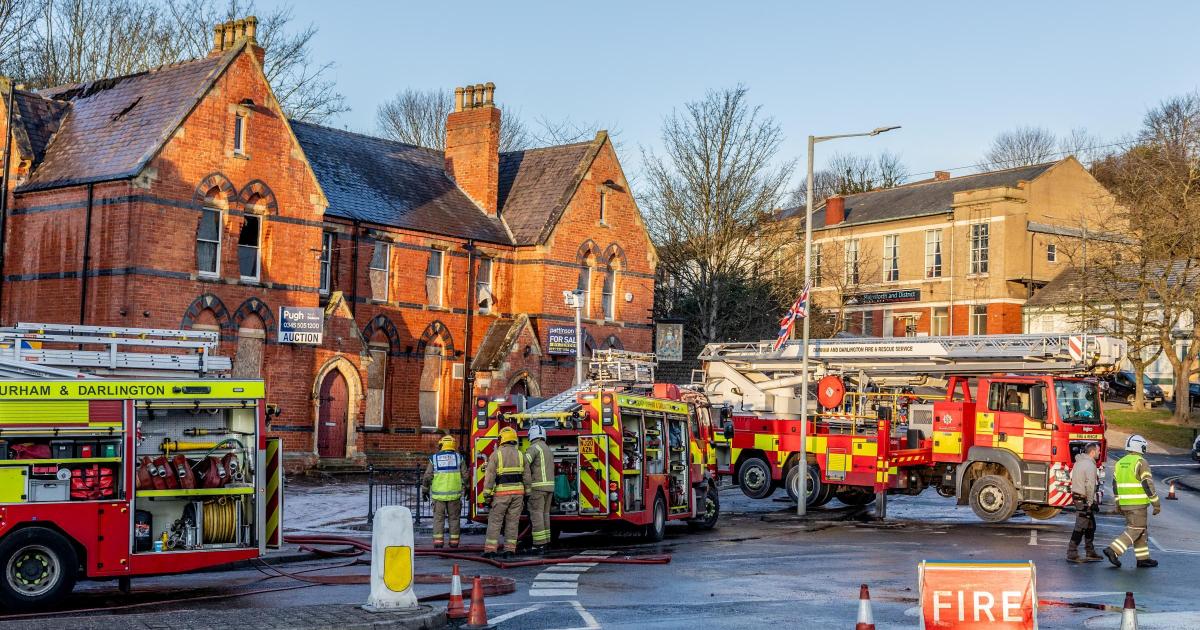
The pub, which was full of Victorian features and was once the home of a world championship star, failed to reopen after the pandemic and has been left empty, yet once it was full of life and it was built in a prime location to bring a touch of London grandeur to the County Durham mining community.
A station was opened at Ferryhill in 1840 by the Clarence Railway which ran to the north bank of the Tees, and when it was joined by the fledgling East Coast Main Line in 1844, Ferryhill became a railway hub with inns – The Clarence, The Swan, and The Commercial – springing up beside the line.
The Eldon Arms, therefore, was a latecomer, opened around 1872 facing the station.

It was the brainchild of William Hogarth, an entrepreneurial joiner and builder, and his wife, Jane Ann. It is said that Mr Hogarth deliberately echoed the style and coloured brickwork that Sir George Gilbert Scott used in designing the fantastic Midland Grand Hotel beside St Pancras Station, which opened in 1873, and perhaps – with a little imagination – he succeeded.
However, he didn’t succeed in business. On December 21, 1878, he was declared bankrupt and the following February, the pub and everything he owned – including two horses, three carts, a pig and 20 pigeons – were auctioned the following February.

Somehow, though, he stayed in business – Jane Ann remained landlady until her death in 1894.
The pub was a real hub of the community: auctions, smoking concerts and retirement presentations were held there, plans for the town’s development were displayed there, in 1890, a cycling club was formed there.

Inquests were held there, including in 1884, into the death of engine driver Thomas Fenwick, 55, who was crushed between two wagons at Coxhoe Bridge.
Public meetings were held there. In 1882, a well attended meeting of railwaymen agreed to form a local branch of the Amalgamated Society of Railway Servants so that their “unity of action” would lead to improved conditions.

In 1887, there was a huge turn-out for a meeting about “the Ferryhill mystery”. It heard from the men organising the search for Robert Bell who had “mysteriously disappeared” but was suspected of throwing himself into 300 yards of water at the bottom of Mainsforth Old Pit Shaft.
The committee said that even though cloth and hair recovered from the shaft did not belong to Robert, there was no more they could do, and formally called off their search.
Then a letter from the missing man’s father, Robert Bell of Silver Street, Darlington, was read to the meeting, and there can hardly have been a dry eye in the pub.
He wrote: “I beg leave, on behalf of myself and family, to offer to your committee and friends our sincere and warmest thanks for your kindness and humanity in making such a noble effort to find the body of my beloved son, who mysteriously disappeared on July 22, 1887. I can assure you all that I’m very sorry indeed that owing to my humble circumstances I am unable to reward your labours. It has been a great consolation to his aged parents and his brothers and sisters to know that so much has been done to clear up this painful circumstance.”
What tragedy!

The Eldon Arms – named after the local landowner, the Earl of Eldon – continued as the community hub into the 20th Century. In the 1930s, it was the rehearsal room for Mainsforth Colliery Band, which met in an upstairs room each Sunday morning. A lodge of the Royal Antediluvian Order of Buffaloes, a fraternal organisation, also met there, and it became renowned as a centre for racing pigeon fanciers. a splendid trophy was always on display behind the bar.

In the late 20th Century, Bob and Elsie Carr were long time hosts, followed by Paula Richardson and Dave Athey who ensured the pub got behind one of their long time regulars, holding raffles and fund-raisers to enable Phill “the Ferryhill Flyer” Nixon to follow his dream and play in the 2007 World Darts Championship.

A 150-1 amateur outsider, he had the name of the pub on his shirt in recognition of the support as, amazingly, he reached the televised final, where he took on Martin “Wolfie” Adams.
It was the first to seven sets and, at the interval, Phill trailed 6-0. He had a beer and a few fags, deliberately jabbed himself in the leg with his darts to wake himself up, and then fought back to 6-6 in one of sport’s most thrilling comebacks.
Though he lost the decider, he won millions of admirers – but the regulars in the Eldon Arms, where he played most Monday nights, were unable to watch him.

The Eldon was a Samuel Smith’s pub and the brewery had a blanket ban on televisions. Even mobile phones are discouraged as the brewery tries to foster a traditional, Victorian atmosphere – an atmosphere that the Eldon had a barful of. After Monday’s major setback, will it ever again be able to relive its days of grandeur at the heart of its community?