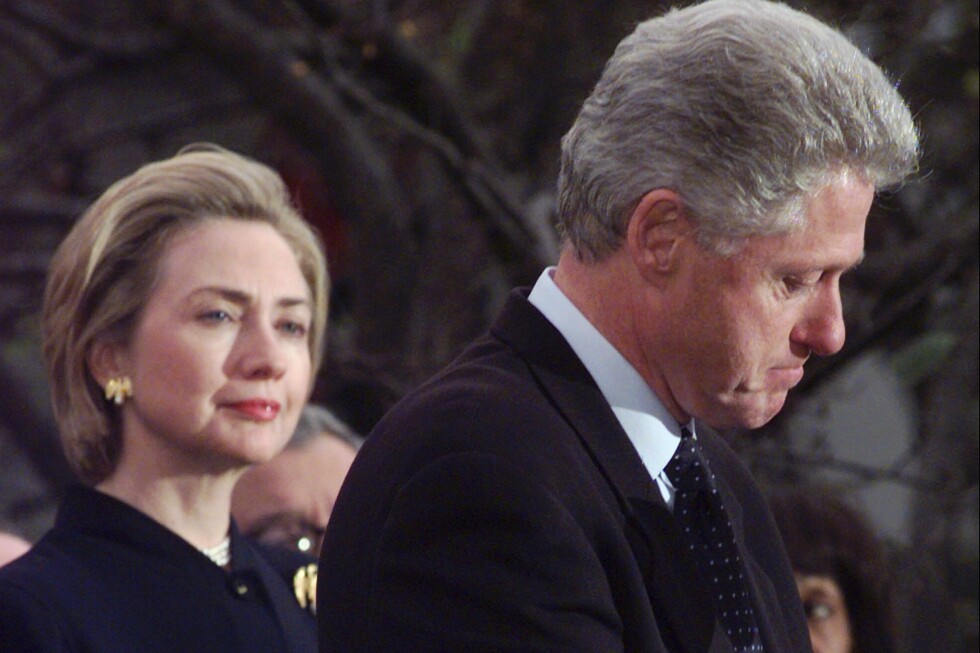



WASHINGTON (AP) — Videos of former President Bill Clinton and former Secretary of State Hillary Clinton answering questions about convicted sex offender Jeffrey Epstein were released Monday by a House committee investigating the late financier.

The recordings of the depositions, which spanned hours over two days last week, show how both Clintons distanced themselves from Epstein. Bill Clinton told the committee that he had ended his relationship with Epstein years before the financier entered a guilty plea in 2008 to soliciting prostitution from an underage girl.
The former Democratic president said he first remembered meeting Epstein when he flew aboard his private jet in 2002 for the Clintons’ humanitarian work, and they parted ways the year after.
“There’s nothing that I saw when I was around him that made me realize he was trafficking women,” Bill Clinton told the committee.
Advertisement
Epstein visited the White House numerous times during Clinton’s presidency and there are photos of them shaking hands, but Bill Clinton said he did not recall those interactions.
Hillary Clinton said she never even recalled meeting Epstein.
Still, they faced hours of questioning under oath from lawmakers who are searching for accountability for anyone who was aware or ignored Epstein’s abuse of underage girls.
A 22-year-old has been found guilty of killing a man outside student accommodation near Cambridge railway station
17:11, 02 Mar 2026Updated 17:15, 02 Mar 2026
A 22-year-old man has been convicted of the murder of a Saudi Arabian student who was stabbed in the neck whilst studying English on a 10-week placement in Cambridge last year. The trial at Cambridge Crown Court heard that Mohammed Algasim, 20, was assaulted outside student accommodation near the city’s train station late on August 1, 2025.
Prosecutors said he was fatally stabbed by Chas Corrigan, who was a stranger to him, in an “unprovoked and senseless act of violence”.
Corrigan, of Holbrook Road, Cambridge, denied murdering Mr Algasim. However, he was found guilty by a jury after two hours and nine minutes of deliberation, a court officer said.
Advertisement
Corrigan, who confessed to carrying a knife, is scheduled to be sentenced at the same court on Wednesday (March 4), the court officer added.
Prosecutor Nicholas Hearn told jurors that Corrigan had been drinking in a pub and may have consumed drugs prior to stabbing Mr Algasim with a kitchen knife. He mentioned that the stabbing was “captured by a high-quality CCTV camera positioned outside the student accommodation”, and footage of this was shown to the jury.
It showed Mr Algasim sitting on a low wall surrounded by a group of people when Corrigan – wearing a hi-vis jacket – approached the group.
Mr Hearn stated that Abdullah Bin Shuail, a fellow student of Mr Algasim, “heard the defendant say something to Mr Algasim but he could not hear what was said and he could not hear whether Mr Algasim said anything in reply”.
Advertisement
He said Corrigan walked away from the group and towards the train station. Mr Hearn said that as the defendant walked away, Mr Bin Shuail heard Mr Algasim say something to the defendant but “could only make out one word”, which was “centre”.
“When Mr Algasim said this, the defendant turned and started to come back towards them,” Mr Hearn said. The prosecutor said the defendant said ‘What did you say, what did you say?’ and that this was “in a very angry and aggressive way”.
He said Mr Bin Shuail “saw the defendant punch Mr Algasim hard to the left side of his neck” and “then saw that the defendant was holding a large knife in his right hand”. Mr Algasim died from a single stab wound, which severed the carotid artery and jugular vein, “causing massive bleeding”, Mr Hearn said.
Mr Hearn added that Mr Algasim “posed no threat to anybody”. He said Mr Algasim “was a student who had come to Cambridge from Saudi Arabia”.
Advertisement
Corrigan maintained that he had the knife with him to frighten off any attacker and insisted he did not realise he had made contact with Mr Algasim. He has been remanded in custody until his sentencing.
Emergency services were called to the crash on Monday (March 2) afternoon.
17:52, 02 Mar 2026Updated 17:54, 02 Mar 2026
A man has been taken to hospital after a crash in a small hamlet. Emergency services were called to a crash in Main Road in Stonely just after 1pm today (Monday, March 2).
The crash involved a car and motorbike. The East of England Ambulance Service attended and transported a man to hospital.
An ambulance spokesperson said: “We were called just after 1pm to a road traffic collision involving a car and a motorbike on Main Road in Stonely. An ambulance and rapid response vehicle were sent to the scene. An adult man was transported to Hinchingbrooke Hospital for further treatment.”
Advertisement
Cambridgeshire Police also attended. A police spokesperson said: “We were called at 1.07pm to Main Road in Stonely with reports of a collision between a car and a motorbike.”
The developers said a new railway station would ‘benefit many’ and could form part of the next phase of proposals
A new railway station could be built as part of a large housing development. Urban&Civic is working on the fourth phase of plans for new homes at Alconbury Weald in Huntingdonshire.
Advertisement
The 1,000 new homes will include a range of one bedroom to four bedroom homes, as well as proposals for shops, a secondary school, and a health and community centre. A railway station could also be built.
Mike Jenner, development manager from Urban&Civic, said: “Phase 4 has an important role to play in the delivery of Alconbury Weald, connecting green spaces and key infrastructure. The design of Phase 4 ensures walking, cycling and public transport links connect to the wider site seamlessly, and supports the aspirations of our local transport partners to progress a rail station, which will benefit many.
“As with other phases of Alconbury Weald, the first step is to establish a development framework and design code for phase four. This sets the parameters for the detailed designs that will come forward for individual housing parcels, green spaces and infrastructure, ensuring a cohesive and high-quality neighbourhood.
“We hope residents and the wider community will review the framework plans and help us shape the next phase of Alconbury Weald.”
Advertisement
The developers said a railway station has “always been part” of the plans, and said it could play a “transformative role to unlock economic growth”. As a part of phase four, Urban&Civic is working with planning authorities, including the Cambridgeshire and Peterborough Combined Authority, Cambridgeshire County Council and Huntingdonshire District Council.
The developers and authorities are working with Network Rail around the opportunities to deliver a new station along the East Coast mainline. Phase four will also look at the development’s “important connection” to green spaces.
The developers added: “The final section of Runway Park sits in Phase 4 and will include pockets of play space in a landscaped setting alongside a waterbody, which will form part of the sustainable drainage system and create a haven for wildlife.
“Marking the historic landing point for aircraft returning to RAF Alconbury, Touchdown Park will sit at the heart of this green space with a platform extending over the water that could be used for community events.”
The event, taking place from Saturday (March 7), will see about 50 venues across the city offer special dining deals, including new participants Ember at the Sheepfolds and The Korean Spoon on Fawcett Street.
Tamer Hassan, owner of Ember, said the restaurant is now ready to take part after 18 months of building its reputation.
Ember at the Sheepfolds is new to Restaurant Week this year. (Image: Ember)
Mr Hassan said: “When we first opened, our main focus was on establishing Ember’s reputation and building strong foundations as a new business.
“At the time, we were conscious that restaurant week could make us exceptionally busy, and we didn’t want to risk putting too much pressure on the team or compromising the standards we were working so hard to set.
Advertisement
“Now, 18 months on, we feel much more established and confident in what we do.
The Korean Spoon on Fawcett Street is also a newcomer to Restaurant Week. (Image: The Korean Spoon)
“It feels like the right time for us to be part of such a brilliant event and to give something back to the community that has supported us so strongly since day one.
“We’re excited to welcome new guests through the door and showcase what Ember is all about.”
Rachel Meng, owner of The Korean Spoon, said the restaurant is looking forward to welcoming diners during the event.
Advertisement
Ms Meng said: “We’re delighted to be taking part in Sunderland Restaurant Week for the first time.
“The support we’ve received since opening has been incredible, and we’re really looking forward to welcoming both new and returning customers to discover our authentic Korean cuisine during the week.”
The full list of venues taking part this year is as follows:
1842 Acropolis Angelos Antico Ashbrooke Home Asiana Babaji BobaCat Kitchen Burger Drop Café Floriana Chesters Lounge Deep North Diegos Ember Enfes Esquires Fausto Gatsby Goa Grand Hotel House of Zen I scream for pizza Keel Tavern Koji Marina Vista Mexico 70 Mumbai Silk My Dehli Panda Garden Pho 179 Port of Call Rio Roma Rumour Has It Saba Maison De Luxe Signatures SIX Spent Grain The 3 Stories The Coffee Snug at The Chair The Korean Spoon The Mad Hatter The Seaburn Bay The Shipwrights The Sweet Petite Vito’s Osteria WEAR Yard Nine
Organised by the City Centre business improvement district (Bid) and seafront Bid, with support from Nexus, the event offers set menus at price points of £10, £15, £20, and £25.
Advertisement
A variety of cuisines are on offer, including Mediterranean, Asian, Turkish, and Indian.
Diners can download the required vouchers from the Sunderland Bid website.
The escalating conflict between Iran, the US and Israel has taken a critical turn. The strait of Hormuz – one of the most important shipping routes for oil and gas – is facing significant disruption. The strait is the main route connecting Persian Gulf ports in Iran and some of the region’s other oil producers to the open ocean.
The strikes on Iran are already having tangible effects: energy flows are slowing, markets are reacting and supply chains are under pressure. This is not just a regional conflict – it is a global supply chain crisis unfolding in real time.
As an expert on supply chains, I am acutely aware of how central the strait is – not only for the stability of the region but also to the functioning of the global economy.
This narrow corridor is one of the world’s most critical chokepoints – around a fifth of the world’s oil passes through the strait daily. Its sudden disruption represents a “chokepoint failure” – a breakdown at a critical node that triggers cascading effects across global systems.
Advertisement
Tanker traffic has dropped sharply, with vessels waiting in surrounding waters as ship owners reassess the risks. Oil prices surged in response to the strikes and the threat to shipping routes. Analysts have warned that prices could climb significantly higher if the disruption persists.
But crucially, this reaction was not driven solely by actual shortages. Markets respond to uncertainty itself. The mere possibility that several million barrels per day could be disrupted is enough to push prices up, even before supply is properly hit. This reflects a broader feature of geopolitical risk: expectations and perceptions can be as economically powerful as material disruptions.
Because energy underpins almost every sector, these price increases transmit rapidly through supply chains. Higher fuel costs raise transportation expenses, increase production costs and ultimately feed into inflation across goods and services that eventually land with consumers.
The strategic importance of the Gulf states
The disruption is not confined to the strait. Instability across the wider Gulf region also affects the United Arab Emirates, as well as other strategically important energy producers and logistics hubs, such as Qatar, Kuwait and Saudi Arabia.
Advertisement
This dimension matters because the Gulf functions not only as an energy supplier but also as a crossroads in global trade and logistics.
Ports such as Dubai handle vast volumes of international shipping, linking Asia, Europe and Africa. As tensions spread, the reliability of these logistics systems is increasingly called into question.
The result is a shift to more widespread insecurity, where both energy flows and trade infrastructure – things like major container ports, shipping lanes, export terminals and storage facilities – are simultaneously at risk.
Energy is the heart of global supply chains. Manufacturing depends on electricity and fuel, transport relies on oil-based logistics and agriculture depends heavily on natural gas-derived fertilisers. When energy flows are disrupted or become more expensive, the effects propagate across entire networks.
Advertisement
Research on geopolitical crises shows that disruptions to key inputs such as oil and gas quickly translate into broader supply chain instability. This affects production, trade and the availability of goods far beyond the conflict zone. The Iran crisis reflects this dynamic. What begins as disruption in a maritime corridor can become a global economic issue within days.
For decades, global supply chains have been optimised for efficiency. This means that they concentrate sourcing and production in regions that minimise costs. This model has delivered large economic benefits, but it has also created weaknesses in the structure.
The crisis in the strait of Hormuz is a prime example of a chokepoint failure. AustralianCamera/Shutterstock
The concentration of energy flowing through a single chokepoint such as the strait of Hormuz exemplifies this trade-off. When it is disrupted, the system lacks resilience.
Advertisement
In response, supply chains are likely to accelerate efforts to diversify and invest in alternative energy routes and sources. Countries that are heavily dependent on oil transiting through the Gulf will seek to expand strategic reserves, diversify their import routes and invest in pipelines that bypass maritime chokepoints.
But at the same time, geopolitical instability strengthens the case for renewable energy, electrification and regional energy integration. Expanding solar, wind and green hydrogen capacity reduces exposure to concentrated fossil fuel corridors. And cross-border electricity connections can improve flexibility during shocks. In this sense, resilience is also an energy transition issue.
At the same time, instability in conflict-hit regions can fuel the rise of informal and illegal supply chains, particularly where governance is weakened. These can include things like unregulated oil trading, goods being smuggled through informal maritime routes and labour exploitation hidden within subcontracting chains.
What’s more, supply chains themselves are increasingly shaped by geopolitical forces, as states use trade, energy and logistics networks as instruments of power.
Advertisement
For consumers, this could mean greater price volatility, shortages and reduced choice as firms adjust sourcing strategies in response to sanctions, trade restrictions or security risks. In some cases, it may also mean higher costs over the long term, as businesses prioritise resilience over efficiency.
A turning point for globalisation?
The situation in the strait of Hormuz may mark a turning point in how global supply chains are understood. It has shone a light on a fundamental tension at the heart of globalisation. Efficiency depends on sourcing and production being concentrated in a few locations, but resilience depends on diversification. When critical links in the chain fail, the consequences extend far beyond their immediate location.
This war demonstrates that supply chains are not merely economic systems. They are deeply embedded in geopolitical realities. The challenge ahead is not simply to manage disruption, but to redesign supply chains and energy sources for a world in which geopolitical risk is no longer exceptional, but structural.
Misty Roberts, 43, stands accused of having sex with a teenage boy at a pool party in 2024.
An ex-mayor is accused of having sex with her son’s teenage friend at a pool party – with her children claiming they witnessed the alleged offence.
Advertisement
Misty Roberts, 43, allegedly carried out the offence at a party in 2024 while serving as mayor of DeRidder, Louisiana. Her trial on a charge of third-degree rape began last week following numerous delays, according to local media. Roberts resigned from office in late July 2024, days before she was arrested and charged with third-degree rape and contributing to the delinquency of juveniles.
Last week, jurors were shown pictures of the party in question, including of children holding drinks by the pool, reports the Mirror. In interviews played to the court, Roberts’ son told investigators he saw his mother having sex with his friend through the crack of a window, while her daughter told investigators she saw her mother and the teenager “on top of each other”, KPLC reports.
However, on Thursday, when both of Roberts’ children took the stand, her son told the court he was not certain what he saw that night. The prosecution presented a text message in which the son appears to tell Roberts: “He is seventeen.” The alleged victim of this case was identified as 16 years old at the time of the alleged offence, according to KPLC.
Advertisement
On Thursday, the defence and prosecution questioned two forensic interviewers who had spoken with children connected to the case. One interviewed three children, including the alleged victim, in July and August 2024. The second interviewed Roberts’ children in March 2025 at the request of the district attorney’s office.
Roberts’ nephew told the court that he used his phone’s camera to see what was happening in the room that night. He testified that he was unsure if he had hit “record”, but said that if he had, the video was never sent to anyone and he has since deleted it from his Snapchat memories.
When the defence asked Roberts’ nephew why he cleared his Snapchat before handing the phone to investigators, he said that he did it because it contained photos of him and his friends drinking, and he was worried about getting in trouble. He said he did not intend to delete any evidence.
None of the three witnesses who testified on Thursday said they saw any “private parts” of Roberts or the alleged victim. One witness said the teenage boy was shirtless.
After the alleged incident, the mother of the alleged victim texted Roberts to make sure she was not pregnant. The court was shown a screenshot of the message in which Roberts replied that she was on birth control.
Advertisement
The court was shown that Roberts sent a screenshot of her conversation with the boy’s mother to a group chat with her friends, who responded by telling her to take Plan B. A DoorDash driver testified that he delivered an emergency contraceptive to Roberts’ house.
The defence suggested in court that a key part of the interview with Roberts’ son was not transcribed. Defence attorney Adam Johnson claimed the interviewer told the boy: “Just say it once, and we can move on.” He also said the transcription notes are unintelligible.
Roberts had appeared in court in early February to enter her plea of not guilty to two felony charges of indecent behaviour with a juvenile and carnal knowledge of a juvenile.
Advertisement
In her resignation letter in July 2024, Roberts said: “For nearly 15 years, my love and passion for DeRidder has been my foundation while serving as Mayor. I will forever be proud of what we have been able to accomplish – together. This role has rewarded me with many great relationships.
“I am humbled to have witnessed the hard work that took a community to come together and overcome through unprecedented times. However, I must adjust my focus and priorities. Please accept this letter as my formal resignation, effective today.
“To the residents of this city: Thank you for your trust, love and support in me to lead our city into our future of greatness. My love for DeRidder will never waiver.” Roberts was in the middle of a second term as the city’s mayor, to which she was re-elected in 2022 with sixty per cent of the vote.
DeRidder is a city in Louisiana with a population of just under 10,000 people.
Advertisement
Get more Daily Record exclusives by signing up for free to Google’s preferred sources. Click HERE.
The beloved Lanchester visitor attraction, now headed by Ann Darlington and her son Richard, originated as a simple lambing event.
It has since flourished into an immersive farm experience renowned nationally.
Last year, the farm welcomed more than 100,000 visitors, confirming its popularity as a destination for hands-on farm activities among families.
Advertisement
Over time, Hall Hill Farm has won both regional and national tourism accolades.
In the North East England Tourism Awards in 2025, it was awarded the titles of Large Farm Attraction of the Year and Large Visitor Attraction of the Year, further cementing its reputation.
The farm is now hiring guides to join its team.
null (Image: HALL HILL FARM)
A job advertisement on the farm’s wesbite reads: “Would you like to join our award winning team?
Advertisement
“Do you enjoy meeting people, could you handle rabbits and chicks, you will need to have a constant smile whatever the weather, and take pride in providing excellent customer service?
“If you are friendly and outgoing, we would love to hear from you.”
For those interested in part-time roles during the weekends and school holidays, the farm is looking for candidates who love animals, enjoy smiling, and meeting new people.
Advertisement
Duties will include interacting with the public, tending to animals such as rabbits and chicks, some feeding and mucking out, and general cleaning tasks.
Applicants must be able to work approximately 10am to 5pm on Saturdays or Sundays and bank holidays, and must be available for Easter holidays and all bank holiday weekends when the farm is open.
The minimum age for applicants is 16 and forms should be sent to chris@hallhill.co.uk.
First, look at the structure. Traditionally, foams are dense, but dedicated cooling memory foam or hybrid mattresses feature enhanced technology for better temperature regulation.
Look for phrases such as “open cell”, which means the foam may have gaps for air to pass through and “gel beads” or “phase change materials”, which both absorb excess thermal energy to draw it away from the body.
Air flows more freely through pocket sprung mattresses, due to the space between the coils. Some designs also incorporate natural materials, such as wool, to dissipate heat and wick moisture.
Advertisement
Composition is important for the cover, too. Natural fibres, such as cotton, are more breathable than synthetic fabrics. Textiles derived from wood pulp (any described as viscose, bamboo, eucalyptus or Tencel) also tend to be better for temperature regulation.
As for firmness, softer mattresses can trap more heat as you sink into them. For further advice, read our guide on how to choose a mattress.
This is Moroccan-inspired and very good with roast lamb or spicy barbecued mackerel. If you want to have it on its own, yogurt or labneh are good alongside and, of course, flatbread or couscous. It might seem like a hassle to roast the fennel and tomatoes separately but it does make things easier when you assemble the salad. Each element stays intact.
You can use coriander or mint instead of parsley in the dressing, and extend the salad by adding fresh leaves (rocket, watercress or baby spinach). Just note that if you add leaves you’ll need to make more dressing.