

Across the UK, millions of households are struggling to afford to heat their homes. Energy poverty has risen sharply since 2021, with around 6 million households unable to keep warm without cutting back on essentials.
At the same time, the UK faces a race to meet net zero by 2050, including delivering 70GW of solar power by 2035 (that’s enough energy to power 35 million homes).
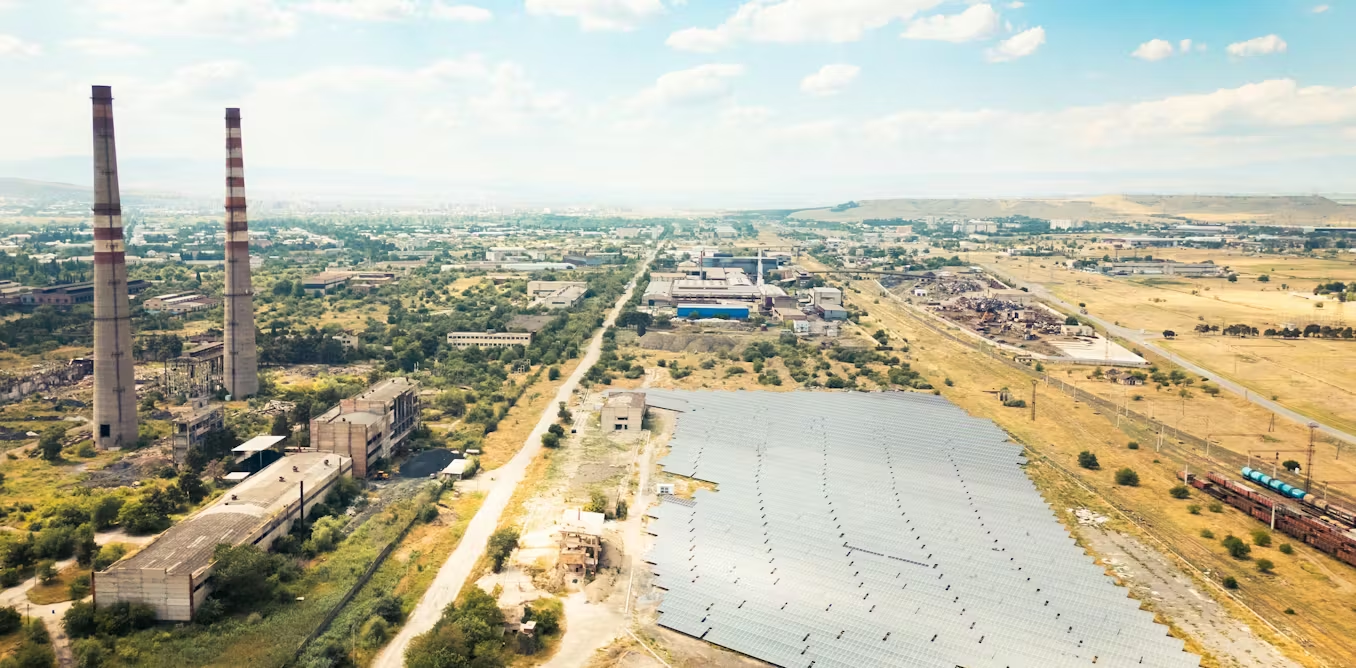
Brownfield sites – the abandoned or disused lands that dot the UK’s cities and towns as a result of de-industrialisation – could be an untapped asset.
As a multidisciplinary sustainability researcher, I have seen how brownfield has slowly been incorporated into urban planning in the UK – from locally managed brownfield assets and datasets through to combined brownfield datasets and eventually to a national register.
To date, there are still more than 37,000 brownfield sites in England alone, many in deprived areas where property values are low and investment scarce. These sites range from as small as 0.001 hectares (0.00000386 square miles) to 157,945 hectares (610 square miles), according to the UK government’s brownfield land register.
Although different countries have different interpretations of what constitutes brownfields, they are often fenced off, contaminated or derelict – a symbol of neglect rather than renewal.
My team’s recent study shows that repurposing this land for community-based renewable energy projects, such as solar farms, wind turbines or ground source heat pumps, could not only help boost the renewable energy uptake, but also cut carbon footprint and tackle energy poverty.
À lire aussi :
Green belt land just isn’t that green anymore
The idea is simply to transform brownfield land from environmental liability and eyesore into local renewable energy generators. Even the smallest brownfield site can house a small number of solar PVs, rooftop wind turbines or a deep-borehole ground-source heat collector.
In the US, this is already happening. Since 1999, the Brightfields Initiative has converted disused industrial sites in California, Connecticut, Minnesota, New York and Virginia into solar farms. The US Environmental Protection Agency has also created a national RE-Powering Mapper tool to find suitable brownfield lands for renewable energy projects.

ThomsonD/Shutterstock
The UK has yet to adopt a similar approach. Since launching in 2017, the current brownfield register mainly tracks potential housing sites, which may limit its redevelopment opportunity due to the site contamination that may require a high cleanup cost and a long restoration period before it can be safe for habitation. Energy development is rarely considered, even though many brownfield sites sit near densely populated areas that would benefit most from cheaper, cleaner power.
The good news is that momentum is building. The energy bill was amended in July 2023 to encourage solar installations on rooftops and brownfield land. In 2024, the government launched its brownfield passport consultation to seek ways to speed up redevelopment of derelict land. Our research supports this effort, and suggests that energy generation should be a formal part of that strategy.
Turning brownfields into brightfields
Brownfield redevelopment isn’t just about land use, it is also about energy justice, where fair access to affordable and sustainable, clean energy can be guaranteed.
This involves three principles. Distributive justice is the element of ensuring a fair allocation of energy resources and burdens between individuals and communities. In this case, brownfield renewable energy can supply affordable energy directly to low income households, who tend to live in underdeveloped areas, reducing their dependence on volatile fossil fuel prices.
This can be more affordable because community-owned renewables avoid profit-driven pricing, reduce transmission losses by generating energy locally and benefit from lower operating costs once the systems are installed. This means savings can be passed directly to households.
Procedural justice emphasises fairness and inclusion in energy-related decision making. In other words, brownfield development should integrate greater public participation, enabling communities to co-design and co-own energy solutions (such as Brixton Energy in London).
Recognition justice involves acknowledging individual and collective energy needs, values and rights. Many brownfield sites lie in areas long burdened by environmental damage. Renewable energy projects can therefore revitalise the land, create jobs and improve local wellbeing.
Community energy, where residents jointly own and manage renewable energy, delivers on all three of these principles. Community energy projects create local jobs, generate income that stays in the area and build trust between citizens and local authorities.
But renewable brownfield redevelopment is not simple. Contamination, complex regulations and financing challenges have slowed progress for decades. Developers also frequently shy away from uncertain cleanup costs or lengthy approvals. These barriers can be overcome through targeted policy support, such as grants for site remediation, streamlined planning processes and public-private partnerships that can reduce financial risks while ensuring community participation.
By developing brownfield for renewable energy, multiple issues can be addressed using existing resources while reaping benefits beyond free sustainable energy. It can enrich energy poor households, enhance biodiversity, provide cleaner air, create safe neighbourhoods and increase property values. This reduces the competition for fresh land development, often termed as greenbelt.
With coordinated policies, community participation and a clear national vision, the energy system can become more just.

Don’t have time to read about climate change as much as you’d like?
Get a weekly roundup in your inbox instead. Every Wednesday, The Conversation’s environment editor writes Imagine, a short email that goes a little deeper into just one climate issue. Join the 47,000+ readers who’ve subscribed so far.



