
News Beat
How Britain banned beauty

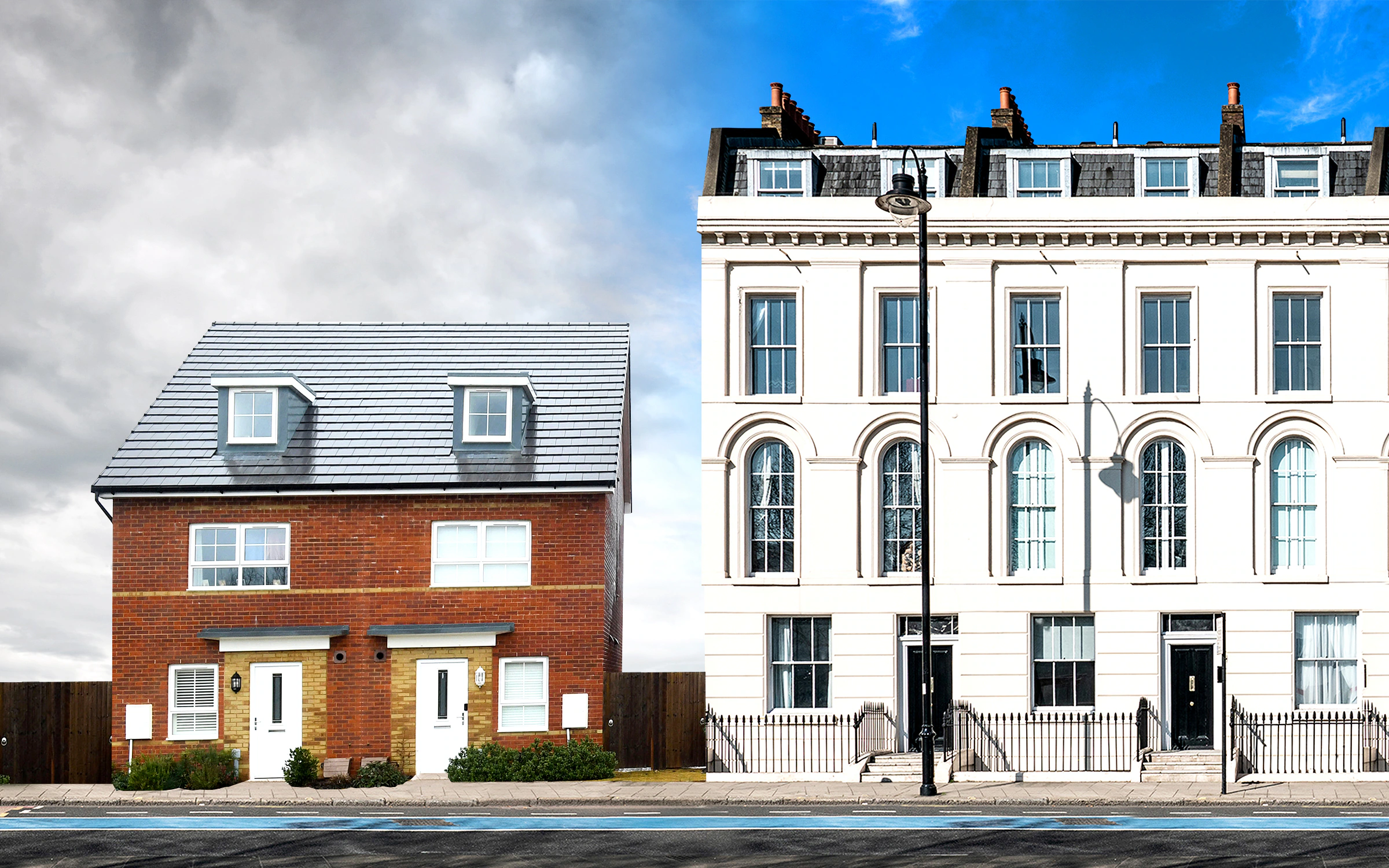
What we know today as the classical Georgian terrace emerged from a catastrophe.
In the wake of the Great Fire of London in 1666, Parliament passed a series of acts to change the way houses were designed.
This meant the capital went from having narrow, cramped streets full of overhanging Tudor homes – complete with wooden beams and eaves – to more uniform, elegant and brick-built terraces.
This triggered what is regarded as Britain’s first speculative building boom, with developers throwing up streets of houses using new construction techniques.
Hundreds of years later, Georgian homes are still beloved by most Britons with polls consistently showing they are actually preferred over new housing.
An Ipsos Mori survey in 2015 found Georgian-style homes were the most popular, preferred by 75pc, while research by Anglian Home Improvements in 2019 found that Georgian architecture was Britain’s “most desirable” property style.
In 2023, research by the Chartered Institute of Building also concluded that most buyers viewed older homes as higher quality. Famous neighbourhoods known for their Georgian homes, such as Clifton in Bristol and Bedford Square in London, are among the country’s most sought-after locations.
Whereas modern developments can feel lacking in character, Georgian properties are known for their ornamental features: pediments and cornicing, pillars and panelled walls, attractive quoining and wrought iron railings.
“Georgian terraced homes are light-filled, they feel natural, they’ve got pattern, variety and a little bit of joy,” says Nicholas Boys-Smith, of design consultancy Create Streets.
“They might have a fan window, a bit of texture, but they’ve also got a dignity and a sort of symmetry and order to them.
“It’s a good compromise between our brain’s need for order and our love of ornament and detail and playfulness.”
It’s a far cry from what many people find today when they tour one of Britain’s modern housing estates.
Home buyers are often faced with streets of drab and unappealing new-builds.
We can all picture these homes in our minds. They are carbon copies of each other, scattered across sprawling new neighbourhoods. The Chartered Institute of Building’s 2023 survey found two fifths of the public believed modern designs suffered from a “lack of character”.
“Surely, part of the function of a building is not just to provide shelter to those who live or use it internally, but also to bring joy and dignity to the much greater number of people who are going to pass by it,” says Boys-Smith.
“So having a boxy and ugly building that is discourteous to the landscape and careless of a local tradition is thus actually not performing part of its function for the people who live nearby.”
Politicians from David Cameron to Sir Keir Starmer have repeatedly promised to make new developments more attractive.
Some, including former housing secretary Michael Gove, have even argued that making homes beautiful is the antidote to Nimbyism.
Yet instead, things seem to be getting worse. For instance, large windows are the most sought-after feature for house-hunters, according to Anglian Homes Improvement, but they keep getting smaller. Why?
One answer, according to experts, is that it is now all but impossible to build the kind of classical homes many of us love.
Through layer upon layer of well-meaning red tape, Britain has effectively banned beauty.
In 2006, then opposition leader David Cameron gave a speech criticising the way new developments looked and vowed to provide “homes that are beautiful in communities that are sustainable”.
However, 17 years later – and 13 years into government – the Tories were still railing against the standard of housing being delivered, with Michael Gove warning it was too often “ugly or identikit”.
Clearly, no politician ever set out to encourage the building of eyesores across Britain.
Yet according to experts, that is what successive governments have accidentally done with a blizzard of regulations.
Take windows, for example. Under rules first introduced under the Major government, upstairs windows have to be either 1.1 metres from the floor or guarded so people can’t fall out of them.
Just how necessary this protection is may be open to debate. The Government does not publish up-to-date figures on how many people die from falling out of windows, but the number is thought to be very small.
Figures from the Office for National Statistics suggest an average of 77 people died per year after falling from windows, balconies, roofs, and walls from 2015 to 2024. However, this included the likes of builders who work at height.
Thirteen children died from falling out of windows between April 2019 and May 2025, according to Bristol University’s National Child Mortality Database.
Many developers overcame these window safety rules by restricting how far they could open. But in 2022, then-housing secretary Michael Gove introduced rules that said windows must also open far enough to ventilate the room with fresh air during hot weather. This effectively ruled out window restrictors and meant developers switched to using smaller, squatter windows to comply with both rules.
Some get around this by putting bars over the windows, costing more than £200 per window, which many homeowners later remove anyway.
Ironically, the regulations mean sash windows – famously good at creating draughts with their top and bottom openings – cannot be included in new builds in certain areas such as London which are deemed to be at “higher risk of overheating”. Getting them might be possible through carrying out expensive heat dynamics surveys, but many developers don’t want to do this.
Samuel Hughes, of the Centre for Policy Studies, says the rules are a particularly bad example of “paternalistic” overreach by the Government.
“It’s amazing to me that building safety regulators think it’s their job to tell British people what size of windows they ought to want,” he says.
“People know how windows work.”
Meanwhile, other regulations dictate the proportions of homes in ways that rule out classical Georgian styles.
Rules updated in 2004 and 2015 say all new homes must have step-free access, a lavatory suitable for wheelchairs on the ground floor and wider doors and hallways.
They are designed to make homes more accessible to people with disabilities – but tend to rule out popular features such as steps to the front door, while preventing the narrower, more space-efficient layouts of Georgian terraces.
Minimum back-to-back distances between properties also mean houses must be spaced further apart. This results in developers being able to build fewer homes than before on the same patch of land. While Georgian homes can span densities of anywhere between 40 to 175 homes per hectare, most modern developments will only have 20 to 30 per hectare, according to Create Streets.
That is partly because Georgian-style properties may lack driveways or have smaller gardens. Take these two examples: The city street with Georgian homes has twice as many homes as the rural new build development.
Despite these drawbacks on driveways and gardens, Boys-Smith of Create Streets argues that such homes are nicer places to live overall.
“The great advantage of slightly higher density is that you just don’t need to build on as much farmland to provide the homes we need,” he says.
“But also, you create a neighbourhood which is actually more sustainable because it’s easier to walk and cycle more if the distance to the nearest shop or pub or school is smaller.”
There is nothing inevitable about the kind of housing Britain has ended up with. Look internationally and you can find modern examples of classical-style housing that prioritises attractiveness.
In the Parisian suburb of Clamart, for example, a regeneration project over the last decade has seen blocks of flats built in the instantly recognisable 19th century Haussmann style, with architects central to the project.
As the Government prepares to build 12 new towns across England, beauty risks being overlooked. But Boys-Smith and others believe there is a modern template worth studying: Poundbury.
A traditionalist “urban extension” to Dorchester, Poundbury was the King’s passion project – intended as a rebuke to modernist architecture.
There, designers found clever ways to incorporate traditional Georgian styles into modern homes – even within current planning rules and regulations.
For example, many homes in Poundbury still feature sash windows. Designers complied with the regulations by making sure they only opened from the top and in some cases by installing bars.
A large number of houses also have steps to the front door, despite accessibility regulations. This is because side or back doors have been made step-free instead.
When he unveiled the new towns programme last year, Sir Keir Starmer hailed Poundbury as an example of the “gentle density” the Government wants to emulate in future developments.
It’s a formula that has proved popular – and rewarding – for local residents.
According to Create Streets, homes in Poundbury will sell at 55pc more value per hectare of development than other areas. Researchers said this is because people are willing to pay more to live in such properties.
Blake Holt, a local resident who moved to Poundbury from the countryside, says more developers should follow the scheme’s example.
The 78-year-old grandfather and his wife love how walkable the development is, as well as its varied and interesting architecture.
“Having seen some other more recent estates that are being built, they look awful. They’re boxy and don’t feel like attractive places to live,” he says.
“In Poundbury, we love the architecture. It’s the way everything fits together. Everything is designed in a way that makes for much more attractive streetscapes.
“I think developers have a lot to learn from it.”
.webp?imwidth=1920)


Poundbury’s Georgian-style visual flourishes serve as a rebuke to modernist architecture
Credit: Russell Sach
The Government insisted that building regulations do not completely ban features such as sash windows but admitted they do preclude them in places such as London where properties are “at higher risk of overheating”.
A spokesman for the ministry of housing and local government said: “Our landmark new towns will be attractive, well designed places where people want to live.
“There is no ban on sash windows – or any type of window – and just today we have launched new design guidance to make sure we’re building homes and neighbourhoods people want to live in.
“This Government is taking action to fix the housing crisis we inherited and build 1.5 million homes to restore the dream of home ownership.”
Beauty isn’t completely banned yet. But unless Britain rediscovers its classical flair on a much grander scale, it may as well be.



