

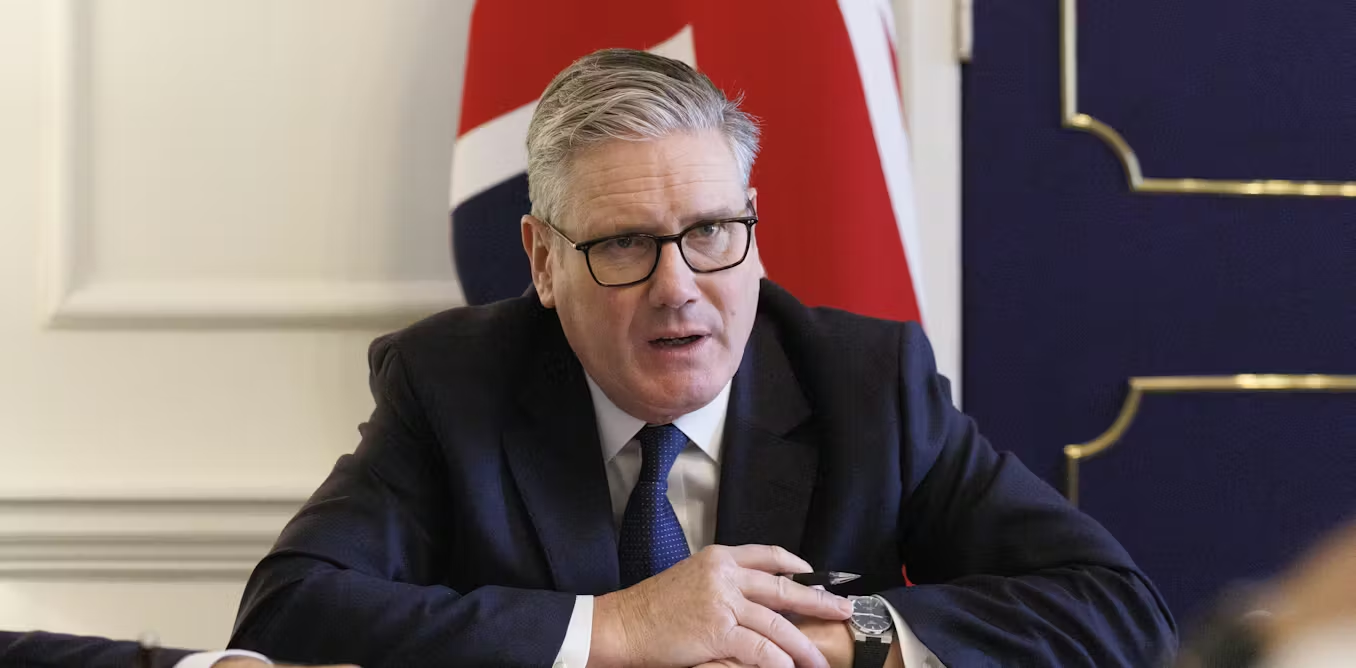
The British media’s obsession with the end of Keir Starmer’s premiership continues, with New Year’s coverage focusing on whether the prime minister will survive 2026.
Starmer began the year by telling BBC broadcaster Laura Kuenssberg that he can – and even that he will lead the Labour party into the next general election. But unless the most unradical of politicians does something very radical very quickly, the elections in May 2026 are likely to produce a leadership challenge.
However, leadership is not the core problem that the Labour party – or indeed, any party – really needs to focus on. The problem is that British politics is trapped in a “doom loop” that is, to some extent, of its own making.
It is lost in a self-reinforcing negative feedback cycle in which an initial problem triggers responses that worsen the original problem, locking the system into a spiral of decline.
Poor economic performance since the 2008 global financial crisis and a marked slowdown in productivity growth has led to poor UK performance in real wage growth and living standards. Low growth, high taxes and rising debt interest leads to declining confidence on the bond markets which leads to higher borrowing costs which, in turn, stifle growth and make deficits harder to tackle.
Although Rishi Sunak fought the 2024 election on the basis that it was possible to “reverse the creeping acceptance of a narrative of decline”, the public was not convinced.
In opposition, Starmer rejected the need for grand narratives or ideological ties. And he did not “win” the election thanks to a positive vision for Britain but largely due to the weight of disillusionment with the chaos of successive Conservative governments.
If anything, the doom loop has simply continued under Starmer, this time as what would become known as “miserabilism”. His governing style has been based around dampening expectations, emphasising national crises and blaming previous governments.
A perceived lack of ambition and a style and persona that emphasised grim necessity over hope and belief has exacerbated the problem. The paradox of such a pessimistic approach is that it has only added to a narrative of “broken Britain” that has increased populist pressures.
The problem is not (just) Starmer. The deeper problem is that none of the main contenders to replace him seem capable of offering a bold story of renewal and achievement that can stimulate collective confidence and national self-belief. Nor, if we are honest, are the leaders of the main opposition parties.
Towards the end of 2025 the doom loop was almost deafening. In October, BBC Radio 4 asked its listeners, “What kind of a state are we actually in?” before summarising their responses in the following terms:
If you pull out the kaleidoscope there are record delays for court cases, prisoners are being released, doctors are striking, water companies are pumping raw sewage wherever they can (preferably into lakes, rivers and the sea, that’s where they like to put it). We are one of the world’s richest seven economies and yet it does not feel like that by listening to the news … Bins on the streets, rats in the kitchen, gangs running prisons, knifes in the schools, university system broken, asylum system broken, benefits system broken, social housing system broken, politics broken, broken railways, poisoned rivers, failing high streets … you’d head for the hills if they weren’t strewn with rubbish.
An absence of ideas in response to these problems has created the political vacuum that Nigel Farage’s Reform party has exploited with such zeal. For Farage the story is simple – the UK is stuck in a spiral of decline that can only be broken by a combination of economic nationalism, cultural conservatism and populist politics.
Whether you believe in Farage’s diagnosis of the problem or prescriptions for reform, what he offers is a vaunted solution to the doom loop problem that is clear and confident.
The power of narrative
As academics Alex Prior and Clara Eroukhmanoff have argued, political leaders not only need a clear narrative but they also have to be compelling characters within that narrative. Margaret Thatcher offered both the narrative and persona. She acknowledged the existence of challenges while telling a story about how she intended to fix them.
Tony Blair did the same. Meanwhile, the loss of a Conservative majority in 2017 was attributed to Theresa May “performing neither the narrative nor the persona”.
Starmer is not, and never has been, a storyteller. The limits of his performative competence were demonstrated in his 2026 New Year “things will get better” message to the British public. His argument that “decline” really will be “reversed” was unconvincing, his body language and facial expressions betrayed a lack of inner belief and the whole video has a tragi-comic dimension that is difficult to miss.
It’s easy to dismiss political storytelling as spin or selective framing – to call it propaganda or a manipulative tool for circumnavigating rational thought. But humans are storytelling animals. Understanding and ideas evolve through narratives.
Stories are sense-making and sense-giving modes of communication. They frame issues and they have an emotional appeal that resonates with their audiences. The “story paradox” is that they can bind people together and they can tear communities apart.
The dominant narrative in British politics is destructive, cynical and polarising. It focuses on failure and perpetuates the doom loop.
The question for 2026 is less about Starmer’s future and more about whether the political class can rebut this dominant and dangerous narrative of “broken Britain” with a positive and inclusive story about nurturing social change, building flourishing communities, generating inclusive growth and playing a role in the emergent world order.
But most of all this story must connect with the day-to-day concerns and lived experiences of voters and be able to radically reshape the tone of public debate. Britain urgently needs to tell a different story.

Want more politics coverage from academic experts? Every week, we bring you informed analysis of developments in government and fact check the claims being made.
Sign up for our weekly politics newsletter, delivered every Friday.



