

A street fight on a cold December night in 1999 gave Manchester United’s most notorious hooligan faction the name that would define them. Two decades on, the ‘Men in Black’ remain etched into the club’s turbulent off-pitch history.
Millwall had the Bushwackers, Chelsea’s mob were known as the Headhunters, while Birmingham City were the Zulu Warriors.
But throughout the 1970s, 80s and much of the 90s Manchester United‘s main hooligan firm didn’t really have a name. Monikers such as the Inter City Jibbers, the Wide Awake Firm or the Red Army were bandied around, but nothing ever really stuck.
But that was to change during a clash with rival fans in East London in 1999 – ironically at a time when football violence was on the wane. For years a faction of United’s hardcore support had shunned club colours in favour of wearing predominantly black clothing to the match.
The fashion choice is thought to date back to a time when Manchester’s bars and clubs had stricter dress codes than today, so fans getting back to town after a game needed to be kitted out fairly smartly if they wanted to carry on drinking.
Never miss a story with the MEN’s daily Catch Up newsletter – get it in your inbox by signing up here
And it was during an away day in London on December 18, 1999, that their no-nonsense clobber earned them the menacing nickname the Men in Black. It came after United fans clashed with West Ham’s notorious ICF crew on Brick Lane after a Premier League match at Upton Park.
Punches were thrown and dustbins were thrown during a number of skirmishes near Queen’s Market. But as United fans headed to Euston to catch their train home, one of the United firm who had not travelled to the capital, called Wing, took a phone call from a West Ham rival.
“Apparently this kid had been one of those we had chased and had told Wing he couldn’t believe it, as all he saw was loads of people emerge from behind trees and out of doorways and run towards them, all dressed in black,” writes former United hooligan head honcho Tony O’Neill in his book The Men in Black.
“‘These f****** men in black just came from everywhere,’ he said, or words to that effect. This was something we hadn’t even thought about, and we all fell about laughing.
“For the next few days we jokingly called ourselves the Men In Black, and it became an unofficial nickname which we adopted for the crack. It even began to work for us, as you do look the part all togged up in black gear, even though it was never a planned look or image, just something that came about through the dress code and designer labels of many of the lads.”
And over the next 25 years both the look and the name stuck as the MIB’s notoriety grew and grew. In 2002 David Beckham was barracked by members of the firm at Budapest airport.
After five United supporters were stabbed in clashes with AS Roma Ultras before a Champions League match in Rome in 2007, an Italian police spokesman said the men were part of a group of 60 or 70 fans dressed ‘head to toe in black’.
“They came over the bridge, went to the River Bar, where the Roma fans go before the match, and started fighting immediately. Some of them threw bottles, some of them threw rocks,” he said.
In 2020 balaclava-wearing members of the group were said to be behind an attack on United executive vice-chairman Ed Woodward’s Cheshire home when red paint was sprayed and fireworks were launched at the property.
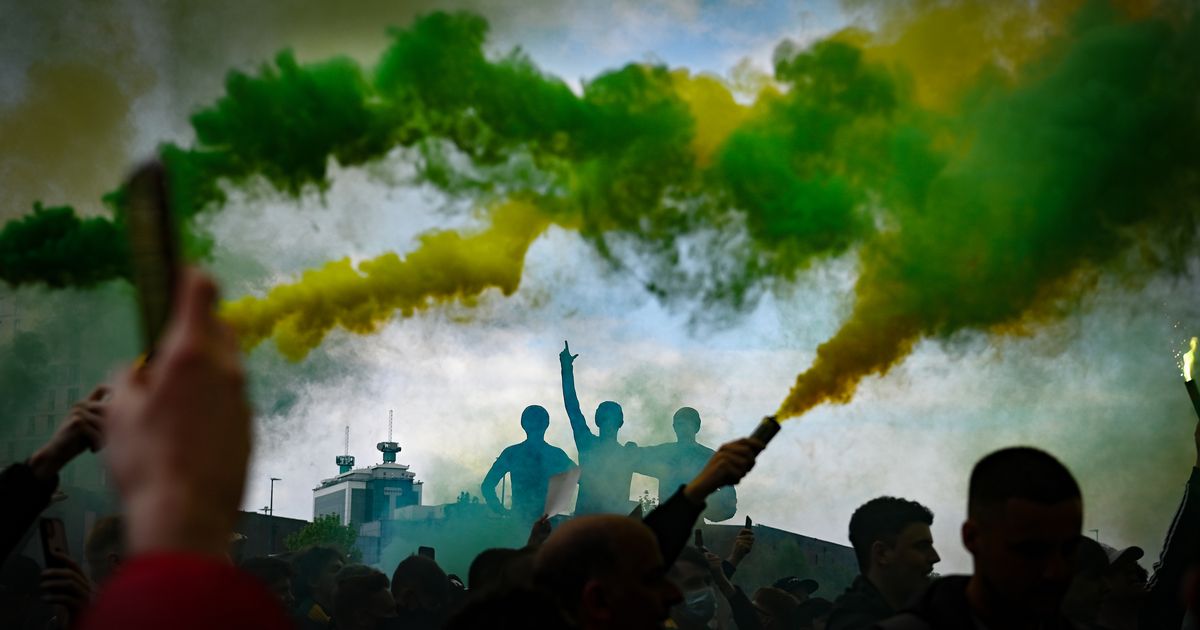
And when the following year large-scale protests broke out against the Glazer family’s continued ownership of the club and their intention to join a new European Super League, the Men in Black once again played a leading role. In April that year around 20 protesters stormed the club’s Carrington training ground and were pictured holding banners reading ‘Glazers out’, ‘We decide when you play’ and ‘51% United’, a reference to the German model of majority fan-owned clubs.
The following month United’s match against Liverpool at Old Trafford was called off after a planned peaceful demonstration outside the stadium exploded in chaotic and violent scenes as about 100 protesters broke into the ground and invaded the pitch, forcing some staff to lock themselves into rooms for safety.
As flares and firecrackers were let off, a police officer suffered serious injuries to his face after bottles were thrown. More than 40 people were eventually convicted in relation to the protest.



