
News Beat
How much oil does Venezuela have – and why is Donald Trump so interested in its reserves? | World News

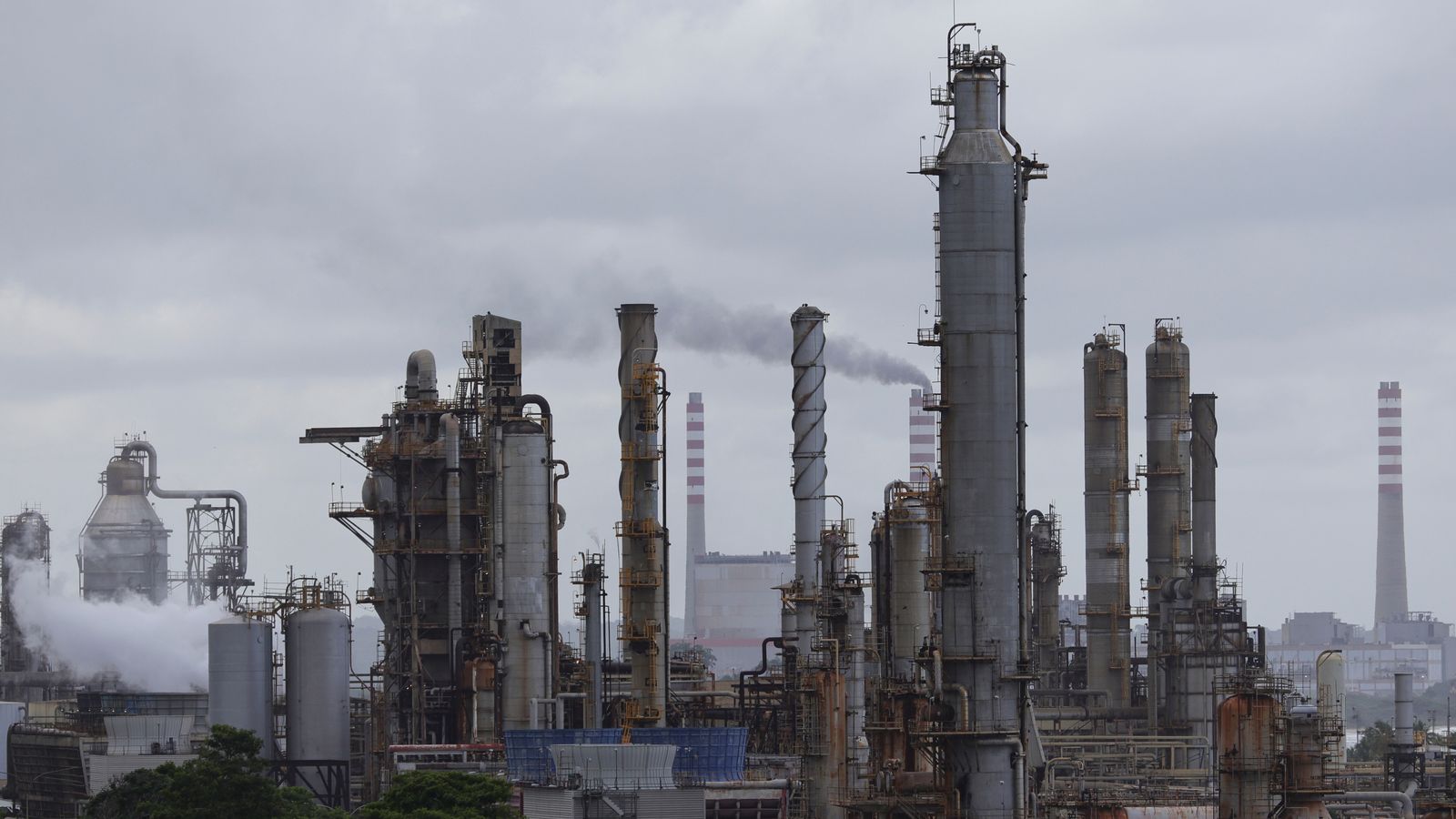
Donald Trump has said the US will “run” Venezuela until a transition can take place – and tap its vast oil reserves to sell to other nations.
Speaking to reporters hours after Nicolas Maduro and his wife were captured, Mr Trump declared that “very large” American oil firms would spend billions of dollars to fix “badly broken infrastructure” in the South American country.
Venezuela has the largest proven oil reserves of any country in the world – and the president has claimed US occupation “won’t cost a penny” as the country will be reimbursed from “money coming out of the ground”.
So far, American oil giants are yet to publicly respond to Mr Trump’s remarks. Only one US energy company, Chevron, continues to operate in Venezuela.
Venezuela crisis: Follow the latest developments
What is the situation right now?
At the moment, a US embargo on all Venezuelan oil is in full effect.
And while Mr Trump eventually wants to get “oil flowing”, analysts have warned that a lack of infrastructure and investment means this ambition could take years to realise.
“There are still many questions that need to be answered about the state of the Venezuelan oil industry, but it is clear that it will take tens of billions of dollars to turn that industry around,” Third Bridge’s Peter McNally said.
Despite these logistical hurdles, Mr Trump has vowed “to take back the oil that, frankly, we should have taken back a long time ago”.
A Chevron spokesperson said: “Chevron remains focused on the safety and wellbeing of our employees, as well as the integrity of our assets. We continue to operate in full compliance with all relevant laws and regulations.”
But other industry leaders – including ExxonMobil and ConocoPhillips – are yet to make their positions clear.
Why does Trump want access to Venezuela’s oil?
As our economics and data editor Ed Conway explained last month, the US is the world’s biggest oil producer by a country mile.
However, it produces light crude – as opposed to the heavy stuff needed to feed its refineries.
In other words, if the US is going to keep its cars fed with gasoline, it needs heavy, gloopy crude, as that’s what most of its refineries are set up to process.
And since it costs many, many billions of dollars to overhaul refineries, no one particularly wants to do that anytime soon.
The upshot is that for all that America theoretically pumps more crude oil than it would ever need out of its own territories, it is still totally dependent on trade to meet its demands for heavy oil.
Most American crude is exported overseas. And America imports well over 6,000 barrels of oil a day to feed its refineries in Texas and Louisiana with the heavy stuff they can digest.
All of which brings us to Venezuela, because it is, alongside Canada and Russia, sitting on the world’s biggest reserves of heavy oil.
Read more:
US strikes on Venezuela: How did we get here?
General reveals how Maduro was captured
What’s the oil situation like in Venezuela?
Figures from the Energy Institute suggest that Venezuela holds about 17% of global oil reserves – equivalent to 303 billion barrels.
While the country was producing up to 3.5 million barrels a day back in the 1970s, this figure slumped to an average of just 1.1 million a day last year – equivalent to just 1% of production worldwide.
The US was once the main buyer of Venezuelan oil – but since sanctions were imposed, China has become the main destination.
Corruption and underfunding go some way to explaining why Venezuela has not been able to leverage its reserves in the way Gulf states such as Saudi Arabia have.
And while some Western oil companies have remained active in the country, sanctions have prevented Venezuela from attracting investment and obtaining the equipment it needs.
Its reserves are made up mostly of heavy oil in Orinoco in central Venezuela, making its crude expensive to produce, but technically relatively simple, according to the US government’s energy department.



