Connect with us

NewsBeat

How reproductive violence is being used in conflicts to deny people’s future

Published

on

How reproductive violence is being used in conflicts to deny people’s future

A recent investigation by the Guardian newspaper and humanitarian NGO Insecurity Insight has exposed how childbirth and reproduction is being weaponised in conflicts worldwide. The evidence is alarming.

In Ethiopia’s Tigray conflict, soldiers reportedly inserted metal objects into women’s wombs. They told victims: “You will never be able to give birth.” In Russian detention facilities, Ukrainian men tell of being subjected to electric shock torture targeting their reproductive organs. Captors declared: “We’re going to sterilise you now.”

During its assault on Gaza, the Israeli military destroyed the territory’s largest fertility clinic in October 2023. The strike eliminated about 4,000 embryos and 1,000 sperm samples. The attack was cited by a UN investigation as a possible example of genocidal intent.

These are examples of reproductive violence. And they are not isolated atrocities. The International Criminal Court (ICC) has defined this as violence that “violates reproductive autonomy and/or it is directed at people on account of their actual or potential reproductive capacity, or perceptions thereof”.

Advertisement

Reproductive violence targets people’s capacity to have children. It is used as a tool of persecution, demographic control and collective punishment.

Serious atrocities such as murder, torture and rape make headlines and should be prosecuted as war crimes, as they often are. But systematic attacks on reproductive capacity remain, as scholars have noted, “in the shadows” of international law.

At the individual level, reproductive violence strikes at something deeply personal: the wish to have children and build a family. When a woman is forcibly sterilised, as has been reported about Uyghur women, the harm goes beyond physical injury. It takes away the possibility of motherhood.

When a man’s reproductive organs are targeted, as has reportedly happened to Ukrainian detainees, it is an assault on identity and future fatherhood. The knowledge that the loss could be permanent compounds the trauma.

Advertisement

At the collective level, reproductive violence enables the slow destruction of a group’s future. Mass killing provokes immediate international outrage. But destroying a fertility clinic or sterilising a population achieves the same outcome over time, with less visible evidence.

As one Uyghur survivor of China’s re-education camps put it: the strategy is “not to kill us in cold blood, but to make us slowly disappear. So slowly that no one would notice”.

Reproductive violence also offers perpetrators plausible deniability. Forced sterilisation can be framed as family planning as China insisted in the case of Uyghur women. Destroyed maternity wards may be explained as collateral damage, as the Israeli government has in the cases of hospitals destroyed in Gaza.

But deniability is not the only reason it is used. Reproductive violence is also devastatingly efficient. When Israeli forces destroyed Gaza’s largest fertility clinic, the United Nations commission of inquiry concluded that “the Israeli security forces knew of the function of the clinic and intended to target it”. One attack, thousands of potential children lost.

Advertisement

A hidden category of harm

While recognition of reproductive violence is growing, it remains poorly understood and rarely prosecuted. Several factors explain this gap.

First, reproduction has historically been classified as belonging to the “private sphere,” outside the proper concern of international law. Forced pregnancies, forced contraception and miscarriages are considered too intimate for public discourse. This creates what international legal scholar Fionnuala Ní Aoláin has called a “zone of silence”.

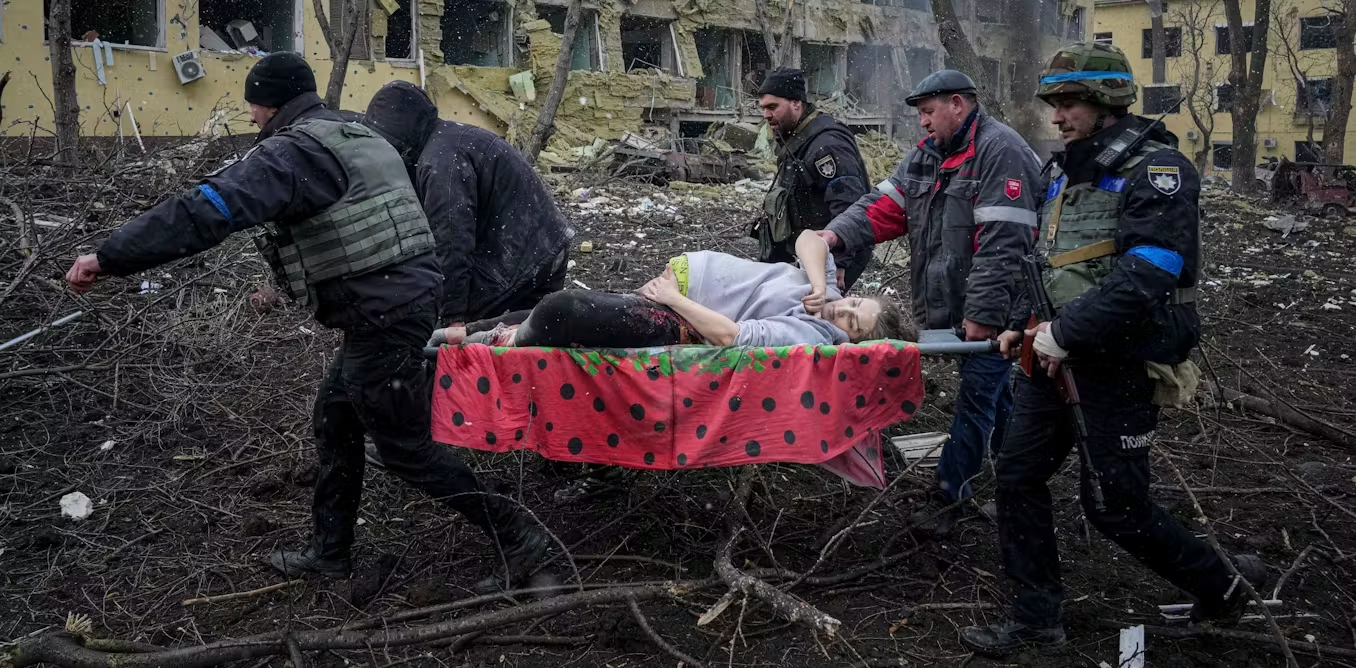
An independent investigation has found widespread use of reproductive violence against women in the bitter civil war that raged in Tigray, northern Ethiopia.
Bjanka Kadic/Alamy Live News

Second, reproductive violence has traditionally been absorbed into sexual violence. This approach has overshadowed reproductive violence as a distinct category. Rape and other sexual crimes have rightly gained attention. But it has also rendered reproductive violence invisible as a distinct category, with its own victims and its own harms.

As Ní Aoláin observed: “While rape in armed conflict makes headlines, obstetric violence against women and girls generally does not.”

Advertisement

Third, much reproductive violence operates indirectly and may appear almost routine. A woman who miscarries because a maternity ward was bombed has suffered reproductive violence. But there is no direct perpetrator with blood on their hands. The deaths are statistical, diffuse, and emerge over time.

Making the invisible visible

Addressing reproductive violence requires first understanding it. A key obstacle has been conceptual: existing definitions fail to unpack its different harms. While forced pregnancy, castration and forced abortion are all reproductive violence, they affect victims in very different ways.

Research I have published in the International Journal of Transitional Justice develops a new typology. It categorises reproductive violence by its consequences for victims.

Birth-compelling harms force unwanted pregnancies. Birth-preventing harms deprive victims of reproductive capacity. Birth-endangering or terminating harms endanger wanted pregnancies or destroy health infrastructure.

Advertisement

This typology matters for three reasons. It makes visible the distinct harms each category inflicts. It helps investigators spot seemingly isolated acts as part of a concerted plan. And it strengthens the case for accountability under international law.

Recognition is slowly emerging. Today, more organisations treat reproductive violence as a distinct form of gender-based violence. But recognition requires deeper understanding of why reproductive violence occurs and its effects on victims. For too long, the law has treated this violence as incidental to mass atrocities rather than central to their execution.

Perpetrators have always known otherwise: control over whether a people can have children is control over whether that people will exist at all.


Advertisement

Source link

Continue Reading
Click to comment

Leave a Reply

Your email address will not be published. Required fields are marked *

NewsBeat

Major EastEnders couple’s future decided by midday drag queens | Soaps

Published

on

Major EastEnders couple's future decided by midday drag queens | Soaps
Can the power of drag repair a fractured relationship? (Picture: BBC/Shutterstock)

Anthony Trueman’s (Nicholas Bailey) funeral brought on a slew of shocks in EastEnders, namely the return (and arrest) of Anthony’s daughter and killer, Jasmine Fisher (Indeyarna Donaldson-Holness).

Another twist saw the return of Howie Danes (Delroy Atkinson), months after his relationship with Kim Fox (Tameka Empson) was decimated by the reveal that he’d turned to stealing as a means to keep Kim in the life she’d become accustomed to, and pocketed cash stolen from Patrick Trueman (Rudolph Walker).

Wounded by a comment from Kim that her former husband, Vincent Hubbard (Richard Blackwood), was a superior provider, Howie buried his guilt after reclaiming the money stolen from Patrick by Oscar Branning (Pierre Counihan-Moullier), keeping his mouth shut and keeping the dosh for himself.

He later picked up a second job in parcel delivery alongside his work as a postman, but upon discovering just how valuable some of the items he was transporting were, he was unable to resist helping himself to fund his family.

Advertisement

When Anthony discovered that the ring Howie’d used to propose to Kim was stolen from Penny Branning (Kitty Castledine), Howie did some digging of his own. Discovering that Anthony’s wife had filed a restraining order against him, they formed an incredibly uneasy truce, both agreeing to keep the others secret.

Howie Danes in EastEnders
Howie’s criminal actions came back to bite him (Picture: BBC/Jack Barns/Kieron McCarron)

But this is Soapland, right? And secrets are legally prohibited from remaining so for too long, and when a concerned Howie confided in Kim about Anthony’s recent dark behaviour, the engagement party quickly exploded as everyone’s tea was spilled.

Kim wasted little time in ending the engagement, banishing Howie from the house and the family while declaring their relationship officially dead.

So while things were understandably tense when he returned to offer his support to the Trueman clan last week, Kim finds herself leaning on Howie for support next week, as Patrick’s reliance on an AI recreation of his deceased son increases and her attempts to get through to him fail.

Upon seeing a struggling Kim in the Vic, Howie decides to intervene and talks to Patrick himself.

Advertisement
Howie Danes and Kim Fox in EastEnders
Howie attempts to help Kim… (Picture: BBC/Jack Barnes/Kieron McCarron)
Kim Fox and Patrick Trueman in EastEnders
…as her attempts to get through to Patrick fail (Picture: BBC/Jack Barnes/Kieron McCarron)

Patrick, however, has some advice of his own and tells Howie to plough all of his efforts into winning Kim back.

Patrick rallies his family together to go for a midday drink, and Kim’s jaw hits the floor when Howie emerges and begins serenading her, flanked by two drag queens to complete the performance.

Don’t miss a Soaps scoop! Add us as a Preferred Source

As a loyal Metro Soaps reader, we want to make sure you never miss our articles when searching for stories. We have all the latest soaps news, spoilers, videos, and interviews, with a vibrant community of highly engaged readers.

Click here and tick Metro.co.uk to ensure you see stories from us first in Google Search.

Soaps authors collage Fact box image only Picture: Metro
Now you can ensure you never miss a story from the Soaps team
Advertisement

Will the power of song (and drag) convince Kim to give things another go with Howie? Or will his performance close the curtain on their relationship for good?

Advertisement
Advertisement

Source link

Continue Reading

NewsBeat

Joe Wicks On Trying To Break A Tough Generational Cycle As A Parent

Published

on

Joe Wicks On Trying To Break A Tough Generational Cycle As A Parent

When Joe Wicks and I sit down for a Teams meeting, we’re both fighting off one of the many winter illnesses that have been doing the rounds of late.

We’re here to chat about why kids should sign up for the TCS Mini London Marathon in schools – but it’s another type of marathon that swiftly crops up in conversation, and that’s the momentous feat that is getting children into bed at the end of the day.

Joe, who is founder of The Body Coach (and also earned another title as the “nation’s PE teacher” during the pandemic), lives with his wife Rosie, and their four children: Indie, 7, Marley, 6, Leni, 3, and Dusty, 1.

Asked how he makes bedtime work, he lets me in on “one of the most incredible lightbulb moments” he had after someone he worked with asked him what his goals were, and he admitted he wanted to be more present around his kids.

Advertisement

Now, he has an alarm on his phone that goes off every day at 6pm, which he’s named “I am a phone-free dad”. At this point, he puts his phone away to focus on his kids.

“It’s changed my life because rather than be distracted and running to my phone and thinking about Instagram and checking DMs and memes, I see that time as their [my kids’] time and I’m not as stressed, and I’m more patient,” he says.

While the younger children fall asleep more quickly (and long may that continue!), Joe and Rosie aim to get their two older children in their bedrooms – that means pyjamas on, teeth brushed, stories read – between 7pm and 7.30pm.

As for when they actually fall asleep, well, that can take a while.

Advertisement

“I think, ‘yes I’ve read books with you two and everything’s good’ and I’ll go down to the kitchen for an hour and come back up and they’re still awake,” he admits. “And I’m like: ‘how are you still awake?’” (As someone whose eldest is still awake at 9pm most nights – despite all of the calming bedtime rituals – this is music to my ears.)

The couple started homeschooling their eldest child, Indie, in 2023, and now they also homeschool Marley. The older children also attend a forest school twice a week.

“It’s a challenge, it’s not as easy as it looks,” says Joe of homeschooling. “You can imagine trying to get two kids to sit and focus, while the other two babies are running around and kicking off, screaming and hungry and stuff.

“You’ve got to be flexible with it, but it brings a certain independence and freedom to learn what you want and have days out.”

Advertisement

That said, he notes this is “really stressful” and “takes so much patience” as the children “want to resist and do anything but learning”.

“I think sometimes 20 minutes of focused learning is the same as, like, an hour in the classroom with 30 kids, so you don’t need to be doing hours and hours of focused concentration for them to be learning,” he says, adding they’ll do everything from playing instruments to reading to cooking and having a kick about in the garden or heading to a skate park.

“It really isn’t easy, but I’m blessed we can do it,” he continues. “But it’s also the most challenging thing as you’re with them all the time and there’s no let-up.”

On the topic of no let-up, any parent will know that staying calm and regulated when your kids aren’t playing ball can be tricky at the best of times, but when you’re with them 24/7 – and you’ve asked them seven times to do one task, only to be ignored – it can be even more intense.

Advertisement

Discussing how he manages the trickier parenting moments, Joe admits he’s still learning: ”I’ve read books on this and I’m trying to change my natural instinct to be ‘fight or flight’ and [instead] be calm.

“But take my situation: there’s four kids in a house and it’s constantly messy, you’re trying to homeschool and run a business.”

He finds exercise helps keep him on an even keel – if he does a morning workout, he notices he feels he can “interact better” and is more patient.

“I hate how I feel when I lose control a little bit.”

“I feel really bad when I shout at my kids, but then I have to remind myself I am with them an un-normal amount of time,” he says.

Advertisement

So, I just apologise, I say ‘I’m sorry I shouted, I’m really trying to stay calm’. And I keep reminding them: ‘when you’re calm, I’m calm. Let’s work together and keep the house nice and level.’

“But they’re still kids and toddlers, so they’re irrational sometimes. I think communicating after is really important.”

Joe has been incredibly open about his own upbringing – his dad struggled with addiction and his mum with obsessive-compulsive disorder (OCD) – and he admits that his childhood was “very shouty, it was very impatient and intolerant, so I’m really trying to break the mould”.

“I hate how I feel when I lose control a little bit,” he adds. “But we are humans and kids can be the most annoying people on earth, so you have to be understanding I suppose, and a little bit more compassionate towards yourself.”

Advertisement

Social media seems to spawn a new parenting style (gentle parenting, FAFO parenting, air traffic control parenting) on a weekly basis. When I ask what his own approach to parenting is, Joe says: “I’m trying to always be the calm, wise owl – that’s my dream, that I’m respectful and I don’t swear and shout and get irritated and slam doors and run out of the house when it gets difficult.

“So, I suppose that’s my aim and my dream. And I’d say 60-70% of the time I am that guy. But then it’s the 40% of the time, it amplifies doesn’t it? Where you feel like:ahh I shout and I’ve lost it and I thought I was a really patient dad but underneath I’m not’. And it’s because my childhood was like that – I was shouted at all the time, it wasn’t a calm environment.

“I think we are a product of our childhood and our environment. I’m having to really refocus and remodel my default setting. My default is probably to shout and scream, but I’m trying my hardest to take a breath and take a moment. And it is exhausting. To be a calm parent is way more exhausting, because your brain is constantly being tensed and stressed and trying to resolve things.”

Exercise, sleep, a balanced diet – these are all important factors that can determine how Joe finds his stride each day as a parent. So, it’s perhaps no surprise that he’s on a mission to encourage more children to get moving after a long winter spent largely indoors.

Advertisement

The UK is in the grips of an “obesity epidemic” with one in 10 children in reception, and almost one in five kids in year 6, impacted. What’s more, rates of high blood pressure among children have doubled in the last 20 years, with poor diet, inactivity and obesity thought to be some of the key factors behind the rise.

It breaks my heart when I see articles around inactivity levels increasing and schools getting budgets cut,” he says. “It feels so obvious that the answer to this problem is to get our kids moving more and really prioritise physical activity as opposed to cutting it out and reducing it.”

Joe Wicks and a team of school children

For his part, Joe is hoping to get thousands of kids moving this spring by encouraging them to take part in the TCS Mini London Marathon in schools.

The TCS Mini London Marathon is the biggest, free one-day children’s event in the UK. This year, it takes place on Saturday 25 April, with entries already sold out, and around 22,000 children aged 4-17 expected to take part in either the one mile or 2.6km distance around St James’s Park.

Advertisement

In 2022, the event was expanded to include all school children – the idea being they can take part in the two-mile event at their school or education setting.

The 2026 event runs from today until Friday 1 May, with schools able to sign-up here. The two miles can be done in one day or split over a number of days, per class or as a whole school.

“It’s such an easy win because most schools have a little bit of a field or an outdoor playground so they can do little loops and things,” says Joe.

Since 2020, more than one million children from across the UK have taken part and a record 2,039 schools registered to complete their own two-mile distance in 2025.

Advertisement

If your child’s on the fence about taking part, Joe has a special message for them: “Run, walk or wheel – it’s not about being this elite little runner and smashing it in five minutes, it’s just like the ‘daily mile’ in schools: it’s fun, it’s sociable, it’s a challenge, but you can cheer each other on and you can do it in your own time.

“You’ll feel so proud of yourself when you’ve finished it,” he adds. “You’ll feel energised, you’ll feel more focused, you’ll feel calmer. It’s not this competitive thing, it’s about doing something that day or week to boost your physical and mental health.”

Source link

Advertisement
Continue Reading

NewsBeat

Michael Mosley’s son Dr Jack ‘surprised’ by comments about dad after tragic death

Published

on

Michael Mosley and his son Jack Mosley in a photo together.

Dr Michael Mosley, an intermittent fasting pioneer, died while on a walk on the Greek island of Symi in 2024, with his body being discovered four days after he went missing

Dr Michael Mosley’s son says he is left “surprised” by the comments he receives about his father. Michael died on the Greek island of Symi after going missing while on a walk in June 2024.

Advertisement

The 67-year-old was found after just over two miles away from the private resort he was staying at with his wife Dr Clare Bailey Mosley. He had been missing for four days at the time.

Michael was known to many for his pioneering work on the 5:2 diet, which promoted intermittent fasting. It led him to TV appearances on the likes of The One Show, Horizon, and Trust Me, I’m a Doctor.

Now his son, Dr Jack Mosley, has revealed that people regularly approach him in the street to discuss his father’s work. It comes as Jack says his father’s work helped “tens of thousands of people” lose weight.

Michael, and the work he did with Clare, even led to Jack becoming a GP himself. He has now taken the lead of the Fast800 from his father.

Advertisement

He said: “He’s had a really big impact on me, they both have really, and they were part of my inspiration to become a doctor, because it was something they were so passionate about and I could see how many tens of thousands of people they had helped with their passion for improving the nation’s metabolic health.

“People tell me all the time how much of a difference my dad has made to their lives and really it has dramatically improved their health. In a way it’s almost surprising at times when people say, ‘I’ve lost X amount of weight’.”

Jack is leading The Fast 800 Online Programme which he says is a “lifestyle programme” that builds on his father’s work. It offers three types of meal plan, the “Very Fast 800” which uses an 800-calorie plan to lose weight over 12 weeks, the 5:2 intermittent fasting plan, and a long-term Mediterranean diet plan.

Advertisement

It also offers exercise guidance through workout plans, using both high-intensity interval training and resistance exercises as well as educational content that covers the science behind weight loss.

Jack added: “The plan was based on a study that found that 800 calories a day for 12 weeks, this rapid weight loss, can reverse their diabetes, which was not thought possible before and if they kept 10kg of weight off, they could keep their diabetes in remission.

“It progressed from there to be this overall lifestyle support system for people who want to have this rapid weight loss and improve their metabolic health but also, there’s people who want to do it more gradually by fasting, like the 5:2, which my dad famously popularised.

Advertisement

“It’s also there to help people with other aspects that we know are so important in your health like exercise, including aerobic, and also mindfulness. It’s this real complete support system and helps provide people with a group of people to do it with who are on the same page.”

Source link

Continue Reading

NewsBeat

Abandoned town slowly being reclaimed by nature where a fire burns underground

Published

on

Daily Mirror

The few remaining residents are determined to stay until they die.

Were it not for the steam billowing like mist from fissures in the ground, motorists could easily drive through this formerly prosperous settlement without realising they’d entered and exited it.

Advertisement

Centralia in Pennsylvania is an unsettling spectacle. Wilderness is gradually reclaiming what was once inhabited land — nearly all residents departed years ago, whilst the few who remain are determined to stay until they die.

This abandoned settlement hides an underground inferno that has raged for decades and is predicted to continue burning for centuries to come. Previously a thriving mining community, Centralia was inhabited by thousands.

Its coal mines opened in 1856, providing livelihoods for local families. During its peak in 1890, Centralia’s population reached 2,761, and the settlement boasted numerous churches, hotels and drinking establishments, alongside theatres, a bank and a post office.

Yet everything started shifting during the 1960s as mining operations dwindled and the town’s fortunes declined, reports the Express.

Advertisement

The precise origins of the subterranean blaze remain unclear. Some theorise it ignited when local authorities commissioned the volunteer fire service to eliminate rubbish from the municipal landfill, situated in a disused strip mine.

The firefighters torched the refuse and allowed it to burn, but the flames never extinguished. An unprotected opening enabled the fire to penetrate the maze of antiquated tunnels running beneath the settlement.

An alternative theory proposes the fire started when a waste collector deposited smouldering coals into the exposed rubbish pit adjacent to the mine. Regardless of its origins, the blaze established itself beneath the surface and continued to spread.

Advertisement

Plumes of smoke started seeping upwards through the earth as firefighters struggled to quench the flames. At first, they believed they’d been successful, but unknown to them, the inferno had extended far beyond anyone’s expectations.

For years, residents viewed the fire as a troublesome but controllable problem. A persistent reek of sulphur and smoke permeated the atmosphere, forcing some inhabitants to abandon their properties due to the poisonous fumes in the late 1960s.

A decade on in 1979, the situation reached a critical juncture. Mayor John Coddington, who also operated a petrol station, made a shocking discovery during a standard inspection — the fuel in his underground storage tanks had reached an alarmingly high temperature of 77.8C.

Two years afterwards, 12-year-old Todd Domboski narrowly avoided disaster when a sinkhole abruptly tore his back garden apart. He plunged into the 150-foot chasm and only survived by grabbing hold of a tree root.

Advertisement

The cavity released lethal concentrations of carbon monoxide into the atmosphere.

Despite clear indications that Centralia was becoming hazardous, locals remained divided over whether the town remained habitable. By 1983, authorities had earmarked over $42 million for relocation initiatives, with nearly all residents accepting the compensation.

Over 1,000 residents relocated and 500 structures were razed to the ground. Census data reveals that by 1990, a mere 63 inhabitants remained.

Fast forward two years, and the entire town was condemned, with only five homes left standing by 2010.

Advertisement

Despite the relentless flames raging beneath their homes, the remaining residents were adamant about not leaving. They contested a court order mandating their departure but remained defiant.

Eventually, in 2013, a settlement was reached allowing the last seven residents to remain in Centralia until their demise, after which their properties would be seized.

Currently, the fire has ravaged an area spanning over 13km. If it continues to burn at its present pace, it could persist for another 250 years or more.

Nowadays, Centralia is largely deserted, with nature reclaiming the streets once teeming with life. The only remnants of the former town are an old church and a highway winding through the verdant landscape.

Advertisement

Warning signs about toxic gases, unstable terrain, and fires are scattered across the area.

The only vestige of this once-thriving town is the steam that billows from the earth’s cracks when rain seeps into the ground, meeting the ever-waiting flames below.

Source link

Advertisement
Continue Reading

NewsBeat

Cambridgeshire town roads filled with ‘crater’ potholes slammed as ‘disgrace’

Published

on

Cambridgeshire Live

One resident finds it ‘scary’ to drive along the roads, as they fear they will damage their car.

Locals have branded a Cambridgeshire town’s roads as a “disgrace”, describing its potholes as “craters”. Residents in Godmanchester are frustrated with the state of the roads in the town.

Advertisement

They are calling for better repairs, as people believe they are causing a danger to motorists. Kate Guerreiro said the roads are a “disgrace”: “It’s like a slalom trying to avoid them.”

Cambridgeshire County Council is responsible for maintaining roads in the county. A council spokesperson said ensuring safe travel is a “key priority” for the council.

Kate continued: “I dread having to drive at night or in the rain now because you can’t see them. Both my partner and I have had to have the tracking on our cars realigned and he’s had a blow out with his children in the car from hitting one.

”It’s scary to drive now because you just don’t know what the road conditions are and if it’s going to affect you. They are going to end up causing severe damage and I worry about bad accidents and harm to people.”

Advertisement

Michelle Carter is “disappointed” with the state of the roads. She added: “We have to put our cars in for MOTs and they have to be road worthy. But, the roads are not worthy for our cars to be on. It’s appalling and it’s dreadful.”

Last year, Michelle took her car in for a MOT and had to pay more than £400 to repair damage that she said had been caused by potholes. She said: “When I took my car in for its MOT, they said part of my wheel was cracked, and that it was down to hitting potholes.”

Roxana believes the roads are getting “worse and worse”. She added: “A few potholes here and there are understandable, and we are just out of winter so that is expected. But, it seems like they are getting deeper and deeper. It’s getting dangerous because you get people swerving the pothole and then avoiding other cars.”

Advertisement

Jo Edwards also thinks the potholes could cause a danger to drivers. She said: “The potholes not only cause damage to cars, but create potential accidents when cars have to drive around them to avoid hitting them. The council need to repair them as a matter of urgency. We pay road tax for using the roads and yet, they are not fit for purpose.”

The county council spokesperson added: “This year we’re investing £73 million in highways maintenance across the county, which is being used to repair roads, cycleways, footpaths and other highway assets. We are proposing to continue this level of investment in 2026/27.

“The 26/27 highways maintenance investment programme will be considered by the council’s Highways and Transport Committee in March 2026. Residents can help us keep our roads and footpaths safe for all users, by reporting the issues they find online via our website.”

Source link

Advertisement
Continue Reading

NewsBeat

Woman’s Hour – SEND reforms: A Woman’s Hour and SEND in the Spotlight special

Published

on

Woman's Hour - SEND reforms: A Woman's Hour and SEND in the Spotlight special

Available for over a year

Woman’s Hour in collaboration with our SEND in the Spotlight podcast brings you a special programme on the impact of the government’s SEND reforms in England.

Whether you’re a parent, a young person, a teacher or someone who works in the wider system we find out what the changes mean for you – and help you decode the new language – whether it’s IB, ISP, Targeted, Targeted Plus, or SPP.

Nuala McGovern speaks to parents, teachers, charities, the School Standards Minister and the Children’s Commissioner for England. We also hear from SEND in the Spotlight podcast regulars – actors Anna Maxwell Martin and Kellie Bright.

Advertisement

Search for the SEND in the Spotlight podcast on BBC Sounds.

Contributors:
Georgia Gould MP, Schools Standards Minister
Marsha Martin, founder of Black SEN Mamas
Katie Ghose, CEO of Kids charity and Disabled Children’s Partnership
Margaret Mulholland, Association of School and College Leaders
Kate McGough, BBC Education reporter
Eleanor Wright, solicitor at SOS!SEN
Ramandeep Kaur, SEND parent
Carrie Grant, SEND parent and broadcaster
Katie Nellist, SEND ambassador
Louise Gittins, chair of the Local Government Association
Dame Rachel de Souza, Children’s Commissioner for England

Presenter: Nuala McGovern
Producer: Sarah Crawley, with Carolyn Atkinson
Digital producer: Olivia Bolton
Editor: Karen Dalziel

Programme Website

Source link

Advertisement
Continue Reading

NewsBeat

Newscast – The David Lammy Interview

Published

on

Newscast - Epstein Files: New Mandelson and Andrew Allegations

Available for over a year

Today, Adam and Chris speak to the deputy prime minister David Lammy about his justice reforms.

He acknowledged the court backlog will continue to rise and may be at the same level as it is today at the next general election despite the government’s planned reforms.

He also said that Labour would be “out on their bums” if they haven’t delivered the change the public want by the time of the next election.

Advertisement

You can now listen to Newscast on a smart speaker. If you want to listen, just say “Ask BBC Sounds to play Newscast”. It works on most smart speakers.

You can join our Newscast online community here: https://bbc.in/newscastdiscord

Get in touch with Newscast by emailing newscast@bbc.co.uk or send us a WhatsApp on +44 0330 123 9480.

New episodes released every day. If you’re in the UK, for more News and Current Affairs podcasts from the BBC, listen on BBC Sounds: https://bbc.in/4guXgXd

Advertisement

Newscast brings you daily analysis of the latest political news stories from the BBC. The presenter was Adam Fleming. It was made by Anna Harris. The social producers were Joe Wilkinson and Jem Westgate. The technical producer was Ben Andrews. The assistant editor is Chris Gray. The senior news editor is Sam Bonham.

Programme Website

Source link

Continue Reading

NewsBeat

Ayrshire man went from kitchen porter to Michelin Star award-winning chef with just 2k in his pocket

Published

on

Daily Record

Douglas Balish is now a celebrated chef at one of the UK’s top hotels

Advertisement

It’s important to never forget that one decision can completely change your whole life path and for award winning Scots chef Douglas Balish it came when he was getting his hands dirty in a sink full of used dishes. The then 20-year-old, originally from Troon but now based in Wales, studied psychology in university when he took up a kitchen porter job in an Ayrshire restaurant.

This was just the first step in his remarkable culinary career which has now seen him work in award winning restaurants across the world with just £2,000 in his pocket. Balish’s admirable work ethic and eagerness in his first role as a dishwasher meant that the restaurant’s staff were soon asking him to help out with other responsibilities and after buying his first cookbook at 20-years-old, that’s where his love for cooking began.

Fast forward twenty years, and the now 40-year-old is a celebrated executive chef at luxury country hotel Grove of Narberth in Pembrokeshire, Wales, where he was awarded the title of Hotel Chef of the Year at the 2025 Hotel Cateys, which is recognised as a huge honour in his industry. However, Balish’s humble nature still shines through as he insists that the award is a team effort by all the staff, Wales Online reports.

He says: “It goes to one person but that doesn’t really feel fair, one person can’t do everything, everyone’s got to be behind it and on board with it so from the kitchen and front of house one doesn’t work without the other.” However, going from being a young dishwasher to the chef of a high end hotel in the space of two decades has not just come as a stroke of luck for Douglas, who has been proactive in guiding the development of his career, including taking multiple risks to get to this award-winning level.

Advertisement
Content cannot be displayed without consent

He says: “When I started out I was absolutely useless, but I enjoyed doing it, so after I’d done that for a few months I couldn’t see myself sitting in a classroom for the next four years, I don’t think it would have been for me, I could see myself getting bored or distracted.

“I think I’m probably the least qualified, education-wise, in the kitchen as I just went straight into a job. I worked in Scotland for a few years but then decided that if I was going to do this I need to do it properly, so I went off to Jersey to work in a Michelin star restaurant.”

This restaurant was called Bohemia, where he was employed for five years, working his way up from the very bottom level to sous chef before moving elsewhere to a lower standard eatery. However, his ambition was set on achieving something even more challenging which his seven years of experience had all been working towards.

There was one specific restaurant in the world that had inspired him ever since he was a young man but it was thousands of miles away.

Advertisement

However, that didn’t stop Balish as he picked up the phone and called Quay in Sydney, which is hailed as Australia’s most celebrated and influential restaurants, which boasted Three Hats in the Good Food Guide for 23 consecutive years.

He said: “It’s where I’ve always wanted to work, so I contacted the chef there and said ‘do you have any jobs’ and he said contact me if you’re ever in Australia, so I got straight on a plane, and knocked on their door as soon as I got there and started working there next day.

“It was a bit of a risk, I could have ended up having to work anywhere just to earn money, and Sydney is quite an expensive place to live so I had to get a job quickly, as I got there as I only had £2,000 in the bank.

“I thought that would last a while but the rent there was around 500 dollars per week, so I realised my savings weren’t going to last very long. Thankfully the risk paid off and it was amazing, I really, really enjoyed it.”

Advertisement

Douglas then received a call from Great Fosters in Surrey, where he was asked to run the restaurant and develop his ideas.

He was persuaded to come back to the UK and took another risk, going from being unknown to a Michelin star in just 18 months.

His rapid success did not got unnoticed in the industry and with it came the call from Neil Kedward, co-owner and co-founder of Grove of Narberth with wife Zoe, who asked if he would move to west Wales to spread his culinary magic.

He says: “I’d only been to Wales once before and that was Cardiff so at that time I didn’t realise what an amazing place it was, but the closer we got to Narberth, the more I saw, I thought Wales was incredible.

Advertisement

“We got through the gates of the hotel and it was March and all the daffodils were coming up and it looked incredible and I was, ‘ok then, we’re done’, it looked stunning.”

Stepping inside the once derelict country house into the hotel created by Neil and Zoe drew Douglas in.

He said: “It was homely, welcoming but luxury at the same time, and as soon as we walked through the front door it was like walking into somebody’s house, it was so special and that was it really from that moment on, we were seriously considering this move.

Advertisement

“We want people to come here and feel like they are in good hands, we want to make everything perfect for them, that they don’t want to go home, for it to be relaxing, away from stress. Yes, it’s a business, but at the end of the day the staff working here look after people, it’s what we want to do, what we’re here for.”

He added: “When I lived in Surrey for five years I had no idea who our next door neighbours were, but the day we moved in here the neighbours were all round, had made us a cawl, it was lovely. And we just love it here – the people, the area – it’s great. It’s an amazing place, it has it all, and the beaches are incredible.”

Since joining Grove of Narberth Douglas and his team have revolutionised the food and drink menus in the business to an award-winning level.

Their culinary offers have now won many accolades including the 2024/2025 Michelin Key and 4 AA Rosettes for dining and, of course, Hotel Chef of the Year 2025.

Advertisement

The hotel on the whole has won awards too. These include Tripadvisor’s 2024/2025 “Best of the Best”, placing it within the top 1% worldwide, Small Luxury Hotels of the World’s hotel of the year 2023/24, and Independent Hotel of the Year 2024 and there have been accolades for the venue’s staff too.

Douglas says the dining experience at the hotel has been developed over a period of years with the core of the construction of the menus always about using produce and ingredients from local suppliers and the result is a strong network of relationships.

He explains: “In the beginning it took me a while to find the suppliers and that was the hardest part, finding the people who could work with us and wanted to work with us for our special requirements, such as meat that’s aged for a certain amount of time, fish brought straight to us to be very fresh, vegetables with particular picking times. I’m quite demanding on what we get.

“This has taken a bit of time to get where it is now, but the ethos is what everything is built around, showcasing Pembrokeshire and Welsh ingredients, but doing it in a slightly different way to how it’s traditionally done in this part of the world by using our experience of working in other places and from our travels, using different cuisines to amplify the Welsh products, such as an Asian influence or using French techniques, things like that.

Advertisement

“The ingredients are from Wales and we try to highlight the suppliers that we’ve got because they are amazing, they are as good as anything else around the rest of the world. We want to build a relationship with people who have the same ethos, to be the best that we can be, but now we have amazing connections, we’re really lucky.”

Looking back, Douglas’ success story has given him valuable insight that he is keen to share with others in the hope of helping people in the industry.

Douglas’ personal experiences has led him to believe that anyone who wants to progress in the industry just needs to have a plan to learn.

He explains: “Get yourself into a job that’s a good level, if you go to somewhere that’s really, really good and learn the proper ways to do things, you can drop that experience into any sector later. Say if you wanted to do a fast food truck, and I’m all for that, if you know the right way to do things in the first place – how to get the most flavour out of things, how to get the most taste out of great ingredients, all the health and safety aspects.

“Find somebody who wants to teach you, not every good place wants to nourish you and make you better, some places will just take from you and you’ll work, work, work and then you leave there thinking you’ve done the same thing for two years. You need someone who will take you under their wing and help you to learn.”

Douglas also says that experience at the start of your culinary career is more important than the salary.

He said: “The money comes later, don’t be chasing an extra two thousand pounds a year, survive on what you can and learn as much as you can, and that will help you for the future.

Advertisement

“There are places that pay over the average but everything comes in a packet, you don’t make anything, you don’t learn anything, reheating something, it puts a cap on your potential if that’s all you’re doing.

“By the time you know it you’re 25 and still don’t know anything and you’ve maxed out at the level that you are at, and you have to make a decision then, are you going to stay at that level or drop back down and be paid less and start learning again, and then you can choose what to do in the future once you have that knowledge.”

It’s an element of development that Grove of Narberth can offer too, as the hotel is part of The Seren Collection that includes Beach House, Oxwich, Lan Y Mor, Saundersfoot and Penmaenchaf, Dolgellau.

Douglas said it’s important to him that the company develop staff, saying that the other restaurants offer a chance to share staff, to develop their skills at the other sites away from Grove of Narberth.

Advertisement

But it’s not just the staff and the menus of fine dining that have been developed by Douglas and the team, but building a relationship with the community extends to young people in schools too.

Douglas says: “We have been doing a competition with primary school age children in Ceredigion where they can work with their teachers and do team work around food – where it comes from, packaging, how it’s grown- giving them an understanding, and then they do a three course meal.

“For us it was about getting to an earlier age group and plant some seeds about good food, how are we going to live more sustainably, what produce is healthy and that you can cook for yourself and feed yourself and family when you’re older.

“In 2026 we want to extend it into Pembrokeshire and Carmarthenshire and maybe into Cardiff and Swansea in 2027.”

Advertisement

Source link

Continue Reading

NewsBeat

Scots dad killed on building site as family pay tribute

Published

on

Daily Record

“He went to work on a building site that morning and, heartbreakingly, did not make it home to his partner Bex and their daughters.”

A dad has been killed while working at a new-build housing estate as his “heartbroken” family pays tribute.

Advertisement

Brian Rodgers, 42, died in an industrial accident in Sprowston, near Norwich, at around 11am on Tuesday, February 17.

The father-of-two, originally from the West Coast of Scotland, was employed as an agency general operative for Tilia Homes.

A police probe, assisted by the Health and Safety Executive, has now been launched into his death.

A tribute from his family reads: “As a family we are truly heartbroken. Brian was a wonderful fiance, father, and brother and our home and lives feel empty without him.

“It is clear from the overwhelming response we have had from friends, work colleagues, neighbours and acquaintances, that he was greatly loved and respected by all of those he came into contact with.

“He brought love, laughter, care, support, comfort and joy to all of us and enriched our lives beyond measure. He will be greatly missed and never forgotten.”

His sister, Wilma Rodgers, also paid tribute to her “kind-hearted” brother. She said: “On Tuesday, February 17, my brother Brian tragically passed away. He went to work on a building site that morning and, heartbreakingly, did not make it home to his partner Bex and their daughters. He was just 42 years old.

Advertisement

“Brian was killed in a workplace incident – a sudden, unimaginable loss for everyone who knew him. He was a hugely popular and kind-hearted man who would help absolutely anyone.

“Brian could strike up a conversation with anyone he met. Although he wasn’t originally from Norwich – having grown up on the west coast of Scotland – he had made Norwich his home for almost 20 years.

“This devastating loss will affect the family in countless ways, including financially.”

His sister has launched a GoFundMe to help ease the “financial pressures” on his family while they “grieve such a tragic loss”.

Brian’s partner, Rebecca Day, spoke about the difficulty of losing her soulmate as she encouraged people to donate. She added: “We have a really long road ahead of us and navigating this without Brian is going to be so difficult. Again, I thank everyone for your love, support and kindness during this awful time.”

Advertisement

A spokesperson for the force said: “A man was sadly declared dead at the scene. The circumstances remain under investigation with officers from Norfolk Police working alongside colleagues from the Health and Safety Executive (HSE).”

A HSE spokesperson added: “We are aware of the incident and making enquiries.”

A spokesperson from Tilia Homes said: “A serious incident occurred at our Furlong Heath development in Sprowston on 17th February, resulting in the tragic death of one of our agency general operatives. The site is now closed, pending a thorough investigation by the relevant authorities.

Advertisement

“Our thoughts and deepest condolences are with the individual’s family, friends and colleagues at this incredibly difficult time. We would like to thank the emergency services for their swift response and professionalism in attending the scene.

“Our immediate focus is on the wellbeing of everyone affected by this incident. The safety and welfare of those who work with us is our highest priority, and we will be providing support to our employees, subcontractors and partners at the development. This includes access to appropriate welfare and counselling services to ensure that those impacted receive the care and assistance they need.”

To donate to the GoFundMe, visit the page here.

Get more Daily Record exclusives by signing up for free to Google’s preferred sources. Click HERE.

Advertisement

Source link

Continue Reading

NewsBeat

Improvements at Mill Lodge NHS ward after inspection – CQC

Published

on

Improvements at Mill Lodge NHS ward after inspection - CQC

Inspectors from the Care Quality Commission (CQC) have improved the rating for child and adolescent mental health wards (CAMHS), run by Leeds and York Partnership NHS Foundation Trust, from requires improvement to good.

It follows an inspection carried out on October 28 and 29 last year.

The wards inspected were at Mill Lodge, off Huntington Road in York, and Red Kite View, in Leeds. Mill Lodge is a 10-bed general adolescent ward while Red Kite View contains two wards, a 16-bed general adolescent unit and a separate six bed Psychiatric Intensive Care Unit (PICU).

Advertisement

CQC said it found a breach of regulation in safe care and treatment when managing medicines and completing mandatory training at the trust.

Leeds and York Partnership NHS Foundation Trust has been told to submit a plan showing what action it is taking in response to these concerns, the watchdog added.

The trust’s overall CQC rating remains good.

Inspectors said trust leaders had “not ensured” all staff at the CAMHS service were trained in safeguarding to keep people safe.

Advertisement

But they said the trust had “plans in place to ensure all staff were trained after the inspection”.

Trust has ‘made improvements’ to service after CQC raised concern, says watchdog

CQC said service staff “didn’t consistently follow good practice with regards to medicines management, including how it was given to people and records showing what they’d been given”.

However, CQC said it found that the trust “had made improvements to the service” since its 2024 inspection, when the watchdog concluded that the service was “not performing as well as it should”.


Recommended reading:

Advertisement

Inspectors said individual care plans at the service were developed, regularly reviewed and updated after their most recent inspection.

They found that staff “worked well across different teams to help support people” and “treated people with compassion and kindness and respected their privacy and dignity”, according to CQC.

The watchdog also said inspectors found that staff at the service “understood their individual needs and supported them to understand and manage their care, treatment or condition”.

CQC added that the “service supported people to live healthier lives and where possible, reduce their future needs for care and support”.

Advertisement

Leeds and York Partnership NHS Foundation Trust has been approached for comment.

Source link

Advertisement
Continue Reading

Trending

Copyright © 2025