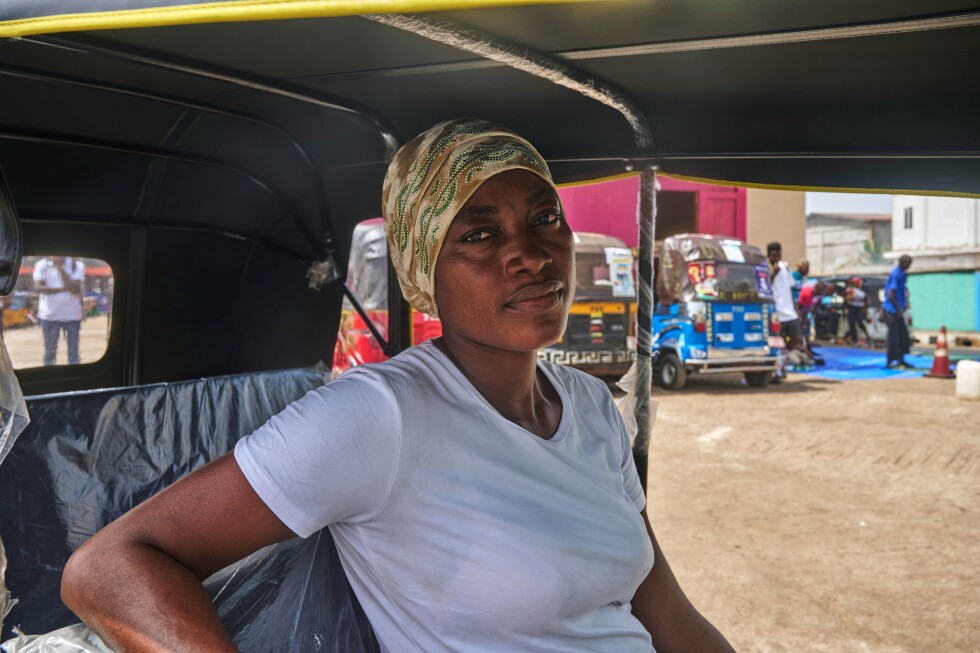
FREETOWN, Sierra Leone (AP) — As the late afternoon sun settles over Freetown’s main transit park, Hawa Mansaray pulls up her motorized three-wheeled vehicle and steps away for a break and to pray.
Mansaray is one of a small but growing number of women entering a male-dominated commercial transport sector in Sierra Leone’s capital, Freetown. The auto-rickshaws, known locally as kekeh, are an essential means of transport and until recently were almost exclusively driven by men.
“I have done different jobs since I came to Freetown but kekeh has done more for me,” said the 27-year-old single mother of one.
The rickshaws have become increasingly popular in Sierra Leone, filling the gaps in a strained public transport system as the West African country struggles to recover from its 1991-2002 civil war.
Freetown’s population has grown to more than 1.5 million, according to city estimates — roughly three times the size it was when much of its infrastructure was planned and built. Public transport systems have struggled to keep up, creating demand for commercial motorcycles and auto-rickshaws.
Although the rickshaws are usually rickety, run at minimal speed, and are considered less safe due to the maximum exposure that comes with how they’re built, commuters still prefer them because they’re easily accessible and offer maximum ventilation and relative comfort.
As more people turn to the rickshaws to earn a living, it’s also become a symbol of what women are capable of.
In the city, however, women are still “seen as people not adequate to do certain types of jobs,” said Marfoh Mariama Samai, a women’s rights advocate with Plan International Sierra Leone.
“So when a young woman ventures into a certain type of job, they are stigmatized,” she says of the female drivers.
A ticket to financial independence for many
Sierra Leone has one of the lowest levels of access to and availability of financial services in Africa, making it harder for groups such as women and rural residents to recover from economic shocks.
As a result, many women are confined to petty trading that offers little stability and makes them rely heavily on their husbands, said Samai.
“When the man gives you the money, he makes all the decisions,” she said of the patriarchal norms still in place in parts of Sierra Leone. “More young women should be encouraged to get into the transport sector.”
Mansaray knows the challenges of financial dependence firsthand. Originally from Kailahun District, where Sierra Leone’s civil war began, she was born at the height of the conflict, and had to drop out of school at the primary level.
As an adult, she turned to running small businesses to make ends meet for herself and her baby, after separating from her husband.
Sign up for Morning Wire:
Our flagship newsletter breaks down the biggest headlines of the day.
Learning to drive rickshaws for a living was initially not in her plans, but she took interest in it and paid to be trained after seeing women like her excelling in the business.
Mansaray now works under a company that requires her to make daily returns of 350 leones ($14), earning an average daily wage of 175 leones ($7), enough to cater to her family and considered high income for many in the country.
“I will advise my fellow women who aren’t employed to come into the game,” she adds.
Alimatu Kamara, another female rickshaw driver, can relate to Mansaray’s experience. She had been unemployed for years before deciding to venture into the business.
It’s been a great ride ever since, Kamara said, but added that a major challenge for her remains aggressive behavior from male riders, a common complaint among female drivers alongside safety concerns at night.
“Some women can panic,” she said. “It takes mind and determination to continue.”
Despite the difficulties, she plans to expand and purchase more rickshaws.
“We can’t just sit, waiting for office jobs. With jobs like kekeh, you can even make more money,” Kamara said.
‘Whatever men can do, women can do better’
The Sierra Leone Kekeh Riders Union has more than 1,000 registered members in western Freetown, but only about 20 are women, a number the union’s district chairman, Mustapha Thoronka, said has improved.
Thoronka said he supports efforts to train and assist female drivers, including advocating for loans for them.
“Whatever men can do, women can do better,” Thoronka said, hoping that through the business “they can support themselves and their families without relying on men.”
Thoronka is urging the government to provide more support, noting that it’s capital intensive, making it more difficult for women to get involved.
Mariama Barrie, a commuter, said she prefers female drivers.
“They are more careful than the men,” she said. For her, the growing presence of women in the kekeh sector sends a message particularly “to women who sit and wait to be spoon fed.”
“If you know how to ride, take kekeh … rather than sitting and waiting for handouts,” she said.
——
For more on Africa and development: https://apnews.com/hub/africa-pulse
The Associated Press receives financial support for global health and development coverage in Africa from the Gates Foundation. The AP is solely responsible for all content. Find AP’s standards for working with philanthropies, a list of supporters and funded coverage areas at AP.org.
















































You must be logged in to post a comment Login