
The 25-year-old Iranian fashion designer hoped that mass protests nearly four years ago — the ones that erupted after a young woman was arrested and died in custody for not wearing the hijab properly — would improve civil rights in the Islamic Republic.
Not much changed, though. Being on those streets, she felt, may have been for nothing. But it didn’t deter her.
In early January, she protested again. The sea of people across Tehran’s busy streets lifted her spirits. This time, the spark was inflation and the plummeting value of the Iranian rial — though chants soon targeted the country’s theocratic leaders.
Advertisement
The crowd was larger, more diverse, she said. Protests in Iran erupt every few years. But this momentum felt unprecedented, she said.
In this photo obtained by The Associated Press, Iranians attend an anti-government protest in Tehran, Iran, Thursday, Jan. 8, 2026. (UGC via AP)
Advertisement
In this photo obtained by The Associated Press, Iranians attend an anti-government protest in Tehran, Iran, Thursday, Jan. 8, 2026. (UGC via AP)
Advertisement
Advertisement
Advertisement
The response by security forces would be, too.
Activists estimate that over 6,000 people, mostly protesters, were killed in the bloodiest crackdown on dissent since the Islamic Republic was created in 1979. They worry the number will increase as information trickles out.
The Associated Press spoke with six Iranians, each on condition of anonymity through secure channels as security forces continued to crack down on dissenters after the protests. They said they demonstrated and witnessed state violence against protesters. Four of them took risks to circumvent an internet shutdown to share what they saw, while two spoke from abroad.
Advertisement
They described a rare sense of hope among protesters, a consensus that the current status quo was no longer sustainable. The younger, more defiant generation was there, they said, but so were older residents, people from well-to-do families, even some children. All said they expected the state to respond aggressively but were horrified by the extent of the brutal crackdown.
“When we went out, I couldn’t say I wasn’t stressed, but there was no way I could stay at home,” the designer said. “I felt that if I stayed home — if anyone stayed home — out of fear, nothing would move forward.”
No group of interviews — no matter how illuminating — can reflect the experiences of an entire population or even a segment of it. They’re not representative of the large country of over 85 million people and its diverse ethnic and religious makeup. But these Iranians offer a rare glimpse of life in the Islamic Republic at a pivotal moment in its history.
Iran was battered by Israeli and U.S. jets during a 12-day war in June and has been under the grip of Western-led sanctions, compounding economic problems. People say the government has not responded to their concerns of economic mismanagement and interference in their personal lives. They want rights, they say. Dignity.
Advertisement
Supreme Leader Ayatollah Ali Khamenei has said several thousand have been killed — a rare admission that indicates the scale of the movement and the government’s response. Officials and state media repeatedly refer to demonstrators as “terrorists,” showing images of buildings and state property they say protesters have burned or damaged. Iran’s mission to the United Nations did not respond to questions from AP about these witnesses’ recollections. Iran’s U.N. ambassador, Amir Saeid Iravani, has previously said security forces “firmly and responsibly” confronted protesters, whom he called “violent separatists.”
The fashion designer: ‘Everyone was afraid’
During the peak of the protests, the fashion designer said, people poured into the streets of Tehran. She described the events of Jan. 8, a turning point in the mood and crackdown on demonstrations.
“When I was outside in the evening, the city was still and empty,” the fashion designer said. Then came a call to protest from Reza Pahlavi, the exiled crown prince. By 8 p.m., she said, she was in a sea of thousands — a crowd larger and more diverse than she’d ever seen.
“Everyone was afraid,” she said, but “they kept saying, ‘No, don’t leave. This time, we can’t leave it. We must not leave until they are over.” She and two friends who protested with her spoke to the AP using a Starlink satellite dish because of the internet blackout, devices now being seized by authorities there.
Advertisement
They marched up Shariati Street, a commercial road that connects some of northern Tehran’s most bustling neighborhoods to one of the country’s busiest bazaars. But shops were closed. The three said they sprayed graffiti and yelled anti-government chants at the top of their lungs.
They described teenagers and elderly people joining Iran’s regular dissenting voices in chants of defiance and anger. Some chants called for the death of Khamenei — a cry that can bring the death penalty.
Then came the security forces.
Anti-riot police and members of the paramilitary Revolutionary Guard’s all-volunteer Basij force arrived, the three friends said, blocking the road and lobbing tear gas and firing pellet guns into the crowd. Protesters panicked and scrambled as the stench of tear gas swept across the crowd.
Advertisement
The group told AP that many pushed forward, throwing rocks at the security forces. Some younger people, veterans of previous protests, donned scarves or masks to protect themselves and hide their identities, expecting a violent pushback.
The protesters built momentum. Some security forces that had arrived on motorcycles appeared to have retreated. But, the fashion designer said, the forces returned, charging at protesters. She knew she and her friends had to run.
They dashed into alleys and side streets, away from the chaos. Residents cheering on protesters had thrown rags and antiseptics from their windows as security forces fired pellets at the crowd.
Soon, tear gas canisters fell into the alley. The fashion designer remembered lessons from other protests: “I thought I’d kick it back,” she said, to protect the wounded. But as she did, she said, security forces were firing paintballs and pellets. She described being pierced in the hand and leg.
Advertisement
Fortunately, she said, her mask softened the blow of the paintball that hit the side of her face.
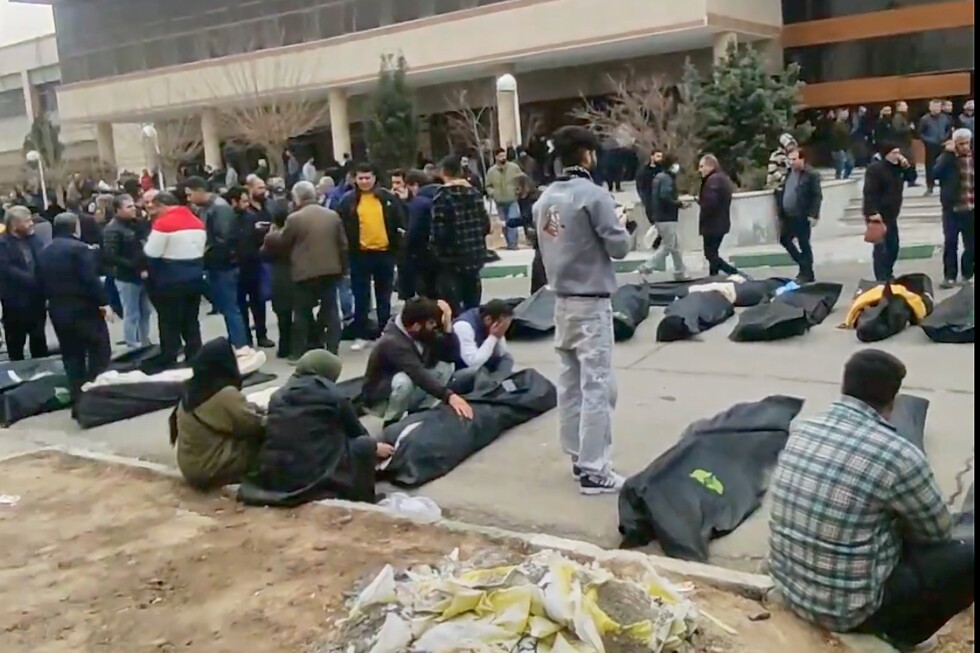
This frame grab from videos taken between Jan. 9 and Jan. 11, 2026, and circulating on social media purportedly shows images from a morgue with dozens of bodies and mourners after crackdown on the outskirts of Iran’s capital, in Kahrizak, Tehran Province. (UGC via AP)
Advertisement
This frame grab from videos taken between Jan. 9 and Jan. 11, 2026, and circulating on social media purportedly shows images from a morgue with dozens of bodies and mourners after crackdown on the outskirts of Iran’s capital, in Kahrizak, Tehran Province. (UGC via AP)
Advertisement
Advertisement
Advertisement
Advertisement
The doctor: ‘This had never happened before at this scale’
When protests reached her part of the country, the doctor said, she wasn’t surprised. But the extent was a different story.
“This had never happened before at this scale,” said the doctor in Mashhad, Iran’s second-largest city and home to an important Shiite shrine. She spoke to AP while visiting family abroad.
Days before a hospital night shift, the physician said, she had attended protests in the northeastern city, hearing gunfire from a distance and feeling tear gas burn her eyes. She saw graffiti on walls and buildings afire, even mosques believed to be used by government forces as rally points.
Once she clocked in at the hospital, Iranian security forces had escalated their response.
Advertisement
“I was not afraid for myself,” the doctor said. “I was afraid for others.”
She didn’t work in the emergency room but tried to see what was going on as ambulances and protesters delivered bodies. Colleagues told her 150 bodies were brought in that night. As she tried to move in closer, she managed a glimpse at some of them, she said: a boy and a young woman lying on stretchers, bearing gunshot wounds.
Security agents in the hospital, both in uniform and plainclothes, took over the command of the hospital emergency room, the doctor said. Doctors protested, she said of the colleagues’ account, but they were told to stop speaking or asking questions.
“They were standing over their (ER workers) heads with a gun, telling them not to touch (the wounded),” the doctor recalled of the experience relayed by one colleague. It was “as if they wanted those injured people to die on their own.”
Advertisement
Momentum ebbed, and Iran remains isolated
Khamenei told the nation that the protesters were either collaborators working for American or Israeli intelligence agencies or misguided members of the public trying to sabotage the country. Authorities held a counterdemonstration showing people loyal to the country’s theocratic leadership.
Crackdowns continued. Momentum ebbed. Iran remains cut off from the world. For some, rage and grief over the violence have grown.
“What I fear is that these events will be treated as something ordinary by the world, that people will simply move on and no one will pay attention,” the doctor said. “The fact that the voices of so many of those who were killed never reaches anyone is truly the most painful thing for me.”
She described observing a family arrive at the hospital to retrieve the body of a relative— a young woman. Agents refused to hand over her body, the doctor said, unless the family gave them her national identification and let them identify her as a Basij volunteer and government supporter. An argument started, and her family was arrested, the doctor said, and the woman’s body was taken to the cemetery with the others.
Advertisement
The family said, “Our daughter was killed by your forces,” the doctor recalled. “I can’t get the picture of that day out of mind, even for an hour.”
As January comes to an end, tensions on the streets have cooled, the three Iranians in Tehran told AP. Some daily life peeks through. But everywhere they go, they said, they remain watchful — in case something sets it all off again.
Advertisement
In this photo obtained by The Associated Press, a slogan is written on a wall reading in Farsi, “Death to dictator” during an anti-government protest in Tehran, Iran, Saturday, Jan. 10, 2026. (UGC via AP)
Advertisement
Advertisement
Advertisement
They can’t connect with Iranians outside their circles because of the internet blackout, but in their area, they said they see large deployments of security forces in public places.

“I don’t know how the other places are,” one of the three said. “But on every square in Tehran, there are agents in plain clothing — and even riot police.”
The doctor said she hopes the world won’t turn away from Iran.
Advertisement
“No matter how many times I explain, I truly can’t really convey the extent of the horrible situation,” she said. “No one would believe that a government of a country can so easily kill its own people.”
Clarke visited potential sites in the United States before settling on Charlotte and Fort Lauderdale as the two main bases for his squad this summer.
Scotland will play Haiti (14 June) and Morocco (19 June) in Massachusetts and finish Group C in Miami against Brazil (24 June).
“I always wanted to go to a World Cup with my country, so I’ve now done that,” said the former Chelsea and St Mirren defender, who won six Scotland caps.
Asked whether the ball was now in the SFA’s court, Clarke was happy to agree.

Advertisement
“Yes, I think it is,” he said. “I’ve had a very brief conversation with Ian [Maxwell, SFA chief executive] about what they want to do moving forward.
“But I think I’m waiting on the Scottish FA now coming to me and saying, ‘look, this is what we see as the future’ and if I’m part of that then we can have that discussion.”
And Clarke admits he’s shifted slightly in his own mind, having previously said his chances of staying were only 25 per cent. He says he’s now more “50-50” and is not phased by the fact nothing’s yet resolved.
“It’s been busy for everyone so I’m not surprised,” he added.
The inspection of Seascape Primary School, in Peterlee, found that pupils “do not achieve well.”
The report raised concerns about the progress made by disadvantaged pupils, stating that it is “consistently well below that of other pupils nationally” and shows no signs of improvement.
A spokesperson from Seascape Primary School said: “We are aware of the outcome of the Ofsted inspection.
Advertisement
“Our safeguarding processes are robust and well established, and we are committed to doing all that we can to ensure our pupils have the best possible learning opportunities.”
However, there are significant learning gaps for pupils with special educational needs and/or disabilities according to Ofsted.
Inspectors found that the school’s curriculum “has not prepared pupils for their next steps” and does not equip them with the knowledge needed.
The progress of pupils, particularly in “reading, writing and mathematics,” has not been prioritised by school leaders, and the “experiences in lessons are often ineffective”, the report said.
Advertisement
It also highlighted that some of the school’s improvement strategies have failed, where “a recently introduced approach to assessment has not supported staff to accurately assess what pupils know or identify gaps in pupils’ understanding.”
The inspection expresses concern about pupils’ future, suggesting that they “do not receive an acceptable standard of education” and “very few pupils achieve the standards expected at the end of key stages 1 and 2.”
Attendance at the school is also below national averages, the report explains.
Inspectors found that “until very recently, leaders have not taken effective action to improve pupils’ attendance.”
Advertisement
Inspectors did acknowledge that school leaders have started to improve behaviour standards, stating: “The school feels safe, calm, orderly and respectful.”
On the rare occasions when there is “discrimination or bullying,” staff “tackle it quickly and effectively.”
The spokesperson from Seascape Primary School added: Work has already begun to make the necessary changes in order to address the recommendations in the report.”
Read more:
Advertisement
The school has recently introduced a new curriculum to help improve the quality of education, but inspectors noted that “the overall impact of this new curriculum is limited” due to teaching weaknesses.
The future focus recommended for Seascape is on identifying the needs of pupils accurately, improving attendance, broadening pupils’ experiences, and developing a better understanding and respect for cultural diversity in modern Britain.
The governors have also been asked to carefully monitor the use of pupil premium funding to ensure that disadvantaged pupils benefit from this.
A notice was published in the London Gazette on Thursday, March 5, sharing details of the individuals who had their MBEs and OBEs taken away.
Most of the honours were stripped due to a criminal conviction or for “bringing the honours system into disrepute”.
The notice regarding the list of people who have had their honours taken away can be found in The London Gazette.
Nine people have had their OBEs and MBEs stripped in 2026 (Image: Andrew Matthews/PA Wire)
King Charles and government praised for “vital” action in stripping honours
The only way to lose an honour like an OBE or an MBE is through a process known as ‘forfeiture’.
Advertisement
This is decided by the Honours Forfeiture Committee, with the monarch approving decisions based on their advice.
The group is made up of a small number of senior civil servants and independent members who look at someone with an honour who has either been convicted of a serious crime or is judged to have brought the system into disrepute.
Discussing the decision to strip people of their honours, Tracy Lamourie of Lamourie Media, said that the process was important to protect the reputation of the government and the monarchy.
She said: It’s actually vital that they do take actions like this because institutions, everything from businesses to the royal family to governments, are under constant scrutiny these days, and people are demanding accountability.
Advertisement
“It’s not ok to sweep things under the rug in 2026.
“If these honour systems are going to continue to exist, they absolutely have to maintain the public’s trust and credibility, or they’re worth less than the cost to manufacture and announce them.”
Michael Ryan, Founder and CEO at Ink Digital, shared similar thoughts on it needing to protect the integrity of the honours system.
He said: “Awards like these are symbolic recognition of service and contribution, so when recipients later become associated with serious misconduct or reputational damage, leaving the honour in place can create a perception problem for the wider system.
Advertisement
“In situations like this, the response is often as much about reputation management as it is about the individuals involved.
“Institutions such as the monarchy operate within a very visible public narrative, and public honours are part of how that narrative is communicated.
“When honours are revoked, it sends a signal that the recognition is tied not just to past achievement but also to ongoing conduct and public trust.”
On the other hand, royal insiders quoted by Radar Online have questioned whether the honours system can retain its value.
Advertisement
A source familiar with the honours system shared: “When you see this many titles being cancelled in such a short time, it inevitably leads some people to ask whether the whole system begins to look a bit meaningless.”
However, not everyone agreed, as another royal source said: “The King has shown he is willing to strip titles when he believes standards have been breached.
“We saw it when Andrew Windsor lost his royal titles and patronages, and now we are seeing the same strict attitude applied to the honours system.”
Advertisement
Full list of people to have their MBEs and OBEs stripped in 2026
Ian Ashbold, received MBE in 2016, stripped due to a criminal conviction
Lloyd Hamilton, received MBE in 2011, stripped due to a criminal conviction
Angela Middleton, received MBE in 2019, stripped due to bringing the honours system into disrepute
Nigel O’Connor, received MBE in 2015, stripped due to professional censure
Tony Reilly, received OBE in 2011, stripped due to professional censure
Paul Rose, received MBE in 2002, stripped due to a criminal conviction
Anant Shah, received OBE in 2020, stripped due to bringing the honours system into disrepute
Graham Trewhella, received MBE in 2010, stripped due to a criminal conviction
Stuart Hogg, received MBE in 2024, stripped due to a criminal conviction
What are OBEs and MBEs?
OBE stands for Officer of the Order of the British Empire.
This is awarded for having a major local role in any activity, including people whose work has made them known nationally in their chosen area.
MBE stands for Member of the Order of the British Empire.
This is awarded for an outstanding achievement or service to the community.
A new interactive map has revealed the areas that will benefit from a new government-funded programme to improve internet speeds
More than a million British homes are due a free internet upgrade from the government – a new interactive map have revealed which areas are eligible.
Advertisement
The Project Gigabit is the government’s new programme to help hard-to-reach communities access lightning-fast gigabit-capable broadband. This initiative is meant to target properties and businesses in parts of the country that are not included in internet suppliers’ plans.
The government announced that it expects 99% of homes and businesses will have gigabit-capable internet by 2032. The Project Gigabit was introduced in 2021 but the rate of upgrades to better connections is now at its fastest rate.
Ministers revealed more than 750 premises are being reached a day during the current phase of the nationwide project. A map below shows the towns and areas where these upgrades are being rolled out.
Advertisement
The Project Gigabit will benefit places across the whole of the UK, but the map below has shown the areas in England and Wales that are part of the massive upgrade project.
Openreach, through a deal worth up to £1.2billion, is working with the government to bring full fibre to over 297,000 homes and businesses across rural parts of the nation. More than 30 other contracts have been signed with other companies as part of Project Gigabit.
There is also a Gigabit Broadband Voucher Scheme as part of the greater project, which gives eligible homes vouchers worth up to £4,500 to help towards the cost of installing gigabit-capable broadband to their premises.
This voucher scheme is currently only open for new projects “to cover premises which are not included within a Project Gigabit procurement or contract and which are not covered by existing or planned commercial coverage”, according to the government website.
Advertisement
Telecoms minister Liz Lloyd said: “Many rural communities have long struggled to do even the basics online due to slow internet speeds. Now, hundreds of households and companies are receiving government-funded upgrades every day – helping those who would otherwise miss out.”
The vehicle was left on its roof after the crash in Penny Pot Lane, Harrogate, shortly after 1.15pm on Monday (March 16).
North Yorkshire Fire and Rescue Service said the car’s occupant was left with paramedics after being freed from the vehicle.
A service spokesperson said: “Crews from Harrogate responded to a single vehicle road traffic collision, involving a car that had rolled on its roof into a ditch.
Advertisement
“Crews rescued one occupant using cutting gear and small tools to remove the door and boot of the vehicle.”
Viewers will know that music teacher Sarah disappeared and was later found murdered in the woods by her house. An unknown person strangled her to death before dumping her dead body and making a run for it.
During tonight’s (March 16) episode of the six-parter, Annie and her colleagues begin to see things in a new light as fresh information continues to emerge.
There’s no denying that Michael’s behaviour has been odd since the disappearance of his wife so it comes as no surprise that he came under scrutiny.
Advertisement
He was not the only one as Sarah’s lover Stephen Sedgwick was also questioned about their whereabouts around the time Sarah disappeared.
Michael insisted that he had no part to play in his death but the police were not fully convinced as Michael did have motive if he knew his wife was having an affair.
Unfortunately the police didn’t have enough evidence, so they had no choice but to release him. Annie wasn’t ready to back down so she decided to interview Michael at his home and record him without his knowledge.
Advertisement
She was quick to notice that his daughter Alana was nowhere to be seen but he insisted that she was staying with her grandparents because she wanted to look after them during this heartbreaking time.
However he was unable to keep up with his lies as he later cracked and claimed that Alana went to her grandparents to get away from him and said he was to blame for the affair.
Throughout his chats with Annie, it was clear that his story wasn’t adding up and viewers watching at home were quick to spot Michael’s odd behaviour.
Advertisement
Many insisted that he is “covering for someone” and the real killer might be his daughter. One fan took to X and wrote: “Michael didn’t kill his wife he’s covering for someone @davemorrissey64.”
Another questioned: “Is he protecting someone? #Gone.” A third commented: “Michael didn’t do it ,so who did , the daughter #gone.”
Meanwhile one praised: “Wow, what an episode the 2 leads are incredible. The tension. Eve Myles and David Morrisey what chemistry.”
You can stream Gone on ITVX
Advertisement
For the latest showbiz, TV, movie and streaming news, go to the new **Everything Gossip** website.
Chelsea signed the 24-year-old last summer in a £60m deal from Brighton and have been pleased with his development.
Pedro was expected to battle with Liam Delap for a place in the Chelsea team but quickly established himself as the first-choice striker at Stamford Bridge.
Advertisement
Caicedo is rightly regarded as one of the best midfielders on the planet but the Ecuador international insists he is by no means the only world-class star in west London.
Chelsea’s former record signing claims Pedro is not only one of the best players in the Premier League but in the world and says he has ‘everything’.
Asked to name his ‘most underrated’ teammate at Stamford Bridge, Caicedo told Sky Sports: ‘Joao Pedro. People don’t know how good he is.
Your football fix
Metro‘s Head of Sport James Goldman delivers punchy analysis, transfer talk and his take on the week’s biggest stories direct to your inbox every week.
Chelsea summer signing Joao Pedro (Picture: Getty)
‘For me he’s one of the best players, not just in the Premier League but in the world. His movement, the way he plays, how he scores goals – for me, as a striker he has everything.’
Caicedo also heaped praise on another Chelsea star, Andrey Santos, claiming the Brazilian is often one of the best players in training.
Advertisement
Santos has made 35 appearances for Chelsea this season and featured heavily since his former Strasbourg manager Liam Rosenior took over in January.
‘There are a lot but Andrey Santos,’ Caicedo said when asked which player often impresses in training.
Advertisement
‘He’s so good every day in training and now he’s doing really well in games too so I’m so happy for him.’
‘I think this week was difficult for us,’ Pedro said ahead of the visit of Champions League holders PSG.
Advertisement
‘We know our strengths, we still believe because we showed in the Club World Cup when we won 3-0. The group believe, the manager believes, the fans should believe as well.’
Chelsea boss Rosenior added: ‘If you look at the game in isolation and the scoreline, we were punished by very good players for our own mistakes.
‘We have been undone in games by those moments. We can’t make mistakes tomorrow.
‘We have to remember PSG are European champions for a reason but we know we can compete.’
It closed its doors, and a temporary bar was set up in January to serve the area, making way for the new and improved restaurant and bar.
The new and improved part of the airport comes with a new menu. You can pick up traditional breakfast items as well as burgers, sharing plates and light bites.
It will come with a fully serviced bar, and customers can pick up pints on draught, wine and spirits. It also provides non-alcoholic alternatives like 0.0% Guinness and Heineken.
As well as the new restaurant and bar, visitors to the airport will be able to pick a coffee from the new Bewleys coffee area within the Northern Quarter.
He set fire to Christmas decorations in the foyer of the hostel
A day after being released from prison, a Cambridge man set fire to a youth hostel foyer, sending him back to jail. The convict had threatened to smash the door down and petrol bomb the centre when he was refused entry.
Advertisement
Nigel Hensby, 27, was released from prison after possessing a knife and a public order offence. After serving time for those offenses, he set fire to Christmas decorations in the foyer of a youth hostel. Hensby threatened the staff member after being denied entry in the building to get a mobile phone from a former partner.
In a ‘fit of rage’ Hensby went to the Cambridge Youth Foyer, in Rustat Close, on December 5 last year. He demanded to see his former partner to get a mobile phone back, but he was refused entry by a member of staff.
Hensby threatened to smash the door down and petrol bomb the building and the staff member hid in an office and called the police. When she checked the reception area, Hensby had set fire to some Christmas decorations with a lighter and run off.
Police say that no one was hurt in the fire, but lives were put at risk. Hensby was arrested in Station Road, Cambridge, at about 9.40pm, shortly after the incident, and admitted to the officer he had started the fire.
Advertisement
On Tuesday (March 10), at Peterborough Crown Court, Hensby, of Drayton Road, Norwich, was jailed for two years. At an earlier hearing, he also pleaded guilty to arson with recklessness as to whether life was endangered.
DC Becky Bertozzi-Wilson, who investigated, said: “Hensby deliberately set fire to a foyer in a building with vulnerable people inside, putting their lives and staff members lives at risk, simply because staff would rightly, not allow him access. The consequences of his actions could have been fatal.”
It started in Weymouth on Friday, March 13, and will see the DJ travel all the way to Edinburgh in a 1,000km journey.
He will be passing through County Durham on Wednesday, March 18, if all goes to plan.
Track where Greg James is on his journey here:
Speaking ahead of the challenge, he said: “Yes, I am mad, and I do think it will be a ludicrous challenge, and one that I don’t know whether or not I can do.
Advertisement
“But I’m going to try it.
“A little bit of pain is worth the overall goal of raising loads of money for Comic Relief.”
This is Mr James’ third challenge for Comic Relief, despite previously vowing not to take on another.
He completed five triathlons in five days in 2016, and in 2018, cycled between and climbed the UK’s three highest peaks: Scafell Pike, Snowdon, and Ben Nevis.
Throughout the journey, Mr James will be joined by special guests, listeners, and fellow presenters.
He said: “I need them to be good cyclists.
“The reality of it might be that they wobble and we both fall off.”
You must be logged in to post a comment Login