
News Beat
Israel ‘undermined’ health of women and babies in Gaza, researchers say


The report also found that all facilities providing infertility treatment in Gaza were destroyed, effectively removing access to fertility care in the Strip.
Between May and June 2025, the Palestinian Ministry of Health reported a 41 per cent decrease in birth rate in Gaza compared to the same period in 2022.
Severe maternal malnutrition and psychological stress impeded lactation, leaving many women unable to breastfeed even when they had successfully done so in previous pregnancies.
“These otherwise healthy women with no co-morbidities were not producing any breast milk, even though they had in previous pregnancies,” one nurse reported.
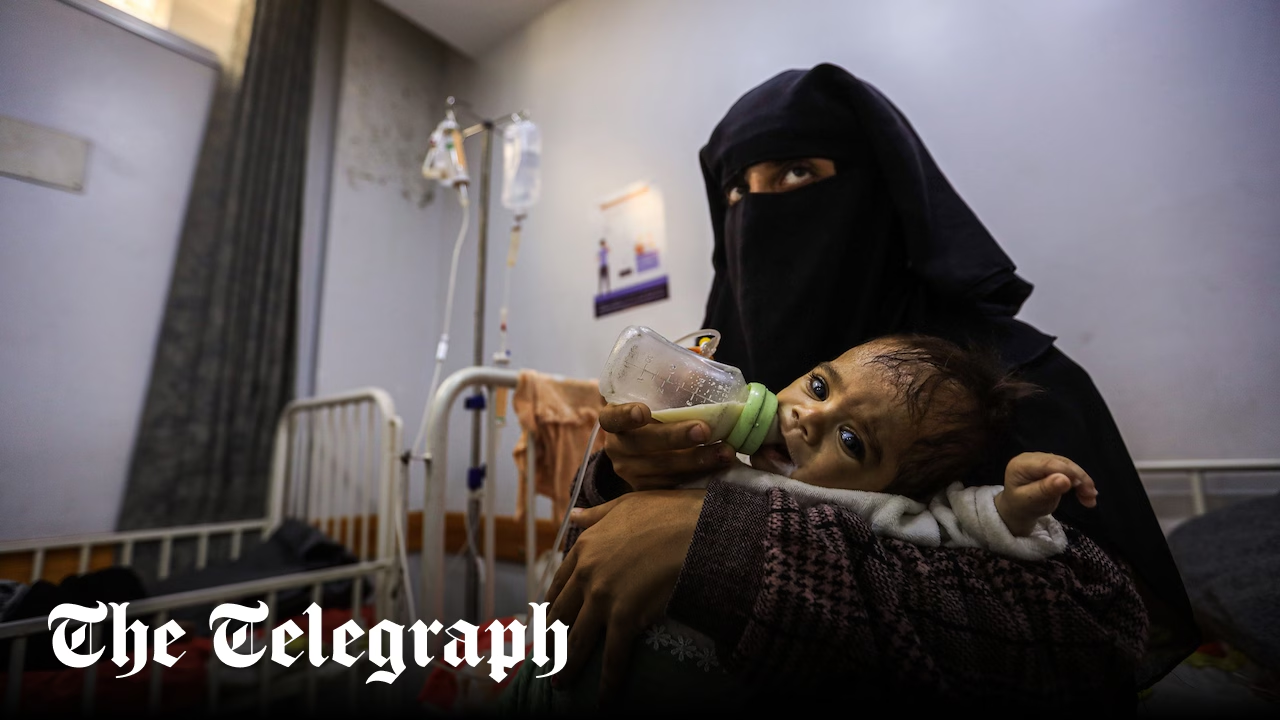
At the same time, restrictions on baby formula hit care for premature infants, malnourished newborns, and babies with medically recognised indications for breast milk substitutes.
Research suggests that without a sufficient energy supply in the first 1,000 days of life, the growth of a child can be impaired, causing irreversible physical and cognitive damage known as ‘stunting’.
In November, the UN reported that Israel was blocking shipments of bottles for baby formula, claiming that the items were “dual-use”, meaning they could be used for both civilian and military purposes.
‘I thought I was dead’
In a separate report, Physicians for Human Rights-Israel, a separate organisation based in Israel, collected testimony from Palestinian women on their experiences with fertility during the conflict.
Maha Younis, 20, was four months pregnant when her home in Gaza City was bombed in October 2023, trapping her under rubble. “I thought I was dead,” she recalled. “I couldn’t hear anything and I couldn’t see anything.”
She suffered head, back, and hearing injuries and later gave birth prematurely in March 2024. Her daughter Masa was born with breathing difficulties and weighing just four-and-a-half pounds.
Sm Younis now lives in a squalid tent with 10 family members, without sanitation and has access to one meal a day.
Nariman Shakoura, 33, from Beit Lahia, described repeated displacement during pregnancy and the fear of giving birth without access to hospitals or transport.
“I was very worried. I kept thinking, how will I give birth when the time comes?” she said. “There are no hospitals, no transportation, no cars. I was terrified.”
The PHR report concludes that the harm done to women and newborns by Israel’s war effort was “foreseeable”.
Despite repeated warnings from UN agencies and humanitarian organisations, restrictions on food and medical supplies continued, the authors note.
“Our evidence shows that the impact on reproductive rights, the reproductive violence, was predicted,” Mr Zia-Zarifi said. “These warnings were disregarded, either intentionally or recklessly.”



