
News Beat
Labour MP Tulip Siddiq handed two-year prison sentence for corruption in Bangladesh

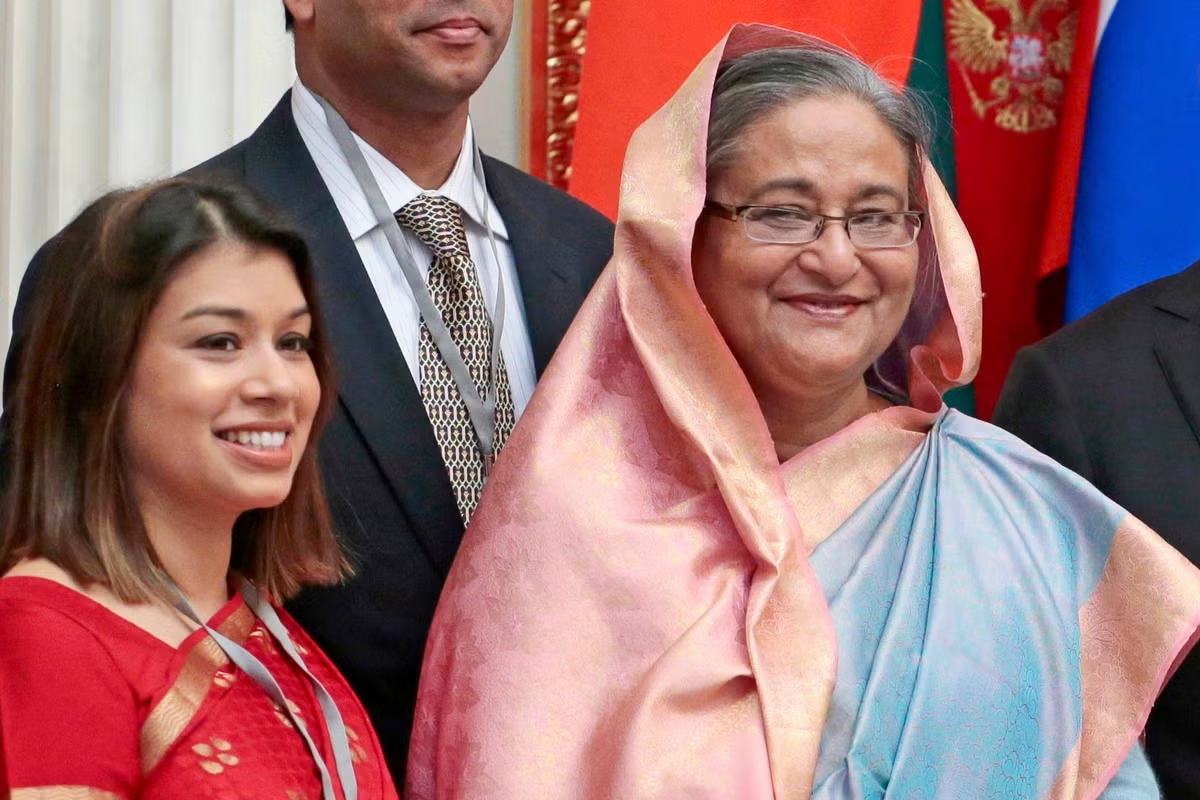
A Bangladesh court has sentenced Labour MP Tulip Siddiq to two years in prison after finding her guilty of corruption over a government land project.
Dhaka’s Special Judge’s Court found Ms Siddiq guilty of corruptly influencing her aunt, the former prime minister Sheikh Hasina, to help her mother acquire a piece of land in the suburbs of the Bangladeshi capital.
Ms Siddiq’s mother, Sheikh Rehana, was given seven years in prison, while Ms Hasina was sentenced to five years in prison.
All were tried in absentia, and the MP for Hampstead and Highgate, who denied the allegations, is unlikely to serve the sentence as the UK does not have an extradition treaty with Bangladesh.
Ms Siddiq faces a number of cases in Bangladesh, which prompted her to resign as Keir Starmer’s anti-corruption minister in January this year.
Ms Hasina, who fled to India in August last year amid massive anti-government protests, has already been awarded a death sentence by a tribunal court in Bangladesh for committing crimes against humanity. Last week, she was handed a combined 21-year prison sentence in other corruption cases.

Prosecutors argued that the land in the Purbachal New Town project was unlawfully allocated through political influence and collusion with senior officials, accusing the defendants of abusing their authority to secure the plot, about 13,610 sq ft, during Ms Hasina’s tenure as prime minister.
Court documents claimed that Ms Siddiq “forced and influenced her aunt and the former prime minister Sheikh Hasina using her special power to secure [a plot of land] for her mother Rehana Siddiq, sister Azmina Siddiq and brother Radwan Siddiq”.
A total of 17 defendants were each fined TK100,000 (£620), or to serve an additional six months in prison if they fail to pay. The 14 other defendants were each sentenced to five years in prison.
Prosecutors said Ms Siddiq was tried as a Bangladeshi citizen after the authorities obtained her Bangladeshi passport, ID and tax number – a claim disputed by the Labour MP.
Her lawyers claimed that she “never had” a registered voter ID and has not “held a [Bangladeshi] passport since she was a child”.
All the defendants, including Ms Siddiq, declined to appoint any defence lawyers to represent them.

Ms Siddiq previously claimed that she was “collateral damage” in the feud between her aunt and Muhammad Yunus – the Nobel laureate named interim leader of Bangladesh following Ms Hasina’s ousting.
“These are wider forces that I’m battling against … There’s no doubt people have done wrong things in Bangladesh, and they should be punished for it. It’s just I’m not one of them,” she told The Guardian.
The Bangladesh court had issued an arrest warrant for Ms Siddiq in April. She was indicted in July.
Ms Siddiq resigned from her ministerial job in the Treasury earlier this year following an investigation by the prime minister’s ethics adviser into her links to Ms Hasina’s regime. She came under scrutiny over her use of properties in London linked to her aunt’s allies.
Although Sir Laurie Magnus concluded that Ms Siddiq had not breached the Ministerial Code, he advised Sir Keir to reconsider her responsibilities. Ms Siddiq chose to resign, saying she had become “a distraction” from the government’s agenda.
Ms Siddiq’s mother and two siblings have been living outside Bangladesh since the August protests. Ms Siddiq’s two siblings face other charges involving last year’s uprising.
In a statement, Ms Hasina rejected the process that found her guilty on Monday. She said: “No country is free from corruption. But corruption needs to be investigated in a way that is not itself corrupt. The ACC [Anti-Corruption Commission] has failed that test today.”
Her Awami League party, which has been banned from taking part in the country’s general election in February, said in a statement: “The allegations against Sheikh Hasina, her sister, and many others, including members of her immediate and wider family, are firmly denied. No persuasive evidence of corruption was heard at the ACC, because none exists.”
Ms Hasina said her successor Dr Yunus was “using the ACC as a smokescreen to distract attention from his own governance failings”.
“He is also using it to suppress a political party that was elected nine times since Independence, including the last time Bangladeshis were allowed to go to the polls,” she said.



