Right now, longevity is all the rage and as we are gradually getting older as a population, we’re hoping to extend our lifetimes even further. It makes perfect sense, right?
Plus, most longevity advice can often be summarised into: eat healthy foods, exercise often and keep a healthy sleep schedule to reduce stress. All of this is great advice and we should be trying to implement it into our lives as much as possible!
However, there is a stage where a preoccupation with longevity is just a little too far and could be impacting your mental health and even the quality of your life as you lock into the quest for a longer life.
It’s called ‘longevity fixation syndrome’
Advertisement
While this isn’t an official diagnosis, experts at Paracelsus Recovery, a mental health clinic based in Zurich have found that an obsessive and unhealthy fixation on longevity is increasingly presenting as anxiety and stress, and even eating disorders with their patients.
Speaking to The Mirror, Jan Gerber, the founder and CEO of Paracelsus Recovery said: “We are seeing a growing number of people whose lives are being dominated by the fear of ageing and decline, so much so that we have identified it as a new condition, Longevity Fixation Syndrome,
“What starts as self‑care becomes obsessive self‑surveillance. The stress generated by this mindset can be so intense that it actively shortens lifespan rather than extending it.”
Gerber adds that “there is no longevity without good mental health.”
Advertisement
Additionally, Jason Wood, a former sufferer of this syndrome said to The Guardian that he believes that longevity obsession is closely aligned to orthorexia: a condition characterised by excessive interest in, concern about, or obsession with healthy food.
Wood says: “I believe many of the underlying factors and desired outcomes which fuel orthorexia are the same for longevity fixation syndrome. But with the latter, there are more variables you feel like you need to control, so even more anxiety.”
If any of this feels familiar to you, speak to your GP or leading eating disorder charity BEAT for support.
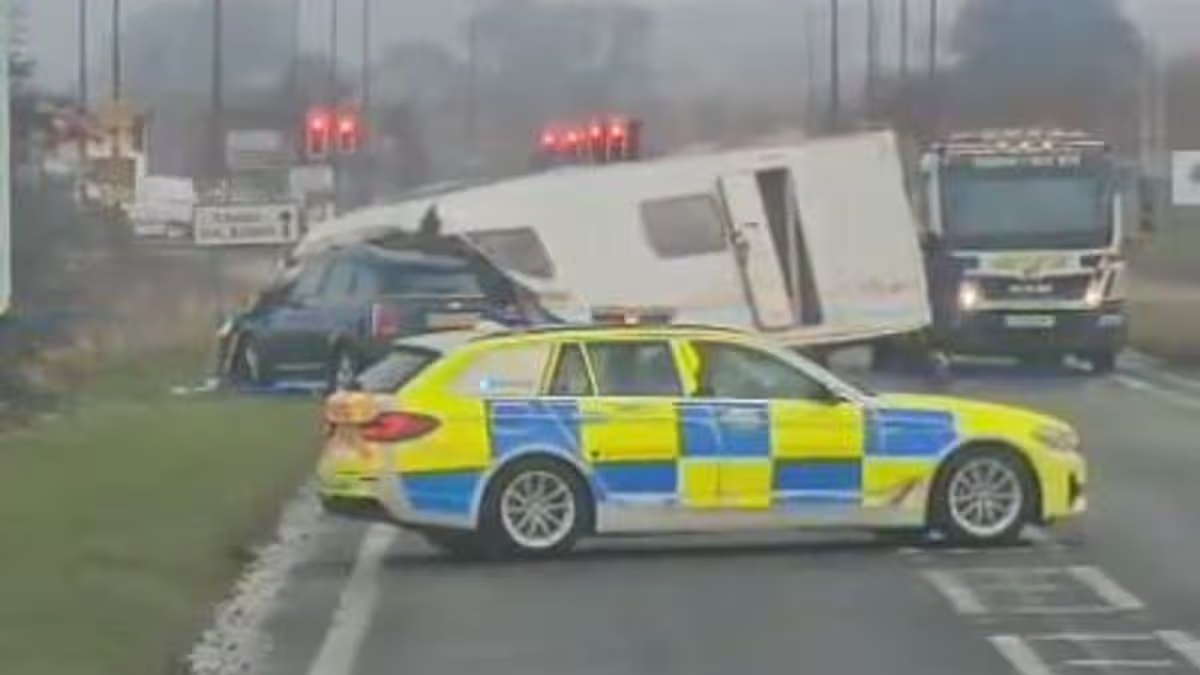
The collision occurred this afternoon on the A71 near East Calder, which saw the road closed in both directions around 2pm. Images from the scene showed a Mini Cooper smashed through a large caravan as debris is sprawled across the road.
A recovery vehicle can be seen parked beside the caravan. A cop car is seen stationed in front of the crash, cordoning off the stretch of road. It is not known if anyone was injured in the collision.
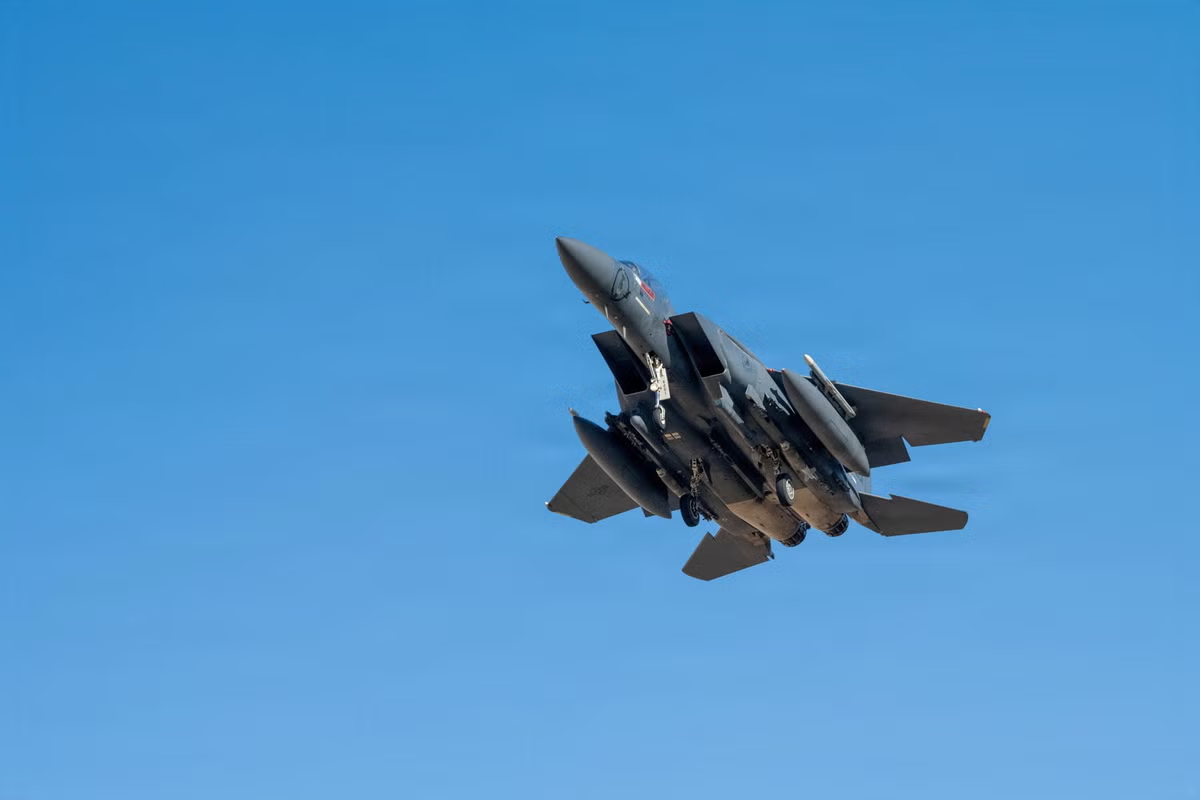
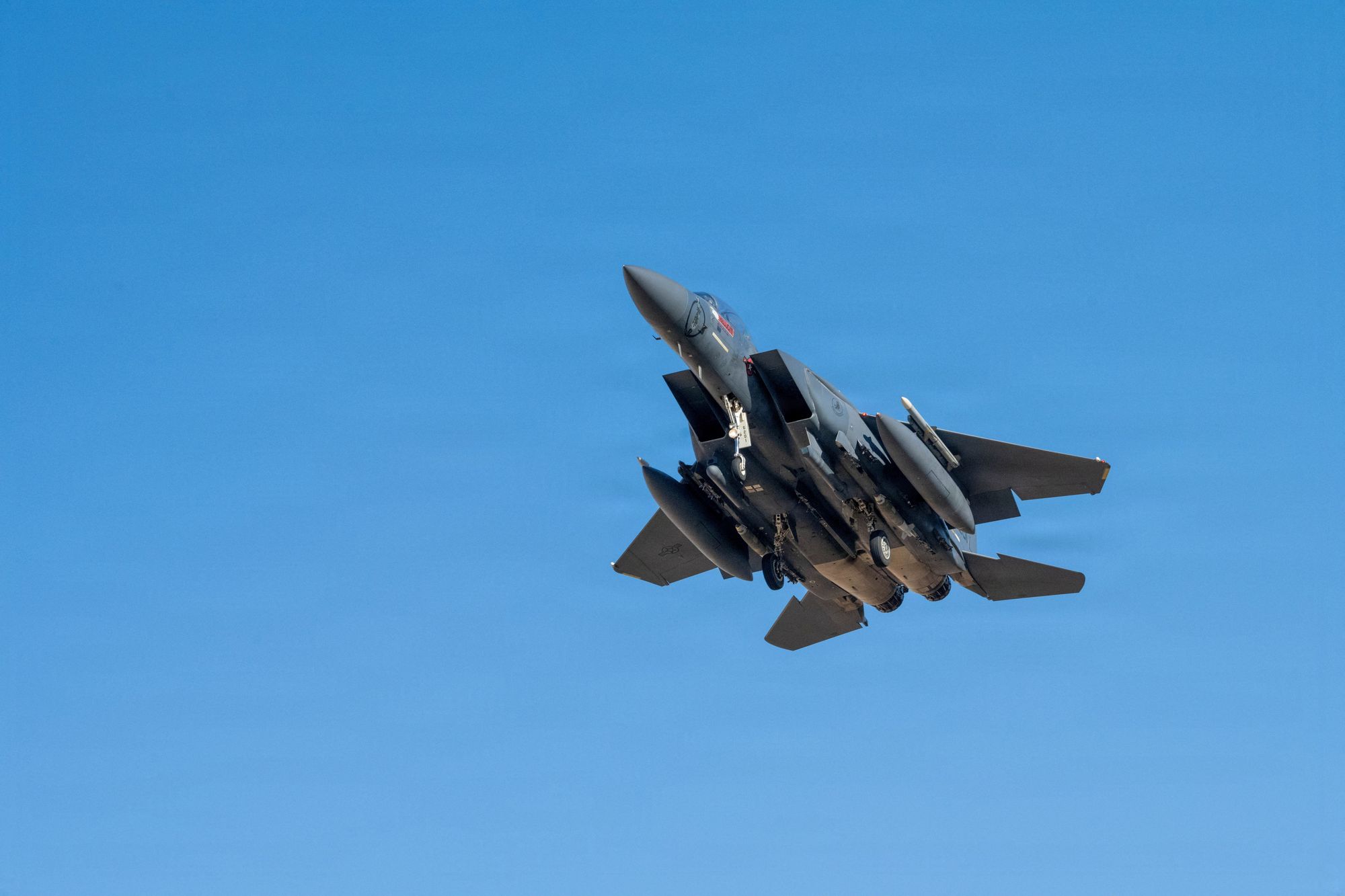
Donald Trump has responded after a US F-15 fighter jet was shot down over Iran, marking the first time a US jet has been downed by enemy fire in the conflict
Mikey Smith Deputy Political Editor in Dallas, Texas, Eliana Nunes News Reporter and Emma O’Neill Content Editor
22:08, 03 Apr 2026
Donald Trump has spoken out following the downing of a US fighter jet in Iran.
When questioned by NBC News about whether the shooting down of the F-15E Strike Eagle impacts negotiations with Iran, the US president responded: “No, not at all. No, it’s war. We’re in war.”
Advertisement
Trump refused to discuss the continuing search and rescue operation for the missing crew member and voiced irritation regarding certain media reporting of the mission due to its delicate nature, NBC News stated.
The incident represents a significant intensification of the conflict, now entering its fifth week, marking the first occasion a US jet has been brought down by hostile fire. Three American F-15E jets were accidentally shot down by friendly Kuwaiti forces on March 2 amidst an Iranian aerial offensive. All six crew members successfully ejected and were retrieved in stable condition, the US military confirmed at that time.
An F-15E carries a price tag of approximately $31 million for variants delivered in the late 1990s, while more recent models cost nearer to $100 million, according to specialist publication Airforce Technology, reports the Mirror.
Advertisement
Separately, a second US warplane is believed to have crashed in the Persian Gulf today, with the pilot managing to eject safely over water.
The A-10 Thunderbolt II attack aircraft, nicknamed the Warthog, came down near the Strait of Hormuz at roughly the same time as an F-15 was shot down over Iran, two officials informed The New York Times. The pilot of the single-seat aircraft was recovered by US forces.
The officials declined to provide additional details surrounding the circumstances of the incident. Iranian state television has claimed that “an American A-10 aircraft was shot by the defence systems of the Army Air Defence Force and crashed in the Persian Gulf in southern Iran”, according to the Iranian Army.
The broadcaster stated the Warthog went down close to the Strait of Hormuz. The aircraft carries a price tag of approximately $18.8 million, as reported by specialist news outlet Military Machine.
Advertisement
This development follows Trump’s sharp criticism on Tuesday of allies reluctant to contribute more substantially to the US military campaign against Iran, instructing them to “go get your own oil” and insisting it wasn’t America’s responsibility to safeguard the Strait of Hormuz.
Global leaders have grappled with ending Iran’s grip on the strait, which has triggered widespread ramifications for the world economy and represents its most significant strategic asset in the conflict. The UN Security Council was due to address the issue on Saturday.
Trump has oscillated between issuing warnings to Iran should it fail to reopen the waterway and urging other countries to “go get your own oil”. On Friday, he declared via social media that “with a little more time, we can easily OPEN THE HORMUZ STRAIT, TAKE THE OIL, and MAKE A FORTUNE”.
Advertisement
Since hostilities commenced with US and Israeli air strikes on February 28, upwards of 1,900 individuals have perished in Iran. An assessment published on Friday by the US-based organisation Armed Conflict Location and Event Data determined that civilian fatalities were concentrated around attacks on security and state-affiliated locations “rather than indiscriminate bombardment” of built-up areas.
Over two dozen individuals have tragically lost their lives in Gulf states and the occupied West Bank, while 19 fatalities have been reported in Israel, including 13 US service members. In Lebanon, the death toll exceeds 1,300 with over a million displaced. Additionally, ten Israeli soldiers have been killed on Lebanese soil.
You didn’t know you needed Auf Wiedersehn Mallorca, a 1976 multi-lingual holiday hits complication complete with frollicking fraulein, until you see it poking from a pile of old vinyl at Dundrum car boot sale.
A discreet once-over, don’t look to keen. “Much?” “A pound, they were my mother-in-law’s records” Done. Where you gonna get anything for a pound much less a musical masterpiece from the early days of mass tourism?
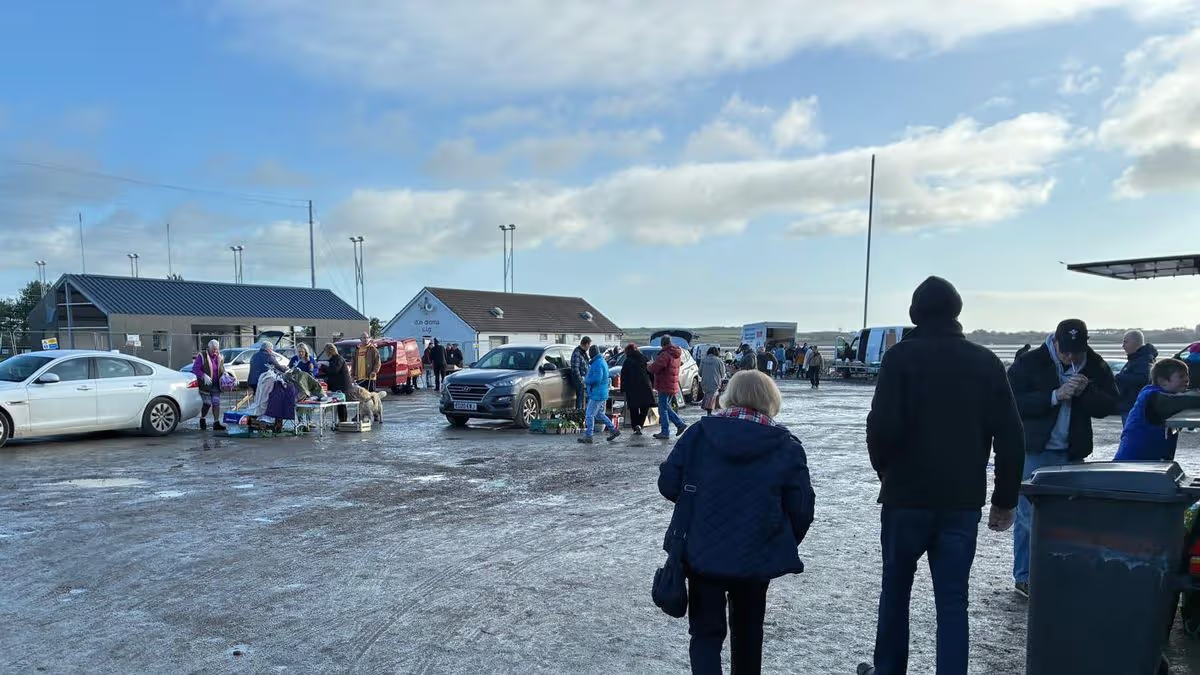
This is what markets used to be like – older generations still have PTSD from being dragged as children around the old St George’s in Belfast which was once a dark and dank midden of fishmongers, fruit and veg, junk and bric-a-brac. Now it’s mostly hipsters and cruise ship tourists. But Dundrum car boot is a glorious riot of sights and sounds held most Sundays in the grounds of Dundrum GAC on the Newcastle Road in Dundrum Co Down.
My unofficial guide for the day, who would only give his name as Eddie, met me at the pitch gates bright and early at 8am a few Sundays ago. “You need to be the early bird or the best stuff goes quick, and if you like it buy it ‘cos some other git will swoop in behind you and have it”. Wise words we can all live by.
Eddie is a rummager by nature and mapped out our route through the tangle of stalls, cars, trestle tables and heaped flotsam and jetsam. Handshakes were fired his way from the regulars. I think I dislocated a wee finger getting a rigorous handshake from Big McAllister The Master Angler. Two mitts like sledgehammers. Eddie also pointed out some other characters, Ruta The Florist, The Crafty Cockney, The Veg Man, The Dogfood man, The Signs Man. There was a slight theme to the monikers I noticed.
Advertisement
A slow start, due to the handshakes, but soon we were away. But Eddie pulled me to one side for a whispered debrief and he had one final bit of local lore to share. Apparently. Now, apparently, a modern masterpiece was found at Dundrum and made its way to an auction in New York where it was valued at a potential $6million.
The story goes that a small Edward Hopper (1882-1967) original entitled The Study of High Noon was unearthed here in 2007 for buttons, posted on ebay for $580 and was soon recognised as the real deal and sold for millions. I got stuck right in to the bargain hunting with a renewed vigour.
And what was my first buy, a £5 ornamental concrete skull. Why? Why not. Have you a £5 ornamental concrete skull?
Advertisement
With the heady scent of victory in my nostrils – that might be the burgers and onions being fired up at the fantastic chip hut actually – I move on slowly and methodically to my next purchases. I’m in a flow state now and my eye has settled in to sort the tat from even more tat.
After Mallorca, comes a souvenir medal all the way from Paris with Napoleon himself on it. What the little Corsican corporal would make of Bruce Springsteen Born In the USA or 20 Buzzin Tracks (Energy Rush II) on cassette is anyone’s guess (the two for £2). I think he was a CD man myself.
Advertisement
Ed tells me these came from The House Clearance Man’s stall. And once you took in the contents of the tables it became clear someone’s old life or home was laid out for sale. The cassettes were in an old black plastic carry case/sorter. The type once seen in every ‘good’ room or teenager’s bedroom. in the 80s and early 90s. There was clothes, ornaments, kitchen utensils, tools, tool box. There was even a GCSE Art sketch pad filled with paintings, doodles and portraits of faces long changed. Not worth Edward Hopper’s $6million but once priceless.
And there lies the beauty of a good car boot, all humanity is here. Warts and all. Speaking of warts my final buy was a bit warty. A cry from one of the vendors went up: “Three pigs’ ears for two poun’.” Stopped in my tracks.
Advertisement
Now I know pigs don’t have three ears naturally so I guessed these were loose. And like a grim Woolworth’s pick’n’mix three choice dried slithers of hide from The Butcher were selected and bagged up for my dog to chew on.
With a short drive to Belfast looming we retired to the highly-recommended Frenchs Cafe & Bistro for a restoring fry and cup of tea where Eddie cast a dismayed eye over my purchases before I headed home to sort out my loot.
Just need a record and cassette player now – will be back next Sunday.
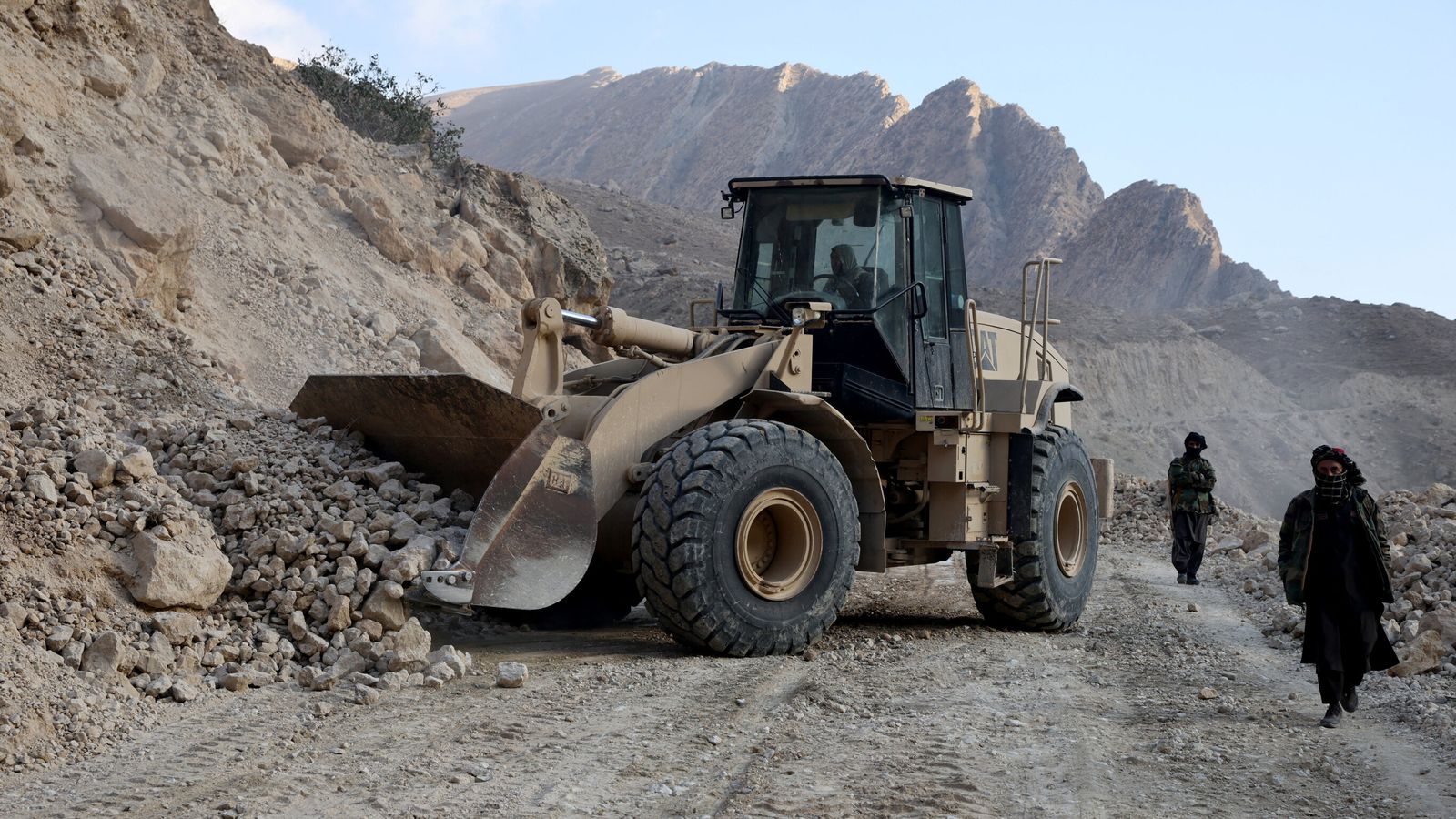
At least eight people are dead, and a child injured, after a 5.9 magnitude earthquake hit parts of Afghanistan and Pakistan late on Friday.
The eight dead and injured child are all members of the same family and were involved in a house collapse, Hafizullah Basharat, a spokesman for the Kabul governor, said.
The earthquake struck Afghanistan’s Hindu Kush region at a depth of 110 miles (177km), according to the German Research Centre for Geosciences.
Advertisement
Provincial health authorities in the country have been put on alert.
Strong tremors were also felt in Pakistan’s capital, Islamabad.
The region is highly seismically active, with earthquakes causing thousands of deaths in recent years.
Last August, a 6.0 earthquake in eastern Afghanistan killed more than 1,400 people, and injured at least 3,250 others – destroying villages and trapping people under rubble.
Most of the casualties in that disaster were in the country’s Kunar province, where people typically live in wood and mud-brick houses along steep valleys.
Advertisement
In November, a 6.3 earthquake struck Samangan province in northern Afghanistan, killing at least 27 people and injuring more than 950.
While in 2023, thousands were killed when a 6.3 quake, followed by strong aftershocks, rocked western Afghanistan.
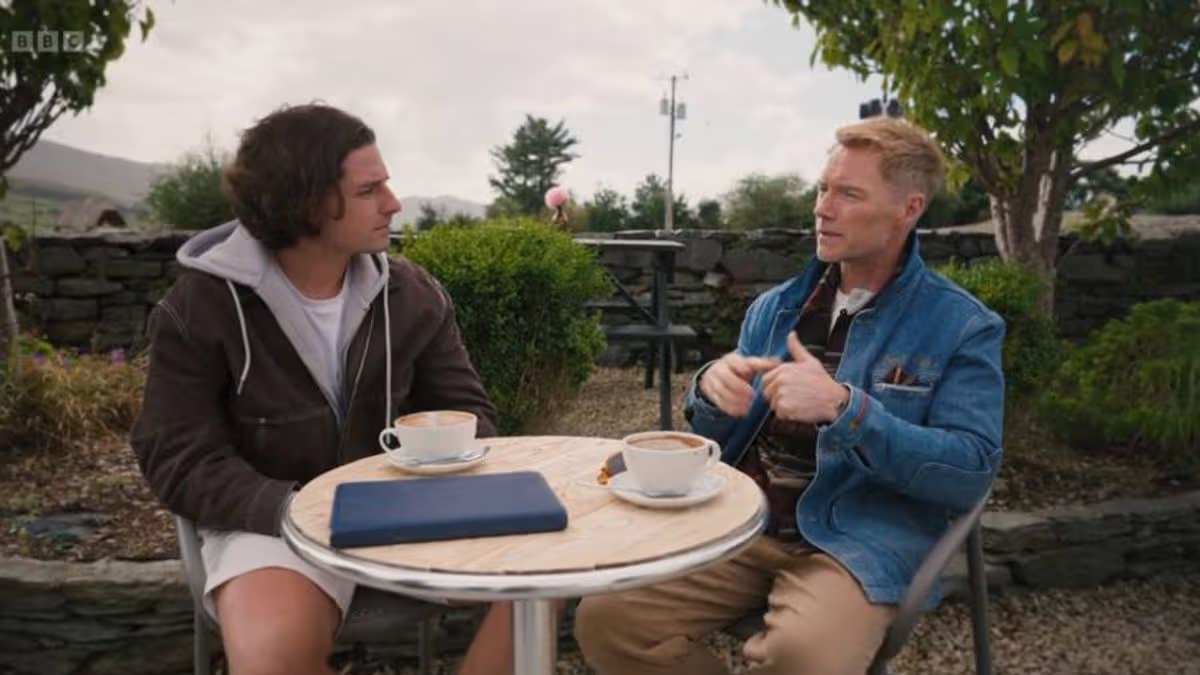
During Friday’s (April 3) instalment of The One Show, footage from Ronan Keating’s Wild Atlantic showed the musician speaking with his nephew, professional footballer Ruairí Keating, about the passing of his father and Ronan’s sibling, Ciarán Keating.
Ciarán was killed in a road collision in 2023 while travelling to watch his son play football, with his wife Annemarie sustaining serious injuries.
In a deeply moving exchange, Ronan disclosed that “our lives haven’t been the same” following his brother’s death, describing him as his “hero”, reports the Irish Mirror.
The Life Is A Rollercoaster performer said: “I’ve kind of parked my emotions for the last two years. I haven’t been able to really deal with it, with the loss.
“And I think this journey that I’m on is me trying to understand more, so that I can somehow grieve and let go because I found it very hard.”
Fighting back emotion, Ronan added: “He was so proud of you and he will still be so proud of you in everything that you’re doing. All of you kids, you were his world.
Advertisement
“I never get to say it but like, I was the baby. He’s my hero. I’ve very hard.”
Ciarán’s son Ruairí also revealed that he continues to “looks up” while playing football and thinks he can still spot his late dad amongst the spectators, and confessed the “hardest part” is no longer witnessing his father’s name appear on his phone following each match.
Ronan proceeded to explain that his brother served as his motivation for undertaking Wild Atlantic as a venture.
Advertisement
He previously stated: ‘It started as a celebration of the west coast of Ireland, the Wild Atlantic Way, the cliffs, the beaches, the people.
“I spent so many summers there, so it already meant a lot to me but as we began filming, it naturally evolved into something more personal.”
Alluding to Ciaran’s decision to reside on the west coast, Ronan continued: “So the journey became about understanding that decision, what drew him there, what he found there.”
Advertisement
‘It turned into a very emotional and very beautiful exploration of his love for that part of Ireland mine too.”
The One Show and Ronan Keating’s Wild Atlantic are available to watch on BBC iPlayer
One crew member has been rescued and the search continues for the second pilot after a U.S. F-15 fighter jet was shot down over Iran, the first aircraft downed in Iranian territory since the war began nearly five weeks ago.
The jet, flown by a two-member crew, was shot down by Iranian forces around 6:45 a.m. ET on Friday and a rescue mission was quickly launched. One of the pilots, who had ejected before the aircraft went down, was rescued by U.S. forces, two U.S. officials have told CBS News. The pilot is alive and receiving medical attention, officials said.
U.S. forces are racing to recover the second pilot, a weapons system officer, before Iranian forces can reach them. Israel is helping the United States with the search and rescue operation.
Meanwhile, an Iranian news anchor has urged residents to hand over any “enemy pilot” to police and promised a reward for anyone who did. An on-screen crawl earlier urged the public to “shoot them if you see them”, referring to social media footage circulating of what appeared to be U.S. aircraft in the area.
Advertisement
The incident marked a major escalation in the conflict just two days after President Donald Trump said in a national address that the U.S. has “beaten and completely decimated Iran” and was “going to finish the job, and we’re going to finish it very fast.”
A U.S. Air Force F-15E Strike Eagle aircraft was shot down over Iran (File photo) (via REUTERS)
In a brief phone interview with The Independent, the president said he could not comment on what his course of action might be if Iranian forces get to the downed airman.
“We hope that’s not going to happen,” said the president, who ended the call shortly thereafter.
Hours after Trump was briefed on the development, the president made no mention of the incident as he took to Truth Social, writing: “KEEP THE OIL, ANYONE?”
But when asked about it during a brief interview with NBC News, Trump said that the downing of the US fighter jet would not affect any negotiations with Iran.
Advertisement
“No, not at all. No, it’s war. We’re in war,” he said on the call.
He declined to discuss the ongoing search and rescue mission.
Earlier Friday, Iranian state-linked media outlets reported that helicopters were deployed to search for the downed jet’s crew, though there were conflicting accounts about their origin.
The Fars news agency said it was unclear who operated the aircraft, while Tasnim reported they were American and claimed at least one helicopter was forced to retreat after coming under fire. Tasnim also said a US C-130 Hercules aircraft was involved in the operation.
Advertisement
Mizan, an outlet affiliated with Iran’s judiciary, reported that an American rescue mission was active and published images it claimed showed U.S. aircraft in Iranian airspace.
Iranian officials called on civilians to be on the lookout for survivors, according to Reuters. The governor of Iran‘s Kohgiluyeh and Boyer-Ahmad province said whoever captured or killed the crew “would be specially commended,” according to the semi-official Iranian news agency ISNA.
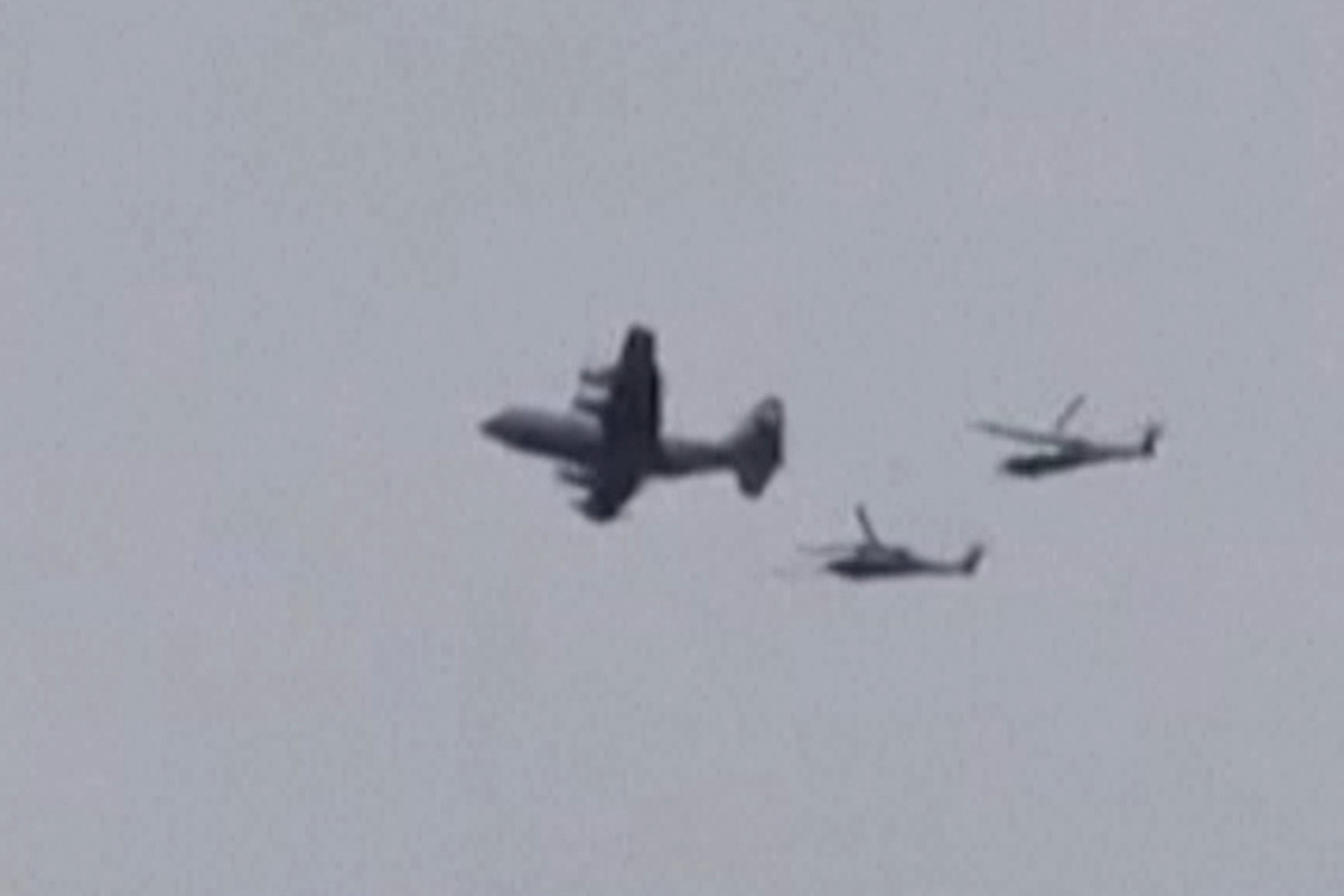
This video grab taken from UGC images posted on social media on April 3, 2026 show a US aircraft, followed by two helicopters, flying over the town of Zaras in the southern Iran’s Khuzestan province (UGC/AFP via Getty Images)
The incident comes as the US and Israel continue to deliver strikes against Iran (AFP via Getty Images)
The incident could represent a significant political complication for Trump, who suggested in a primetime address to the nation this week that the war was ending and that Iran’s military capability had been all but destroyed. He nevertheless said the US-Israeli bombardment would continue for “two or three weeks”.
“With a little more time, we can easily OPEN THE HORMUZ STRAIT, TAKE THE OIL, & MAKE A FORTUNE. IT WOULD BE A “GUSHER” FOR THE WORLD??? President DONALD J. TRUMP”
Advertisement
Iran’s attacks on Gulf energy infrastructure and its tight grip on the Strait of Hormuz, through which a fifth of the world’s oil and natural gas transits in peacetime, have roiled stock markets, sent oil prices skyrocketing, and threatened to raise the cost of many basic goods, including food.
Trump has threatened further escalation, warning of potential strikes on Iran’s energy grid if the strait is not reopened. Iranian officials have rejected negotiations under current conditions.
“Bridges next, then Electric Power Plants!” he wrote on social media late Thursday. “New Regime leadership knows what has to be done, and has to be done, FAST!”
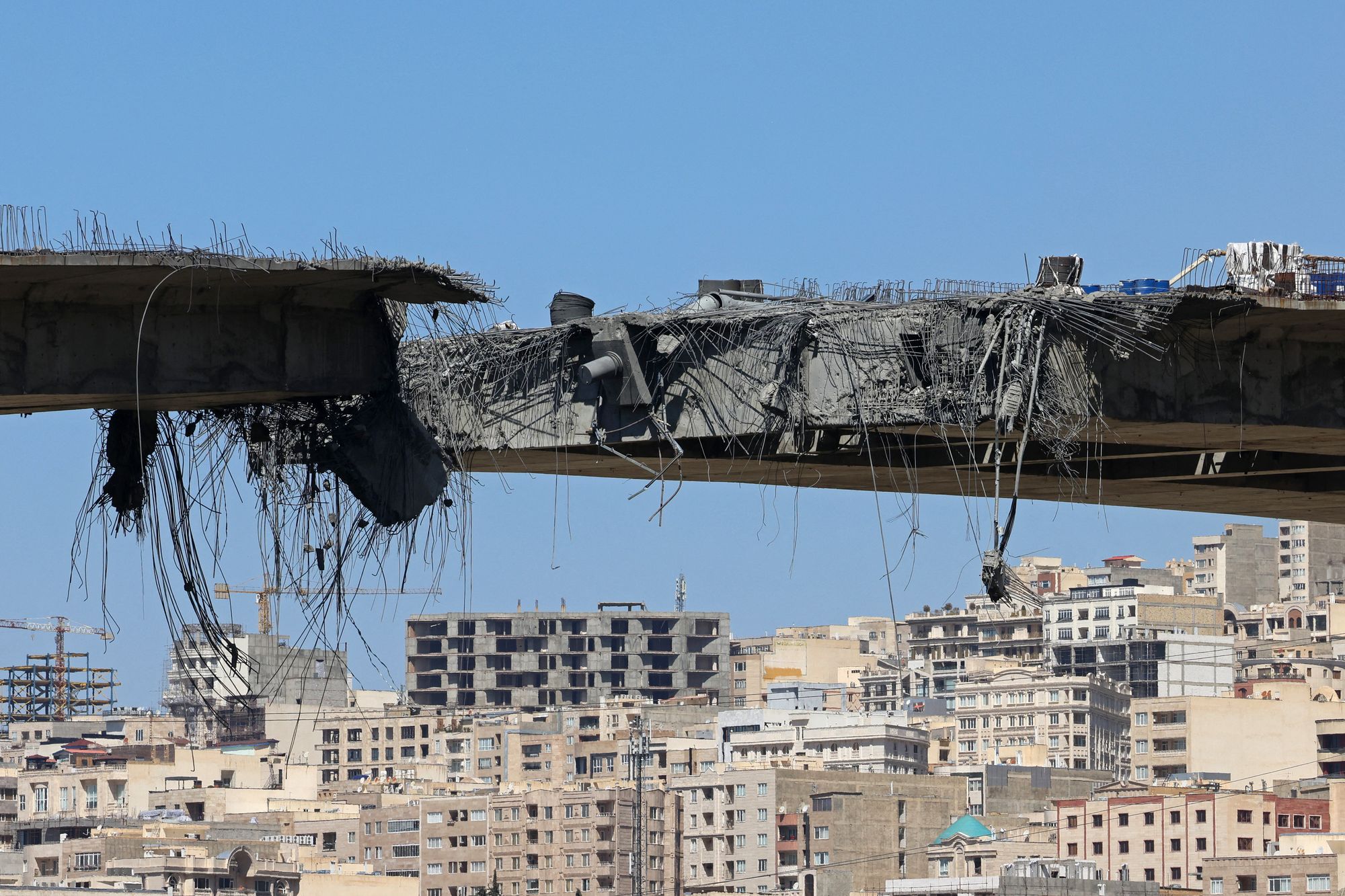
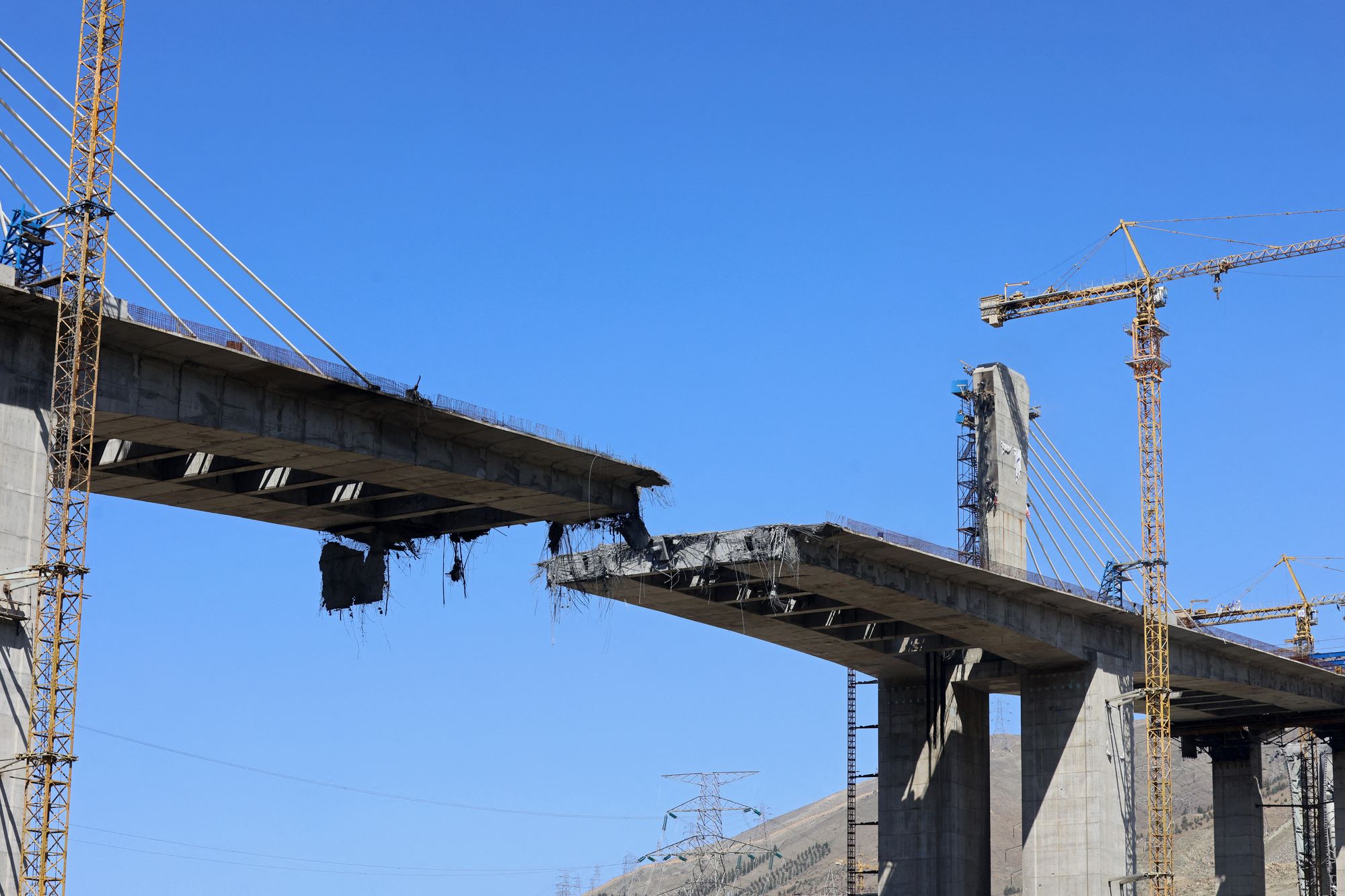
On Friday, Trump celebrated the bombing of an Iranian bridge, as he warned on social media that there was “much more to follow.” Footage showed the moment the B1 bridge in Karaj, west of Tehran, was cut in half by the strike on Thursday. The attack killed eight people and wounded 95, Iranian news media reported.
Advertisement
A view of the B1 bridge is pictured, a day after it was destroyed by a strike in Karaj, southwest of Tehran (AFP via Getty Images)
Today’s incident is the first U.S. or Israeli jet to have been shot down over Iran since the war started. Three U.S. F-15E Strike Eagle jets were downed by friendly fire over Kuwait in March. None of the aircrews were injured.
More than 1,900 people have been killed in Iran since the war began on 28 February with U.S. and Israeli strikes, the Associated Press reported. In a review released Friday, the Armed Conflict Location and Event Data, a U.S.-based group, said it found that civilian casualties were clustered around strikes on security and state-linked sites “rather than indiscriminate bombardment” of urban areas.
More than two dozen people have died in Gulf states and the occupied West Bank, 19 have been reported dead in Israel, and 13 U.S. service members have been killed. More than 1,300 people have been killed and more than 1 million displaced in Lebanon. Ten Israeli soldiers have also died there.
Performance 28, based on the Drum Industrial Estate, has become the go-to showroom for professional footballers hunting for prestige, sports and American muscle cars.
Among the top-flight names linked with the business are Newcastle United stars Dan Burn and Lewis Miley, along with former Magpies goalkeeper Tim Krul.
Dan Burn’s partnership with Performance 28
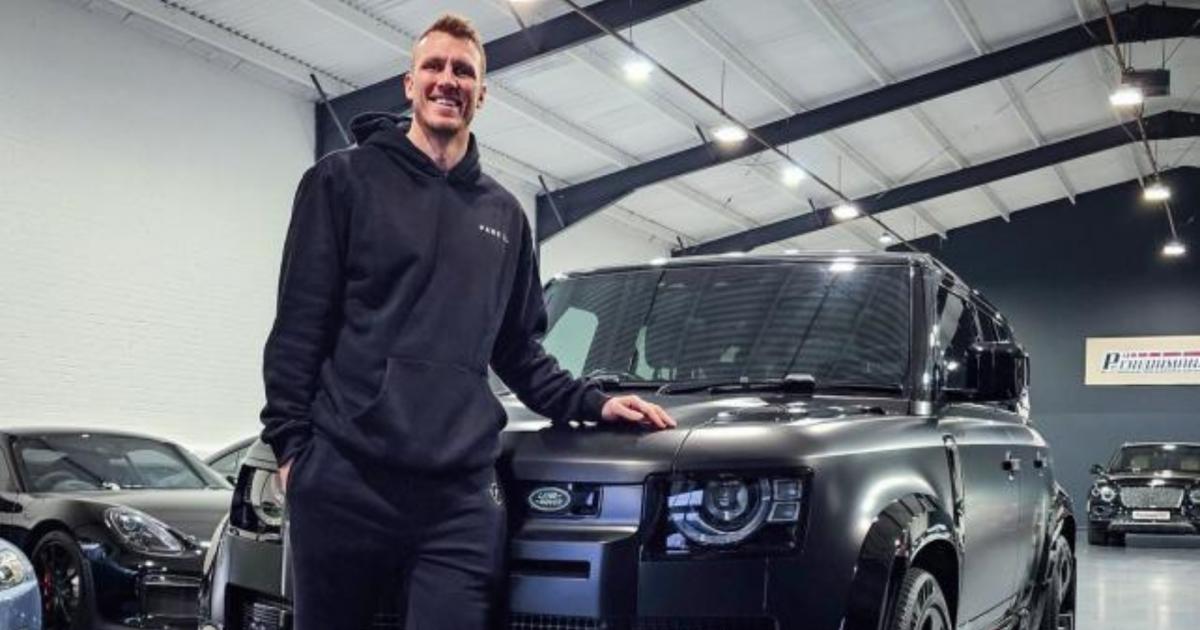
Blyth-born defender Dan Burn – who stands at an imposing six foot six – made a visit to Performance 28 late last year for more than just a new car collection.
The dealership revealed on its social media channels that it had entered into a sponsorship deal with the Newcastle United defender, handing over a custom Dodge Challenger Hellcat as part of the partnership.
Advertisement
Dan Burn (Image: PERFORMANCE28)
Tim Krul’s long-standing link with the showroom
Dutch goalkeeper Tim Krul, who now plays for Luton Town, is another player with long ties to the County Durham dealership.
Krul stopped by Performance 28 ahead of Luton’s Championship clash with Sunderland last year – but his connection with the business stretches back decades.
Managing director Tony Thomson has been supplying cars to Krul since he was just 18 years old, building a relationship that has lasted through the keeper’s career at clubs across England.
Tim Krul (Image: PERFORMANCE28)
Lewis Miley upgrades before a memorable Leeds clash
Rising Newcastle United star Lewis Miley, 19, is also among the dealership’s loyal customers.
Advertisement
The Stanley-born youngster was spotted at Performance 28 in January this year, only hours before starring in the Magpies’ thrilling 4–3 win over Leeds United.
Tony Thomson praised the teenager’s enthusiasm for cars, describing him as a “lovely, down-to-earth lad” with a passion for AMG Mercedes models.
“We’ve sold Lewis a few cars now, and he and his family are really good customers,” Tony said. “He’s enthusiastic about his cars, always open to our input, and loves creating something unique.”
Advertisement
While it may not always make national headlines, Performance 28 has built a strong reputation across the North East and beyond.
The Chester-le-Street dealership’s mix of luxury show models, bespoke customisations and personalised service has made it a trusted name among professional athletes and car enthusiasts alike.
With its growing celebrity clientele and eye-catching fleet, it’s no surprise that Performance 28 is now known as County Durham’s home for high-performance luxury.
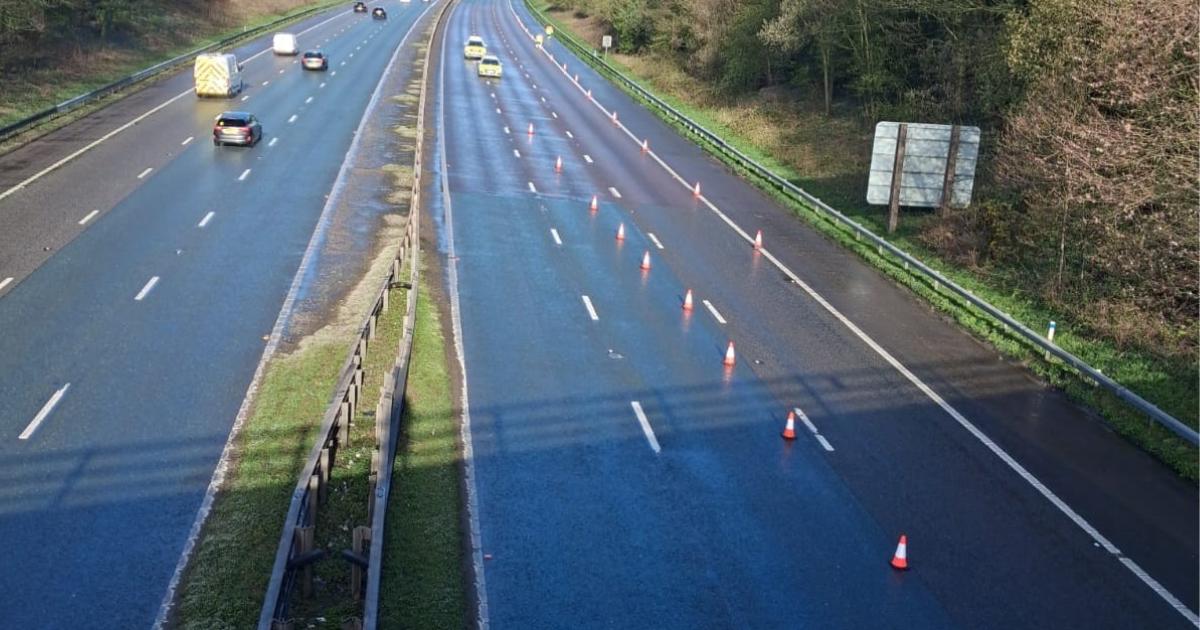
A petition has been set up urging authorities to enhance the barriers on the M61 motorway bridges, but work was not ultimately carried out.
Mr Bullen revived efforts to install greater safety measures after last week’s incident, though he had been in contact with National Highways prior to this.
“There was something about three months ago that really spurred me on to look into this,” said Mr Bullen.
Advertisement
“I was having a drink with my wife in one of the Over Hulton pubs and this guy came in.
“He’d seen a woman on the bridge and managed to jump out of his car and grab hold of her.
“We were all shocked.”
National Highways assured him that the motorway bridge was on their radar and was due for safety upgrades, but that other areas with even high numbers of incidents must come first.
Advertisement
National Highways plan to heighten the parapets, with each installation costing around £1m.
Other safety installations have recently taken place at three locations along the M602 in Salford, Greater Manchester.
A National Highways spokesperson said: “Everyone’s safety on our network matters to us. We recognise the wide reaching and devastating impact of suicide for both individuals and communities.
“We work closely with groups like Samaritans, the police, local authorities and other partners and routinely review incidents to see what more might be done to help people in crisis.
Advertisement
“There isn’t a single solution that works for every situation – for example there can be complicated technical challenges involved in altering bridge structures – however, whenever we become aware of any incidents, we carefully review the options and take practical steps to address them whenever we can.”
When life is difficult, Samaritans are here to listen – day or night, 365 days a year. You can call them for free on 116 123 or visitsamaritans.org.
To be known as the BMW i3 it will be fully electric and have a range of more than 500 miles on a single charge.
In this instalment of Drive Time, John previewsthe exciting all-electric BMW i3, which is being produced at the company’s Munich plant, and discovers the extended range version of the Nissan Micra now qualifies for the full UK EV grant.
Advertisement
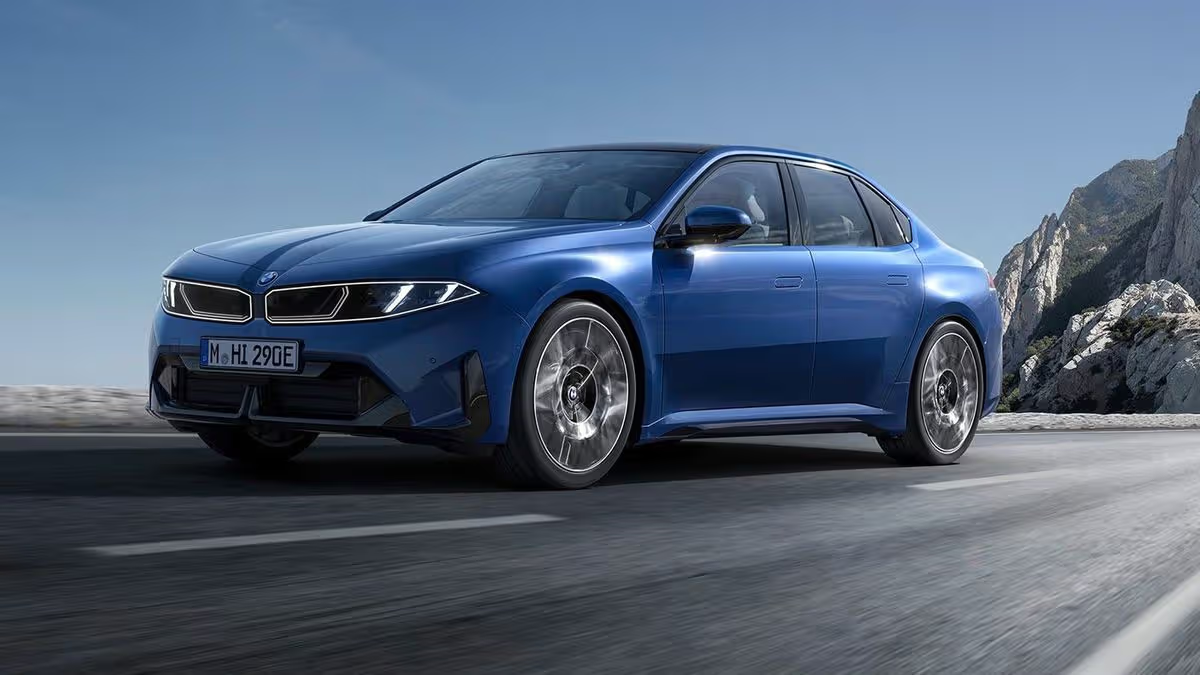
A brand new BMW 3 Series has been announced as the second Neue Klasse model in the German brand’s portfolio.
To be known as the BMW i3 it will be fully electric and have a range of more than 500 miles on a single charge.
BMW says it will have precise handling thanks to a ‘superbrain’ system that will be responsible for all driving functions.
The BMW i3 launches with the 50 xDrive model variant, which is powered by two electric motors which drive the front and rear axle to develop a combined system output of 469 hp and 645 Nm of torque.
Advertisement
It can be charged at speeds of up to 400kW at an 800-volt DC charging station to drastically reduce charging times.
The result is up to 250 miles in just 10 minutes.
This capability is enabled by sixth-generation BMW eDrive technology, which teams highly efficient electric motors, 800-volt technology and new high-voltage batteries with energy-dense cylindrical cells.
Instantly recognisable as a 3 Series, the BMW i3 offers a modern interpretation of the hallmark BMW Saloon design with its new silhouette.
Reduced to the essentials, its design is characterised by a long wheelbase with short overhangs, precise lines and a sloping roofline.
Inside, there is a sporty and contemporary cockpit which is optimised around the driver.
Positioned front and centre is the BMW Panoramic iDrive, which consists of four key components – the BMW Panoramic Vision display, the optional BMW 3D Head-Up Display, the driver-oriented Central Display and the new multi-function steering wheel – helping drivers to keep their hands on the wheel and eyes on the road.
Advertisement
Drivers will be able to customise the interior and exterior of their BMW i3 with different trim levels, including M Sport, following its success within the UK market.
The front-end is sculpted in a sporty shark-nose design and centred around a reimagined horizontal kidney grille, where twin headlights merge with an innovative light signature.
The side profile features pronounced wheel arches, retractable flush door handles that extend automatically, and bold lines that flow to the rear where there’s a refreshed BMW roundel.
The new BMW i3 will be built at the home of BMW Group, Plant Munich, which has been producing premium vehicles for over a century.
Over the last four years, the production plant has seen significant modernisation with the construction of a new body shop, cutting-edge assembly facility and logistics space.
Production will commence in August 2026, with first UK customer deliveries expected in late autumn.
A year later, Munich’s production portfolio will switch to fully electric vehicles of the Neue Klasse.
Advertisement
Further information, including UK pricing and detailed model specifications will follow nearer the launch date.
Meanwhile, long range versions of the all-new Nissan Micra now qualify for the full £3750 UK Electric Car Grant thanks to a new Europe-sourced battery.
The Micra 52kWh – which is built at the ElectriCity car production hub in northern France – will be priced from £23,245 with the higher Electric Car Grant applied.
First UK customer deliveries of the new city car are scheduled to take place in the coming weeks, with Nissan confirming that both existing and future customer orders for the Micra 52kWh will qualify for the full EV discount.
Advertisement
Micra 40kWh versions also continue to qualify for the lower £1,500 Electric Car Grant.
James Taylor, managing director of Nissan GB, said: “Our new battery supplier means our longer-range Micra 52kWh now qualifies for the full £3750 Electric Car Grant, ensuring great value for money for our customers.
“It also means that both of our new model launches so far this year – Micra and Leaf – are available with the maximum EV grant discount, demonstrating Nissan’s continued leadership in providing accessible and exciting electric cars for people keen to switch to zero emission motoring.”
Advertisement
As a compact city car with over six million units sold globally, the new, sixth-generation electric Micra marks a bold step forward for Nissan’s electrification strategy.
Combining affordability, innovation and everyday practicality, the Micra also features advanced in-car technology including Google Built-in and the NissanConnect Services app.
Available with two battery options, the range starts with a 40kWh model capable of up to 196 miles on a single charge.
This model qualifies for the lower £1500 Electric Car Grant and is priced from £21,495.
The longer-range Micra 52kWh model can travel up to 257 miles on a single charge and is priced from £23,245 including the higher £3750 Electric Car Grant.
*Don’t miss the latest headlines from around Lanarkshire. Sign up to our newsletters here.
And did you know Lanarkshire Live had its own app? Download yours for free here.
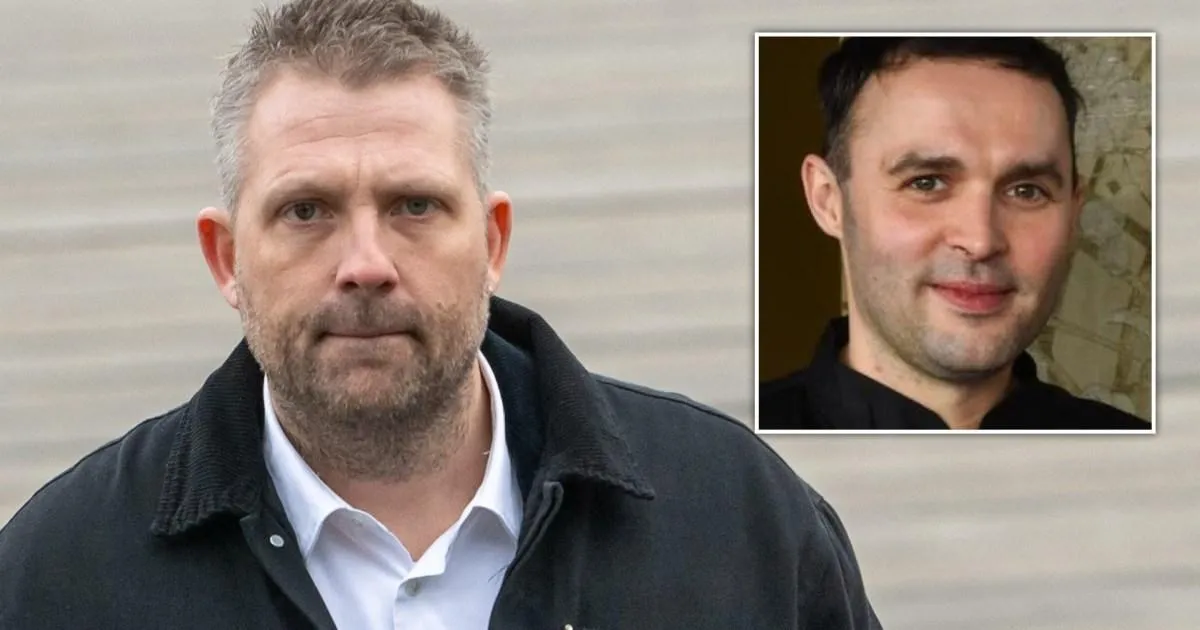
Chef Nick Bril (left) ran over his intern after a staff party, leaving him in a coma for almost two months
A British intern had to have a double amputation after a Michelin-star chef drove over his legs with an SUV.
Joe Claridge, 39, suffered life-changing injuries after the chef Nick Bril ran over his legs following a staff party in Antwerp, Belgium.
Mr Claridge, a sous chef, was interning for Bril, who runs a two-star restaurant, when the catastrophic crash happened on January 8, 2024.
It unfolded when Bril backed his Land Rover Defender before driving it forward, going over Mr Claridge who lay on the ground outside The Jane, the luxury eatery owned by the high-profile Dutch chef.
Advertisement
Chef Nick Bril arriving at a hearing in December last year over the crash, which left Joe Claridge with life-changing injuries (Picture: Nicolas Maeterlinck/Belga/Shutterstock)
The intern suffered catastrophic injuries and was in a coma for 50 days before having both of his legs amputated, the Sun reports.
While the court deemed the crash was an accident, prosecutors accused the chef of not acting quickly enough in the aftermath.
The emergency services were allegedly only alerted after a jogger urged Bril to call for help at about 6am.
The prosecutors said: ‘Without the jogger, he would probably have gotten back into the car and driven away.’
Advertisement
Bril was accused of being unusually silent at the scene when paramedics tried to find out what had happened.
The judge found that his ‘knowing and wilful’ silence with the emergency services amounted to a kind of hit-and-run.
He was found guilty of leaving the scene and failing to report what had happened, and cleared of deliberately driving over Mr Claridge.
The judges said he could ‘not have foreseen the accident and did not intend the consequences.’
Advertisement
Bril, who admitted wrongdoing at the trial, said he can ‘only imagine how the last few years have unfolded’ for Mr Claridge.
The chef was given a 12-month suspended sentence and a four-month driving ban.
Mr Claridge, who has a young son, has reportedly moved to the island of Jersey with his family following the accident, where he spent a week in hospital in December, unable to attend an earlier court hearing.
His lawyer said he and his family have moved to an adapted house on the island, according to the Belgian outlet Het Laatste Nieuws.
Advertisement
Compensation to Mr Claridge was first set at a symbolic €1 (£0.87), with the full amount due to be set at a later date.












































You must be logged in to post a comment Login