Connect with us

NewsBeat

Man dies after crash with lorry trailer on A14

Published

on

Cambridgeshire Live

Police are appealing for more information.

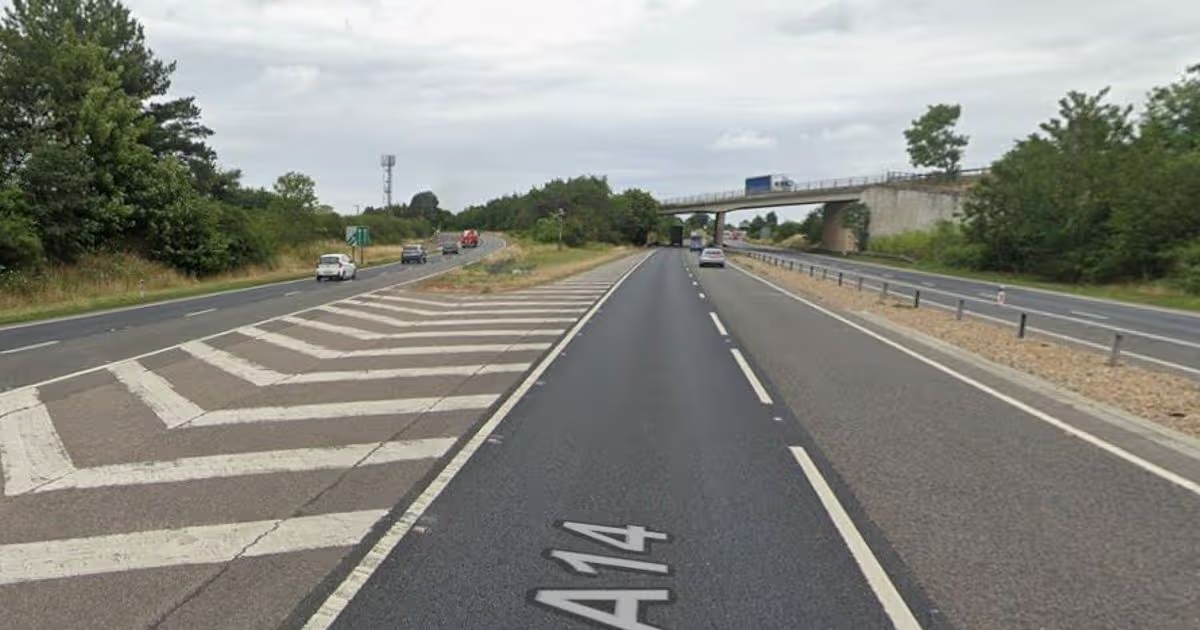
A man has died after a crash on the A14 in Cambridgeshire. Emergency services were called to the A14 westbound between J38 of the A11 and J39 at Kentford at around 6.40pm on Wednesday (January 28).

Advertisement

A red Suzuki motorbike was involved in a crash with the trailer of a silver Mercedes lorry parked in a layby. The rider of the motorbike, 53-year-old man from Wicken, was pronounced dead at the scene.

The lorry driver is helping police with the investigation. A police spokesperson said: “Officers are appealing for witnesses and dashcam footage after a motorcyclist died in a collision on the A14.”

Anyone with information should contact police online or call 101 and quote incident 434 of January 28.

Do you want more of the latest Cambridgeshire news as it comes in from across the county? Sign up to our dedicated newsletter to make sure you never miss a big story from Cambridge or anywhere else in the county. You can also sign up to our dedicated Peterborough, Traffic and Crime newsletters for the latest updates on the topics you are most interested in .

Advertisement

Source link

Continue Reading
Click to comment

Leave a Reply

Your email address will not be published. Required fields are marked *

NewsBeat

All-purpose buttery cookie dough recipe

Published

on

All-purpose buttery cookie dough recipe

Halve the dough. If you want to roll out the dough and stamp out shapes with a cookie cutter, shape into two discs. Alternatively, if you want to make sliced cookies, roll the dough into two logs. Either way, wrap in cling film and chill for at least two hours and up to two weeks (or keep the logs in the freezer for up to two months and slice and bake from frozen).

Source link

Continue Reading

NewsBeat

Why asking ‘Was Jane Austen gay?’ still causes controversy

Published

on

Why asking ‘Was Jane Austen gay?’ still causes controversy

Would Jane Austen have even understood the question of whether she was gay? Michel Foucault, French theorist and author of The History of Sexuality (1976), would answer: “Non”.

Foucault argues that, even though homosexual acts had been performed in the past, homosexuality as an identity did not develop until the later 19th century. Before then, you could do homosexuality, but you couldn’t be a homosexual. That’s because homosexuality as an identity didn’t exist yet.


Anne Lister, a contemporary of Austen’s who wrote coded diaries about her sexual liaisons with women and is now often hailed as the first modern lesbian, might disagree with Foucault. But it is unlikely that Austen thought of herself as gay.

In 1995 the London Review of Books (LRB) ran a review of Deidre Le Faye’s monumental edition of Austen’s letters. The piece, written by US literary critic Terry Castle was called Sister-Sister, but it was cheekily retitled “Was Jane Austen Gay?” on the cover. In her article, Castle suggested that Austen appears mainly dismissive of men in her correspondence, and was similarly dismissive of the various proposals she is said to have received.

Advertisement

Castle’s review, especially the LRB’s provocative retitling, caused a storm in a teacup of Austenian proportions. Readers of the LRB and Austen scholars fell into a fury of scandalised incomprehension, trading competing interpretations of Austen’s private life and public writing.

For Castle, Austen’s most significant relationship was with her sister, Cassandra. Her nuanced argument about the erotics of this relationship was brought to life recently in a collaboration between the LRB and City of London Sinfonia in London’s Covent Garden, the event’s name recalling the LRB coverline for Castle’s essay.

A programme from the event.
City of London Sinfonia, Author provided (no reuse)

Becoming Jane and friends

A one-off show which was part of the LRB and City of London Sinfonia’s Ideas in Concert series, Was Jane Austen Gay? brought to life Castle’s essay and the tumultuous response to it. Actresses Claudie Blakley, who played Charlotte Lucas in the 2005 Pride and Prejudice, and Lost in Austen’s Jemima Rooper read out Castle’s essay, as well as letters from, to, and about Austen. A concert mixing songs from Austen’s own music collection with modern-day Austen film soundtracks accompanied the staged reading.

The show began and ended with Castle’s bewildered response to the brouhaha that erupted over her argument on Austen’s inner life. “Surely,” bemoans Castle, “literary critics writing in the London Review are still allowed to speculate about such things”. As Blakley and Rooper demonstrated in the reading of Castle’s essay, Castle herself was not above a little childishness – malevolence, even.

Advertisement

She describes – deliciously – Cassandra’s portrait of Jane as having eyes like “small astigmatic raisins”. So mean, and so Austen-like! And she also ventriloquises a taboo wish, which she detects running through writing on Jane and Cassandra: “Why did Jane have to be the one to die?”

Blakley and Rooper performed Castle’s essay in different voices, affecting an American twang for the critic’s rueful response to her British reception. They also alternated between breathless excitement for Jane, mournfulness for Cassandra, and pomposity for Austen’s family biographer James Edward Austen-Leigh.

There were voices, too, from Austen’s fiction, including Northanger Abbey’s Henry Tilney, an “unheterosexual” (to borrow critic D.A Miller’s phrase gentleman with a fondness for fine fabrics, and Emma, erotically enamoured with Harriet Smith.

The evening allowed for a deeper dive into Austen’s letters, as well as a taster of Anne Lister’s, and took great delight in dramatising the aftermath of Castle’s essay, often very funnily. This included a letter from the Independent’s arts correspondent castigating Terry Castle’s prurience, while mistaking her for a man. The LRB editors laconically responded: “We wonder what Ms McDonald would have written had she been alert to the fact that Terry Castle is a woman.”

Advertisement
Some musicians and singers on stage.
The City of London Sinfonia set the Jane Austen brouhaha to music.
Dale Wightman

Alexandra Wood, violinist and creative director of City of London Sinfonia, brought together a wonderful ensemble to provide a musical counterpoint to Blakley and Rooper’s dramatised reading of Castle’s essay. When Blakely and Roper discussed Jane’s flirtatious style in her letters to Cassandra, the music teased and flirted with the audience.

Another letter published in the wake of Castle’s essay, by the great Austen scholar Claudia Johnson – sadly overlooked in this event – begins: “Is she prudish? – is she queer?” Johnson playfully shifts focus from Austen’s sexuality to the oddness of one of her character’s here. Fanny Price is “queer” because she is immune to the dubious charms of Henry Crawford, who is asking these questions about her in Mansfield Park.

Reviewing attitudes to Austen’s sexuality that run the gamut from frigid to lesbian, Johnson defends Castle’s argument that sisterly bonds are among the most powerful in Austen’s writing. She expresses a preference for the naughty Austen glimpsed in her letters to Cassandra and available as a narrative voice – mischievous, stylish, “unheterosexual” – in her novels.

It is a voice that finds excitement and enjoyment by pressing at the confines of the marriage plot, which enforces a kind of normative heterosexuality on proceedings. It laughs at the misunderstandings and miscommunications that seem to bedevil all the actual marriages in Austen’s novels, and sides with characters like Henry Tilney, Emma Woodhouse and Fanny Price, who stand apart from these heterosexual demands, desiring otherwise.

Like Johnson, along with Castle and the organisers of “Was Jane Austen Gay?”, I find this naughty Austen more seductive than alternative visions of her as a heteronormative moraliser. Reading Austen’s novels queerly opens them up as works with surprising and subversive things to say about how to live and think and write. Even if Austen herself did not – and could not – think of herself as a homosexual, her writing invites queer interpretations, celebrating the mischievous, the stylish, and the “unheterosexual”.

Advertisement

Rather than asking “Was Jane Austen Gay?”, perhaps we should ask, “How can we read Austen today?” The original Castle essay and the LRB/CLS event named after it provide ways to do just that, thinking about Austen speculatively, wittily, and musically.

This article features references to books that have been included for editorial reasons, and may contain links to bookshop.org. If you click on one of the links and go on to buy something, The Conversation UK may earn a commission.


Looking for something good? Cut through the noise with a carefully curated selection of the latest releases, live events and exhibitions, straight to your inbox every fortnight, on Fridays. Sign up here.


Source link

Advertisement
Continue Reading

NewsBeat

Spring-like weather in the UK

Published

on

Close-up of a bee covered in pollen on a violet crocus.

On Tuesday, temperatures in High Beach in Essex and Frittenden in Kent reached 16.6C.

In Kinloss, in Moray, 13.7C was recorded.

In Wales and Northern Ireland, temperatures fell a little short of those recorded at the weekend but still reached 15.2C and 13.4C in Hawarden and Helen’s Bay respectively.

The mercury could rise a little further still on Wednesday in south-east England with a small chance of 18C (64F) in the best of the sunshine. Northern Ireland may also be a little warmer than on Tuesday, following a wet start.

Advertisement

In the north and west of the UK there will be more cloud and some rain, but temperatures even here will still be above average.

To put this warmer weather into context – the last time the temperature reached 18C was 13 November 2025, and the record for February is 21.2C (70.2F) on 26 February 2019 at Kew Gardens.

Wednesday is likely to be the peak of the warmth this week, with temperatures back to near average on the last day on February and a possible frost for many on Friday night.

Source link

Advertisement
Continue Reading

NewsBeat

Idaho woman charged in connection with stolen ambulance that was driven into building housing DHS

Published

on

Idaho woman charged in connection with stolen ambulance that was driven into building housing DHS

A Boise, Idaho woman has been charged with malicious destruction of federal property by fire after prosecutors said she stole an ambulance, drove it into a building that houses U.S. Department of Homeland Security offices and then poured accelerant inside the property.

Sarah Elizabeth George, 43, was scheduled to be arraigned Tuesday afternoon in U.S. District Court in Boise.

In court documents, FBI special agent Daniel Ramirez said a suspect believed to be George stole a Canyon County Paramedics ambulance from St. Luke’s Hospital Emergency Center in the Boise bedroom community of Meridian late on Feb. 18. Ramirez said the suspect then drove the ambulance to a nearby parking lot, loaded at least two gas jugs and a plastic bag into the vehicle and then drove the ambulance through the front doors of a nearby office building before getting out and pouring the contents of the jugs on the lobby floor.

The building is owned by St. Luke’s Health System and the hospital has faced criticism for leasing space in the building to the Department of Homeland Security while President Donald Trump’s administration carries out his immigration enforcement crackdown.

Advertisement

Messages were left Tuesday for a public defender listed as George’s attorney and at a number listed for George.

Meridian Police Chief Tracy Basterrechea said during a press conference shortly after the incident that responding agencies apparently scared off the suspect before the accelerant was ignited. Police were unable to locate the suspect at the time, but Ramirez wrote in court documents that investigators were able to identify George after reviewing footage from closed-circuit cameras in the area. Camera footage and receipts from stores in the area also showed George purchased gas jugs and gas shortly before the ambulance was stolen, Ramirez said.

George’s Facebook page included a post with the words, “If it can be destroyed by the truth then it should be destroyed; it was built in lies anyways,” above an image depicting the White House in flames, Ramirez wrote in court documents.

George is also charged with malicious destruction of property used or affecting interstate or foreign commerce, according to court documents. She has not yet had the opportunity to enter a plea.

Advertisement

Each charge carries a maximum penalty of up to 20 years in prison.

Source link

Continue Reading

NewsBeat

our financial model can better illustrate long-term value

Published

on

our financial model can better illustrate long-term value

When deciding whether to invest in environmental projects, it’s important to consider the economic value of any long-term benefits.

Whether climate solutions (such as offshore wind power or solar farms) are recognised as valuable or worthless depends very much on which economic model is used to evaluate it.

If the present value of the benefit (calculated by using a widely accepted financial model called “exponential discounting”) is too small compared to the cost, it may seem to damage the economy too much.

As a mathematician researching in finance, my study shows how it is possible to use another financial model called “social discounting” to value the long-term benefits far into the future. My colleague and I have demonstrated that a perfectly consistent valuation method can be established using social discounting.

Advertisement

Exponential discounting is commonly used to calculate the present value of a future benefit. Banks use this all the time to calculate the value of products linked to interest rates. Exponential discounting tells us how much to put in an account now to reach that future value – it incorporates how, when interests accumulated overnight are instantly put into the account, those interests will accumulate additional interests.

Social discounting is another way of calculating the present value of future, long-term benefits such as the prevention of drought, forest fire, or the submersion of coastal cities.

A recent University of Exeter report titled Recalibrating Climate Risk highlights a range of shortcomings in how traditional economic models are applied to climate issues.

While it makes sense to use exponential discounting if the future beneficiary of the decision made today is the same person who is making the decision, that isn’t always the case when they are different.

Advertisement

The benefits of long-term social projects for sustainable energy or climate change may only arise in 100 years. By using an exponential discounting model, a large benefit occurring in the distant future will be assigned an unfairly low value right now. This won’t be enough to justify the costs involved in funding the project, so the project might not get off the ground.

Given that future generations have no say on choices made by society today, it seems unfair to heavily discount their future benefits. Nevertheless, there is a strong argument, most notably advocated by the climate economist and Nobel laureate William Nordhaus, that investment in climate projects should be treated like any other investment; subject to the usual exponential discounting.

The Nordhaus argument is widely used to evaluate climate policies around the world. For example, a UK thinktank called the Global Warming Policy Foundation has used it to warn the government against investing in safeguarding future generations. Fossil fuel companies employ versions of the Nordhaus argument to deter public investment in climate policy and focus on the short-term benefits of an economy based on fossil fuel extraction.

Advertisement

Social discounting takes into account the future value of a project or contract.
vectorfusionart/Shutterstock

There is a catch

Leaving aside morale and ethical debates on the use of exponential discounting, a little-known principle in finance shows that the exponential rate of discounting cannot decline over a long time horizon when benefits of climate policies are delivered.

One consequence is that the benefit of long-term social projects to tackle climate change is inevitably heavily discounted in the exponential model. This makes the investment seem less attractive, making it difficult for lawmakers to pass climate bills.

An alternative assessment follows from using social discounting, where the discounting is considerably milder so that the present value of the benefit of a climate policy far in the future may be as significant as the amount of investment required for implementing the policy, making the investment a worthwhile proposition.

In spite of its morale attraction, in the academic literature it was thought for a long time that it is not possible to evaluate future benefits in a consistent way using a social discounting. Without evaluating future benefits in a reliable, consistent way makes it difficult to argue the economic case for a climate investment. But my research shows that it is possible.

Advertisement

There are no economic or financial reasons to circumvent the use of social discounting on the basis of consistency. So it’s time to move on from the old-school economic arguments favoured by the fossil fuel industry and other climate sceptics.

Source link

Advertisement
Continue Reading

NewsBeat

Lord Mandelson’s lawyers say arrest sparked by ‘baseless’ claim he was about to leave the country

Published

on

Lord Mandelson's lawyers say arrest sparked by 'baseless' claim he was about to leave the country

“There is absolutely no truth whatsoever in any such suggestion. We have asked the MPS for the evidence relied upon to justify the arrest. Peter Mandelson’s overriding priority is to cooperate with the police investigation, as he has done throughout this process, and to clear his name.”

Source link

Continue Reading

NewsBeat

Driver thought he was going to die as car flew across the road towards him

Published

on

Wales Online

Shane Davies’ passenger at the time of the crash said it was like he was driving a racing car

Advertisement

A driver thought he was going to die when a Volkswagen Polo came flying towards him on the wrong side of the road. Cardiff Crown Court heard how Shane Davies, 47, had been driving “like a racing driver” in the moments before the collision.

Victoria Maud, prosecuting, told the court how in May 2025 Davies gave two men he knew a lift in his blue Volkswagen. He had been driving “perfect appropriately” and then he dropped the first passenger off and his driving changed.

The court heard how when he turned onto Crumlin Road, between Pontypool and Crumlin, his driving became “extremely concerning” and he was driving over solid white lines and behaving like a racing driver. Don’t miss a court report by signing up to our crime newsletter here.

Davies had been driving on the wrong side of the road when he turned a corner and lost control having driven over something like a pothole or mudhole. Davies’ car floored across the road, turned over, and hit a Volvo which was coming the other way head-on – something the court heard the Volvo driver was “wholly unable to avoid”.

Advertisement

The court heard how Mr Harvey, the driver of the Volvo, suffered extreme damage to his car and significant injuries to his thumb.

Tests carried out following the crash found Davies had drugs from the previous day, which were still breaking down, in his system.

In a victim impact statement, read on behalf of Mr Harvey by Ms Maud, the court heard how he sustained a permanent thumb injury during the collision. “I genuinely believed I was going to be killed as I saw the underside of the car come towards me,” Mr Harvey said.

The victim added how he struggled to believe someone could drive in such a way while giving someone a lift and said it had taken him six weeks to get behind the wheel again and he has since become a very nervous passenger.

Advertisement

The court also heard a statement from Davies’ passenger at the time of the crash, Mr Meredith. “As soon as he turned into Crumlin Road he wasn’t travelling at the speed limit – it was like he was driving a racing car,” he said.

Mr Meredith recalled asking him to stop driving in such a way three times but said it was as though Davies didn’t care. Ensure our latest news and sport headlines always appear at the top of your Google Search by making us a Preferred Source. Click here to activate or add us as Preferred Source in your Google search settings.

Davies, of Offway in Cwmbran, has five previous convictions for 15 offences including two previous driving convictions. Most recently, in 2017, he was convicted of driving while over the drug limit.

Abdallah Barakat, representing Davies, said his client was very remorseful for his actions and said a period of imprisonment would have a negative impact on his children who Davies sees at weekends and during school holidays.

Advertisement

Mr Barakat also said Davies had worked and held down jobs his whole life and told the court his partner of eight years was in the courtroom supporting him.

Davies pleaded guilty to one count of dangerous driving at the earliest opportunity, the court heard.

During sentencing Judge Vanessa Francis said Davies had ignored his passenger’s fears and carried on before his car eventually hit something on the road and crashed head-on with Mr Harvey’s car. She said the crash could have been much worse but the impact had been reduced by the type of car Mr Harvey was driving.

Judge Francis sentenced Davies to 14 months in prison suspended for 18 months. She also ordered that he attends 10 rehabilitation requirement days, completes 80 hours of unpaid work in the community, and has an electronicially-monitored curfew for the next two months.

Advertisement

Davies was also disqualified from driving for two years and must pass an extended driving test before returning to the roads.

Get daily breaking news updates on your phone by joining our WhatsApp community here. We occasionally treat members to special offers, promotions and ads from us and our partners. See our Privacy Notice.

Source link

Advertisement
Continue Reading

NewsBeat

The best scented candles for a cosy home, tried and tested

Published

on

The best scented candles for a cosy home, tried and tested

The sheer range of candles on the market means that you need clear parameters to help you pick one. For Chikumbu, the decision comes down to “three S’s”: scent, style and strength.

Scent

“I like to match the scent to the mood or the season,” says Chikumbu. “I like vanilla or a crisp cedar for all seasons but for autumn and winter, I tend to go smokier and bolder with firewood scents.”

Advertisement

Style

Given candles are items we display, the way they look is just as important as how they smell. For style, Chikumbu likes “maximalist chic” candles. He likes Trudon for this, but if you prefer something more understated, Jo Malone’s Townhouse ceramic pots are elegant, while Pott specialises in refillable candles and holders designed to become part of the furniture.

Strength

“I want to feel the candle scent in the room, so I’m looking for something with a strong throw,” says Chikumbu. “I like a thicker cotton wick, because it burns stronger and throws the flame better.” A thinner wick is more likely to blacken and crumble, while a wooden wick might crackle.

Advertisement

It’s also worth thinking about wax types here: paraffin wax can hold a higher concentration of fragrance oil to make a stronger scent, but you might prefer the cleaner burn of natural waxes, including soy and rapeseed. For more information, consult our frequently asked questions.

Source link

Continue Reading

NewsBeat

Mandelson arrest sparked by ‘baseless’ claim he planned to leave UK, lawyers say

Published

on

Mandelson arrest sparked by ‘baseless’ claim he planned to leave UK, lawyers say

“There is absolutely no truth whatsoever in any such suggestion. We have asked the MPS for the evidence relied upon to justify the arrest. Peter Mandelson’s overriding priority is to cooperate with the police investigation, as he has done throughout this process, and to clear his name.”

Source link

Continue Reading

NewsBeat

Final decision approaching on future of Roselawn crematorium

Published

on

Belfast Live

The crematorium opened in 1961 when expectations were for 700 cremations a year but demand means a new facility is being proposed

A final decision on the future of Belfast’s Roselawn cemetery is approaching after a City Hall committee backed a plan to redevelop the site with a new two-chapel building.

Elected representatives at the council’s Strategic Policy and Resources Committee recently approved a proposal for a new two-chapel crematorium at the current site at Roselawn. The vote, which was taken behind closed doors in a secret meeting away from the public and press, has not been made public, but reportedly was not unanimous, with Sinn Féin showing opposition to the proposal.

The committee decision will go to the next monthly meeting of the full council for ratification, on Monday March 2, where it is expected there will be another vote on the matter.

Advertisement

READ MORE: Graphic abortion posters in Belfast City Centre would be prohibited under proposed byelaws

READ MORE: Belfast City Hall looks at study to improve gritting for pedestrians and cyclists in the city

Belfast City Council first revealed an £18 million plan for a new crematorium five years ago, while funeral directors and families have expressed frustration at the long delay in decision-making at City Hall. It was due to open in 2024, and accommodate 4,500 ceremonies a year. Meanwhile long lists of families using the facility are limited to rushed ceremonies packed into 20 minute slots.

The crematorium opened in 1961 when expectations were for 700 cremations a year, but demand has significantly grown since then in Northern Ireland. Up until 2023 Roselawn had the only crematorium in Northern Ireland, Antrim and Newtonabbey now also provides a service.

Advertisement

Green Councillor Anthony Flynn, who made the proposal for a new two chapel crematorium at the current site at a Belfast Council working group, welcomed the committee decision.

He said: “A few weeks ago I visited Roselawn to meet the staff and see first-hand how services are being delivered. The people working there are doing incredible work. They support families with compassion and professionalism at the most difficult moments in their lives. They deserve real credit.

“But the building itself is no longer fit for purpose. It was designed in the 1960s for a very different Belfast. Since then, our city has grown and changed.

“Funeral practices have evolved. Families now expect more flexibility, more time and more space to grieve in a way that reflects their traditions and beliefs. The current facilities simply cannot meet that demand.

Advertisement

“That is why I have consistently supported a new two chapel crematorium at Roselawn, with a hybrid model that gives families longer service times if they want them. It is about dignity, choice and modern facilities that reflect the needs of today’s Belfast.”

He added: “This week, a committee approved the proposal for the new two chapel site. It will now go to full council for ratification. Some have argued it should be built somewhere else.

“But residents have already waited years for improvement. Delaying again would mean more time, more cost and no better outcome for families who need certainty now. For me, this is simple. Support the staff, support the investment, support families at their time of grief.”

Want to see more of the stories you love from Belfast Live? Making us your preferred source on Google means you’ll get more of our exclusives, top stories and must-read content straight away. To add Belfast Live as a preferred source, simply click here.

Advertisement

Source link

Continue Reading

Trending

Copyright © 2025