

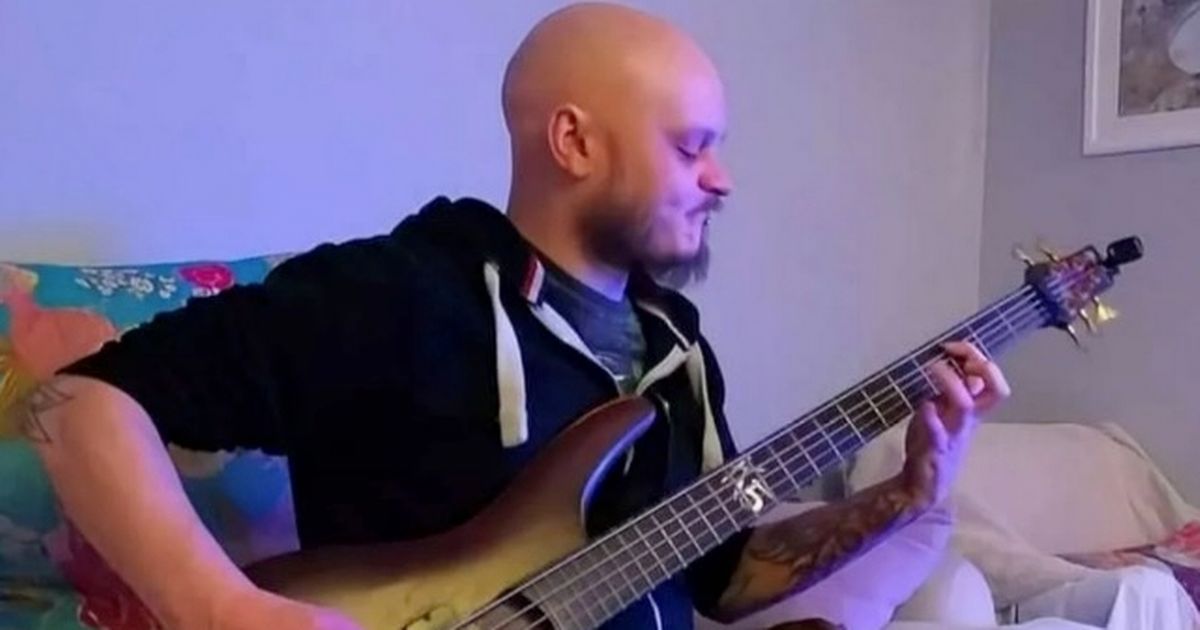
Musician Luke Raggatt, 40, suffered a seizure and fell at the the NHS Royal Cornwall Hospital after a 30-hour wait in A&E – an inquest into his death is now underway
A musician tragically died from a traumatic brain injury after a fall in hospital following a 30-hour A&E wait, an inquest has heard.
An inquest in Truro heard yesterday that Luke Raggatt’s girlfriend pleaded with medical staff at the NHS Royal Cornwall Hospital in Treliske for a brain scan following the fall in October last year, but was told it wasn’t necessary. Speaking before the inquest, an emergency department consultant described not prescribing medication to prevent a seizure as a “real missed opportunity”, and said that Luke had been in the emergency department for “far too long” – over 30 hours – due to “extreme overcrowding”.
Luke, 40, from Redruth, Cornwall, had a history of social anxiety, agoraphobia and depression, alongside long-standing issues alcohol.
READ MORE: Young mum said hospital visit was ‘waste of time’ – hours later she was deadREAD MORE: ‘Beloved mum’ died after ‘catching legionella infection from hot tub on birthday trip’
In a written statement, his mum Lynne Merrick told the inquest that Luke was her middle son between his brothers James and Joshua. He was a guitar teacher who recorded and performed with a band, but battled anxiety and depression throughout most of his life, frequently contemplating suicide and making suicide attempts which led to hospital admissions on two occasions, reports Cornwall Live.
Luke would have a cannabis joint and six to seven pints of cider each evening to help him sleep. In March 2021, he tragically attempted suicide by overdosing on anti-depressants, which led to his hospitalisation after suffering a seizure and being put on a ventilator. His mum said his medical records from that time should have alerted ED staff last year that he was alcohol-dependent. She said he found more stability in his life when he moved into his own home and was waiting for an assessment for suspected attention deficit hyperactivity disorder (ADHD). He was happy in a relationship, and was socialising, often going to gigs.
His girlfriend Pat Burnett was with him throughout his admission to Treliske’s emergency department until his death and told Emma Hillson, assistant coroner for Cornwall and Isle of Scilly, that on October 23, 2024, Luke arrived with a swollen arm – which was later diagnosed as likely cellulitis – after being referred by Camborne Redruth Community Hospital. She said he was given medication and was complaining of a headache.
They spent Wednesday and Thursday in ED before he was moved to a lounge within the department with reclining seats to rest, but still wasn’t given a bed. When they went for a cigarette near the ambulance bay outside the hospital, Luke said he wanted to discharge himself so he could get some sleep at his partner’s home. He asked Ms Burnett to go back on the ward and get his belongings.
When she returned, she was stopped by a paramedic who told her that Luke had fallen, banged his head, had a seizure and had been taken to the resuscitation room. The paramedic has never been able to be identified in order to give a witness report. Ms Burnett said he had a large lump on the back of his head, was very disorientated, and didn’t have a clue what had happened.
She said: “It took him 30 to 40 minutes to understand where he was and what had happened. He complained of having a headache. I asked the doctor who was looking after Luke if they were going to do a scan of his head due to the size of the lump on the back of his head and the ongoing headache he was having. She told me it wasn’t applicable at this time.”
He was taken outside in a wheelchair to have a cigarette, but he felt too dizzy and nauseous to finish it, and she said: “This was when I thought he had concussion due to the bump on his head. Once again I asked if he was he was going to have a scan. I was told he didn’t fit the criteria.”
Ms Burnett told the inquest that Luke then slept for nine-and-a-half hours and she spent the entire time with him, apart from a couple of comfort breaks, until he woke up on the Friday morning. Luke was acting normally until he took medication and was sick five minutes later.
“He then started holding his head and shouting. A male doctor shone a torch in his eyes and he became unresponsive.” She was asked to leave the room while medical staff tended to Luke. Ms Burnett was then told Luke had suffered a major bleed on the brain, which was too severe to operate on and he would be made comfortable until his death. He died on the evening of Saturday, October 26.
“My feelings are that if Luke had been scanned on the evening of the fall, he would still be with us. Also him being left to sleep after the seizure and head bump was wrong in my opinion,” Ms Burnett said. She believed his previous seizure in hospital in March 2021 should have been flagged in his notes.
Ms Burnett added that no-one had come to look at Luke while he slept, but “peeped through the curtains to look at the [monitoring] screen above him”. She said that no-one had roused him or checked his pupils throughout the night. However, the inquest later heard that medical notes showed that such checks had been made on several occasions.
The inquest heard from pathologist Dr Tom Grigor, who said Luke’s cause of death was a brain haemorrhage following a seizure from alcohol withdrawal. There was no alcohol in his blood. He believed Luke would have fallen after suffering the seizure, rather than the other way round.
A statement from emergency department consultant Dr David Friedericksen said that no red flags were raised on Luke’s arrival at ED regarding the swelling on his arm or the complaint of a mild headache. The department’s matron, Alice Halman, said Luke was triaged within the necessary 15-minute period and the appropriate observations took place. She told the inquest that patients are asked questions pertinent to their complaint at the triage stage. Asking if a patient was alcohol dependent would not necessarily be requested during triage unless the patient offered that information.
Ms Harman said that while Luke was monitored in resus following his fall, there was an option to start neuro observations on an additional chart. “I would have expected that to have started post his head injury and I couldn’t see any evidence of that.” She said it was noted that he was on continual blood pressure and oxygen monitoring in resus. He was then put on neuro observation monitoring at just after 2am on the Friday morning as he was “newly confused”.
The coroner said: “You’ve heard the evidence from Ms Burnett that apart from a short period of time when she used the toilet and went out for a cigarette, nobody came and looked in Luke’s eyes or roused him.” The matron responded that she would expect the nurses to interact with the patient and carry out physical observations to ascertain any brain issues, which had all been recorded during his time in resus. She said he was checked at just after midnight, 2.17am, 3.51am, 4.56am and 6.16am when he would have been roused and his pupils looked at on each occasion.
Ms Hillson asked her if there was any understanding why Luke’s partner stated that no-one had looked in his eyes or visited him in that period of time. “I have no explanation,” said Ms Harman, adding that monitoring and regular observations had been documented by the resus practitioner.
It was noted at 7.10am that Luke was alert but complaining of a headache. His Glasgow Coma Score [a neurological scale used to assess a person’s level of consciousness] was rated 15 at this time – fully alert. His condition deteriorated just under an hour later. She was asked if there was evidence in the nursing notes that he had suffered a head injury. Ms Harman said there was no evidence.
The inquest heard that the hospital’s medical records are a mix of handwritten notes and electronic notes and that a new system is being introduced next year to combine notes in a purely electronic way, which would be easier to assess. The inquest then heard from ED consultant Anna Shekhdar, who was in charge of the department when Luke was admitted.
“Unfortunately when Luke was clerked for the emergency department doctor we failed to appreciate his significant past medical history with regards to his dependence on alcohol,” said Dr Shekhdar. “He remained in the emergency department for far too long – a total of 30 hours and seven minutes. He was having to sit back in the waiting room between antibiotic doses. This was due to extreme overcrowding of our department at that time as a result of multiple admissions and a lack of patient flow into and out of in-patient beds.”
She added: “It’s recognised that 48 to 72 hours after your last drink is your biggest risk of having a seizure if you drink a significant amount. That unfortunately does correlate with Luke’s time of seizure.” Dr Shekhdar said medical staff try to pre-empt that becoming a problem by prescribing a specific drug. She added: “That option here was missed.”
The consultant said she would have liked to have seen more frequent observations immediately after Luke’s seizure. She stressed that medical guidance was followed during observations. “However, I appreciate Pat was there and she was worried, so we shouldn’t dismiss that concern, so we need to use extra information than just guidelines when looking after our patients.”
The coroner said the inquest would hear strong evidence from an ED governance review of avoidability of death. Dr Shekhdar was asked if she had any view that a “missed opportunity to prescribe alcohol withdrawal treatments and then after do a CT scan” may have played a part in Luke’s death. She said she thought “the real missed opportunity” was not prescribing the drug to try and prevent the seizure “because it is really the seizure which the avoidability comes from from preventing the cause of the fall”.
Evidence continues, with the inquest ruling due today.
*If you’re struggling and need to talk, the Samaritans operate a free helpline open 24/7 on 116 123. Alternatively, you can email jo@samaritans.org or visit their site to find your local branch.



