Connect with us

NewsBeat

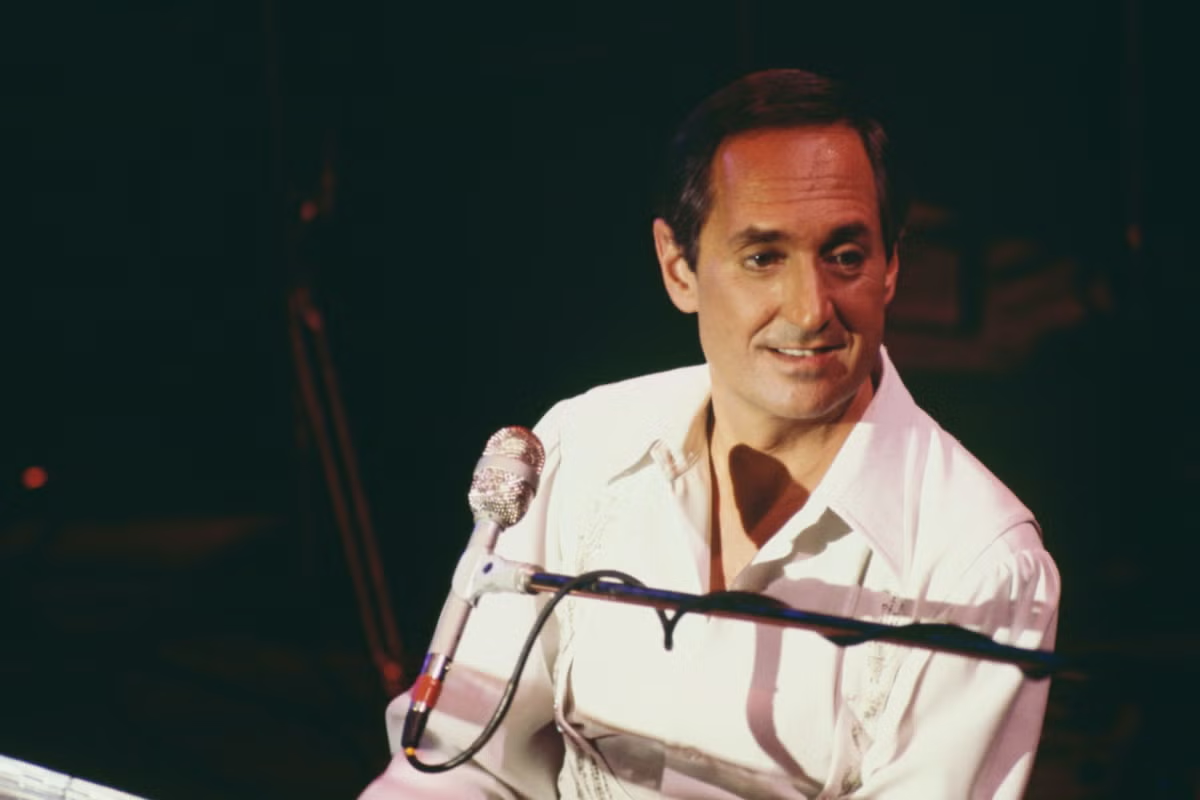
Neil Sedaka, legendary ‘(Is This the Way to) Amarillo’ songwriter, dies aged 86

Published

on

Neil Sedaka, legendary ‘(Is This the Way to) Amarillo’ songwriter, dies aged 86

Neil Sedaka, the legendary songwriter behind hits including “(Is This the Way to) Amarillo”, “Breaking Up Is Hard to Do” and “Love Will Keep Us Together,” has died. He was 86.

The New York-born songwriter was reportedly rushed to hospital in Los Angeles this morning.

In a statement to Variety, Sedaka’s relatives said: “Our family is devastated by the sudden passing of our beloved husband, father and grandfather, Neil Sedaka.

“A true rock and roll legend, an inspiration to millions, but most importantly, at least to those of us who were lucky enough to know him, an incredible human being who will be deeply missed.”

Advertisement

More to follow…

Source link

Continue Reading
Click to comment

Leave a Reply

Your email address will not be published. Required fields are marked *

NewsBeat

Ian Huntley’s mum tells pal ‘hopes he dies’ as she rushed to visit Soham killer in hospital

Published

on

Daily Record

Ian Huntley’s mum Lynda Richards reportedly made a secret hospital visit after the Soham killer was bludgeoned in HMP Frankland, with sources claiming she told pals ‘part of me hopes he passes away’

Ian Huntley’s mother is understood to have visited her son in hospital, telling pals that “part of me hopes he passes away” following the brutal assault on the child killer behind bars.

The Soham double murderer remains critically ill after a fellow prisoner attacked him with a metal bar during a workshop session at HMP Frankland. The notorious killer, responsible for the deaths of 10-year-olds Holly Wells and Jessica Chapman, was rushed to hospital with serious head injuries following Thursday morning’s incident, with reports suggesting medics gave him merely a 5% survival chance.

Advertisement

Mother Lynda Richards, 71, made the 175-mile journey from her Lincolnshire residence to be at her son’s bedside, with sources suggesting she subsequently told friends she “just wants to be free of it”.

The former caretaker is serving life imprisonment after murdering the two youngsters, who had left a family barbecue to purchase sweets in Soham, Cambridgeshire, on August 4 2002, reports the Mirror.

According to The Sun, a source revealed Richards and a companion were accompanied to the hospital wing by Prison Service personnel – whilst her son remains under armed police protection. The source further claimed the mother “couldn’t recognise her own son” upon seeing him following the vicious assault.

The source revealed: “He’s been attacked on so many occasions and she now thinks it might be better if he didn’t pull through. It’s an extraordinarily difficult thing for her to come to terms with.

“Part of her just hopes he passes away this time. But he’s still her son, regardless of what happened, and they have remained very close.”

The same source claimed Richards had spoken with her son just two days prior to the brutal assault, stating she “can’t be at peace until it’s all over – and it won’t be over until he’s gone”.

Durham Constabulary provided an update this morning regarding Huntley’s condition, confirming: “There has been no change in the 52-year-old man’s condition overnight – he remains in hospital in a serious condition.”

Advertisement

The prime suspect in the prison assault was identified last night as triple murderer Anthony Russell, though neither police nor prison officials have verified his identity. The suspect allegedly shouted “I’ve killed him” as warders escorted him from the scene.

This follows revelations from a source who told The Mirror that the Soham killer “knew he was a target” and had become increasingly anxious about being poisoned. The source stated: “He knew that he was a target. That is why he was so paranoid about his food.”

Source link

Advertisement
Continue Reading

NewsBeat

Abusive Chipping man jailed after attack left partner paralysed

Published

on

Abusive Chipping man jailed after attack left partner paralysed

Robert Easom, 57, of Longridge Road, Chipping, appeared before Preston Crown Court charged with GBH with intent, two counts of ABH and two counts of controlling and coercive behaviour.

The charges relate to a period between 2017 and 2025, when the defendant subjected Trudi Burgess to constant verbal, emotional and physical abuse.

It culminated in an incident on February 17, 2025, when Easom launched a sickening attack on his victim, which left her with a broken neck and permanently paralysed.

Advertisement

Laura Magill, prosecuting, said: “He manipulated her body into a position where she was on her knees. With both of his hands and all of his chest onto the back of her head, he pushed back with his entire body weight, pushing her chin into her chest.

“She was trying to scream, but he continued to push. She was trying to say he was killing her, but she could not speak.

“She said she felt like his body was going to crack her skeleton. She heard a crack, and all of the feeling left her body. She thought she was dying, but he did not stop.

“He kept shouting, ‘I will shut you up.’ By the time he stopped, he had broken her neck, affecting all four limbs.

Advertisement

“Doctors would later operate on her, but were unable to undo the neurological damage.

“She realised at the moment he said he had done this that life as she knew it was over.”

Judge Robert Altham said that the injuries she sustained were comparable to those of someone who had fallen from a height.

He added: “She had depression, anxiety and symptoms of PTSD. She suffered flashbacks of the attack on her. She loved to sing for pleasure and professionally. She is someone who likes to look her best, and she now has to leave that to others.

Advertisement

“A third heading is the impact on her family, and the impact of harm is testified to by her children. Her mother cannot come to terms with the impact. Her grandchildren cannot understand where their grandmother has gone.

“The impact upon them is profound. She describes the social impact. She used to be an active person with a normal social life, and getting anywhere, including to court today, is a massive operation.

“Even with the lengthy sentence I am going to impose, you will have a future, unlike your victim.”

Before the incident, Easom subjected the woman he claimed to love to a relentless campaign of coercive and controlling behaviour.

Advertisement

Around seven months into the relationship, during a trip to York, Easom “switched” into a rage, dragged her around a bathroom and threatened her, quoting a line from Rambo: “Don’t push or I’ll give you a war.”

In another incident in 2019, Easom went into a rage after the victim went to get a glass of wine, thinking the defendant was asleep.

Storming down the stairs, Easom berated her, grabbed her by her hair and rammed her head against each of the steps, leaving her with cuts to her nose.

In January 2025, after an evening at a friend’s house, Ms Burgess made a joke about the lack of crockery at the defendant’s house.

Advertisement

Judge Altham said: “It is the hallmark of a sophisticated abuser to combine cruelty and kindness, and that, as you intended, you led this intelligent and articulate woman to doubt her own experiences. It is a chilling insight into your manipulation and control of her.”

Easom then drove at 80mph before stopping and headbutting her.

Ms Magill added: “He did this to frighten her, and it worked. With the car stationary, he headbutted her and dragged his stubble down her face.”

READ MORE: Sentencing of bully who left girlfriend paralysed in vicious attack – updates

Advertisement

READ MORE: Controlling’ bully who left woman paralysed is convicted

During the relationship, Ms Burgess kept notes to herself in her Apple Notes, which highlighted the levels of gaslighting that Easom imposed on her.

A section of former teacher Ms Burgess’s victim impact statement said: “I am slowly learning how to live with my spinal injury, but the reality is… this is a life sentence.

“Emotionally I have been shattered. I suffer from bouts of depression, daily anxiety and symptoms of PTSD. I have flashbacks of the attack and nightmares that wake me up.

Advertisement

“My sense of safety for my family and me has been taken from me, and the thought of him walking freely is a terrifying prospect. I grieve every day for the life I’ve lost – a life that was stolen from me by someone whom I trusted.

“I feel trapped and powerless. Sometimes I feel like I’m just surviving, not living. Everything that once gave me joy now feels out of reach.

“I also want the court to be aware of my real concern for anyone getting involved with Robert in the future, romantically or otherwise. He has a true Jekyll and Hyde personality.

“He could be a loving and attentive partner and then he could switch in a moment into a truly terrifying monster, restraining me, dragging me round the room, screaming threats at me.

Advertisement

“All of which were dismissed moments later. I am living proof of the devastating effects of his uncontrolled bursts of anger.”

In mitigation, Tobias Smith outlined that his client accepted full criminality; however, Judge Altham said that was not the case due to his failing to admit to anything in his pre-sentence report.

He also added that his client had engaged well whilst in prison and was supporting other inmates with horticultural tasks.

Easom was sentenced to 20 years, of which he will serve a maximum of 16 years in custody.

Advertisement

Source link

Continue Reading

NewsBeat

what to visit and see this week

Published

on

what to visit and see this week

When I was growing up there were three channels on the telly, which seems quaint now. You watched what was on, like it or lump it. But I have only good memories of children’s TV in the 1970s. Hiding behind a cushion as we watched Dr Who, singing along to Sesame Street, lots of excellent dramas, and a surprising array of weird trippy stop-motion animation that featured stoned rabbits and talking TVs.

But my favourite was a wonderful art show aimed primarily at deaf children called Vision On. (For anyone who’d like a walk down memory lane, listen to the groovy theme tune below and transport yourself back to your 1970s living room.)

Vision On.

A lovely man called Tony Hart shared simple art techniques, and later got his own spin-off show called Take Hart. It was here in 1977 that I first encountered a charming little Plasticine character called Morph who persisted in interrupting Tony has he tried to make art, generally making a mess and causing chaos. But always in the most endearing way.

Advertisement
The original 1970s claymation superstar, Morph.
Wally Cassidy / Shutterstock

It was groundbreaking stuff in those days, watching a ball of plasticine unfurl into this funny little figure with big eyes and a bigger heart. Who would have guessed Morph was the beginning of Aardman, one of the most successful stop-motion animation studios in the world? One that would go on to create beloved characters like Wallace & Gromit and even win Oscars?

That success is surely down to a very British sensibility that celebrates quirk and eccentricity, chewy regional accents, DIY and a heroic sweetness that remains untainted by cynicism. I still marvel at the genius of the long-suffering Gromit’s scowl, conveyed only by two indented thumbprints for eyebrows.

Aardman’s work is now rightly being celebrated in an exhibition at the Young V&A in London. We sent along animation expert Christopher Holliday to give us his take as the studio celebrates almost half a century of hi-octane slapstick, unlikely heroes and comical villains.

Two national treasures

It’s a great week for celebrating quintessential Britishness in film, art and fashion. In Edinburgh The Biba Story has just begun at the wonderful Dovecot tapestry studio. The show is a warm, inclusive and affectionate look at the impact of Barbara Hulanicki’s groundbreaking Biba fashion and lifestyle label that brought a splash of excitement to drab postwar Britain in the mid-1960s. Best of all are the vivid memories of women now in their eighties describing the thrill of high fashion at low prices in their teens.

Advertisement
A young woman modelling Biba fashions.
Ingrid Boulting modelling Biba in 1970.
Duffy Archive

At the Tate Modern in London, the irrepressible Tracey Emin is back with a restrospective called, appropriately, Tracey Emin: A Second Life after she rose like a phoenix from the ashes of her grim encounter with cancer and the life-changing surgery that followed. I adore Emin (even though I don’t always like her work) because she makes art utterly on her own terms. Complicated, contradictory, uncompromising and fearless, many people find that altogether too much in one woman. But Emin mines her life and experience in ways that make her vulnerable which I find brave, honest and admirable.

Films heading for the Oscars

Wagner Moura and Rose Byrne are each nominated for best actor/actress gongs at this year’s Oscars, and both, according to our reviewers, would be worthy winners.

Set in 1977 during Brazil’s two-decade dictatorship, The Secret Agent is a gripping thriller that features an outstanding performance from Moura. The Brazilian actor plays Armando, an academic forced into hiding after clashing with big business interests aligned with the regime who want to get their hands on his research. Kleber Mendonça Filho’s film makes clear that authoritarianism attacks society not only through violence and repression of civilians, but through the silencing of knowledge and learning. This timely and important film reminds us why academic freedom must be protected.

Very handsome man with black hair and beard leaning against a wall.
Wagner Moura as Armando in The Secret Agent.
CinemaSco’pio / MK Production

Rose Byrne gives a relentless performance as Linda, an exhausted resentful mother quickly unravelling in If I Had Legs I’d Kick You. Her husband who works away is unconcerned that she is looking after their seriously ill daughter solo. Her unfulfilling but demanding work as a therapist piles on more pressure and her own therapist is deeply unsympathetic. Unsupported and drowning in despair, she is unable to find respite. This dark and unsettling film, says our reviewer Laura O’Flanagan, “is an example of how cinema has become less interested in saccharine, idealised depictions of mothers and more concerned with their inner lives, however messy”.

Source link

Advertisement
Continue Reading

NewsBeat

Review: Robbie Williams gets intimate at Aviva Studios in Manchester

Published

on

Manchester Evening News

Robbie Williams was performing at Manchester’s Aviva Studios

Robbie Williams is getting pretty used to breaking records of late and he claimed yet another as he stepped onto stage in Manchester on Friday night. His 16th solo studio album, Britpop, became his record-breaking 16th chart-topper earlier this year (as Robbie was keen to remind us), and this Aviva Studios gig, fans soon discovered, has become the biggest ever selling charity concert for War Child.

Advertisement

It’s also a gig that came as a big, and welcome, surprise to fans when it was announced mere days ago as a special charity gig to tie in with BRITs Week here in Manchester.

Needless to say such is Robbie’s sustained star power, those tickets needed mere minutes to sell out. The show follows his run of just four intimate gigs on the “Long ’90s” tour celebrating both his original debut album, Life Thru a Lens, and his 16th number one album Britpop.

Click here to prioritise Manchester news in Google from the MEN

Once inside, of course, it didn’t really matter how far back you were, because you were still getting up close and personal with Mr Williams.

Advertisement

Last summer, here in Manchester we had him in the vast expanse of Co-op Live, throwing everything bar the kitchen sink at his fans in a blockbuster of an arena show that saw him literally fly out as a rocket man. He described the night as his “love letter to entertainment”.

Here at the slightly more intimate climes of Aviva Studios (although the Warehouse felt pretty vast), there may not be rocket blasters, but there’s never less than the usual Robbie energy.

He walks out on stage with his own T-shirt tribute to all things Manc – a “Roy Division” image blending the famous Joy Division artwork of Unknown Pleasures with the face of, who else, but Man United legend Roy Keane.

Advertisement

Launching into Lazy Days, we were sent straight back into the 90s, with Robbie also quick to talk about his experiences of going solo after the highs and lows of Take That.

He’s also happy to admit his failings, asking the crowd if they’ve seen the recent Netflix Take That documentary.

“I don’t think anyone has seen a man smugger than Robbie Williams in that second episode”, he says. “And you know what I felt really bad I felt really horrible about it, I’d been horrible to Gary, horrible to Howard, I was genuinely thinking about it for days and days I was thinking “I’ve got to apologise again, I’ve apologised 500 times but I’ve got to apologise again. And then I started this little mini tour up in Glasgow and I thought hang on no one has ever left a boy band and gone “they’re a ****, they’re a ****, except me.

Advertisement

“So for this moment I’m just getting rid of shame and guilt of upsetting everybody and lean into “they’re all ****s”, before launching into Ego a Go Go. He later added, to big cheers, that he loves Gary and “Gary loves me”. All very cathartic stuff.

Before Robbie headed onto stage it was down to Leigh’s Lottery Winners to warm up the crowds, as they had done so memorably last summer too. The band have struck up quite the friendship with Rob, and cheeky lead singer Thomas Rylance couldn’t resist paying tribute to the star by leading an early singalong of Angels to the delight of the crowds.

Naturally, when it came to Robbie’s turn to sing the anthem, fairly early on in the show, it nearly blasted the roof off the Warehouse – without him singing a word of it for the first half of the anthem such was the lusty singalong.

Advertisement

The first half of nostalgia is broken up, rather fittingly, with Everything Changes played in the background, before Robbie returns for the second half of new tracks from Britpop.

Rocket is a masterful new anthem from this King of entertainment, to kick it all off.

Introducing his song dedicated to his “favourite ever artist who’s still alive and he’s from Manchester” we get his ode to Morrissey.

He ends the show by telling us all he’s still ambitious, still wants to be out there which is music to the ears of these fans.

Advertisement

And there’s a final reward, an outing of fan anthem Feel leaving the crowd on a high after a special night.

Setlist

Lazy Days

Life Thru a Lens

Ego a Go Go

Advertisement

Angels

South of the Border

Old Before I Die

One of God’s Better People

Advertisement

Killing Me

Let Me Entertain You

Clean

Hello, Sir

Advertisement

[Everything Changes interlude]

Rocket

Spies

Pretty Face

Advertisement

Bite Your Tongue

Cocky

All My Life

Human

Advertisement

Morrissey

It’s Ok Until the Drugs Stop Working

Selfish Disco

Feel

Advertisement

Pocket Rocket

Source link

Continue Reading

NewsBeat

A virus hiding inside bacteria may help explain colorectal cancer

Published

on

A virus hiding inside bacteria may help explain colorectal cancer

The gut bacterium Bacteroides fragilis has long presented researchers with a paradox. It has been associated with colorectal cancer, yet it also lives quite happily in most healthy people. A new study from a Danish research team offers a possible clue. When they looked beyond the bacterium itself and into its genome, they found a previously unknown virus embedded within it – one that was significantly more common in cancer patients.

Colorectal cancer is the third most common cancer worldwide and is responsible for the second highest number of cancer-related deaths. Up to 80% of colorectal cancer cases are attributed to environmental factors, with one of the most significant being the gut microbiome – the collection of bacteria, fungi and viruses that live in the human gut.

This means that colorectal cancer could – in theory – be partly preventable. But the precise link between the microbiome and colorectal cancer remains poorly understood. It is much easier to associate two things than it is to show a mechanism.

Most studies of the gut microbiome examine which species of bacteria are present and how abundant they are. But species are not homogeneous. Think of how all domestic dogs belong to the same species (Canis familiaris) yet show enormous within-species diversity – a chihuahua is not the same as a great dane. The same is true for bacteria, even if it is harder to visualise.

Advertisement

Just looking at which species are present may not give us the resolution we need to understand what is going on. Perhaps the answer lies not in which bacteria are in the gut, but in the finer genetic differences between strains of the same species.

Bacteroides fragilis is generally considered a harmless member of the gut microbiome and is found in most healthy people. Despite this, it has repeatedly been found to be more abundant in people with colorectal cancer. So could there be specific genetic features that set some strains of B fragilis apart from others, and could these features be linked to colorectal cancer?

Even bacteria get infections

All cellular life can be infected by viruses. Bacteria are no exception. The specific viruses that infect bacteria are called bacteriophages – from the Greek phagos, meaning to eat or devour. They selectively infect bacteria and, importantly, do not infect human cells.

But not all of these viruses kill the bacteria they infect. Some integrate their own genome within the bacterium’s genome, becoming what is known as a prophage – a hitchhiker within the bacterial cell.

Advertisement

Many prophages carry genes that can alter the characteristics of their bacterial host. Diseases such as cholera, botulism and diphtheria are all the result of toxins carried by prophages within otherwise (mostly) harmless bacteria. The conversion of harmless bacteria to harmful ones by prophages is well documented.

A micrograph of B fragilis.
Gado Images/Alamy

To determine whether specific genetic signatures linked B fragilis to colorectal cancer, a Danish team sequenced the genomes of B fragilis from people with and without a colorectal cancer diagnosis.

First, they looked at whether the cancer-associated bacteria came from a distinct evolutionary lineage. They did not. But not all genetic features of bacteria are passed from mother to daughter. Some are acquired sideways, through a process called horizontal gene transfer – such as infection by a prophage.

When the researchers compared the genomes more closely, they found that bacteria from cancer patients carried two previously unknown prophages that were largely absent in bacteria from people without cancer.

Advertisement

These prophages did not carry any obvious genes that would link the bacteria to colorectal cancer – in the way that cholera toxin genes are readily identifiable – but most prophage-carried genes are very poorly understood and we know little about what they do.

A broader test

This initial finding was based on 48 bacteria collected from patients, so the team wanted to test whether the pattern held more broadly. They screened data from faecal samples taken from 877 people across Europe, the US and Asia – 434 with colorectal cancer and 443 without.

Patients with colorectal cancer were more than twice as likely to have detectable levels of the prophages. It is important to stress that this is an association, not proof that these prophages cause or contribute to colorectal cancer. No biological mechanism by which they might do so has been proposed.

It is also possible that the gut environment in cancer patients simply suits these particular strains of B fragilis – meaning the disease could be creating conditions in which the bacteria thrive, rather than the bacteria helping to cause the disease. An alternative explanation is that the gut environment itself predisposes people both to harbour these prophage-containing strains and to develop colorectal cancer.

Advertisement

The study had limitations worth noting. The bacteria originally examined came from patients with bloodstream infections rather than bowel cancer itself, while the broader validation used stool samples – a different source entirely. And some of the “healthy” comparison group had not been formally confirmed to be cancer free.

Despite these limitations, the finding raises an interesting possibility for cancer screening. The most common non-invasive screening method for colorectal cancer is the “faecal immunochemical test”, which checks stool samples for traces of blood. A test that also screened for these viral traces could, in principle, be performed on the same samples.

A preliminary analysis by the researchers found that a panel based on fragments of the prophage genomes detected around 40% of colorectal cancer cases. This is a very early result and would need considerable further work, but it points to the possibility of using viral signatures alongside existing screening methods.

The broader implication of this work is a shift in how we think about the gut microbiome and its relationship to disease. It may not be enough to ask which bacteria are present. We may also need to look at what is inside those bacteria – and what those hidden passengers might be doing.

Advertisement

Source link

Continue Reading

NewsBeat

‘I don’t remember when I became a Christian, but the God that rescued my mam became my God too’ Katie Taylor on her deep faith

Published

on

Belfast Live

She was preaching to a congregation of sorts. Boxing fans, running club members, media and influencers – all hanging on her every word as she fielded questions on everything from her boxing career to a final fight in Dublin and everything in between.

Then a question from the floor, from someone looking for an inspirational message to take back to his church, to share with the congregation there.

He wanted the back-story to Katie Taylor’s journey in Christianity, and how her faith had helped her get through the tough days.

Taylor has never been shy to show her gratitude to God, or throw in a piece of scripture, into an interview.

Advertisement

But what was it that turned the Bray boxer, Olympic champion and world champion to a higher power?

We were at Intersport Elverys in Fonthill for the unveiling of Taylor as Brooks Running’s newest ambassador when mental health advocate Aidan Loughnane posed the question.

There was silence from the floor as she delivered her response.

“My journey in faith has been so connected to how my mam became a Christian,” started Taylor.

Advertisement

“My mam [Bridget], as a young woman, she won’t mind me saying this, she is here today, she was a heavy drinker, a heavy smoker.

“Her life was very, very chaotic, my father’s life was very, very chaotic as well.

“They had four little kids and they were in their early-20s, and it was a bit of a crazy, chaotic home.

“There wasn’t much structure there, there wasn’t any real vision for a good life, just two broken people trying their best to raise four young kids.”

Advertisement

And then she delivered the lines that – like one of her famous uppercuts – KO’d her audience.

“My mam walked into a coffee shop one day after a tragic incident happened,” Taylor explained.

“One of our neighbours, there was this house fire where basically the whole family passed away, it was a family of six and only two people survived.

“And that really deeply affected my mam, that house fire, that made her think there has to be more to life than this.

Advertisement

“The next day she went for a walk, she went into a coffee shop, and a couple were in there that had been very kind to her as a teenager.

“This couple had invited her to Bible studies as a young girl, and they left a deep impression on her, and that the couple just invited her to church.

Advertisement

“She went to church with them and that was the start of the journey for her.

“She started to follow God, she became a Christian, she gave her life to the Lord.

“And honestly it was night and day in the house after that, there was peace in our house for the first time.

“She gave up drinking, she gave up smoking, there was a sense of peace in her as well, there was a sense of life in our house.

Advertisement

“She’d speak of peace and hope and life to us as young kids. She started to tell us that God had a plan for us.

“She started to tell us that with God nothing is impossible, that God could turn humble things into great things.

“This became part of our normal lives. And so from then on my journey as a Christian started.

“I don’t really remember specifically when I became a Christian, it’s just that the God that rescued my mam became my God too.

Advertisement

“I just heard scripture in my house all the way up, I heard my mam praying with such deep conviction as well.

“It became the cornerstone of my life, really.”

Taylor spoke about the hardships, about the 2016 Olympic quarter-final defeat in Rio and the 3 Arena defeat to Chantelle Cameron in May 2023, and how her faith got her through those times.

“I fell in love with the Word of God, and the Word of God has become my cornerstone, I would say,” she said.

Advertisement

“It’s gotten me through so many tough, tough moments in my life as well.

“When things aren’t going well for me I walk through with peace and assurance just because I know that God is walking with me.

“And, yeah, for me living my life with Christ has been the most remarkable journey and I am so grateful for the goodness of God all my life, his faith, he is such a faithful God, he cares about every detail of my life.

“And for me I know, I’m confident that it wasn’t just my hard work or my talent that got me to where I was, but that God literally transformed my family life and he transformed my life.

Advertisement

“And for that I am forever grateful.”

Want to see more of the stories you love from Belfast Live? Making us your preferred source on Google means you’ll get more of our exclusives, top stories and must-read content straight away. To add Belfast Live as a preferred source, simply click here.

Click here to sign up to our sport newsletter, bringing you the latest sports news, headlines and top stories

Source link

Advertisement
Continue Reading

NewsBeat

James Martin of Glawning speaks of Dragon Den tv appearance

Published

on

James Martin of Glawning speaks of Dragon Den tv appearance

James Martin of Ripon-based Glawning posted on social media today (Fri): “What a rollercoaster!”

James recalled: “Peter Jones called the pitch disingenuous then offered up his number.”

“Steven Bartlett said he’s a “big fan” of the company’s driveaway awning.

RECOMMENDED READING:

Advertisement

And Jenna Meek said with the company appearing at so many events it may have “the start of something huge.,”

Glawning founder James Martin appeared on the show seeking £60,000 for 10% of the business. The programme broadcast on Thursday night was recorded in May.

James Martin with his invention (Image: Pic supplied)

James’ pitch was his driveaway awning invention and the vision behind what he calls “the Glawning Revolution.”

James did not get the investment, but he says he came away from the show with something just as powerful.

Advertisement

He explained: “Since the episode aired, we’ve seen a 6000% increase in website traffic, hundreds of comments, and an incredible wave of support from campers, adventurers, and glamping enthusiasts across the UK.

“Yes, the edit was tough in places and standing in front of the Dragons was nerve shredding. But putting our invention on national television and sharing our story with millions? That’s a win we’ll always be proud of.”

James added: “We’re especially grateful for the offer of a direct line to Peter Jones when the patent is through! Not to mention every single one of you who reached out, shared, commented, or placed an order.

“From a brand built from the ground up in North Yorkshire to national TV — this is only the beginning.”

Advertisement

Source link

Continue Reading

NewsBeat

what Hannah Spencer’s speech tells us about her, and the state of British politics

Published

on

what Hannah Spencer’s speech tells us about her, and the state of British politics

Hannah Spencer’s parliamentary story – as the new Green MP for Gorton and Denton – has just begun.

Nevertheless, the life story that she presented in her victory speech was that of a plumber, not a politician. She identified herself – in present tense – by that trade; she had not grown up wanting to be a politician. She also celebrated qualifying as a plasterer during the “chaos” and “pressure” of the election campaign. She described campaigning jovially as “all this”, as if it were just a challenge in the broader adventure, not the adventure itself.

Despite, or perhaps because of, accusations that the Greens used “sectarian politics” to secure victory, the speech was one of solidarity, of aligning herself with the struggles and achievements of “the community that I am from”. Spencer said that she had lived there in one of the hardest times of her life, and presented the strength of the community “at holding things together” as an inspiration.

She aligned herself and her personal characteristics with those of the constituency, stressing that “I am no different to every single person here in this constituency. I work hard. That is what we do.”

Advertisement

Alongside all the talk of “we”, of common interests and lack of difference, Spencer singled out several audiences for her story. One such audience? Her now-plumberless “customers”, to whom she duly apologised: “I’m sorry, but I think I might have to cancel the work that you had booked in, because I’m heading to parliament”.

Spencer also addressed those who voted for her, and those who didn’t. She spoke of “my Muslim friends and neighbours”, who “are just like me: human”. She discussed the “left-behind” (“I see you, and I will fight for you”), and people doing jobs like hers: “We will finally get a seat at the table”. And she addressed “our white working class communities, the background that I have become so glad to be from”.

A personal and political journey

My research focuses on political narratives and storytelling as a means of communication: the stories that parliaments contain and project, the stories we tell about the places we’re in and the stories that politicians use to communicate themselves to voters. Spencer’s speech is an attempt to portray a compelling story to her new constituency.

Advertisement

She spoke about how moving away from the constituency to nearby Trafford made the qualities of Gorton and Denton’s community “even clearer”. Only realising your love for a place and the people in it when you’ve moved away is a familiar narrative device. As Joni Mitchell once sang, “You don’t know what you’ve got ‘til it’s gone”.

In Spencer’s speech, this tactic carried a sharper political edge. This is a constituency that people move away from to get the “nice life” that Spencer described: “good schools, a thriving high street and clean air”.

This part of the story carried a rebuke to an audience that Spencer was addressing, but not by name: the Labour Party, for whom this was a traditionally safe seat. Spencer observed that “working hard used to get you something”.

I would argue that “you”, in this context, is a reference to traditional Labour voters. The implication here is that it is voting Labour that “used to get you something”.

Advertisement

Being a politician now isn’t an aspect of Spencer’s story that she’s keen to claim. She may now sit at Westminster, but she appears to frame this as an extension of who she already is — a worker, a neighbour, a constituent — in a new arena.

In doing so, she attempts to recast political representation itself as continuity of identity. The challenge, of course, will be whether she can sustain that claim. It is easier to say “I am no different” on a victory stage following a byelection win than from the House of Commons. The durability of her narrative – and perhaps her political appeal – will rest on whether she can remain recognisably “from” the constituency while operating within the institution of parliament.

Source link

Advertisement
Continue Reading

NewsBeat

We’d rather have a dumb home than smart tech – here’s why

Published

on

We'd rather have a dumb home than smart tech - here's why

Far from embracing and being dependent upon technology, many people are pushing against it and ditching smart home devices.

They are turning their backs on lights that turn on automatically, robot vacuum cleaners and ovens you can turn on from your office 30 miles away.

They are living in what are being called ‘dumb homes’, where lights are turned on by proper switches, the oven needs to be manually operated with knobs, and the fridge doesn’t send photos to your phone when you’re short of milk.

Advertisement

Our house is and always will be a dumb house. My husband and I each have a smartphone, and we have an internet router, but other than that our house and its contents are bordering Neolithic.

When people arrive at our house they don’t get filmed by a doorbell as they dither about on the doorstep; they simply knock on the door. I know ring doorbells are supposed to be good for security, but society has managed for centuries with a door knock, and that is what we’re sticking with.

We don’t have lights that turn on automatically with the morning alarm or blinds that open themselves.

We don’t have a fridge that sends an alert to us if we accidentally leave the door open. If this happens we just curse a little and take it on the chin. And we wouldn’t dream of getting one of those high-tech fridges fitted with cameras that take pictures – ‘shelfies’ – of their contents and send them to your phone so you know what to stick on your shopping list. Basically, we have a small, no-mod-cons fridge, one step up from an old-fashioned larder.

Advertisement

Our oven isn’t very smart either. In fact, until I started writing this column I didn’t know there was such a thing as a smart oven – one that allows users to monitor and control cooking from their phones. They can include automated cooking programs, recipe suggestions sent directly to the oven, voice control, and built-in cameras to check on food remotely. I couldn’t think of anything worse. I find it hard enough to successfully cook a meal while standing in front of my oven never mind from several miles away. Were I to try remote cooking I’d need the fire service on standby.

This growing shift towards dumb homes – highlighted by estate agents and often referred to in newspaper property supplements – features reliable, no-fuss appliances over automated systems. Many homeowners are opting for simple buttons, switches, and knobs over voice-activated or app-controlled systems.

Our TV isn’t smart, our radio isn’t smart, our vacuum cleaner isn’t robotic and our toilet hasn’t got Bluetooth: don’t you just hate those loos that flush when they feel like it – usually when you’re still on it?

Our home is well and truly dumb, and I’m glad of that.

Advertisement

We also have – brace yourself – a landline, which I have to say I use more than my mobile to make calls. Speaking on it doesn’t make my tinnitus worse, which mobiles tend to do, especially after more than ten minutes.

I recently read about ‘dumb phones’ – basic models offering a digital detox from smartphone distractions. They are gaining popularity for their simplicity, long battery life, and affordability, often featuring physical keypads, small screens, and limited, or no internet connectivity.

I don’t want a fully-integrated smart home. I want a comfortable house that, if anything, harks back to the good old days when people flipped light switches, drew curtains and flushed the toilet themselves. Dependable and reliable, and far better than all this so-called smart nonsense.

Advertisement

Source link

Continue Reading

NewsBeat

Attorney General Pam Bondi announces 30 more indicted in Minnesota church protest

Published

on

Attorney General Pam Bondi announces 30 more indicted in Minnesota church protest

Attorney General Pam Bondi announced federal charges Friday against 30 more people who are accused of civil rights violations in a January protest inside a Minnesota church where a pastor works for Immigration and Customs Enforcement.

Bondi said on social media that 25 people were in custody and more arrests would follow. The new indictment comes a month after independent journalists Don Lemon and Georgia Fort and prominent local activist Nekima Levy Armstrong were charged for their alleged roles in a protest at Cities Church in St. Paul.

Bondi accused the group of attacking a house of worship.

“If you do so, you cannot hide from us — we will find you, arrest you, and prosecute you,” she wrote on social media.

Advertisement

A livestreamed video posted on Facebook shows people interrupting services at Cities Church on Jan. 18 by chanting “ICE out” and “Justice for Renee Good,” a reference to the woman who was fatally shot by an ICE officer in Minneapolis on Jan. 7.

Protesters targeted church over its pastor

Protesters descended on Cities Church after learning that one of the church’s pastors also serves as an ICE official. The protest drew swift condemnation from Trump administration officials and conservative leaders for disrupting a Sunday service.

In total, 39 people now face charges of conspiracy against religious freedom and interfering with the right of religious freedom. The new defendants had initial court appearances and were released.

Lemon and Fort said they were at the church as journalists covering news. Levy Armstrong was the subject of a doctored photo posted by the White House showing her crying during her arrest. The three have pleaded not guilty.

Advertisement

The indictment says the “agitators” entered the church in a “coordinated takeover-style attack” and engaged in acts of intimidation and obstruction.

“Young children were left to wonder, as one child put it, if their parents were going to die,” the indictment says.

Church welcomes more arrests

A lawyer for the church praised the Justice Department for charging more people.

“The First Amendment does not give anyone — regardless of profession, prominence, or politics — license to storm a church and intimidate, threaten, and terrorize families and children worshipping inside,” Doug Wardlow said in a statement.

Advertisement

The revised indictment adds new allegations when compared to the original filed in January.

It says two people “conducted reconnaissance” outside the church a day before the protest and recorded their visit on video, with one saying, “My thoughts are to be able to close up this whole alleyway right here.”

The court filing quotes one protester as chanting in the church, “This ain’t God’s house. This is the house of the devil.”

Trahern Crews, who was charged in January and is lead organizer of Black Lives Matter Minnesota, said the latest arrests were a “waste of time.”

Advertisement

“It’s a shame that the people who have killed Alex Pretti and Renee Good or Keith Porter have not been arrested but peaceful protesters have,” Crews said. Porter was fatally shot in Los Angeles by an off-duty ICE officer.

Minnesota was hotbed for immigration blitz

Levy Armstrong defended the protest shortly after it occurred. She said critics needed to “check their hearts” if they were more concerned about a disruption than the “atrocities that we are experiencing in our community.”

The protest came at a tense time in Minnesota, where the Trump administration sent thousands of federal officers for Operation Metro Surge after a series of public fraud cases where the majority of defendants had Somali roots. Officers frequently deployed tear gas for crowd control in neighborhood clashes with residents, often detaining them along with immigrants.

Good, 37, was shot in Minneapolis. In another fatal shooting a week after the church protest, a federal officer killed Pretti, a 37-year-old nurse, in the same city.

Advertisement

Nationwide demonstrations erupted in response, followed by a change in Operation Metro Surge’s leadership and the eventual wind-down of the immigration enforcement operation. Roughly 400 ICE officers and Homeland Security agents were expected to remain in Minneapolis by early March, down from roughly 3,000 at the peak, according to a court filing.

Since then, the Twin Cities have grappled with the impact to communities and the local economy. Minneapolis said it suffered an impact of $203 million due to the operation, with tens of thousands of residents in need of urgent relief assistance.

Separately, a woman who was at the church service has filed a lawsuit against some people who were charged, alleging emotional trauma and an inability to exercise her religion that day.

___

Advertisement

Associated Press writer Ed White in Detroit contributed to this report.

Source link

Advertisement
Continue Reading

Trending

Copyright © 2025