

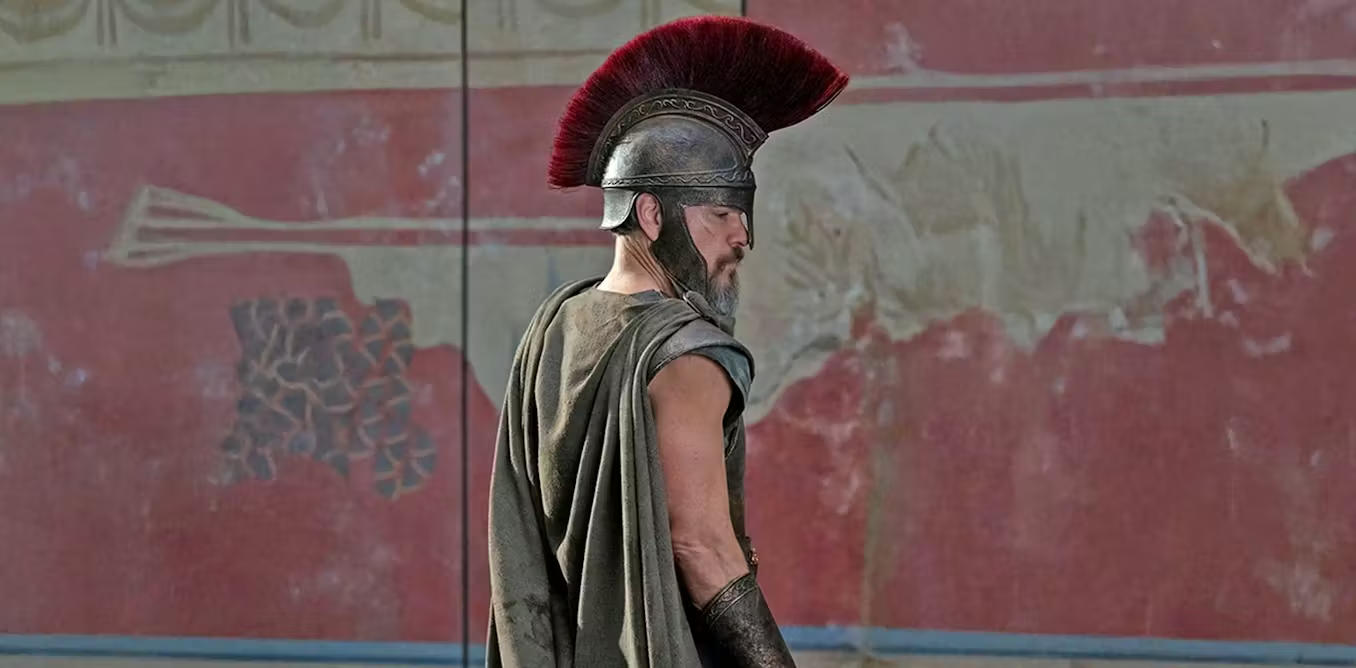
Imagine waking up to find strangers in your home – eating your food, killing your animals, then laughing as they blind you. Later, they tell the world you were the monster.
We are describing one of the better known episodes of Homer’s Odyssey, written around the late 8th or early 7th century BC. The intruders are protagonist Odysseus’s men, and the “monster” they attack is Polyphemus, a solitary giant shepherd later remembered only as a cyclops.
For centuries, we’ve followed the hero’s journey without asking what it costs. But what if the cyclops wasn’t the monster, but just one of many lives shattered along the way?
Director Christopher Nolan’s new adaptation of The Odyssey hits cinemas in July 2026. But will it celebrate Odysseus as the clever hero – or finally confront the wreckage he leaves in his wake?
Homer’s Odyssey, composed at the turn of the 8th to the 7th century BC, follows Odysseus, king of Ithaca, as he struggles to return home from the Trojan war, outwitting monsters, gods and fate. It’s a tale of resilience and cunning – and the template for countless stories since: the clever man triumphs over the monstrous other and sails home in glory.
We know the pattern by heart. But we rarely ask: who gets trampled along the way, and whose story is never told?
This article is part of Rethinking the Classics. The stories in this series offer insightful new ways to think about and interpret classic books and artworks. This is the canon – with a twist.
In the scene of Odysseus v Polyphemus, the cyclops is cast as a brute, a savage who traps the hero and his men in a cave. Odysseus responds with legendary cunning: wine, lies, a sharpened stake – and escape.
From the outside, it’s textbook heroism, yet Homer himself hints at the cost of that victory. He has Odysseus reveal his name only after the escape: “Tell them it was Odysseus, sacker of cities, who blinded you.” It’s a moment of pride, not necessity – the spark that seals his fate. In that instant, the clever survivor becomes the arrogant aggressor, and the story’s moral axis begins to tilt.
Yet if we shift perspective, the story changes. Polyphemus is a solitary shepherd, living in peace. Strangers break into his home, steal his food, kill his livestock, and leave him blinded and broken. His cave isn’t a prison but a home under siege. His violence, while brutal, emerges from desperation. You could easily argue that Polyphemus isn’t the villain. He’s the victim.
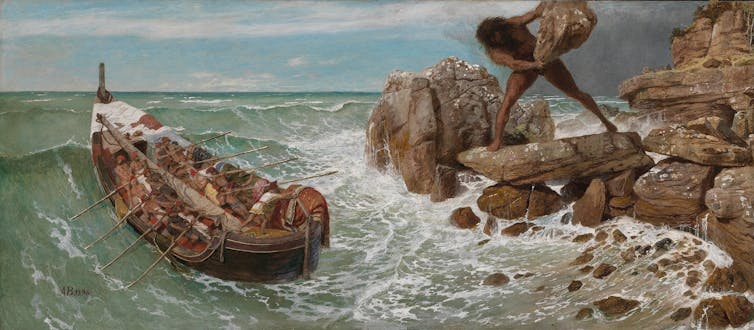
Museum of Fine Arts Boston
This reversal reveals a troubling pattern: our cultural instinct to root for the protagonist, no matter what they do – as long as the cause feels noble. From ancient epics to Hollywood blockbusters, we excuse deception, destruction, even murder, if it serves the “greater good”.
We cheer when the hero escapes – but rarely look back at what’s left behind. A burned city. A grieving family. A blinded shepherd. If it fits the story, we accept the collateral damage as necessary. That’s the seductive logic of heroism: clean endings, messy consequences.
In Homer’s writing, Polyphemus gets a single moment of anguish – a prayer to Poseidon, his father – and then vanishes from the story. His voice, his pain, his version of events do not fit the heroic arc.
And this pattern continues. Empires and conquerors have long branded enemies as “barbarians”, “savages” or “monsters” to justify violence. From Roman propaganda to colonial domination in the Americas and Africa – and, more recently, to claims of “denazification” in Ukraine – this tactic dehumanises the “other side” and erases their stories. Strip the enemy of humanity, and their suffering becomes legitimised.
If history is so often written by the victors, we must ask: what remains of heroism when we finally listen to the so-called monsters? As global conflicts polarise public discourse around heroes and villains, the stories we choose, and those we silence, matter more than ever.
What if we shift the spotlight? Polyphemus becomes more than a monster – he’s a mirror, showing how unchecked heroism can slip into cruelty. Cleverness isn’t virtue. And survival at others’ expense isn’t always justified.
Odysseus, the “man of many turns” is brilliant but ambiguous. His actions bring destruction alongside triumph. For every hero who returns, many suffer or are lost. True heroism lies not just in daring escapes, but in owning the cost left behind.
The cyclops’ tale warns us how easily we dehumanise those in the hero’s way. How we flatten complexity to fit a script. How we justify harm if the story feels right. Rethinking Polyphemus complicates Odysseus and challenges us as storytellers and audiences.
The real challenge for Nolan’s The Odyssey won’t be spectacle or scale, but perspective. Will it dare to look beyond the hero? Will it give voice to those left in his shadow? Clint Eastwood did just that with Flags of Our Fathers (2006) and Letters from Iwo Jima (2006), telling the story of the battle of Iwo Jima from opposing sides. By letting the “enemy” speak, he shattered the illusion of a single, righteous story.
If Nolan embraces that sort of complexity, The Odyssey won’t just retell a myth but will challenge us to rethink who we name as heroes and to listen more closely to those we once dismissed as monsters.

Looking for something good? Cut through the noise with a carefully curated selection of the latest releases, live events and exhibitions, straight to your inbox every fortnight, on Fridays. Sign up here.
This article features references to books that have been included for editorial reasons, and may contain links to bookshop.org. If you click on one of the links and go on to buy something from bookshop.org The Conversation UK may earn a commission.



