

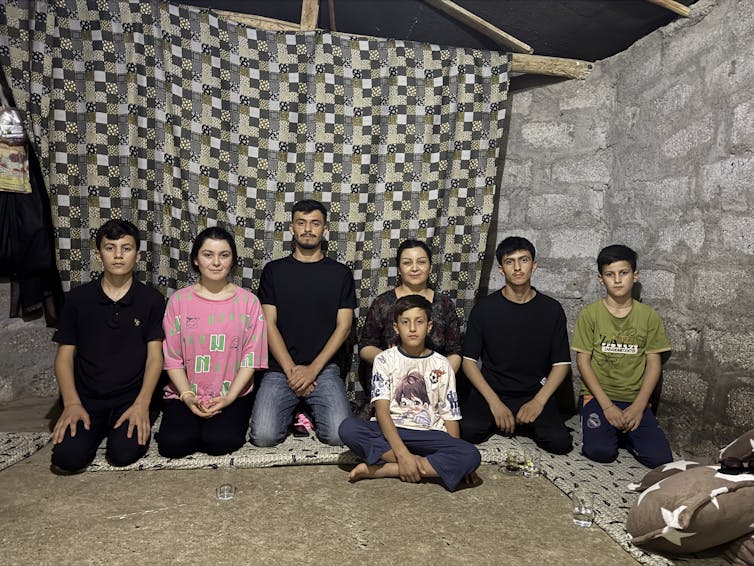
The sun burns down on a small village less than 20 miles north-east of Mosul, Iraq. Milisia, 14, and her sister Madlin, 13, greet me at the gate in flawless, almost accent-free German. They lead me into the yard of a grey, rectangular, one-story building where their family rents a single room.
We sit in the heat, joined by their mother and two younger brothers, aged nine and ten. Their eyes hold a mixture of hope and despair – as if I am both a bridge to the world they lost and a reminder of it. The girls hand me a carefully preserved plastic folder: their end-of-year school assessments from Germany.
I flip through the papers, and a teacher’s note catches my eye: “Despite not having German as her mother tongue, Madlin was always able to express herself clearly. She participated eagerly in lessons, was open and receptive to new content, and always strived for her own creative ideas. In written work, she was focused and willing to make an effort.” (translation from German.)
This folder is one of the few tangible remnants of a life that was abruptly torn apart a year ago. Until October 2024, the family lived in Adlkofen, a small municipality in Bavaria, southern Germany. But when I met them, in late August 2025, they were over 2,000 miles away in Babirah (Kurdish: Babîrê), a village in Iraqi Kurdistan, a semi-autonomous region of Iraq.
Madlin and Milisia’s family are not ordinary returnees. They are Yazidis (also spelled Yezidis or Ezidis), a non-Muslim religious minority native to northern Iraq. In 2014, Islamic State (IS) unleashed a campaign of mass killings, abductions, enslavement, sexual violence, and forced indoctrination against Yazidis – a horror that made international headlines and forced thousands to flee.
Multiple international bodies and western states, including Germany and the UK, have officially recognised IS atrocities against the Yazidis as genocide.

The Insights section is committed to high-quality longform journalism. Our editors work with academics from many different backgrounds who are tackling a wide range of societal and scientific challenges.
Germany, home to the largest Yazidi diaspora outside Iraq, initially granted protection to those fleeing IS. But in recent years, asylum approval rates have plummeted. Following an informal readmission agreement with Iraq in 2023, Germany began deporting Yazidis back to the country they had fled.
This situation has drawn my attention as a refugee and human rights scholar, leading me to explore how genocide, displacement, and European refugee law intersect. In Iraqi Kurdistan, I met Yazidis deported from Germany to document their experiences and witness the human consequences of Germany’s approach as part of my ongoing research.
Milisia’s family is among the people recently deported. They had lived in Germany for nearly six years. The children went to school, learned the language, and for Milisia, life meant responsibilities far beyond her age – translating, interpreting, and advocating for her family. Now, she feels a deep sense of betrayal by the country she once called home, whose language she speaks and whose values she embraced.
Milisia remembers the deportation date; it is etched in her memory: October 5, 2024. Her voice trembles with anger as she recounts, in German, what happened:
It was 5 am. We were sleeping when men in police uniforms surrounded the house. The social worker opened the door – she had a key. We will never forget it, we were so scared … It was really terrible … We have rights too.
The police separated them. The mother and the girls in one car, the father with the boys in another, and drove straight to the airport. Milisia described the helplessness and disbelief: “We couldn’t even pack our things. If they had sent us a letter beforehand, we could have gotten a lawyer, we could have asked our teachers at school. But they didn’t even send us a letter.”
What happened in 2014
The Yazidis are a small, predominantly Kurdish-speaking non-Muslim religious minority. For centuries they have faced persecution, misrepresentation of their ancient faith, and were often stigmatised as “infidels” or “devil worshippers.”
Nothing in their history, however, matches the scale of the IS attack in 2014. Estimates suggest that around 5,000 Yazidis were murdered; some 7,000 women and girls were abducted, many subjected to enslavement and abuse. More than 2,500 people remain missing.
The assault in August 2014 forced over 350,000 Yazidis to flee their homes in Sinjar (Kurdish: Shingal), a mountainous district in north-western Iraq near the Syrian border and the historic centre of the community.
More than a decade on, an anticipated large-scale return has not happened. As of 2025, fewer than half of those displaced have gone back. Around 100,000 still live in IDP (Internally Displaced Persons) camps in the Kurdistan Region, which is not their place of origin.
Tens of thousands have made their way to Europe and other western countries, often through dangerous routes in the absence of legal alternatives.
A broken promise
The Yazidi case has become a clear illustration of the limits of European refugee protection frameworks when applied to a community targeted for genocide. Asylum law is geared toward proving individual persecution, not addressing the collective and structural harms that follow mass atrocities.
This gap is particularly visible in Germany, home to the world’s largest Yazidi diaspora – over 230,000 people, including earlier migrant generations. About 100,000 Iraqi Yazidis have sought asylum in Germany since 2014.
EPA/STR
In the immediate aftermath of the IS attacks, Germany responded generously: between 2014 and 2017, more than 90% of Iraqi Yazidi asylum claims were approved. In addition, a number of federal states introduced targeted reception programmes to support Yazidi women and children who were especially at risk. Among these efforts, the Baden-Württemberg special contingent stood out, providing a pathway for roughly 1,100 survivors of IS captivity to relocate to Germany.
But after IS lost territorial control in 2017, the German approach shifted. Authorities concluded that group-specific persecution had ended, in practice setting a legal cut-off for the genocide.
Approval rates declined sharply. In 2023, fewer than 40% of the roughly 3,400 applications from Iraqi Yazidis were accepted, while about 40% were outright rejected. Another 7.5% resulted in temporary suspensions of deportation, offering no long-term security. The remaining cases were dismissed as inadmissible under the Dublin Regulation, which assigns responsibility for an asylum claim to another EU member state.
This shift has created a hierarchy of protection within the same minority: those who arrived before 2018 typically retain refugee status, while later arrivals – often from the same camps and with identical experiences of displacement – are rejected.
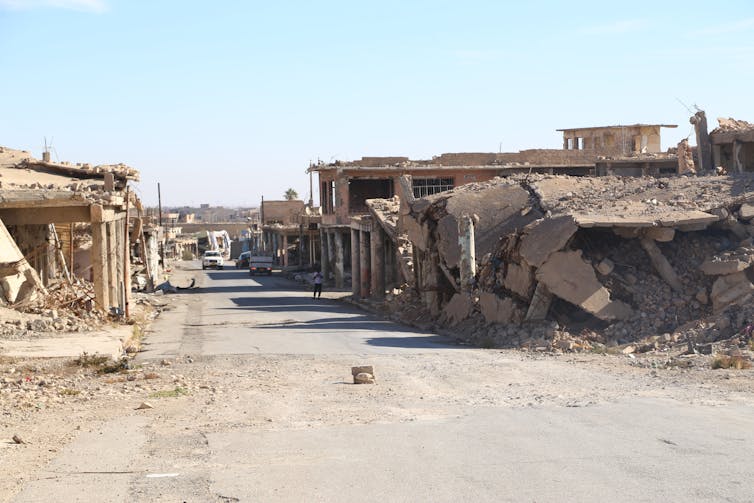
At the same time, conditions in Iraq remain shaped by the consequences of genocide. Sinjar is still devastated and reconstruction is slow. Infrastructure is largely destroyed, armed groups continue to operate, the security situation remains volatile. The district’s status is disputed and large areas are contaminated with landmines. Whole neighbourhoods lie abandoned and basic services are minimal. Mass graves continue to mark the terrain.
In the Kurdistan Region, displaced Yazidis face discrimination in accessing employment and social marginalisation. Tens of thousands have lived in IDP camps for more than a decade, with no viable path to return or integration – conditions that, for many, are an ongoing legacy of genocidal violence.
In January 2023, the German parliament formally recognised Yazidi genocide. Lawmakers acknowledged that its effects remained “omnipresent,” that tens of thousands of Yazidis still lived in camps, and that return to Sinjar was “hardly possible”.
Yet, the recognition remains largely symbolic. It has no influence on asylum decisions, a disconnect that is seen by members of the Yazidi community as a “broken promise”. Between January 2024 and June 2025, more than 1,000 Iraqis were deported. Although the government does not publish disaggregated data, Yazidis are frequently reported to be among them.
Those deported include families with school-age children whose lives were abruptly interrupted. Milisia’s family is not an isolated case. In summer 2025, German media reported on the Qasim family of six, who were returned to Sinjar on the very day their legal appeal succeeded – though the decision arrived only after their plane had taken off.
‘We cannot even go to school in Iraq. Everything is gone.’
Most Yazidis in Iraq come from Sinjar, but others – like Milisia’s family – have lived in villages in the Nineveh Plains closer to Duhok, the third largest city in the Kurdistan Region. Babirah, where they now live, sits amid a patchwork of communities and is surrounded by Arab-majority villages. To reach it, I drove past settlements marked by Arabic signs and men in traditional dishdashas.
Babirah lies about 80 miles north-east of Sinjar. In August 2014, as IS pushed into Sinjar and advanced toward their villages, Milisia’s family fled. Their own village was not occupied, but IS destroyed Yazidi temples as it moved through the area. The family escaped to a site near Erbil, the capital of the Kurdistan Region, and spent four months in an IDP camp. When they eventually returned, their home had been looted.
Aleksandra Ancite-Jepifánova
The sense of insecurity never fully lifted. “We were always scared … always thinking we would be forced to leave again. That feeling never went away,” Najwa, 35, the children’s mother, recalls. By then, several of her siblings already lived in Germany, and her parents had been sponsored there in 2016. Two years later, she and her husband decided to join them. “We sold our car, household belongings, and some sheep, and spent our savings to pay smugglers and take our children somewhere safe.”
In late 2018, they began the journey to Germany via Turkey. Their youngest child was two. They crossed waterways in plastic boats and continued on foot. “The smugglers put us in a black car,” Najwa says, “and hid us the whole way until we reached Germany.”
After arriving, they applied for asylum. They first stayed in a reception centre near Nuremberg, then in shared housing, before moving into a small two-room apartment covered by state assistance. The father worked part-time in a restaurant; Najwa cared for the children and took them to school. The children integrated quickly – speaking German, making friends, and settling into school and kindergarten.
But because they arrived in Germany in 2018, their asylum claim was rejected. Authorities argued there was no longer group-based persecution of Yazidis in Iraq. Their appeal was dismissed in May 2022, and in October 2023 their request to suspend deportation was denied. While officials noted that the children were enrolled in school, the decision made no reference to their formative years in Germany, their fluency in German, or educational prospects in Iraq.
“When we came to Germany, I was seven and my sister was six,” Milisia says. “My brothers were very small. Now we’re 14 and 13.”
The deportation uprooted them entirely. Since October 2024, the children have not attended school, as schools in the area require prior instruction in the local curriculum – a system they have never been part of. They cannot read or write Kurdish or Arabic. “We only speak German with each other,” Milisia explains. “In Germany I was in seventh grade. Only two more years and I could start vocational training. But they sent us back. Now everything is gone.” Her sister adds quietly, “Sometimes children in the village make fun of us because we don’t go to school.”
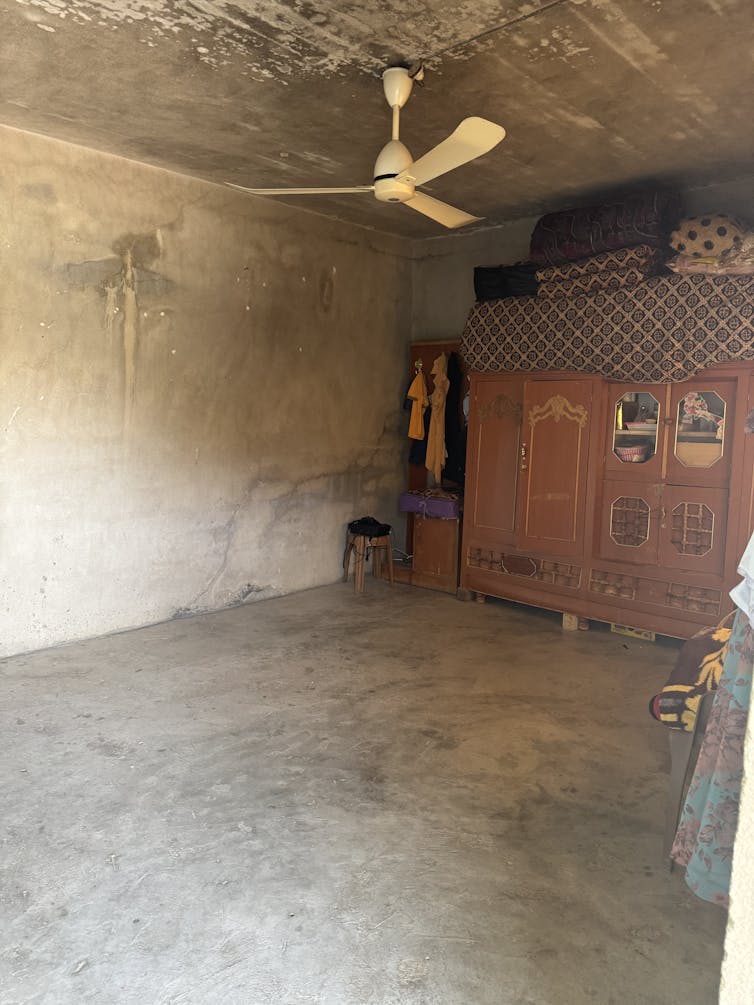
The family now rents a single room with grey, faded walls, furnished only with a cupboard and an old ceiling fan. The father does casual day labour, earning roughly 10,000 Iraqi dinars (around £6) per day. He suffers ongoing health problems following surgery in Germany and was in hospital during the interview.
Aleksandra Ancite-Jepifánova
“I don’t know how we are going to build a life here,” Najwa said. “The money my husband earns is barely enough to survive. We don’t feel we belong in Iraq. We have nothing here … I just want a decent life for my children. I don’t want to live in Iraq.”
She adds that living in a village surrounded by Arab communities with a complex history of conflict only heightens the family’s sense of vulnerability.
Trapped in limbo, the family still holds on to the hope of returning to Germany, even if it means taking irregular and dangerous routes. “Even if we don’t find any legal way to go back, we will try other ways,” Najwa said. “But we don’t have money anymore to pay smugglers, and there are no options left now.”
A permanent state of limbo
Other Yazidis living in the Kurdistan Region are displaced from Sinjar. Saad, 24, recently deported from Germany, embodies the limbo many face – unable to return to their original homeland, yet unable to rebuild a stable life in Kurdistan.
I met Saad and his mother in Shekhka, another Yazidi village. We sat on floor cushions in the house they rent – the fifth since they fled Sinjar 11 years ago. Saad’s father was killed in 2007, when his mother was 25 and Saad was five. In August 2014, when IS advanced on Sinjar, Saad – then 12 – escaped with his mother and two younger brothers. They spent several days stranded on Mount Sinjar before reaching Syria and eventually the Kurdistan Region. His grandparents, unable to walk, were captured along with a young female relative. The family never learned what happened to them.
In the Kurdistan Region, they initially took shelter in a school building. Later, relatives of Saad’s mother who lived in the Shekhka village invited them to stay. Over the years, they moved between five different houses as owners reclaimed the properties. “We had nothing permanent,” Saad’s mother says. The family survived on menial labour—harvesting vegetables, cleaning gardens.
Saad never received proper schooling. He attended school for only half a year after displacement. “After what we saw – running from IS, hearing gunshots, people crying – the children couldn’t focus,” his mother said. “They were too traumatised.”
In 2021, Saad heard about the Belarus–Poland route to Europe. The family sold land belonging to his grandfather in Sinjar to pay a smuggler. In October that year, he flew from Baghdad to Damascus and then to Minsk, before moving through forests to the Polish border.
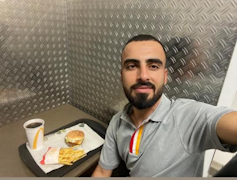
Saad Nawaf Abdo
He endured cold, rain and repeated pushbacks. “One time Polish guards threw away our belongings, even our passports, and humiliated us,” Saad recalls. Eventually, he made his way to Germany, driven from Poland by a Ukrainian smuggler.
In Germany, he applied for asylum, but his claim and appeals were rejected. He completed an integration course, worked at McDonald’s, lived in a shared apartment and sent money home for his mother’s surgery and basic needs.
“At least I could provide for myself and help my family,” he says. Then, one night, police came to his door.
They were banging so hard I thought it would break. They gave me 40 minutes to pack and took me straight to the airport.
Saad said he received no prior notice of the deportation. Today, he and his family rent a house owned by a Yazidi woman who lives in Australia. “Once she told us to leave because she was coming for two months,” his mother recalls. “We begged her – we had nowhere else to go. She finally let us stay.”
Returning to Sinjar is not an option. Their home in their native village is destroyed, there is no reliable electricity or water, and Saad’s mother suffers from chronic health problems requiring regular treatment. Above all, the trauma of 2014 remains close. “When we go to Sinjar, we remember everything – how IS attacked us, burned our houses,” she says. They visit only occasionally to see relatives or Saad’s father’s grave.
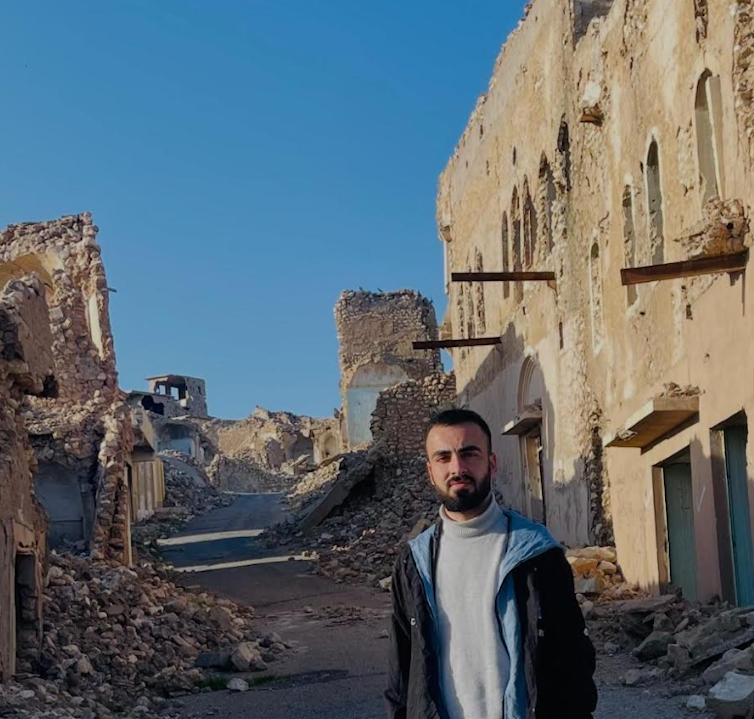
Saad Nawaf Abdo
German authorities often argue that Yazidis can find work in the Kurdistan Region. Saad, who speaks the Kurmanji dialect of Kurdish like most Yazidis, shakes his head. “They don’t understand. I didn’t finish school. I don’t speak Arabic or Sorani (the main dialect in Iraqi Kurdistan). How can I work?”
He and his mother are also affected by instances of misrepresentation and online hate speech from segments of the local Muslim Kurdish population. “People post insults about Yazidis. No one stops them. We are treated as the lowest,” Saad’s mother says.
Since his return, Saad and his brothers, now 19 and 20, work seasonal agricultural jobs – harvesting vegetables from 3am until late morning for about 14,000 Iraqi dinars each (around £8) a day. This work is available only for several months each year, leaving the family’s total income around or below the poverty line in the Kurdistan Region. “When Saad went to Germany, we hoped he could take us there legally,” his mother says. “But nothing happened.”
Saad’s passport now carries a deportation stamp, barring legal re-entry. “I want to go to Germany again, but I cannot legally enter,” he says. He remembers Germany with longing: “There, I could work. I didn’t have to wake up before dawn to dig potatoes under the sun…Now even that work here has stopped – the season is over.”
His mother added, quietly: “When Saad came back, he was in a very bad state. I had to be both mother and father. I tried to calm him – otherwise he might have taken his own life.”
‘I’ve always lived in the camp’
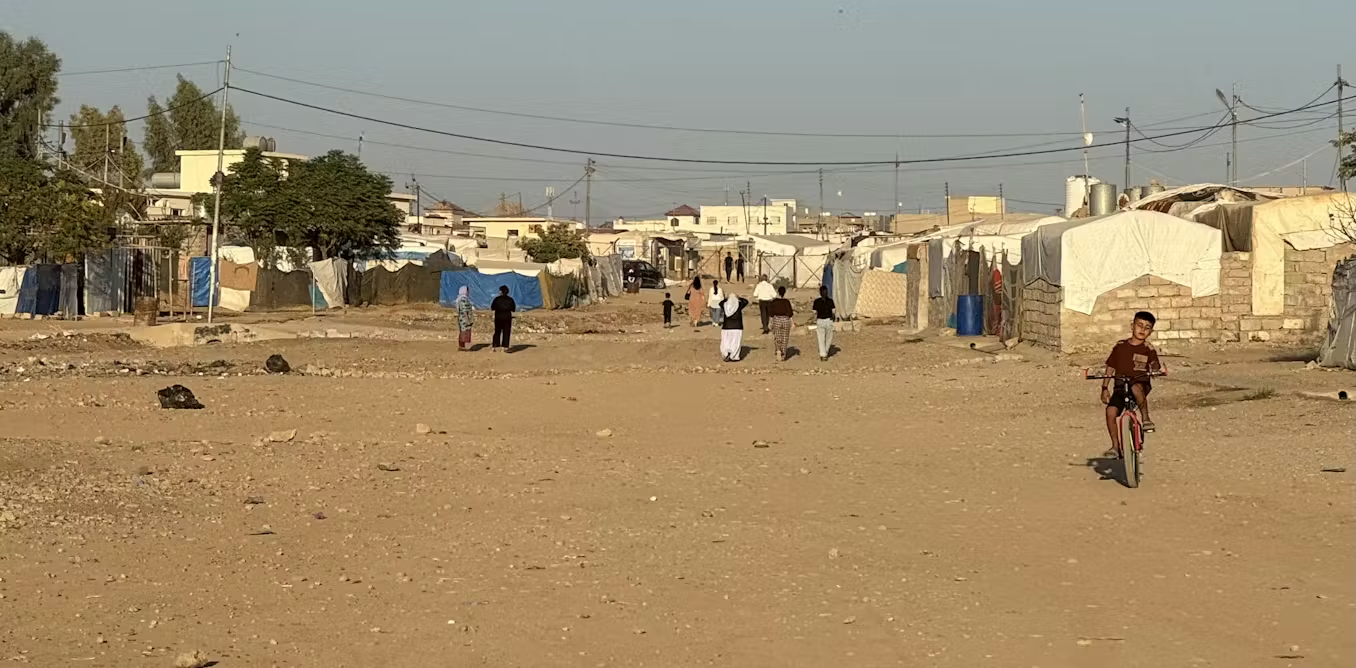
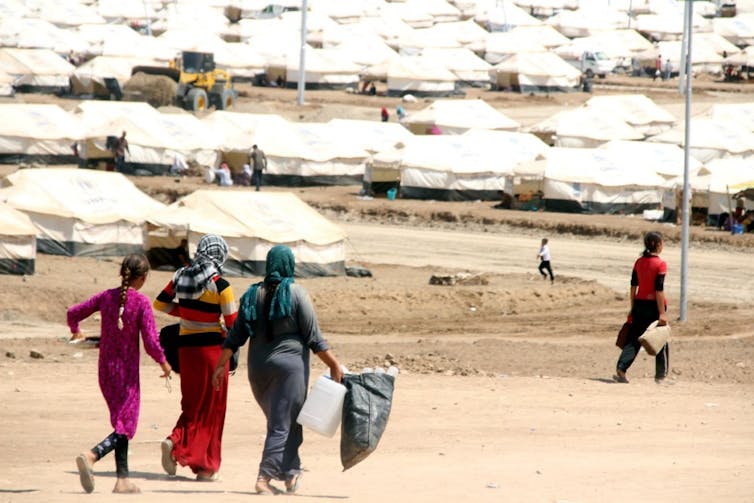
While Milisia’s and Saad’s families live in Yazidi villages, over 100,000 Yazidis remain displaced in IDP camps near Duhok. Eleven years after IS’s initial attack, these camps – originally intended as temporary shelters – have become a lasting part of Kurdistan’s landscape, permanent settlements of waiting and uncertainty. For many, moving abroad is the only thing that offers hope.
Even being returned to an IDP camp does not protect Yazidis from deportation from Germany. Authorities and courts have adopted a narrow interpretation, arguing that basic needs will be met in the camp. This approach has led to cases where people are sent back to the very camps they once fled, undoing years of integration in Germany and reinforcing the cycle of displacement and despair.
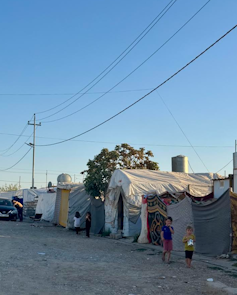
Aleksandra Ancite-Jepifánova
Saber, 27, is one such example. German media reported on his case after he was deported to Sharya IDP camp in the Kurdistan Region, where he now lives in a tent after four years in Germany. He had worked full time, spoke fluent German and had been well integrated into daily life.
Others with precarious residence status in Germany face similar risks, often separated from family members who remain in the camps. German restrictions on family reunification have kept many families apart for years: wives run households alone, children grow up without fathers, and men in Germany wait in legal limbo, while families survive in tents. For these families, Germany represents the only hope for a durable solution.
Layla, 40, and her children have lived in Khanke IDP camp since fleeing Sinjar in 2014. As I walked through the camp, tents stretched in neat rows, children played on dusty paths – a generation that has never seen life outside the camp. After repeated fires in standard tents, residents were permitted to rebuild their shelters using concrete blocks, while the roofs remain temporary. Layla’s family now occupies a single small room, furnished with a few plastic chairs, a sofa, a TV and a refrigerator.
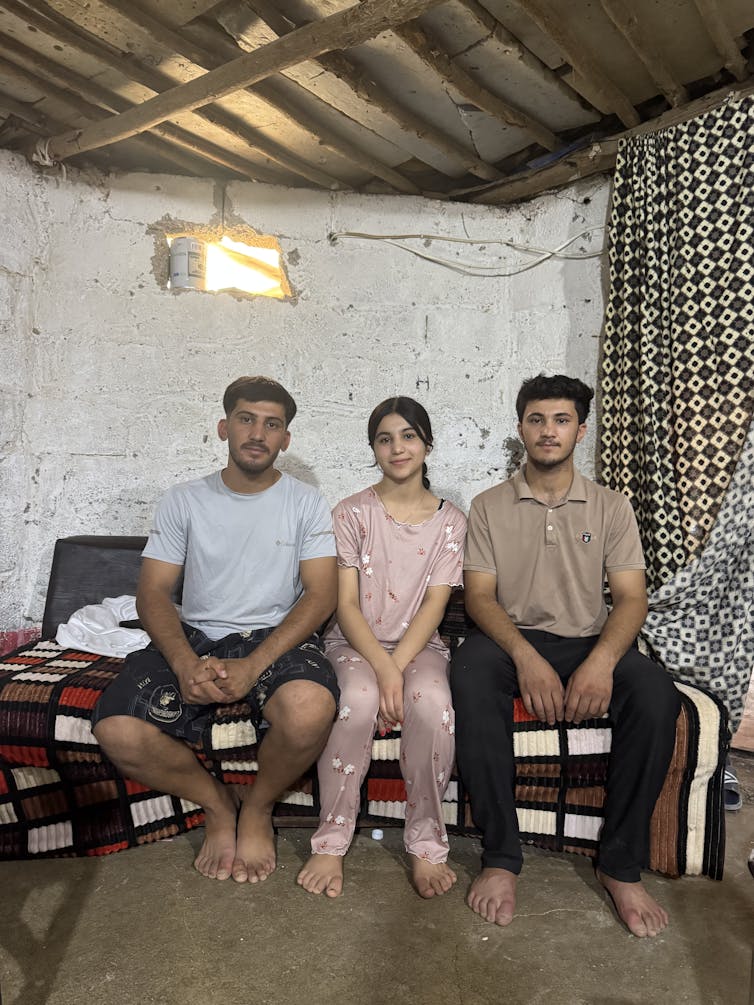
Aleksandra Ancite-Jepifánova
Layla’s husband left for Germany in 2017, travelling irregularly. His asylum application was initially rejected, but he later received a Duldung – a temporary suspension of deportation. This status did not allow family reunification, leaving the family stranded in the camp. He now works at McDonald’s in Hanover and has obtained a residence permit, which would allow family reunification – but too late for Layla’s two sons, who also live in the camp and are now young adults. Only Layla and her daughter remain eligible, provided the father earns a sufficient income. Their eldest son, in his early twenties, who migrated irregularly in 2021, now faces deportation back to the same camp. Layla’s daughter, 13, explained:
I don’t remember my father. I only speak with him on the phone.
Layla added: “It’s very difficult to live without a husband. The children should have their father. I handle everything alone – the hospital, shopping. All the burden is on me.”
Returning to Sinjar is not an option. Their home is destroyed, the area abandoned. “No one from our village lives there anymore,” Layla said. For her daughter, the camp has become permanent: “I don’t remember Sinjar. I’ve always lived in this camp.” Her mother echoes this: “Even when people ask where we are from, we say, ‘We are from the camps.’”
Germany represents hope. “In Germany, there is safety, human rights and work,” Layla said. “I left school young. If I were in Germany, I would go back and finish. Women can work and have a life. Here, there is nothing.” Both mother and daughter are learning German. The daughter studies online and can now introduce herself in German: “If I go to Germany, I want to study. I want to become a doctor and help sick people.”
Layla expressed frustration at Germany’s shift in policy. “We were hoping Germany would continue helping us. At first, we felt supported, that people were standing behind us, but then they stopped. We have survived so many genocides. Every time it happens, we survive, and then it happens again.” Her message to Germany is simple:
We don’t want much. Just stop deporting Yazidis. Give them permanent residence and reunite the families.
‘We ran from monsters’
Nearby in the same camp, Majida, 38, lives with her six children in a small room; the camp has been their home since 2014. Her husband, Kamal, left for Germany in 2017, hoping to secure protection and eventually reunite the family, following the path of a friend who had managed to do so.
Aleksandra Ancite-Jepifánova
Instead, his asylum claims were repeatedly rejected, leaving him in a precarious legal status and unable to bring them. “We haven’t seen him for eight years,” Majida says.
Before 2014, Kamal had worked for years to build their house in their Sinjar village. “It was our dream,” Majida recalls. “We moved in and lived there only one year before IS came. Then we fled, and the house was destroyed.”
When they first arrived at the camp, they believed it would be temporary. “At first, we thought this would last only a few days. But year after year, we realised no one is going to do anything for us.”
“We don’t see any future here – not in the camp, not in Sinjar,” she said. The family recently returned to Sinjar to process ID cards, their first visit since fleeing over a decade ago. “I didn’t want to go,” Majida says.
When I went there, I remembered everything – my childhood, our neighbours, those who were killed, how we escaped. I cried. But I was grateful I could save my children. We ran from monsters.
The Iraqi government offers four million Iraqi dinars (around £2,300) to each displaced Yazidi household willing to return and rebuild. Yazidis and rights groups say the amount is far too small. Majida’s family spent around 30 million dinars (around £17,000) to build their house.
Majida said she does not feel accepted in the Kurdistan Region either. Life in the camp is largely isolated, and the family has little interaction with Muslim Kurds, the dominant group in the area, which contributes to feelings of insecurity. Majida believes Yazidis are not seen as part of the wider community.
Fear and mistrust run deep. Even if new houses were built in the Kurdistan Region, Majida said she would still prefer the camp among other Yazidis over a two-storey home in a Muslim-majority area.
I don’t trust the government. I’m afraid everything that happened to me will happen to my children too. Even when I take them to the playground in the neighbouring town, I don’t feel safe.
Discrimination in employment adds to these sentiments. Yazidis are often excluded from jobs in the food industry because their non-Muslim faith is seen as incompatible with handling “halal” food.
Majida’s six children are now aged between 11 and 18. Raising them alone has been exhausting. Majida cries as she recalls the early years without her husband.
We have been through so many difficulties. At the beginning, the children were selling beans on the street. My husband was hiding in Germany, unable to work, unable to send money. NGOs later trained me in sewing, so I opened a small tailoring business. But the money is never enough. I spent so much on hospitals and doctors, and to send the children to school. It was still not enough.
In desperation, and tired of waiting for a legal path to family reunification, Majida and her children attempted to reach Europe irregularly through Turkey in 2023. They were caught and returned to Iraq.
One of her sons, now 18, added: “In Germany, you can build your future – go to school, work. Here, we don’t know what will happen.” Another son said: “Once we finish school, we’ll try to find a way to go to Germany. That’s our only hope.”
Majida’s husband, Kamal, 45, lives in the German city of Braunschweig, near Hanover. I interviewed him separately via video call. Kamal lives in refugee accommodation, sharing a small room with another man, and works shifts at warehouses.
After eight years marked by asylum rejections, periods of irregular status and hundreds of euros spent on legal fees, Kamal has recently been granted a temporary two-year residence permit. While the permit may lead to permanent residency, it allows family reunification only in exceptional humanitarian cases – a threshold so high that reunification with his family remains out of reach.
During the interview, Kamal broke down in tears. “We don’t have a future in Iraq. Yazidis have always been targeted, and I believe it will happen again,” he says.
I came to Germany hoping they would protect my family. Everyone talked about human rights here. But my life is on hold. Every night I cry because I miss my children. I haven’t seen them in years, and they no longer know me.
He added: “There is no humanity left for me, and I have lost hope in Germany. I don’t know what to do. Will I stay alone like this for the rest of my life? Sometimes I even think about ending my life. It’s too much.”
Sinjar will never be the same again
Instead of family reunification in Germany, many Yazidi men now face the risk of being deported back to the camps. This is what happened to Ali, 42. In autumn 2023, he joined protests in Berlin against the deportation of Yazidis, speaking to German media outside the parliament. Only weeks later, in December 2023, Ali himself was deported, after five years in Germany. He initially returned to the IDP camp in the Kurdistan Region where his wife and seven children had lived since 2014, after fleeing Sinjar.
Ali had arrived in Germany in late 2018, hoping eventually to bring his family. He paid around US $10,000 to smugglers – money borrowed from relatives and taken from his savings. His asylum claim and subsequent appeals were rejected. During his years in Germany, he worked in construction. In autumn 2023, he received a deportation notice.
Shutterstock/Tomas Davidov
We spoke on the phone while I was in Duhok and he was in Sinjar, where he moved a few months ago after leaving the camp. His children, now aged between five and 18, barely knew him. “When I came back to the camp, they asked, ‘Who is this man?’” he says. “I tried to give them something; they wouldn’t take it because they didn’t know me. It took them about a year to get a little bit used to me. Even now, they don’t act normally around me. None of them sleep next to me – they always sleep with their mum. I always feel like a stranger to them. Even when I try to be close, to kiss them, they don’t return it. It’s a strange feeling.”
Ali and his family spent 11 months in the camp after his deportation. He struggled with his mental health and eventually decided to return to Sinjar.
Their house had been completely destroyed. Ali applied for the government compensation of four million Iraqi dinars, but the family has not yet received it. “We are living in someone else’s house,” he explains. “When the owners return, they’ll ask us to leave.” Much of their street remains destroyed or abandoned.
To survive, the family works in orchards planting vegetables, but the income is unstable and seasonal. As Ali puts it, “Here and the camp – both places are bad.”
What needs to change
Although the Islamic State was militarily defeated, the harm inflicted on the Yazidis did not end in 2017. For a small, historically persecuted minority rooted in a single region, prolonged displacement in undignified conditions perpetuates the long-term consequences of genocide. With no viable local solutions, relocation abroad has become the only realistic way for many Yazidis to rebuild their lives.
Crucially, the numbers involved are low. After a peak of around 37,000 applications in 2016, annual asylum claims by Iraqi Yazidis in Germany have recently fallen to around or below 4,000. Germany’s largest refugee support NGO, Pro Asyl, estimates that up to 10,000 Yazidis currently face the risk of deportation back to Iraq.
At a minimum, Germany should grant secure temporary residence to Yazidis who arrived after 2017, with the right to work and family reunification, alongside a clear path to permanent status. Children’s rights must be prioritised to prevent the loss of education and belonging seen in cases like Milisia’s.
A draft law proposed by the German Green Party would offer a three-year residence permit to Yazidis from Iraq who arrived by July 2025, recognising both ongoing instability in Iraq and Germany’s special responsibility after acknowledging the genocide. Whether it will pass remains uncertain.
Ultimately, addressing the Yazidi case requires a tailored approach that recognises genocide survivors as a distinct vulnerable group and provides durable solutions that prevent the continuation of displacement and harm.
Ali still believes the only viable long-term solution for Yazidis is to move abroad. He sees Germany as offering safety, freedom of religion and future opportunities.
There, nobody asks about our religion, nobody cares about that, and we would have a future. Here [Sinjar], it will never be like before 2014. We always have fear inside.
For you: more from our Insights series:
To hear about new Insights articles, join the hundreds of thousands of people who value The Conversation’s evidence-based news. Subscribe to our newsletter.



