

Connect with us

NewsBeat

Painful tropical virus could become established in UK as temperatures rise

Published

on

Painful tropical virus could become established in UK as temperatures rise

A debilitating and painful tropical disease caused by infected mosquito bites is posing a greater threat to Europe, and could become established in the UK in the coming years.

In a new study, researchers have discovered that Asian tiger mosquitoes can spread the chikungunya virus when air temperatures are as low as 13C – cooler than previously believed.

A current outbreak of the virus has caused the US to issue a warning for people heading to Seychelles, Bolivia and Suriname, urging them to get vaccinated before they travel.

It comes as new data shows the virus can now be transmitted across most of Europe. Sandeep Tegar, who led the study, said: “Europe is warming rapidly, and the tiger mosquito is gradually expanding northwards through the continent.”

Advertisement

The species, which is occasionally detected in south-east England, could become more prevalent across Britain as climate change causes temperatures to increase.

“The lower temperature threshold that we have identified will therefore result in more areas – and more months of the year – becoming potentially suitable for transmission,” Mr Tegar said.

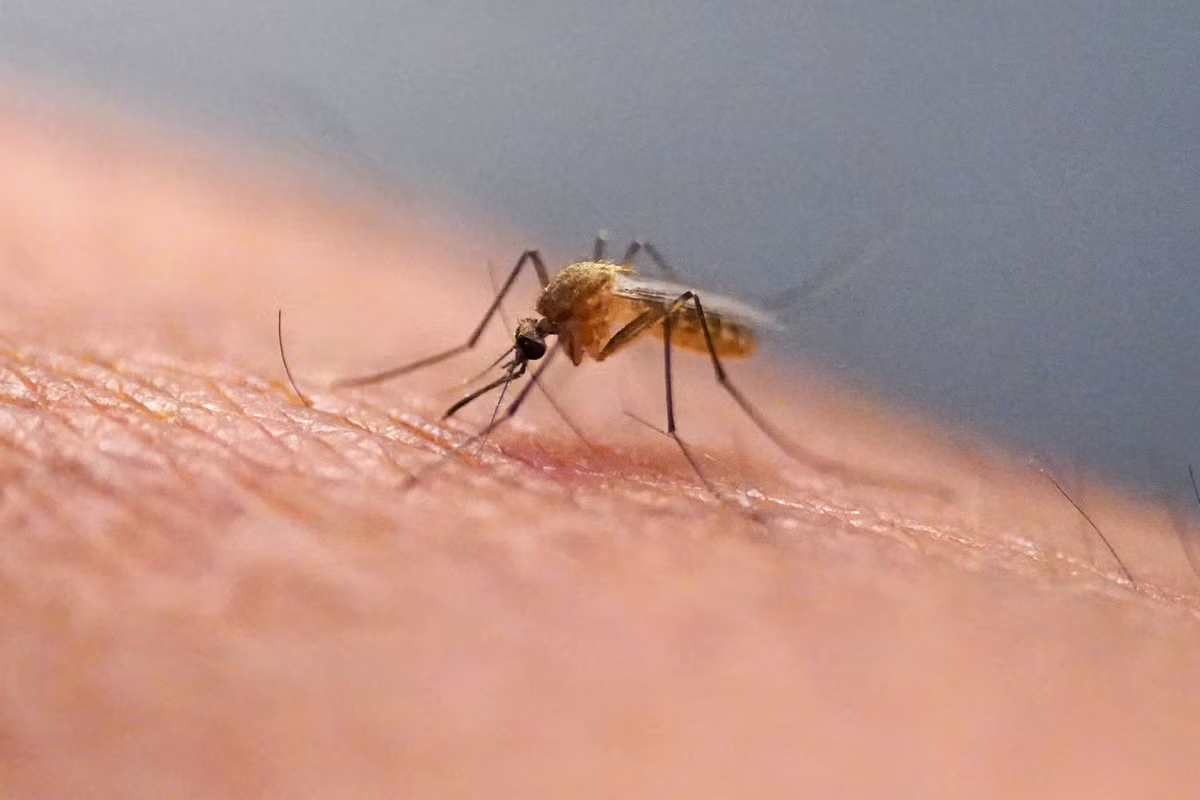
Chikungunya is a virus spread by mosquito bites

Chikungunya is a virus spread by mosquito bites (Alamy/PA)

In 2025, France and Italy saw record numbers of local outbreaks of chikungunya. The mosquito species has also caused a rise in the country’s dengue fever cases in recent years.

Advertisement

The researchers, from the UK Centre for Ecology and Hydrology, said the mosquitoes have started local outbreaks in Europe after biting people who have contracted the virus overseas.

New data shows that the possibility of infection is present for two to three months of the year across much of Europe, and up to six months in Spain and Portugal. 

“Identifying specific locations and the months of possible transmission will enable local authorities to decide when and where to take action to reduce the risk or scale of outbreaks,” Mr Tegar said. “Our research could also help predict how climate change could influence the future spread of the chikungunya virus.”

Chikungunya is not typically a fatal disease, but it can cause excruciating long-term pain. The UK Health Security Agency describes the virus as “a sudden onset of fever usually accompanied by joint pain”.

Advertisement

Joint pains may last for months or longer, but other symptoms such as headaches, sensitivity to light and skin rashes usually subside within a few weeks.

Two chikungunya vaccines are available in the UK

Two chikungunya vaccines are available in the UK (AFP/Getty)

In August, British travellers were urged to take precautions against mosquito bites during a rise in people returning to the UK with the virus.

Warmer weather creates better conditions for the mosquito to thrive and increases the rate at which the virus replicates and is transmitted. 

Advertisement

There is currently a low risk of the virus in south-east England over the summer months. However, researchers warned that rising temperatures will increase the odds of the tiger mosquito establishing in the UK, as has happened elsewhere in Europe.

Scientists found eggs of the mosquito in a trap at a freight depot near Heathrow airport in October. The country saw its hottest summer on record last year and experts have warned of 2C of global warming by 2050.

The study’s senior author, Dr Steven White, said: “It is important that there is continued action to try to prevent the tiger mosquito from establishing in this country because this highly invasive species is capable of transmitting several infections that can cause serious health conditions including chikungunya, dengue and Zika viruses.” 

The first known outbreak of the virus was in Tanzania in 1952. It now affects more than 110 countries across Asia, Africa, Europe and the Americas. 

Advertisement

As of November 2024, around 480,000 cases of chikungunya have been detected, causing 190 deaths.

A vaccination is available, but can only be obtained privately through travel clinics or certain pharmacies in the UK.

Source link

Advertisement
Continue Reading
Click to comment

Leave a Reply

Your email address will not be published. Required fields are marked *

NewsBeat

Bolton arrest as police crackdown on organised crime in city region

Published

on

Bolton arrest as police crackdown on organised crime in city region

A total of 258 officers were deployed in the day of action tackling serious and organised crime across the region.

In total 23 men linked to an Organised Crime Group in Greater Manchester were arrested.

Police from across the units and departments in Greater Manchester worked together today alongside Chief Constable Sir Stephen Watson.

A briefing was held at Clayton Brook complex at 5:30am.

Advertisement

258 officers worked together (Image: GMP)

In total 22 warrants were executed where a total of 23 suspects were arrested.

Seventeen men, between the ages of 18 and 55, and six boys between the ages of 13 and 17 were arrested on suspicion of a range of offences.

This included conspiracy to supply Class A and B drugs modern day slavery offences and robbery.

Eleven of these arrests were made across the City of Manchester, with one in Bolton and one in Bury.

Advertisement

Four were made in Salford, two in Wigan and one in Rochdale.

Eleven of these arrests were made across the City of Manchester. (Image: GMP)

Another two arrests were made in Merseyside and one in South Wales.

Several weapons have been seized, including two imitation firearms, bladed articles and tasers, along with Class A and Class B drugs – cocaine and ketamine – £3,000 of cash, eight Rolex watches, valuables in excess of £40,000, and a caravan, all believed to be related to the group’s criminal activity. 

Detective Superintendent Joe Harrop, who leads GMP’s Serious Organised Crime Division, said: “Today’s operation has been a powerful example of our continued, determined effort to dismantle organised crime in our region. 

Advertisement

“We now have 23 people in custody; all linked to a family-run organised crime group that have been causing widespread harm across our communities. Their criminal enterprise has been significantly disrupted and today marks a major step towards completely dismantling their operation. 

Several weapons have been seized along with class A and class B drugs (Image: GMP)

“During the execution of 22 warrants across Greater Manchester and Liverpool this morning, officers weapons, drugs, suspected criminally gained cash, and even a caravan believed to have been used as the headquarters of their operation. 

“The exploitation of children and the supply of drugs will never be tolerated. The individuals we have arrested today we believe have brought significant harm, particularly to the City of Manchester and Salford. 

“Our job isn’t over, and while this operation has been six months in the planning, we will carry on with our relentless action for as long as is necessary, and until organised crime groups are dismantled. 

Advertisement

“We still have persons of interest that we want to lock up, so let this be a message to you: we will come for you, and we will find you.”

Source link

Advertisement
Continue Reading

NewsBeat

Eight skiers found dead after avalanche in California | US News

Published

on

Members of a rescue team in Soda Springs. Pic: Nevada County Sheriff's Office via AP

Eight skiers have been found dead, and one is still missing, after an avalanche in the northern California mountains, authorities have said.

The avalanche hit the Castle Peak area of Truckee in California about 10 miles (16km) north of Lake Tahoe, at around 11.30am local time on Tuesday.

The cascade engulfed a group of backcountry skiers, with six people being rescued after they became trapped.

Authorities were still searching for nine missing people on Wednesday morning local time, but have now confirmed eight fatalities and one unaccounted for.

“Eight of the additional nine skiers have been located deceased,” Nevada County sheriff Shannan Moon said.

“We are still looking for one of the members at this time.”

Advertisement

Ms Moon said the difficult conditions and the risk of further avalanches had hampered rescue efforts, with the operation still ongoing.

The group of 15 backcountry skiers – who were outside ski resort boundaries – were returning from a three-day excursion when the avalanche struck, the organising tour company Blackbird Mountain Guides said.

The rescued skiers – including one guide and five clients – had taken refuge in a makeshift shelter made from tarpaulin sheets and communicated with authorities using a radio beacon and text messaging.

Image:
Much of California’s Central Sierra Nevada region has been covered in heavy snow. Pic: AP

Two of them were unable to walk because of their injuries and were taken to hospital, Ms Moon said.

Advertisement

One person’s condition had been stabilised and released on Tuesday night, while another person remained in hospital.

The survivors include five women and one man, authorities said.

Ms Moon said it was initially believed that 16 people had been on the tour, but the number was revised to 15 after it was confirmed that one person had pulled out at the last minute.

California has been hit by a powerful storm this week, bringing heavy snow, high winds and severe thunderstorms to the mountainous region.

Advertisement

The Sierra Avalanche Center issued an avalanche warning for the area in the Central Sierra Nevada, starting on Tuesday at 5am local time, with large slides expected into Wednesday.

The rapid accumulation of snow in unstable layers, coupled with gale-force winds had produced the dangerous conditions.

The area near Donner Summit has one of the highest snowfalls in the Western Hemisphere, with an average of nearly 35 feet (10 meters) of snow a year.

The area is named after the infamous Donner Party, a group of pioneers who resorted to cannibalism after becoming trapped in the winter of 1846 to 1847.

Advertisement

The incident marks the deadliest avalanche in the US since 1981, when 11 climbers were killed on Mount Rainier in Washington.

Each winter, between 25 to 30 people die in avalanches in the US, according to the National Avalanche Center.

This breaking news story is being updated and more details will be published shortly.

Please refresh the page for the fullest version.

Advertisement

You can receive breaking news alerts on a smartphone or tablet via the Sky News app. You can also follow us on WhatsApp and subscribe to our YouTube channel to keep up with the latest news.

Source link

Advertisement
Continue Reading

NewsBeat

when the brain can’t plan the words

Published

on

when the brain can’t plan the words

Talking is one of the most complex actions the human body performs, yet the process of turning thoughts into speech is coordinated on millisecond timescales. For some children, the brain struggles to plan the movements needed for speech, turning everyday conversation into hard work. Even forming a single word can affect learning, friendships and confidence.

UK guidance suggests around one in ten children experience some form of speech, language or communication difficulty, including speech sound disorders. These conditions can influence educational progress, emotional wellbeing and social development. Communication underpins not only learning, but also how children express feelings and connect with others.

As a speech scientist specialising in clinical phonetics and speech acquisition, I am currently researching a less common speech motor disorder: childhood apraxia of speech (CAS). This is a speech motor disorder, meaning the difficulty lies in the brain’s ability to plan and coordinate the movements needed to produce speech.

CAS is estimated to affect roughly one in 1,000 children, though figures vary. Many children improve with specialist speech and language therapy and regular practice. Without this support, speech difficulties are more likely to persist and some children may remain difficult to understand, even to close family members. Families and teachers also play an important role in reinforcing therapy and supporting everyday communication.

Advertisement

Understanding how speech is produced helps explain why these conditions occur and how they can be treated. Speech and language therapists receive extensive training in phonetics, the science of how speech sounds are created, transmitted and heard. Caregivers and teachers can also benefit from a basic understanding of just how complex speech production really is.

Moving parts

Producing even a single sound involves a carefully timed sequence of movements known as a speech motor plan, which the brain must assemble before the sound is spoken. For English speech, the lungs first generate a steady stream of air, usually by exhaling more slowly than during normal breathing.

As this air passes through the voice box, also called the larynx, it moves across the vocal folds. These small folds of tissue can behave in several ways. They can close tightly and release to produce a glottal stop, the brief catch in the throat heard in the middle of “uh-oh”. They can remain open so air flows through freely, creating voiceless sounds such as “s”. Or they can vibrate to produce “voicing”, the low buzzing sound you can feel in your throat when saying sounds like “z” or “b”. Each option depends on fine control of vocal fold position and tension.

Advertisement


À lire aussi :
Common myths about speech problems in children


After leaving the larynx, air travels either through the mouth alone or through both the mouth and nose. This pathway is controlled by the velum, the soft part at the back of the roof of the mouth. The velum lifts to block the nasal passage when air needs to stay in the mouth. When air reaches the mouth, the articulators, including the tongue, lips and teeth, shape it into recognisable speech sounds by creating narrow gaps or brief closures.

Take the first sound in the word “sat”, the /s/ sound. The tip of the tongue moves close to the roof of the mouth just behind the upper teeth, forming a narrow channel. Air rushing through this gap creates friction, producing the familiar hissing sound. At the same time, the velum lifts to stop air entering the nose and the vocal folds stay open so the sound remains voiceless.

Small changes in timing or position can create entirely different sounds. If the vocal folds vibrate, the /z/ sound in “zoo” is produced instead of /s/. If the tongue presses fully against the roof of the mouth, the sound becomes /t/, as in “two”.

Advertisement

Speech becomes even more complex in words and sentences, where sounds overlap and influence each other. The shape of the lips for one sound may be adjusted in advance for the next. When saying “seat”, the lips spread wide, but in “soup” they round in anticipation of the following vowel. Real-time imaging of the vocal tract during speech, including MRI and ultrasound studies, shows how intricate and rapid these adjustments are.

Therapy can help

Because speech relies on so many coordinated actions, the brain must assemble detailed movement plans and send them to the muscles with precise timing. In speech motor disorders such as CAS, this planning process is disrupted. The result is speech that may sound inconsistent, effortful and difficult to understand, with words sometimes produced differently each time, even for people who know the child well.

Therapy grounded in motor skill learning principles has been shown to help some children practise and stabilise these movement patterns. Support may also include augmentative and alternative communication, which refers to tools and strategies that help children communicate while their speech skills develop. These can range from picture boards to speech generating devices.

Advertisement

No single approach fits every child, but progress is possible. Specialist therapy, classroom support and tools such as augmentative and alternative communication can all help. The goal is not perfection, but participation. Being able to share ideas, ask for help and connect with others is what matters most for a child’s development.

Source link

Advertisement
Continue Reading

NewsBeat

Arrest following sexual assault in Downpatrick

Published

on

Ipso logo

A 23-year-old man has been arrested in connection with the incident

A man has been arrested following reports of a sexual assault in Downpatrick.

Advertisement

It has been alleged that the incident took place on January 19 in the Co Down town but was reported to police a number of days later on Sunday, February 1.

As part of the investigation into the incident, a 23-year-old man was arrested on Tuesday, February 3. He has since been released on bail pending further enquiries.

A PSNI spokesperson said: “Police received a report of sexual assault on Sunday, February 1, in the Downpatrick area.

“A 23-year-old man was arrested on Tuesday, 3rd February. He has since been released on bail pending further enquiries.”

Advertisement

Want to see more of the stories you love from Belfast Live? Making us your preferred source on Google means you’ll get more of our exclusives, top stories and must-read content straight away. To add Belfast Live as a preferred source, simply click here

Source link

Advertisement
Continue Reading

NewsBeat

Shiffrin wins slalom at Olympics, Klaebo claims 10th gold, Canada wins in OT

Published

on

Shiffrin wins slalom at Olympics, Klaebo claims 10th gold, Canada wins in OT

CORTINA D’AMPEZZO, Italy (AP) — Redemption, at last, for Mikaela Shiffrin at the Winter Olympics.

The American superstar put in two dominant runs to win the women’s slalom on Wednesday by a massive 1.50 seconds, ending a run of eight straight Olympic races without a medal for arguably the greatest Alpine skier of all time.

It was the largest margin of victory in any Olympic Alpine skiing event since 1998 and the third biggest in women’s slalom, the event she won as a fresh-faced 18-year-old in Sochi in 2014.

After adding gold and silver to her collection in Pyeongchang in 2018, Shiffrin went 0 for 6 in Beijing in 2022 and failed to medal in either the team combined or giant slalom in Cortina.

Advertisement

Shiffrin became the first American skier to win three Alpine gold medals.

Canada needs OT to beat Czechia

Canada avoided what would have been a stunning quarterfinal exit at the Olympics by rallying to beat Czechia 4-3 in overtime. Nick Suzuki tied it on a deflection with 3:27 left, Mitch Marner scored in OT.

Canada fell behind with 7:42 remaining when Ondrej Palat scored on an odd-man rush off a pass from Martin Necas. The goal sent the Czech bench and fans into a wild celebration, but it was short-lived.

Canada even staying in the tournament has a major concern after losing Sidney Crosby to injury five minutes into the second period. Crosby’s right leg appeared to buckle bracing for contact from rugged Czechia defenseman Radko Gudas.

Advertisement

Klaebo extends golden run

Johannes Hoesflot Klaebo’s golden run continued as the Norwegian cross-country star secured his fifth gold at these Games — and a record 10th overall — by winning the men’s team sprint.

Klaebo beat back a challenge from the United States to improve on his own record tally, racing with Einar Hedegart to win in 18 minutes, 28.9 seconds.

Americans Ben Ogden and Gus Schumacher were 1.4 seconds behind for the silver, while Italy’s Elia Barp and Federico Pellegrino pleased the home crowd by taking bronze.

Sweden won gold in the women’s team sprint.

Advertisement

Slopestyle gold for China’s Su Yiming

Su Yiming of China won the gold medal in men’s slopestyle snowboarding.

Su collected his fourth career medal and his second of these Games on his 22nd birthday.

Taiga Hasegawa of Japan took silver and American rider Jake Canter claimed the bronze.

Su’s first of three runs that earned him 82.41 points proved enough after no rival was able to better that score.

Advertisement

It was China’s first gold of the Milan Cortina Games.

___

AP Olympics: https://apnews.com/hub/milan-cortina-2026-winter-olympics

Advertisement

Source link

Continue Reading

NewsBeat

Laura Whitmore shares pregnancy snaps and confirms second baby with Iain Stirling

Published

on

Laura Whitmore shares pregnancy snaps and confirms second baby with Iain Stirling
Laura Whitmore and Iain Stirling already share a daughter (Picture: David Fisher/Shutterstock)

Laura Whitmore has shared the news with fans that she is expecting a second baby with Iain Stirling.

The Irish model and TV presenter shared bump-filled snaps that make it clear another baby is on the way, in an Instagram post on Wednesday evening.

The 40-year-old posted plenty of pictures of her bump in warmer climes, writing in the caption: ‘Instagram V Reality – Spoiler: It wasn’t just a big meal mama ate. She’s been cooking away! 

‘I’d like to thank stretchy pants and travel sick bags.’

Advertisement

Several of Whitmore’s celeb pals took to the comments section to congratulate her on the news, with Vick Hope writing: ‘Huge congrats lovely Laura!!’

Emily Atack also left a string of loveheart emojis and Whitmore’s husband Stirling, who has lent his pipes to Love Island for years now, simply wrote: ‘I love you.’

Laura Whitmore pregnant Instagram V Reality - Spoiler: It wasn?t just a big meal mama ate. She?s been cooking away! I?d like to thank stretchy pants and travel sick bags
‘I’d like to thank stretchy pants and travel sick bags’ (Picture: Laura Whitmore/Instagram)
Laura Whitmore pregnant Instagram V Reality - Spoiler: It wasn?t just a big meal mama ate. She?s been cooking away! I?d like to thank stretchy pants and travel sick bags
Whitmore tied the knot with Stirling in 2020 (Picture: Laura Whitmore/Instagram)

The couple welcomed daughter Stevie Ré, in March 2021, having tied the knot during the Covid times in 2020.

When the Irish presenter announced she was pregnant with their first child, it was just a day after she married the Scottish comedian.

At the time, she stressed how much the couple value their privacy in an Instagram post, writing: ‘So I’ve always tried to be protective over the personal side of my life. A lot of things are just for me and my loved ones and we’ve chosen not to share publicly. 

Advertisement

‘However I want to now share good news as it’s our news to share – and I’m gonna be honest it’s starting to look like my lockdown beer belly is out of control. Iain and I are expecting a baby early 2021. 

‘It’s been hard to keep such happy news quiet. Especially the times when I’ve had to run out of live radio to get sick in a bin or my penchant for a bowl of mashed potato in the morning. 

‘I wasn’t hungover like everyone thought. In fact I was completely sober filming the entire series of Celeb Juice, which is quite the accolade!

‘We’d appreciate our privacy respected but just wanted to spread some love and a reminder of the beauty of life.’

Advertisement

Whitmore was a member of the panel on Celebrity Juice between 2020 and 2022. She is also the former host of the ITV villa, having been succeeded by Maya Jama in the villa spot.

Whitmore has since presented Laura Whitmore’s Breakfast Show and Laura Whitmore Investigates on ITV, the former of which was axed after one series.

Got a story?

If you’ve got a celebrity story, video or pictures get in touch with the Metro.co.uk entertainment team by emailing us celebtips@metro.co.uk, calling 020 3615 2145 or by visiting our Submit Stuff page – we’d love to hear from you.

Advertisement
Advertisement

Source link

Continue Reading

NewsBeat

Jose Mourinho sounded like he was victim blaming – but Vinicius Junior needs empathy over alleged racist abuse | World News

Published

on

Real Madrid's Vinicius Junior. Pic: AP

Vinicius Junior had every right to want to leave the pitch – and for the game to be abandoned.

Because while he is a superstar of the game, well used to the biggest Champions League occasions, being the target of racism cannot be excused as coming with football’s tribalism.

This was reporting being racially abused at work. Just after adding another wondrous strike to his collection of goals.

Image:
Vinicius Junior celebrates his goal. Pic: Reuters

The accused – Benfica’s Gianluca Prestianni – has every right to a thorough process if he persists with denials.

Advertisement

And the UEFA case has to be watertight before imposing the minimum 10-game ban for racism.

But Benfica have gone beyond defending their man with statements, showing no empathy with a player who has been singled out for hate because he is black too often in his career.


‘Another match that has shamed football’

There has been no acknowledgement of how difficult it is to take a stand and report abuse, halting a match being watched worldwide by millions.

Advertisement

There has been no recognition of the anguish Vinicius will be feeling, even if, as a club, you do not believe he was called a monkey by Prestianni on Tuesday night in Lisbon – five times, according to his Real teammate Kylian Mbappe.

You can recognise that personal pain as a club without admitting wrongdoing.

Real Madrid's Vinicius Junior complains to referee Francois Letexier. Pic: Reuters
Image:
Real Madrid’s Vinicius Junior complains to referee Francois Letexier. Pic: Reuters

For all the courage and dignity demonstrated by Vinicius – praised by his Brazilian FA bosses – there was only deflection and no compassion from Jose Mourinho and Benfica.

They only complained about facing a “defamation campaign”, and appropriated the memory and legacy of Eusebio and the black superstar’s legendary career with them in the 1960s and 70s as evidence that the club cannot be racist. That overlooked the racism Eusebio endured.

How does Benfica reaffirming their “historical and unwavering commitment to defending the values of equality, respect, and inclusion” align with victim blaming?

Advertisement
Benfica coach Jose Mourinho and Real Madrid's Vinicius Junior. Pic: Reuters
Image:
Benfica coach Jose Mourinho and Real Madrid’s Vinicius Junior. Pic: Reuters

Mourinho suggested Vinicius incited the crowd with his goal celebration.

And yet if there is anyone in football known for goading, overexuberant celebrations, it is Mourinho himself on the touchlines.

UEFA has avoided saying anything beyond the appointment of an ethics and disciplinary inspector to investigate.

Benfica's Gianluca Prestianni (left) allegedly racially abused Real Madrid's Vinicius Junior. Pic: Reuters
Image:
Benfica’s Gianluca Prestianni (left) allegedly racially abused Real Madrid’s Vinicius Junior. Pic: Reuters

But FIFA President Gianni Infantino did speak out in a statement naming Vinicius, showing “full solidarity to victims of racism and any form of discrimination” and saying: “We need all the relevant stakeholders to take action and hold those responsible to account.”

But that did not happen when another Real Madrid player, Antonio Rudiger, reported being racially abused last year.

It was in the Club World Cup – a tournament run by FIFA. An investigation was launched, but no one was held to account.

Advertisement

Read more on Sky News:
UEFA investigates Vinicius allegations
Fans jailed for Vinicius racist abuse

So, when the world asks why racism is still a stain on the game, why black players fear being abused in stadiums and online, the words and actions of those with status and power come under greater scrutiny.

Advertisement

And at the heart of it is Vinicius feeling he isn’t being protected enough by football, and could have to face the alleged perpetrator next week in the second leg in Madrid.

Source link

Advertisement
Continue Reading

NewsBeat

Using AI responsibly means knowing when not to use it

Published

on

Using AI responsibly means knowing when not to use it

Most AI training teaches you how to get outputs. Write a better prompt. Refine your query. Generate content faster. This approach treats AI as a productivity tool and measures success by speed. It misses the point entirely.

Critical AI literacy asks different questions. Not “how do I use this?” but “should I use this at all?” Not “how do I make this faster?” but “what am I losing when I do?”

AI systems carry biases that most users never see. Researchers analysing the British Newspaper Archive in 2025 found that digitised Victorian newspapers represent less than 20% of what was actually printed. The sample skews toward overtly political publications and away from independent voices.

Anyone drawing conclusions about Victorian society from this data risks reproducing distortions baked into the archive. The same principle applies to the datasets that power today’s AI tools. We cannot interrogate what we do not see.

Advertisement

Literary scholars have long understood that texts help to construct, rather than simply reflect, reality. A newspaper article from 1870 is not a window onto the past but a curated representation shaped by editors, advertisers and owners.

AI outputs work the same way. They synthesise patterns from training data that reflects particular worldviews and commercial interests. The humanities teach us to ask whose voice is present and whose is absent.

Research published in the Lancet Global Health journal in 2023 demonstrates this. Researchers attempted to invert stereotypical global health imagery using AI image generation, prompting the system to create visuals of black African doctors providing care to white children.

Despite generating over 300 images, the AI proved incapable of producing this inversion. Recipients of care were always rendered black. The system had absorbed existing imagery so thoroughly that it could not imagine alternatives.

Advertisement

AI slop is not just articles peppered with “delve” and em dashes. Those are merely stylistic tells. The real problem is outputs that perpetuate biases without interrogation.

Consider friendship. Philosophers Micah Lott and William Hasselberger argue that AI cannot be your friend because friendship requires caring about the good of another for their own sake. An AI tool lacks an internal good. It exists to serve the user.

When companies market AI as a companion, they offer simulated empathy without the friction of human relationships. The AI cannot reject you or pursue its own interests. The relationship remains one-sided; a commercial transaction disguised as connection.

AI and professional responsibility

Educators need to distinguish when AI supports learning and when it substitutes for the cognitive work that produces understanding. Journalists need criteria for evaluating AI-generated content. Healthcare professionals need protocols for integrating AI recommendations without abdicating clinical judgment.

Advertisement

This is the work I pursue through Slow AI, a community exploring how to engage with AI effectively and ethically. The current trajectory of AI development assumes we will all move faster, think less and accept synthetic outputs as a default state. Critical AI literacy resists that momentum.

None of this requires rejecting technology. The Luddites (textile workers who organised against factory owners across the English Midlands in the early 19th century) who smashed weaving frames were not opposed to progress. They were skilled craftsmen defending their livelihoods against the social costs of automation.

When Lord Byron rose in the House of Lords in 1812 to deliver his maiden speech against the frame-breaking bill (which made the destruction of frames punishable by death), he argued these were not ignorant wreckers but people driven by circumstances of unparalleled distress.

The Luddites saw clearly what the machines meant: the erasure of craft and the reduction of human skill to mechanical repetition. They were not rejecting technology. They were rejecting its uncritical adoption. Critical AI literacy asks us to recover that discernment. Moving beyond “how to use” toward an understanding of “how to think”.

Advertisement

The stakes are not hypothetical. Decisions made with AI assistance are already shaping hiring, healthcare, education and justice. If we lack frameworks to evaluate these systems critically, we outsource judgement to algorithms whose limitations remain invisible.

Ultimately, critical AI literacy is not about mastering prompts or optimising workflows. It is about knowing when to use AI and when to leave it the hell alone.


Looking for something good? Cut through the noise with a carefully curated selection of the latest releases, live events and exhibitions, straight to your inbox every fortnight, on Fridays. Sign up here.

Advertisement

Source link

Continue Reading

NewsBeat

Norway’s Johannes Hoesflot Klaebo sets record with fifth Olympic gold medal – and 10th overall – at Winter Games | World News

Published

on

Norway's Johannes Hoesflot Klaebo with his fifth gold medal at the Winter Olympics 2026. Pic: AP

Norway’s Johannes Hoesflot Klaebo has won his fifth Olympic gold medal at the Winter Games – and the 10th of his career.

The 29-year-old cross-country skier won gold again on Wednesday when he, along with Einar Hedegart, won the men’s team sprint with a time of 18 minutes and 28.9 seconds.

He has won every race he has entered in at the 2026 Milan Cortina Games, breaking the Winter Olympics record in Sunday’s 4 x 7.5km relay. His final race will be in the 50km mass start this weekend.

The latest win means Norway’s Klaebo is now only the second athlete to win 10 Olympic gold medals, following US swimming legend Michael Phelps, who has a total of 23.

Advertisement

Advertisement

How it feels to win two golds at Winter Olympics

“It’s obviously very satisfying to make this happen,” Klaebo said after his win. “The team sprint is one of the most fun events, but also one of the hardest.”

He added: “There are so many strong teams, and so many fast skiers, so it always comes down to tight battles. That makes it even more rewarding.”

Pic: AP
Image:
Pic: AP

Coming in second place were US skiers Ben Ogden and Gus Schumacher, who were just 1.4 seconds behind for the silver medal.

Speaking to journalists after the race, Schumacher said that he “locked in” – and followed Klaebo over the line.

Advertisement

“I did it, and I’m really proud of it,” he said.

Read more from Sky News:
British man killed in avalanche in French Alps
Ukrainian officials to boycott Winter Paralympics

With 10 metres to go, he saw Ogden – now the US’s most decorated male cross-country skier – across the finish line to greet him, and knew a medal was in hand, having beaten Italy’s Federico Pellegrino.

Advertisement

Source link

Continue Reading

NewsBeat

Man dies after being hit by car in Edinburgh Tesco car park

Published

on

Daily Record

A 66-year-old man was airlifted by specialist ambulance helicopter for treatment after being hit by a car, but died a short time later. His family have been informed.

A man has died after being struck by a vehicle whilst walking through a supermarket car park.

The tragedy occurred in the Tesco car park on Meadow Place Road, Edinburgh, at approximately 9am on Wednesday (February 18). It involved a blue Volkswagen Polo.

Advertisement

The 66-year-old man who was hit was transported by specialist air ambulance helicopter for medical treatment, but sadly passed away shortly afterwards. His relatives have been notified.

No other casualties were reported. The section of the car park was cordoned off whilst investigators examined the scene, before reopening at 1.20pm.

Police Scotland Sergeant Paul Ewing stated: “Our thoughts are with the family and friends of the man who has died. Inquiries are ongoing to establish the full circumstances of what occurred and I am appealing to anyone who has information to come forward.”, reports Birmingham Live.

“In addition, anyone with dashcam footage which may assist is asked to please contact us. Anyone with information should call 101, quoting incident number 0688 of February 18.”

Advertisement

Source link

Continue Reading

Trending

Copyright © 2025