Pakistan’s defence minister has said that the country is in an “open war” with neighbouring Afghanistan, after both nations launched airstrikes overnight.
Khawaja Muhammad Asif said Islamabad’s patience had run out as tensions escalated, with casualties reported on both sides.
“Our cup of patience has overflowed,” he said. “Now it is open war between us and you (Afghanistan).”
Advertisement
This breaking news story is being updated and more details will be published shortly.
A bid from Pivovar to licence a vacant unit in the Guildhall complex for its proposed Mittel River Terrace is set to go before councillors on Monday, April 13.
Director Jamie Hawksworth said the venue would serve a range of lagers produced on-site by the Elvington-based firm and offer the best private views across the River Ouse.
But several companies with offices in the Guildhall complex said opening a bar there would disrupt them during working hours.
It comes after Pivovar lodged a the licensing application for the Guildhall Restaurant unit with City of York Council in February through its company Leeds Tap Ltd.
Advertisement
RECOMMENDED READING:
Planning permission has been granted for the company, which produces Mittel pilsner and lager and operates 14 bars and restaurants including in York, to redevelop the unit.
The council-owned two-storey restaurant space overlooking the River Ouse, off Lendal, has stood empty since it was built as part a £20m refurbishment to the Guildhall complex completed in 2022.
Pivovar boss Mr Hawksworth said in February Mittel River Terrace would serve a range of lagers produced in a bespoke on-site copper brewhouse made in the Czech Republic.
Advertisement
He told the Local Democracy Reporting Service (LDRS) the venue would also offer a range of food including oysters, rotisserie pork and chicken sourced from local suppliers.
But five comments have been lodged including from four companies and organisations based at the complex all voicing concerns about the plans.
York Science Park, which offers offices and co-working space to 23 companies there, called for a ban on outside music and seated drinking only during working hours.
The outside of the Guildhall Restaurant, off Lendal, in York (Image: LDRS)
They said: “Our tenants chose The Guildhall for its prestige and professional serenity.
Advertisement
“The introduction of a gastro-brew pub threatens tenant retention and the first impression for visiting clients.”
The Archaeology Data Service, which is due to move into the complex in June, said the venue’s location was ill-advised, risking bottlenecks along the narrow passageways used to reach it.
The firm said: “The grant of this licence in its current form would be detrimental to our research and development activity and, in the worst case, would force us to reconsider our location in the city.”
XR Stories, run by the University of York, and Colour Urban Design Ltd which are also based in The Guildhall objected over noise, public nuisance and disorder.
Advertisement
North Yorkshire Police and the council’s licensing department have also raised concerns about the plans.
The applicants have agreed close the venue earlier, at midnight rather than the 1.30am originally proposed.
Drinks would not be served after 11.30pm and its outside terrace would be closed at 11pm.
No outdoor speakers would be used at any time and bottles would not be taken to bins off the premises during office hours from Monday to Friday.
Advertisement
A part of the terrace would also be reserved for staff from overlooking businesses from 9am to 5pm, Monday to Friday, to have their own food and soft drinks there.
The venue would be licensed to serve alcohol from 10am to 11.30pm daily if the application is approved.
At least two door supervisors would be at the premises from 7pm until closing time on race days.
He also directed a series of sexually offensive remarks at one police woman called to the scene of a city centre street brawl.
A Belfast man who subjected PSNI officers to a “shocking” tirade of racist and sectarian slurs has been jailed for three months.
Advertisement
Neil Henry, 32, also directed a series of sexually offensive remarks at one police woman called to the scene of a city centre street brawl.
The outburst earlier this month included making offensive and menacing comments about one victim’s relatives and children.
Belfast Magistrates’ Court heard Henry, of no fixed abode, has only spent four weeks outside of prison in the last five years.
He pleaded guilty to new charges of disorderly behaviour and assault on police.
Advertisement
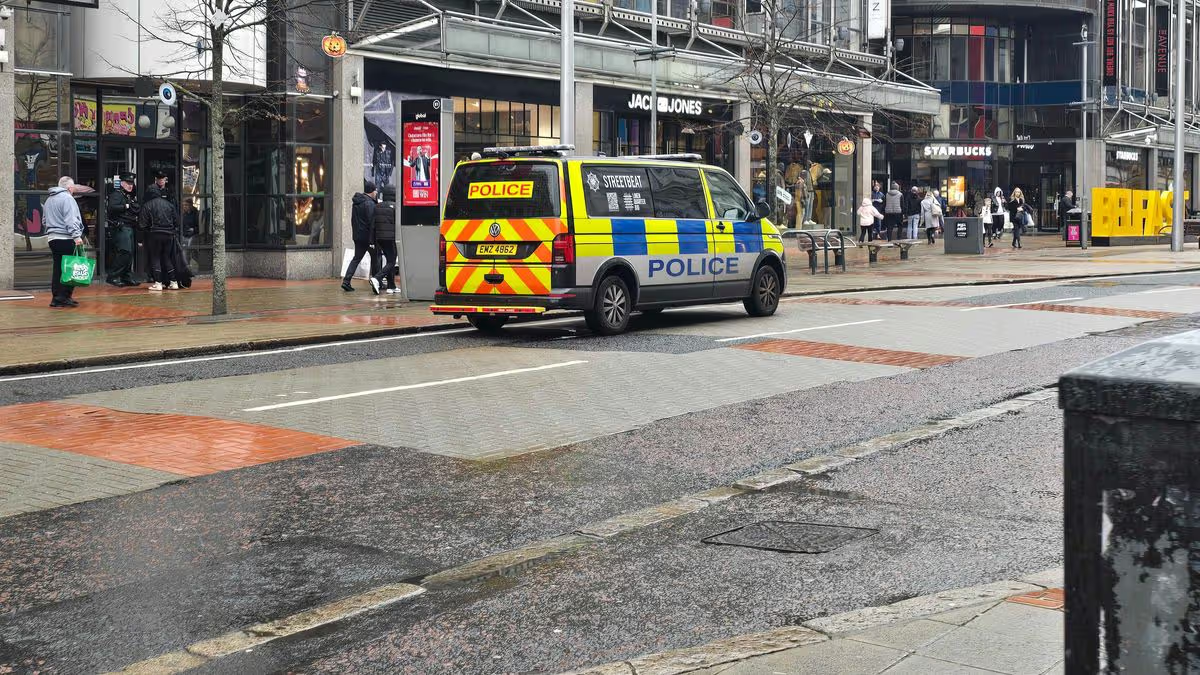
Officers had been dealing with an unrelated incident at CastleCourt shopping centre on April 4 when they were alerted to a number of men fighting outside.
Henry was detained at the scene on Royal Avenue, but immediately became verbally abusive.
“He shouted sectarian slurs such as ‘specky, four-eyed fenian b*****d’ and ‘dirty fenian rebel b*****ds’,” a Crown lawyer said.
The defendant made threats about cutting the throat of one officer, asking if he wanted his family to be short or his children raped.
Advertisement
At one point Henry had to be restrained on the ground due to the level of his aggression.
When a female officer approached he called her a “rat” and then shouted: “F*** up you dirty slut, go take a c***.”
The tirade continued after another constable approached to assist her, according to the prosecution, with Henry directing repeated racist remarks at him.
He told that officer: “Don’t you f***ing come near me, you black c***, you dirty f***ing rat.”
Advertisement
Removing any doubt about his intentions, the defendant then declared: “I’m a racist b*****d.”
During the outburst, he went on: “I f***ing hate blacks, they get everything, they are dirty immigrant c***s.”
Despite the repeated slurs, the charges were not classed as aggravated by hostility or hatred.
Deputy District Judge Gerard Trainor suggested it may have been an oversight by the prosecution.
Advertisement
A defence barrister told the court Henry was keen to get the case dealt with.
“He has an unenviable record… he has spent effectively no more than four weeks outside of prison in the last five years,” counsel disclosed.
Mr Trainor ruled that the offences were serious enough to justify sentencing Henry to a further jail term.
Imposing three months’ immediate custody, the judge said: “Although the aggravator is missing and I can’t rely on that, these facts and the outbursts are shocking to the ears of this court and any other reasonable person.”
Manchester City are short of defenders after Pep Guardiola provided an update on his squad ahead of the Premier League trip to Chelsea.
Manchester City return to Premier League action this weekend with a trip to Chelsea as they seek to keep pace with Arsenal at the top of the table.
Advertisement
Pep Guardiola’s side beat the Gunners in the Carabao Cup final a few weeks ago and returned from the international break in style when thumping Liverpool 4-0 to reach the last four of the FA Cup.
The Blues will now be targeting a win at Stamford Bridge to keep alive their hopes of reeling in league leaders Arsenal. Here’s the injury latest from the Etihad.
Get MEN Premium now for just £1 HERE – or get involved in our City WhatsApp group by clicking HERE. You can also join our City Facebook page by clicking HERE and don’t miss out on our brilliant selection of newsletters HERE.
Ruben Dias
Injury: Ankle
Advertisement
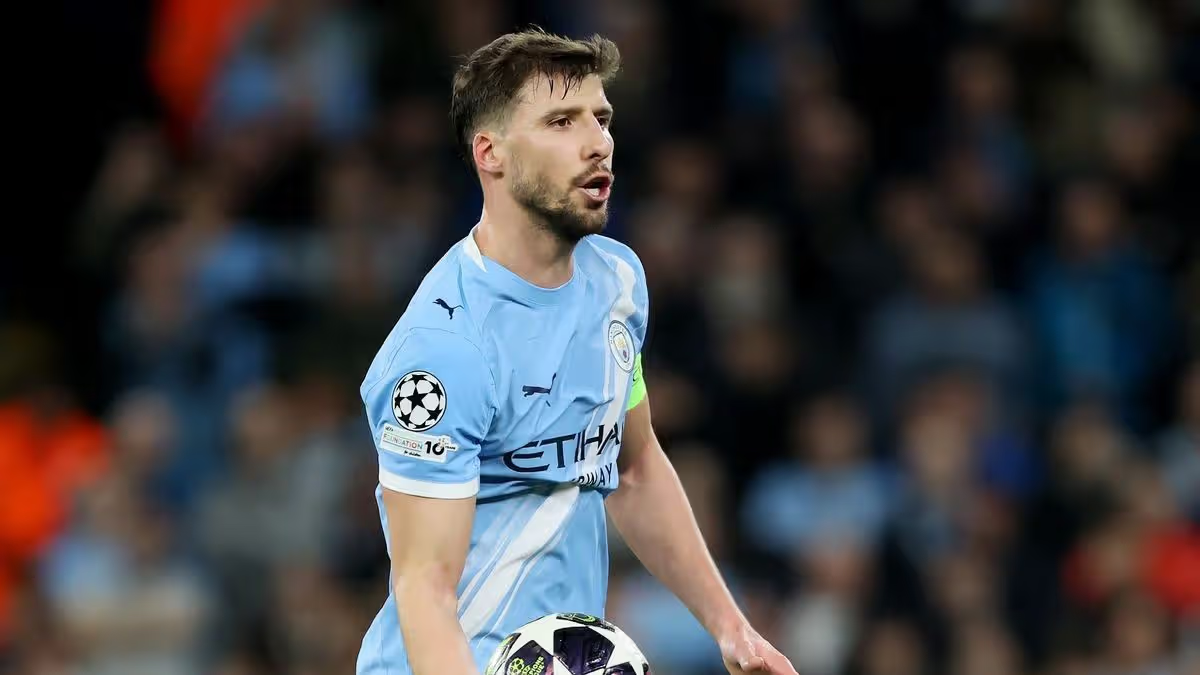
Dias missed the FA Cup win over Liverpool with an injury picked up in training and had a scan last weekend. The Portugal international is not fit enough to return to the squad for the trip to Chelsea and must be considered a doubt for the crunch clash with Arsenal.
“He is getting better but he is not ready for Sunday,” said Guardiola in his pre-match press conference.
Potential return date: Arsenal (H) April 19
John Stones
Injury: Thigh
Advertisement
Stones has suffered an injury-hit campaign and was forced to pull out of Thomas Tuchel’s England squad last month. He missed the weekend win over Liverpool as a result and is unlikely to feature against Chelsea given the centre back has yet to return to full training.
“He will maybe do partial training today,” said Guardiola on Friday.
Potential return date: Burnley (A), April 22
Man City vs Southampton VIP and hospitality tickets
Advertisement
This article contains affiliate links, we will receive a commission on any sales we generate from it. Learn more
Seat Unique offers hospitality packages for Manchester City’s FA Cup semi-final clash with Southampton, including ‘premium’ seats at Wembley and complimentary food and drink.
Josko Gvardiol
Injury: Leg
The Croat broke his leg in the reverse fixture with Chelsea in January and remains a long-term absentee. He might recover in time for the closing weeks of the season but there is no guarantee given he will want to be fully-fit for the World Cup this summer.
Advertisement
“He is getting better too, but still he is not close,” said Guardiola on Friday.
However, on Friday (April 10), Greater Manchester Police said they had charged a 32-year-old Bolton man with Section 18 assault, attempted Section 18 assault and dangerous driving.
Advertisement
Daniel Ashton, of Tattersall Avenue, Bolton, has been remanded into custody ahead of a court appearance at a later date.
A force spokesperson said: “Daniel Ashton, 32, of Tattersall Avenue, Bolton, has been charged with S18 assault, attempted S18 assault, and dangerous driving.
“He has been remanded in custody and is due for a court appearance at a later date.”
Commenting on the initial incident, GMP added: “At around 10.53pm on Friday, April 3, we were called to reports of a road traffic collision between a car and three pedestrians.
Advertisement
“Emergency services attended, and two men were taken to hospital for treatment.”
The pub did not want to comment on the incident itself due to its sensitivity, but did confirm that one of its staff members had been injured.
“The event has been traumatic for the staff team,” said Kevin Galbraith of the Victoria and Albert, “so we don’t wish to go over it again.
“We have assisted police with their enquiries.”
Advertisement
GMP issued an appeal for CCTV and dashcam footage to aid them in their investigations.
Horwich Cllr Charlotte Moncado-Sears said: “Horwich isn’t a place where we want people driving dangerously – we’re such a small, close-knit town.
“And Horwich is always so busy on Good Friday – everybody goes up Rivington Pike and comes back down into the village for a drink or something to eat.
“I know it was late, but there could be families and kids there.”
Advertisement
Horwich Councillor Ryan Bamforth said: “I really do hope everyone involved in the incident is alright.”
Anybody with information or footage of the incident is advised to contact GMP on 101 or via the online chat facility on the GMP website.
Anybody not comfortable contacting the police directly can call Crimestoppers on 0800 555111 to submit their footage/information anonymously.
The list of exclusions from schools in Wales includes children as young as four and five as teachers warn of violence and behaviour crisis
04:48, 11 Apr 2026
Advertisement
Schools in Wales have permanently excluded 92 children and teenagers this academic year. Most were expelled for assaulting teachers and other pupils or for verbal aggression and threats.
Thousands more have been issued with fixed term exclusions, mostly for disruptive behaviour, but also for violence, including the youngest reception class children aged four to five. Data from local education authorities, provided to WalesOnline under a Freedom of Information request, reveals more than 360 pupils were permanently excluded between September 2023 to March this year, including 92 between September 2025 and March 2026.
The true figure will be higher as only half of councils asked responded to the FOI and one declined to. Read the biggest stories in Wales first by signing up to our daily newsletter here.
The worrying exlusion statisics come as teaching unions warn of a behavior crisis in schools with some walking out in protest. There have also been high profile court cases for pupils attacking staff.
Advertisement
Reasons for the thousands of fixed term exclusions include violence, verbal threats, racist abuse, sexual misconduct, damage to property, theft, drugs and alcohol.
High profile, though unusual cases, include both teachers and pupils being stabbed. The data period covers 2024 when a 14 year-old girl used a knife to stab two teachers and a pupil at Ysgol Dyffryn Aman in Ammanford, Carmarthenshire. She was later found guilty of three counts of attempted murder.
Most fixed term exclusions are half to a full school day, while some run to two and three days. The law states pupils cannot be temporarily excluded for a total of more than 45 days in a school year.
Wales’ largest education authority was only able to provide data for 2023/24 school year. That showed for that year there were 2,712 fixed term exclusions, most for older children, but among them nearly 500 in primaries including 40 for the youngest reception class children aged four to five. Most fixed term exclusions were one day.
The same year there were 53 permanent exclusions for children aged eight to 16.
Advertisement
Reasons for both types of exclusion included 276 assaults on adults, 560 assaults on pupils, 588 cases of verbal abuse and threats to pupils and adults, 36 cases of racist abuse, 752 for persistent disruptive behaviour, 72 for damage and 56 for drugs/alcohol.
Anglesey
Fixed term exclusions:
2023-24: 722
Advertisement
2024/25: 634
2025- March 2006: 389
Permanent exclusions:
2023-24: 17
Advertisement
2024-25: 24
2025-March 2026: 17
Reasons (with number for each of the three school years)
Bullying : six, seven, two
Advertisement
Damage : 20, 13, nine
Drug and alcohol related: 14, 29, 15
Other: 110, 50, 57
Persistent disruptive behaviour: 205, 220, 131
Advertisement
Physical assault against a pupil: 123, 114, 68
Physical assault against an adult: 50, 32, 12
Racist abuse: 18, 15, seven
Sexual misconduct: one, three, one
Advertisement
Theft: two, three, zero
Verbal abuse/threatening behaviour against a pupil: 15, 28, 15
Verbal abuse/threatening behaviour against an adult: 146, 155, 83
Pembrokeshire
Advertisement
Fixed term exclusions:
2023-24: 606
2024-25:563
2025-26: 337
Advertisement
Most exclusions were older pupils but there were also hundreds among primary aged reception to year six.
Permanent exclusions:
There were less than five permanent exclusions in this three year period.
Flintshire
Advertisement
Flintshire only provided the number of exclusions and not the reasons for them. Its data showed that in the 2023/24 school year there were more than 130 exclusions in primaries including 20 in reception and 11 in year one. The same year there were more than 2,000 fixed term exclusions in secondaries.
In 2024/25 there were 230 exclusions in primaries and just under 2,000 in secondaries.
2023-24: 1,893, including 12 in reception and 16 in year one
2024-25: 1,833 including two in reception and 11 in year one
2025-March 2026: 1,034 including two in reception and 17 in year one
Permanent term exclusions:
Advertisement
2023-24: 37, including two in primaries
2024-25: 19, all in secondaries
2025-March 2026: 12, all in secondaries
So far this school year in NPT there have been 76 exclusions for violence to adults and 126 for violence to pupils. In 2023/24 there were 181 exclusions for violence to adults and 318 for violence to pupils while the following year the figures 130 and 234 respectively.
Advertisement
Caerphilly
Fixed term exclusions:
2023-24: two, 180, including 22 for reception pupils
2024-25: 2,033
Advertisement
2025-to March 2026: 1,204
Permanent exclusions:
2023-24: 43 (all secondary)
2024-25: 57 (including eight in primaries)
Advertisement
2025-March 2026: 34 (including two in primaries)
Reasons are given for 2023-24 only. For that school year they include 16 assaults on staff in secondary schools and 48 assaults on staff in primary schools. There were also 285 exclusions for pupils assaulting other pupils and 509 for disruptive behaviour.
Powys
Fixed term exclusions:
Advertisement
2023-24: 811
2024-25: 667
2025-March 2026: 328 (including 17 in year one)
Permanent exclusions:
Advertisement
2023-24: 10 (including two in primaries)
2024-25: 19 (including two in primaries)
2025-March 2026: two
Merthyr
Advertisement
Fixed term exclusions:
2023-24: 687 (including 11 reception classes)
2024-25: 612 (including 15 in reception classes)
2025-26 to date 352 (including two in reception classes)
2023-24: 1,058. Of these 67 were for violence against an adult member of staff and more than 100 for violence against a pupil.
2024-25: 984 (including one in nursery and 10 in reception classes) Of these more than 100 were for violence against an adult and more than 150 violence against pupils.
Advertisement
2025-March 26: 494 (including two in reception)
Three fixed term exclusions over the period were for sexual misconduct, 36 for drugs and alcohol, more than 300 for verbal abuse and more than 300 for physical assault against adults or pupils.
Permanent exclusions:
2023-24: seven (all but one in secondaries) Six were for violence against staff or pupils and one “other” reasons.
Advertisement
2024-25: Three (two in secondaries, one in primary) two for violence against pupils/adults and one “other” reasons.
2025-March 2026: zero
Wrexham
Fixed term exclusions:
Advertisement
2023-24: 1,895 including 17 in reception classes and 546 in year eight.
2024-25: 2,209 including 13 in reception classes and 560 in year nine.
2025- March 2026: 1,651 including 14 in reception and 355 in GCSE year 10.
Permanent exclusions:
Advertisement
2023-24: 17 in years eight and nine and less than five each in years seven, 10 and 11.
2024-25: Six in year nine and less than five each in years six of primary and seven, eight and 10.
2025-March 2026: Less than five each in years seven, eight, nine and 10.
Monmouthshire: Refused FOI request for details of school exclusions.
Advertisement
What the law says about school exclusions in Wales
Exclusion from maintained schools and pupil referral units in Wales is governed by the 2002 Education Act, supported by regulations made under that Act. They state that pupils should only be excluded in response to serious breaches of the school’s behaviour policy and if allowing them to remain in school “would seriously harm the education or welfareof the learner or others in the school”. Only the headteacher or teacher in charge of the school in their absence can exclude a pupil.
On permanent exclusions the regulations say a decision to exclude a learner permanently is “serious”. It will usually be the final step in a process for dealing with disciplinary offences “following a wide range ofother strategies that have been tried without success”. It is an acknowledgement by the school “that it has exhausted all available strategies for dealing with the learner and should normally be used as a last resort”.
Headteachers can permanently exclude a pupil for a first or one-off offence such as serious actual or threatened violence against another pupil or member of staff and use or threatened use of an offensive weapon.
The regulations state that pupils should not be excluded for uniform breaches, more than three days at a time or for more than 45 days in a school year.
“Unofficial” exclusions, where children are sent home or asked not to come in are unlawful. All exclusions must be officiall recorded.
Permanently excluded pupils may be moved to other schools or the education authority arranges out of school learning.
Families can appeal a school’s decision to exclude. If the parent, carer, pupil, governing body or local authority consider that the panel’s decision is wrong they have the right to the High Court for a judicial review.
A Welsh Government spokesperson said: “The Welsh Government expects all exclusions to be carried out in line with the legislation, the regulations and the statutory guidance.”
Reasons for exclusions:
Schools and local education authorities are required to follow a broad set list of reasons for exclusion. These include disruptive behaviour, violence/threats of violence to adults or pupils, verbal abuse, racist abuse, sexual misconduct, drugs/alcohol, theft and damage to property. There is also a broad sweep category for “other”.
Data on weapon-related exclusions is not categorised in Wales. Some councils told WalesOnline that they would need to manually search thousands of records to identify those that reference weapons as a reason for exclusion, which would be outside the statutory 18-hour limit for work on an FOI request.
Get daily breaking news updates on your phone by joining our WhatsApp community here. We occasionally treat members to special offers, promotions and ads from us and our partners. See our Privacy Notice.
St John’s Chapel, located in Upper Weardale within the North Pennines National Landscape, is praised for its peaceful character, historic charm, and scenic surroundings.
The heart of the village is St John the Baptist Church, an 18th-century building that remains central to community life and a focal point for visitors.
Heritage and hospitality
Set amid stone cottages and narrow lanes, the church and its graveyard contribute to the village’s sense of history, which many visitors note as they explore the area.
Advertisement
Tourists are also drawn to its riverside setting along the River Wear, with views toward the surrounding fells and upland countryside.
The Golden Lion, a traditional Dales pub, is recommended for its welcoming atmosphere, cask ales, and generous servings.
A working village
Despite its growing popularity, St John’s Chapel remains a working village, blending history, community, and access to the outdoors.
Recent visitors have described it as a “hidden gem,” making it an ideal destination for those seeking relaxation and natural beauty.
Advertisement
Walking and attractions
The village serves as a base for walkers, with access to the Weardale Way and other routes offering riverside paths, meadowland, and higher moorland tracks.
This mix of shorter strolls and more challenging hikes has helped attract those seeking open landscapes without large crowds.
Weardale’s industrial heritage remains visible in old mine workings and ruins scattered across the valley.
Advertisement
The nearby Killhope Lead Mining Museum provides insight into the lead industry that once shaped the region.
Other attractions within easy reach include High Force waterfall on the River Tees and the market town of Stanhope, known for its fossil tree in the churchyard.
Butchers have shared a simple cooking method to get juicier and tastier sausages that you might not expect.
If you’re anything like most folk, you probably reckon you’ve already mastered the art of cooking sausages. You’ve been doing it for years and are perfectly satisfied with the outcome. However, with just a few minor adjustments, you could potentially be serving up some of the finest bangers you’ve ever tasted.
Advertisement
The butchers at Lepp Farm Market reveal that their “hands down, favourite way to cook sausages” is on the barbeque.
Yet for day-to-day cooking, they’ve shared the ultimate technique to follow. It does require two stages, but “you won’t be disappointed by the results”. They insisted that sausages prepared this way were “some of the best they’d ever had”.
Pan-frying sausages appears to be amongst the most widely used cooking methods, yet it fails to impress the professionals.
Although it might seem a little unconventional, the butchers suggest boiling sausages to make them “juicier and tastier”.
Simply pop the raw sausages into a pot and submerge them in cold water, ensuring there’s roughly an inch of water above them.
Set your hob to a medium heat and bring it up to a gentle simmer. Avoid piercing the sausages or cooking them at a rolling boil, as “you’ll lose all those tasty juices”.
When you’ve achieved a simmer, keep cooking for just two to three additional minutes.
Advertisement
This brief cooking period is sufficient to bring the core temperature to a safe 160 degrees.
Drain the sausages and throw away the water. At this point, you can slice them as they are for a casserole or pasta dish; they’re completely cooked and ready to serve.
Admittedly, they’re not the most appealing shade, but you can easily fix that if desired.
Warm one tablespoon of cooking oil in a frying pan over a moderate heat, and fry the slices or whole sausages “just long enough until they’re golden brown”.
All five were the very best in the world at what they did. They all transcended their individual sport and became iconic figures way beyond the boundaries of their own field of excellence
Staff reporter
15:23, 10 Apr 2026
The countdown is over and the very best of the best make the top five Northern Ireland sport stars of all-time.
All have solid claims to be number one but, as ever, there can only be one.
All five were the very best in the world at what they did. They all transcended their individual sport and became iconic figures way beyond the boundaries of their own field of excellence.
Advertisement
Some have airports named after them, others may do in future.
But it’s fitting that on the final day, our number one sport star is on top of the leaderboard as he defends the title he won in such memorable circumstances 12 months ago.
Rory McIlroy is our number one choice – an iconic player who is admired the world over by fans, rivals and other sporting stars. He was a star from a young age and has managed to stay right at the very top of a global sport to this day and beyond.
On day one, we had international hockey star Katie Mullan, gymnast trailblazer Rhys McClenaghan, rugby legend Mike Gibson, GAA colossus Kieran McGeeney and Olympic gold medal winning swimmer Dan Wiffen.
Advertisement
At number 20, on day two, was soccer legend Pat Jennings. Former champion jockey Richard Dunwoody was in 19th, while Norman Whiteside, ex of Manchester United was in 18th. Three-time All-Ireland winner hero Sean Cavanagh was next in 17th, with boxing legend Wayne McCullough in 16th.
At number 15 was Paralympic legend Bethany Firth. Down GAA hero of the 1960s Sean O’Neill was 14th, while Ireland and Lions rugby icon Willie John McBride was 13th.
At number 12 was Belfast two-weight world boxing champion Carl Frampton and at number 12 was six-time World Superbike champion Jonathan Rea.
In the top 10, Olympic champion Mary Peters came first, with Northern Ireland and Tottenham football legend Danny Blanchflower in second.
Advertisement
Tyrone GAA hero Peter Canavan was eighth. Ireland rugby grand slam skipper Jack Kyle was in seventh with motorsport icon Joey Dunlop in sixth.
This is the top five in Northern Ireland’s greatest ever sport stars..
5. JIMMY McLARNIN
Born in Hillsborough, his family briefly moved to Inchicore in Dublin and then to Canada.
Advertisement
Made his pro debut on his 16th birthday and became a two-time Undisputed Welterweight World Champion and an International Boxing Hall of Fame inductee.
The BoxRec website ranks McLarnin as the second greatest pound for pound fighter of all time, only behind Sugar Ray Robinson.
In mid May of 1928 he was outpointed by Sammy Mandell in a lightweight title challenge; he was six months shy of 21, which makes him Ireland’s youngest ever world title challenger to this day.
Five years and one week after that, he challenged welterweight champion Young Corbett III at Wrigley Field in Los Angeles – and floored Corbett three times en route to stopping him in just 157 seconds.
Advertisement
Six weeks before he turned 29, he beat reigning lightweight champion Lou Ambers in a non-title bout in a full Madison Square Garden and then promptly announced his retirement with a record of 55-11 and three draws.
During his career he fought 23 times against former, current or future world title holders and beat all but one of them, former welterweight and future middleweight champion Lou Brouillard.
4. ALEX HIGGINS
Alex ‘Hurricane’ Higgins is remembered as a chaotic genius who revolutionised snooker into a high-speed, popular TV sport, earning him the title ‘The People’s Champion’.
Advertisement
The Sandy Row man’s legacy is defined by winning two World Championships (1972, 1982) and his charismatic, aggressive, and unpredictable style inspired generations.
Higgins won the Masters title in 1978 and 1981 and the UK Championship in 1983, where he recovered from 0–7 behind to defeat Steve Davis 16–15 in the final.
Despite his volatile behavior, he was immensely popular, admired for his raw talent and attacking, “death or glory” approach to playing.
His career was marked by controversies, including fights with fellow pros like fellow Northern Ireland snooker star Dennis Taylor, disciplinary issues, and public struggles with alcohol. Higgins passed away in 2010 at age 61 after a long battle with throat cancer.
Advertisement
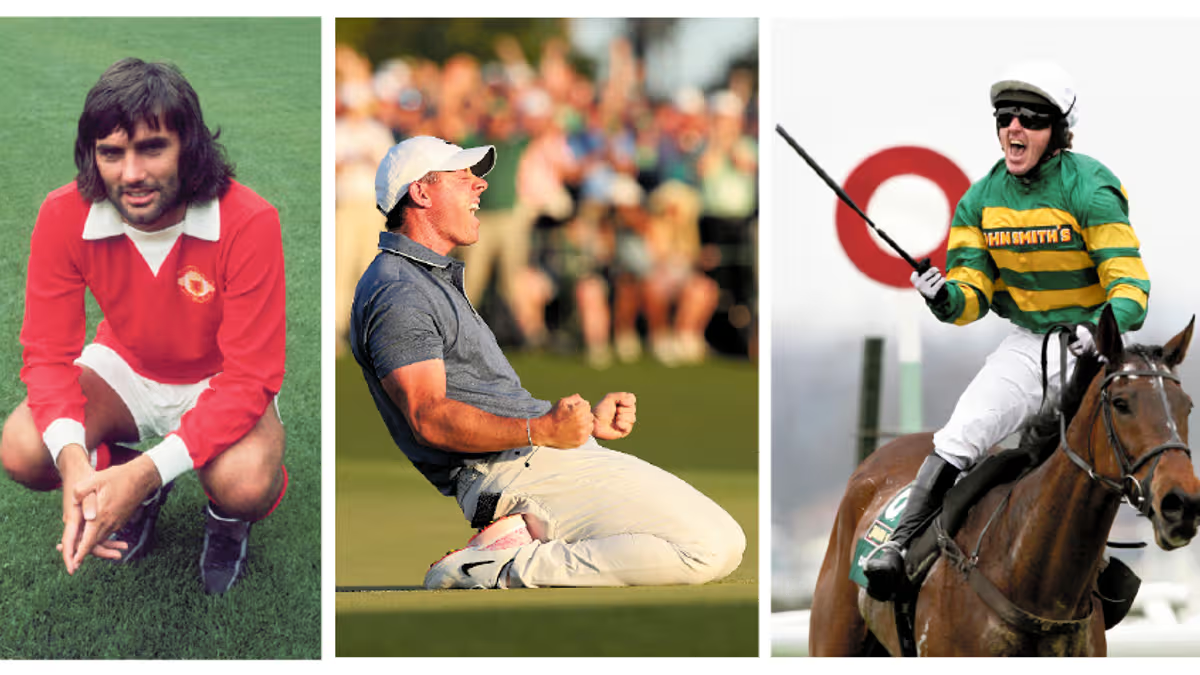
3. AP McCOY
Moneyglass man Sir Anthony ‘AP’ McCoy is recognised as the greatest jump jockey in history, achieving an unmatched 4,358 career wins and securing 20 consecutive Champion Jockey titles (1995–2015).
After a long wait, he won the 2010 Grand National on Don’t Push It, the 2012 Cheltenham Gold Cup, three Champion Hurdles.
He is the only sportsman of his kind to have been awarded ‘BBC Sports Personality of the Year’ (2010), the ‘BBC Sports Personality Lifetime Achievement Award’ (2015) & ‘BT’s Outstanding Contribution to Sport Award’ (2015).
Advertisement
McCoy also set a record for the highest number of wins in a season (289), surpassing Sir Gordon Richards’ record. He retired in 2015 after a final victory at Newbury.
McCoy was appointed Knight Bachelor in 2016 for services to horse racing and continues to work as a respected TV pundit.
2. GEORGE BEST
He was truly the best, but sadly he could have been so much better.
Advertisement
Few could move with a football at their feet like the brilliant Belfast man. He made even the heaviest and muddiest pitch look like an ice-rink, as he glided around opponents as if they weren’t there.
He scored 181 goals for Manchester United, and nine in 37 caps for Northern Ireland, and won two First Division titles and a European Cup during his time at Old Trafford.
Best was named the European Footballer of the Year (Ballon d’Or) in 1968 at the age of 22, becoming the first and only Northern Irish player to win the prestigious award. That came after a stellar season where he helped United secure their first European Cup, scoring in the 4-1 final win against Benfica.
It’s such a shame that off-field temptations led to his career spiralling downwards by his late-20s, but he had done enough by then to convince the world that he belonged among the pantheon of greats.
Advertisement
1. RORY McILROY
Holywood man Rory McIlroy has been one of golf’s defining stars of the modern era.
He is a five-time major champion, including a Masters win in 2025 that completed the career Grand Slam. McIlroy is one of only six golfers in history to achieve that feat, joining Gene Sarazen, Ben Hogan, Gary Player, Jack Nicklaus, and Tiger Woods. McIlroy is the first European Grand Slam winner.
He also has 29 PGA Tour victories. Add in a stack of season-long trophies – seven Race to Dubai titles and three FedExCup titles – and you get a measure of his success and longevity in a truly global sport.
Advertisement
The 36-year-old has played for Europe at the Ryder Cup in every edition from 2010 to 2025, with Europe winning six of those
McIlroy is among a rare group of global athletes whose presence transcends their sport, making him a global ambassador for golf. He has also spent 122 weeks as the No. 1 player in the world.
He puts his green jacket on the line at The Masters this week and shared the lead after round one.
WASHINGTON (AP) — First lady Melania Trump’s seemingly out-of-the-blue statement Thursday denying affiliation with disgraced sex trafficker Jeffrey Epstein left people still wondering Friday what prompted the public declaration at a time when the case had receded from the spotlight.
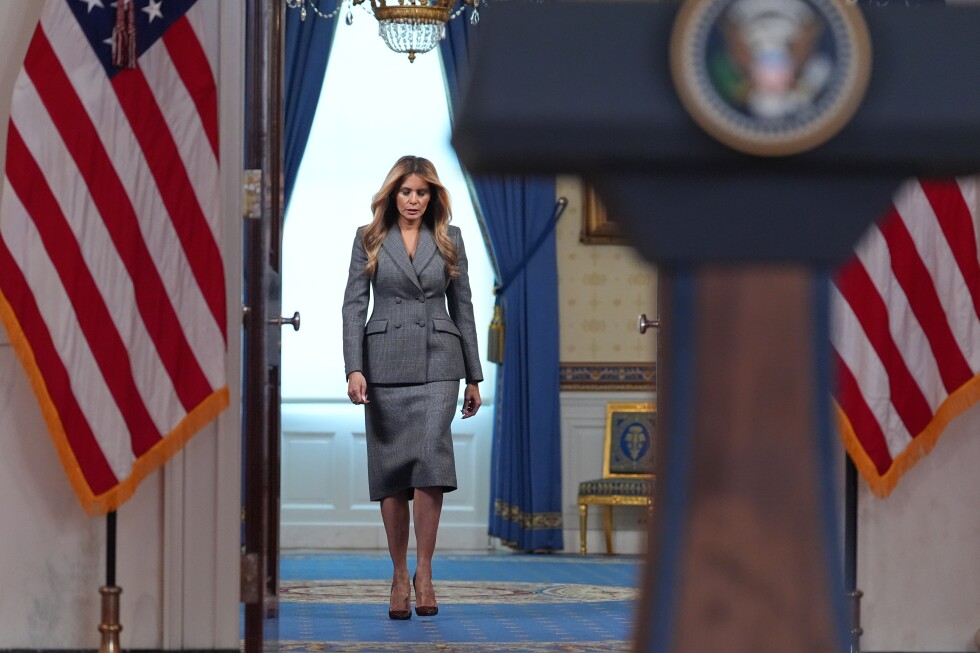
Reading prepared remarks at the White House on Thursday, Melania Trump said she and her attorneys were fighting back against “unfound and baseless lies” in regards to her connections to the late financier, a convicted sex offender who leveraged connections to the rich, powerful and famous to recruit his victims and cover up his crimes.
“The lies linking me with the disgraceful Jeffrey Epstein need to end today,” she said. “The individuals lying about me are devoid of ethical standards, humility and respect. I do not object to their ignorance, but rather I reject their mean-spirited attempts to defame my reputation.”
The first lady didn’t take questions from the press after her statement, leaving many with questions:
Advertisement
AP AUDIO: What to know about Melania Trump’s statement denying knowledge of Jeffrey Epstein’s crimes
Advertisement
In a statement, first lady Melania Trump says ‘lies’ linking her to Jeffrey Epstein need to end now.
Why now?
It’s unclear.
The message came as her husband, President Donald Trump, and his administration had finally seemed to move past more than a year of controversy surrounding Epstein, especially as the Iran war had become all-consuming in Washington.
The first lady’s comments almost assuredly will serve to push the story back into the political spotlight even as the president urged the public and media to move on from the case.
Advertisement
Who was Melania Trump responding to?
Melania Trump seemingly referenced a brief email from 2002 with the sender and recipient blacked out. It begins, “Dear G!” and ends “Love, Melania,” and compliments the recipient on a magazine article about “JE.”
“I know you are very busy flying all over the world,” it says. “How was Palm Beach? I cannot wait to go down. Give me a call when you are back in NY.”
That email was sent the same month that a New York Magazine article was published about Epstein in which Trump called him a “terrific guy.”
Melania Trump said Thursday that she was not friends with Epstein or his confidant and onetime girlfriend Ghislaine Maxwell, but was in overlapping social circles in New York and Florida. She described an email reply she sent to Maxwell as “casual correspondence” without elaborating.
Advertisement
“My polite reply to her email doesn’t amount to anything more than a trivial note,” she said.
Among other documents released was an image from Epstein’s home showing a series of photographs along a credenza and in drawers. In that image, inside a drawer among other photos, was a photograph of Donald Trump alongside Epstein, Melania Trump and Maxwell.
Melania Trump noted Thursday that several individuals and organizations have had to apologize for their “lies about me.” Of the examples she cited, the most recent was in October. In that case, book publisher HarperCollins UK apologized to the first lady and retracted passages from a book suggesting Epstein played a role in introducing her and Donald Trump.
What did President Trump say about his wife’s comments?
MS NOW reporter Jacqueline Alemany said on social media Thursday that President Trump told her he did not “know anything about” Melania Trump’s statement about Epstein.
Advertisement
The White House press office did not respond to requests for comment.
Nick Clemens, a spokesperson for the first lady, said the West Wing was aware beforehand that she was making a statement. But he deferred to the West Wing on whether the content of what Melania Trump planned to say was known.
In recent weeks President Trump’s public appearances have largely centered around the war in Iran.
What is the status of the release of the Epstein files?
Lawmakers initially complained when the Justice Department made only a limited release, but officials said more time was needed to review additional documents that were discovered and to ensure no sensitive information about victims was released.
Did anyone get punished after the files were made public?
Several key leaders in Europe have been punished for their affiliation with Epstein but there have been no comparable prosecutions in the U.S.
Most notably, Andrew Mountbatten-Windsor — Britain’s former Prince Andrew — was arrested in February following the most recent trove of files that were released. Mountbatten-Windsor’s name frequently appeared in the files, depicting a close relationship with Epstein.
But his arrest didn’t have anything to do with sexual impropriety. Instead, he was arrested for allegedly sharing confidential trade information with Epstein.
Advertisement
Melania Trump called on Congress to hold a public hearing centered on survivors of Epstein’s crimes, with a chance to testify before lawmakers and have their stories entered into the congressional record.
“Each and every woman should have her day to tell her story in public if she wishes,” she said. “Then, and only then, we will have the truth.”
Astrology offers a revealing lens into these habits (Picture: Getty/Metro)
Everyone wants a happy-ever-after (by their definition) in love, and when things don’t turn out that way it’s an easy, but not helpful, habit to look outside the relationship for blame or influence.
Actually, in many cases, it’s our own patterns, fears, and blind spots quietly running the show. And that’s good news because that means the secrets to success lie within your own remit.
Astrology offers a revealing lens into these habits. Each zodiac sign has strengths in relationships, but also a signature way of self-sabotaging love — usually without realising it.
Here’s how each star sign tends to get in their own way.
Advertisement
Looking for deeper insight?
My full Love Tarot Reading will tell you everything you need to know about your past, present and future love life.
Or, come join my magical, mystical tarot club, free for a whole month when you sign up using this link.
Advertisement
Aries
March 21 to April 20
Your relationship weakness is impatience (Picture: Getty/Metro.co.uk)
How Aries self-sabotages in love: Impatience
Burning passion often has a shelf life, and you’ve got the intensity but not always the longevity when it comes to love affairts. Your self-sabotage is impatience. You want passion now, resolution now, certainty now.
Slow down, let things unfold at their own pace, and accept what comes. You might be surprised that slower-building love can reach deeper and last longer.
Your relationship weakness is fear of change (Picture: Getty/Metro.co.uk)
How Taurus self-sabotages in love: The Taurean love of certainty and stability can create a side-effect fear of change which can keep you stuck in situations long past their sell-by date.
Even when you know things aren’t right, you don’t let go. And this can waste months, even years, of life! Love takes work and isn’t all sunshine and flowers, but it shouldn’t feel like an endurance test either.
Your relationship weakness is overthinking (Picture: Getty/Metro.co.uk)
How Gemini self-sabotages in love: The overthinking! Your mind can be heaven or hell, a best friend or a worst enemy… and in relationships there’s always doubts, strange moments, whispers and crossed wires which provides more than enough fodder for analysis and projection and assumption.
Don’t jump to conclusions, always get the facts, or validate your hypothesis, before you decide how someone feels about you.
Your relationship weakness is fear of rejection (Picture: Getty/Metro.co.uk)
How Cancer self-sabotages in love: Your fear of rejection can make you retreat or test people emotionally. You self-sabotage by expecting others to ‘just know’ how you feel.
Then, when they inevitably fail these tests, you can sulk or withdraw and will not offer any reason why, because you fear they’ll be scared off by knowing how intensely you ‘monitor’ them. Open up, talk about it, ask for what you need.
Your relationship weakness is a need for validation (Picture: Getty/Metro.co.uk)
How Leo self-sabotages in love: Everyone loves Leo — but your need to feel valued can tip into seeking constant validation and tying your worth to how much attention or affection you receive.
Your partner isn’t a bottomless well of compliments and passion for you alone and (long term) things won’t feel like a movie romance, or an effortless passion fest centred on you. Self respect and love are your route out of this.
Your relationship weakness is perfectionism (Picture: Getty/Metro.co.uk)
How Virgo self-sabotages in love: You are naturally a helpful person who wants to ‘fix’ whatever is visibly wrong in your own and your loved ones’ lives. Your self-sabotage is perfectionism. This urge to repair, upgrade and improve can exhaust other folk, make them feel they’re not up to scratch, inject a mood of stress and tension and judgment into what should just be an easygoing, fun time.
It’s hard for you to drop your standards but, sometimes, love just needs to be accepted as it is. You can’t force or make other folk something that they’re just not.
Your relationship weakness is pushing you true feelings down (Picture: Getty/Metro.co.uk)
How Libra self-sabotages in love: You’re effortlessly charming and diplomatic but this can slip into a desire to keep the peace that can lead you to avoiding all conflict or suppressing your true feelings. Ultimately it always backfires because resentment builds when you’re always accommodating others, and then you explode.
Face into small battles sooner and fight them well, start out on firm and fair footing, nip things in the bud.
Your relationship weakness is fear of betrayal (Picture: Getty/Metro.co.uk)
How Scorpio self-sabotages in love: Love is a deep and intense emotion when you’re truly attracted and magnetised to someone — but your fear of betrayal can make you guarded or controlling. Sometimes this leads to you testing loyalty by laying traps, or holding emotional power with silence or distance.
Real intimacy requires vulnerability, not surveillance, so you must force yourself to trust someone until the point they truly give you reason not to. Start out open-hearted, not on guard.
Your relationship weakness is avoidance (Picture: Getty/Metro.co.uk)
How Sagittarius self-sabotages in love: Avoidant behaviour is a common trait of Sagittarian folk because you crave freedom and adventure. Keeping things as light and casual as possible feeds your need for independence, because you think you should always be able to see the exit sign… but true love asks you to stay, not go.
You must resist this urge to bolt when things start to get serious — it only means you have to start all over again, anyway. Stay and see what happens!
Your relationship weakness is closing yourself off (Picture: Getty/Metro.co.uk)
How Capricorn self-sabotages in love: Stoicism, ambition and strength are such deeply attractive traits in you, but they do have a flip-side. You self-sabotage by closing off your feelings when you feel unsure or emotional.
Love isn’t something to manage like a project — it needs presence, vulnerability, and the courage to ride the waves with someone, never guaranteeing how it’ll all turn out. Love is an adventure not a job.
Your relationship weakness is emotional detachment (Picture: Getty/Metro.co.uk)
How Aquarius self-sabotages in love: Aloof and detached are words that get used to describe Aquarians many times. You are warm, friendly and outgoing but, in love, your colder side can emerge, maybe to protect your free spirit from being trapped, maybe to ensure you’re getting the space to express yourself fully.
You can step back and observe rather than experience things too, which also looks like detachment to others. Let yourself feel, not just analyse.
Your relationship weakness is idealism (Picture: Getty/Metro.co.uk)
How Pisces self-sabotages in love: Those in love can wear rose-tinted glasses about their partner, and this is definitely true for Pisces. Your self-sabotage is escapism. You see potential instead of reality. This can lead you to believing whatever you’re told, vs shown, if it upholds the daydream and vision of love you’ve bought into.
Come down to Earth, see folk for what they are, take actions over and above words. You’re too good to be treated poorly!
Kerry King has been reading, teaching and creating tarot for 30 years. Join her magical, exclusive Tarot Club for forecasts, predictions, lessons and readings straight to your inbox. Enjoy one month free for all Metro readers (no lock-in or commitment) over on Patreon.
Your daily Metro.co.uk horoscope is here every morning, seven days a week (yes, including weekends!). To check your forecast, head to our dedicated horoscopes page.




















































You must be logged in to post a comment Login