

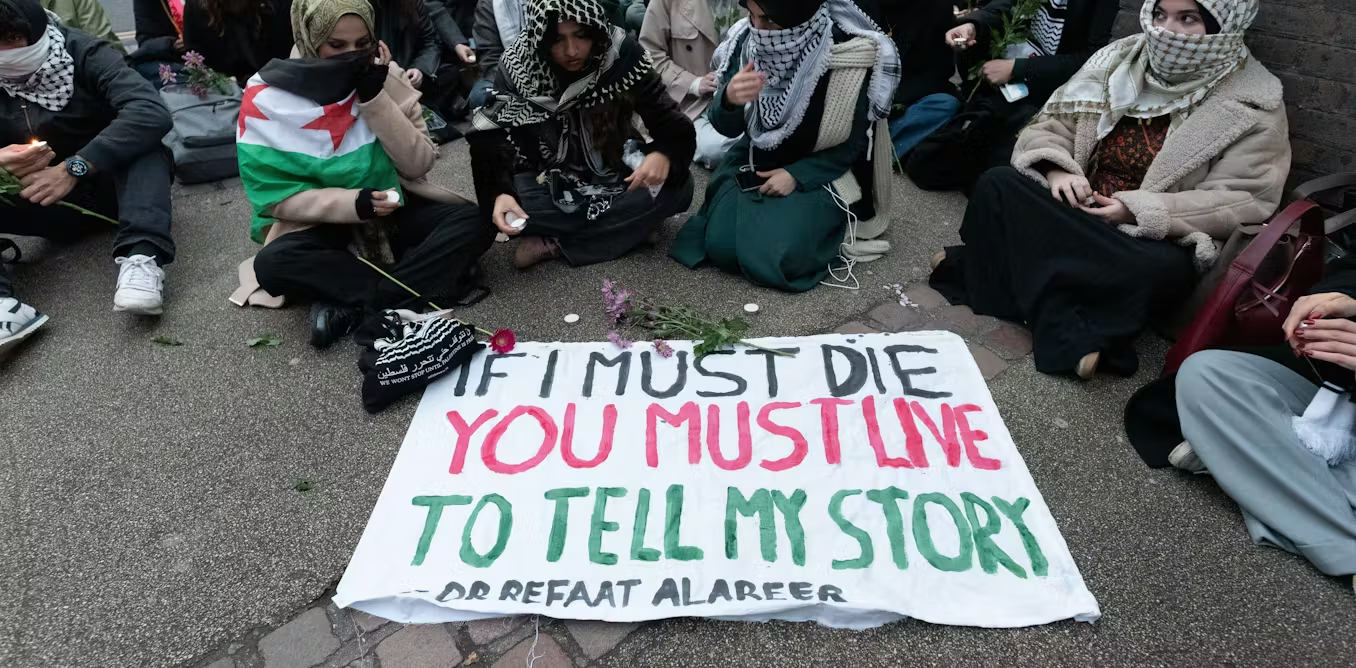
In times of war and crisis, poetry can become more than just art: it can become testimony. For the people of Palestine living under siege, poetry is not a mere reflection of their suffering, but rather an act of resistance which campaigns for survival and remembrance.
Poetry has adopted these functions throughout history. Most famously in the west, the poetry of the first and second world wars still haunts cultural and sociological imaginations, from Wilfred Owen’s depictions of the trenches to Primo Levi’s poetic recollections of surviving the Holocaust.
But survivors from across history and the wider world have turned to the poetic form in an attempt to distil chaos into meaning, and to offer a language to witnessing where oppressive silence threatens to prevail.
For more than two years our phones, newspapers and televisions have displayed an onslaught of imagery documenting the violence in Palestine. The images that we have come to expect from the bitter conflict, while recording the realities of survivors on the ground, can also often portray Palestinian people as the passive victims of what has become a largely decontextualised violence.
While coverage of crisis in the media aims to elicit empathy and immediate action, it relies on portraying displaced people as hopeless victims. This re-enforces their position as outsiders while attempting to rekindle a sense of urgency in audiences who have grown desensitised to crises across the globe that are protracted and countless.
Ron Fassbender/Alamy Live News
This is a common trope in the portrayal of refugees and displaced people. Many have come to expect bleak images of destruction, starving children with crying mothers, and people in camps without basic necessities.
In the era of 24-hour news cycles and never-ending scrolling, why does poetry in times of crisis still matter? I believe it is because the enduring nature of poetry slows us down.
Where headlines and TikToks flash and vanish, poetry lingers, demanding contemplation. Social media no doubt plays a role in the wider dissemination of poetry. After their deaths, Alareer’s and Abu Nada’s poems have been shared millions of times for example. However, the poem as a form itself resists the fleeting, disposable nature of digital content.
Poetry offers something that news and visual imagery cannot in times of crisis: depth over immediacy and meaning over spectacle. The poetry being penned by Palestinian people is an alternative archive of their experience of Israel’s two-year assault on Gaza, preserving their voices and identity against erasure.
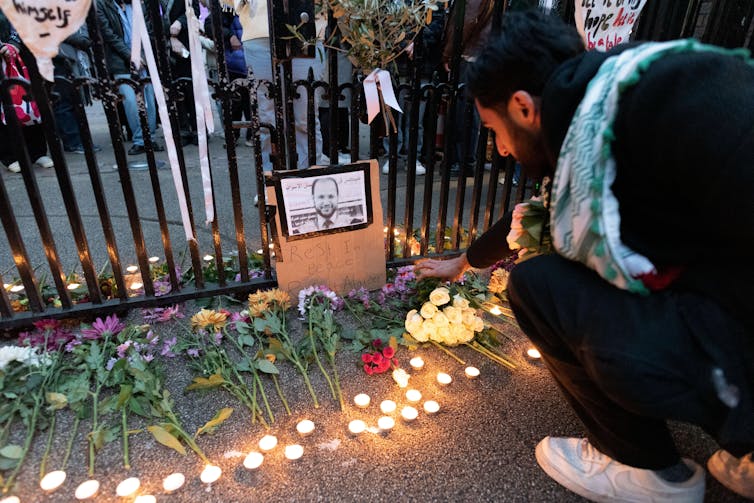
The deaths of Refaat Alareer and Hiba Abu Nada in Israeli airstrikes underscores the stakes of this literary resistance. Posthumously, their work has transformed from the art of witnessing into enduring evidence and history from below.
Examples of Palestinian poetry
Alareer’s “If I Must Die” centres around the use of conditionality: language that expresses possibility or uncertainty. The titular phrase might first signal the poet’s resignation but also highlights his resistance.
The poem does not focus on the trauma porn of violence and death but rather focuses on the practicalities and imperative nature of remembrance.
If I must die,
you must live
to tell my story
…
If I must die
let it bring hope
let it be a tale.
The transformation of the poet’s impending mortality into narrative immortality and continuity situates individual loss within a collective horizon for Palestinian people.
By framing his death in this conditional way, and by using simplistic language to belie the complexity of his poetic message, Alareer asserts agency in what was to become his final moments.
Ron Fassbender/Alamy Live News
Similarly, Abu Nada’s I Grant You Refuge uses the conceit of shelter to complicate the concepts of safety and asylum.
The poem’s central theme of offering refuge creates a powerful paradox: the destruction of homes and lives in Palestine has created mass displacement and precarity, yet I Grant You Refuge attempts to create a symbolic space for community where literal, physical safety is unachievable.
Nada’s persistent repetition of the phrase “I grant you refuge” inverts the normative dynamic of refugee and host, where the displaced person has become the one who grants refuge, creating a new social dynamic for the Palestinian people. Nada’s death in October 2023 renders the poem tragically self-reflexive. The promise of refuge collapses under bombardment yet endures through poetic testimony.
I grant you refuge in knowing
that the dust will clear,
and they who fell in love and died together
will one day laugh.
In contrast to If I Must Die and I Grant You Refuge, Abu Toha’s Under the Rubble sidesteps metaphor in favour of stark imagery, cataloguing painful scenes of mutilation and violence. For example, a mother collecting her daughter’s flesh “in a piggy bank”, a father killed while fetching bread, a child’s drawings on a wall ending at four feet high because “the painter has died in an air strike”.
Toha’s use of imagery imbues the minutiae details of everyday life with suffering. The poem’s short lines create a fractured structure and a crotchety sense of time, where mundane routine is interrupted by unpredictable violence.
These three poems are but a selection of many testimonial works emerging from Palestine. They illustrate that poetry in times of crisis is neither incidental nor ornamental. Digital platforms accelerate the circulation of images, stories and data, but the rapid, incessant flow of information can make them seem temporary and disconnected from their original meaning.
Poetry, by contrast, demands interpretive engagement and reflection. The viral dissemination of crisis poetry creates a paradox: social media at once amplifies poetry’s reach while its richness of meaning keeps it from feeling as fleeting as other online material.

Looking for something good? Cut through the noise with a carefully curated selection of the latest releases, live events and exhibitions, straight to your inbox every fortnight, on Fridays. Sign up here.



